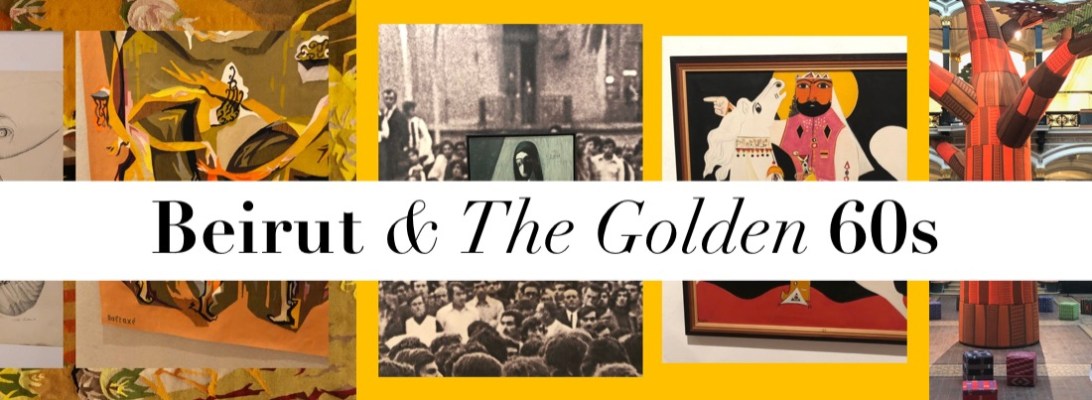
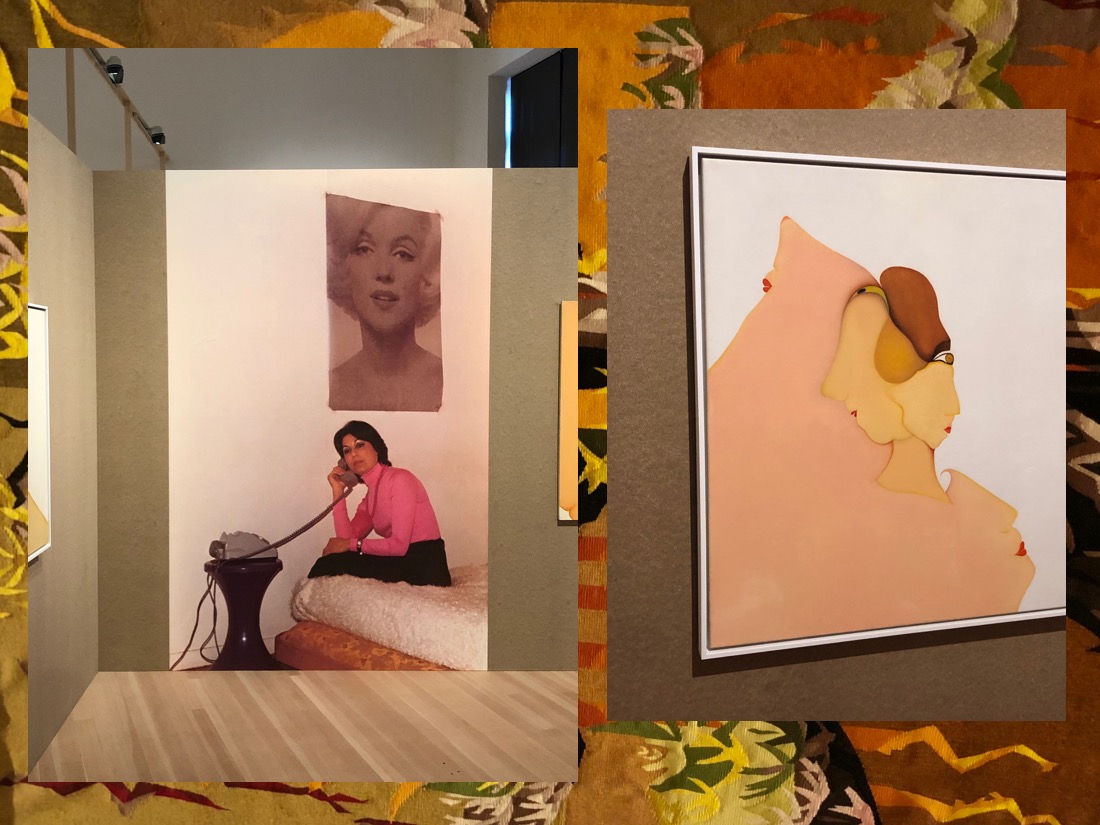
Until the 12th of June, there’s an incredible exhibition going on at Berlin‘s Gropius Bau. “Beirut and the Golden Sixties: A Manifesto of Fragility” revisits a dazzling yet moving chapter in Beirut’s modern history. Spanning the period between the late 1950s and the 1970s, from the Lebanon Crisis in 1958 to the outbreak of the Lebanese Civil War in 1975, the exhibition traces the complicated tension between Beirut’s artistic cosmopolitanism and its pervasive transregional and political antagonisms. At that time, the city’s character was shaped by the influx of people and their inexhaustible ideas. A heterogeneous mix of artists from Lebanon and abroad articulated their different and sometimes contradictory visions of modernity. Their drive for formal innovation was often as strong as their political convictions. With 230 works by 34 artists and more than 300 archival documents from nearly 40 collections, this is the most comprehensive exhibition to date of a crucial period in Beirut’s history. It reveals the complex connections between the city’s past and its current problems and challenges the romanticized portrayal of Beirut’s so-called Golden Age, which ended in the outbreak of the Lebanese Civil War in 1975. Beirut and the Golden Sixties: A Manifesto of Fragility tells the story of a city’s hunger for life and its contradictory ambitions.
The Neue Nationalgalerie in Berlin is dedicated to 20th century art – and the place itself is an artwork. The museum is the last major project completed by the internationally famous architect Ludwig Mies van der Rohe. His long-term preoccupation with creating fluid, open spaces culminated in the design of the glazed upper pavilion of the gallery. With its steel roof and gracefully austere architectural language, the Neue Nationalgalerie not only stands as an icon of modernism, but as testament to a visionary architect. The history of the Neue Nationalgalerie is inextricably linked to the political division of Germany and the city of Berlin that was a consequence of the Second World War. The Nationalgalerie’s collection, originally on display on the Museumsinsel (Berlin’s Museum Island) and later, in the 1920s, also in the Kronprinzen Palais on the boulevard Unter den Linden, was initially managed by the Municipality of Greater Berlin in the immediate post-war years. The founding in 1949 of two German states, with opposed political systems and differing ideologies concerning art and its role in society, marked the end of a unified collection. While the East Berlin Nationalgalerie could stay in its original building (following repairs), in West Berlin there was initially no dedicated space for the collection. Beginning in the late 1940s, the West Berlin authorities took strides to rebuild the collection by setting up a “Gallery of the 20th Century.” Further to this, part of the National Gallery’s original collection of nineteenth-century artwork, found in West Germany after the war, was absorbed the newly established Stiftung Preußischer Kulturbesitz (Prussian Cultural Heritage Foundation). As these two art collections were to be united, in 1962 Mies van der Rohe was commissioned to design a new museum building to house them both. In September 1965, the architect came to Berlin for the laying of the foundation stone. Two years later he also personally attended the most spectacular construction stage: the hydraulic raising into place of the gigantic steel roof. The building was opened on 15 September 1968 and bore the name Neue Nationalgalerie (New National Gallery). Its name signalled the idea of departing from the old and beginning a new chapter – the cultural rebirth of West Berlin.
The building’s architectural structure has remained virtually unchanged ever since. But the collection of the Neue Nationalgalerie is on-goingly re-visited. It brings together an array of key artworks from the twentieth century by various artists from Europe and North America, including Francis Bacon, Max Beckmann, Salvador Dalí, Max Ernst, George Grosz, Hannah Höch, Rebecca Horn, Ernst Ludwig Kirchner, Paul Klee, Lotte Laserstein, Paula Modersohn-Becker, Edvard Munch, Pablo Picasso, Gerhard Richter, and Andy Warhol. Among the Neue Nationalgalerie’s most famous and iconic works are “Potsdamer Platz” by Ernst Ludwig Kirchner, “The Skat Players” by Otto Dix, and “Who’s Afraid of Red, Yellow and Blue IV” by Barnett Newman. If you’re in Berlin, make sure to visit this amazing place. Plus, the site-specific text installation by Barbara Kruger in the iconic, upper-level hall is on until the end of August!










 Design & Culture by Ed