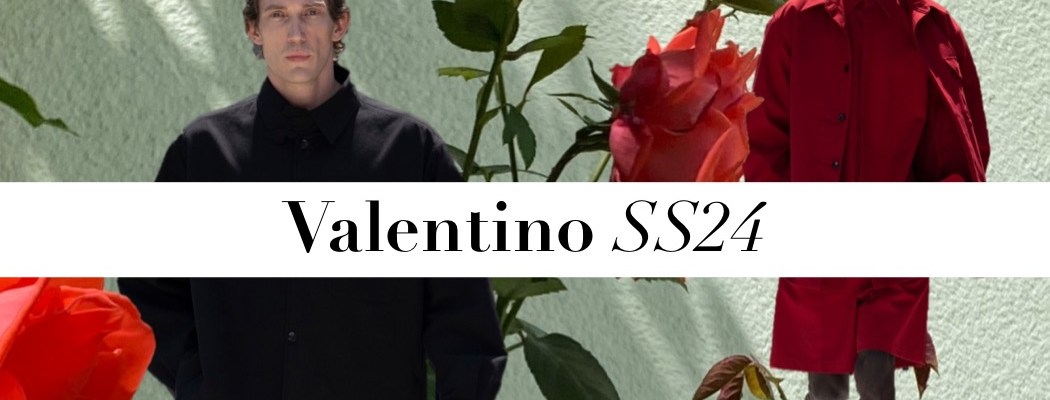
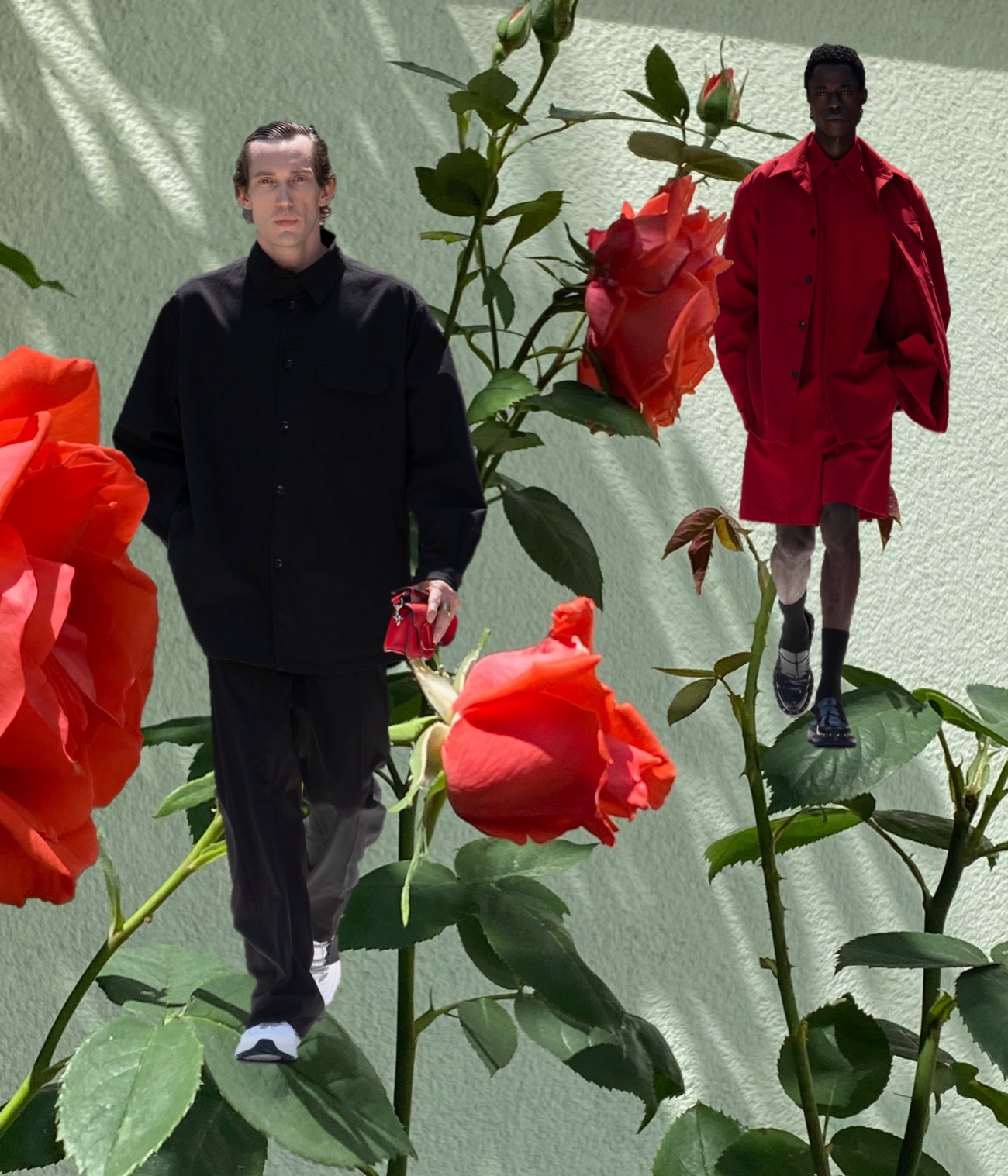
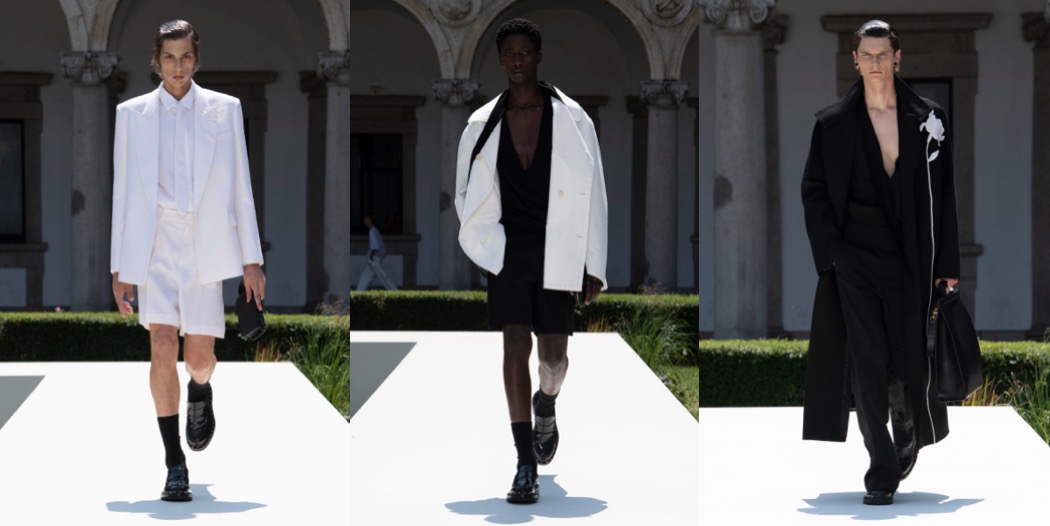
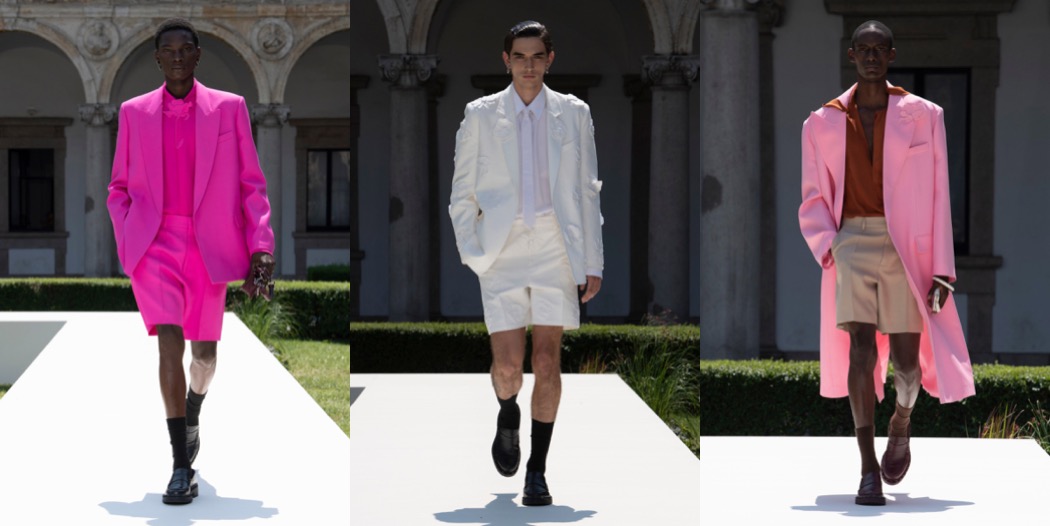
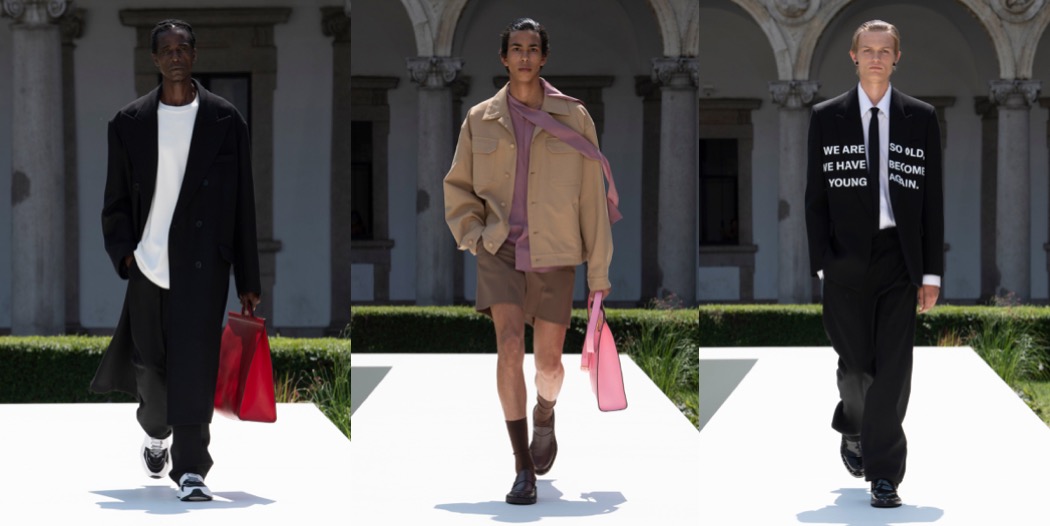
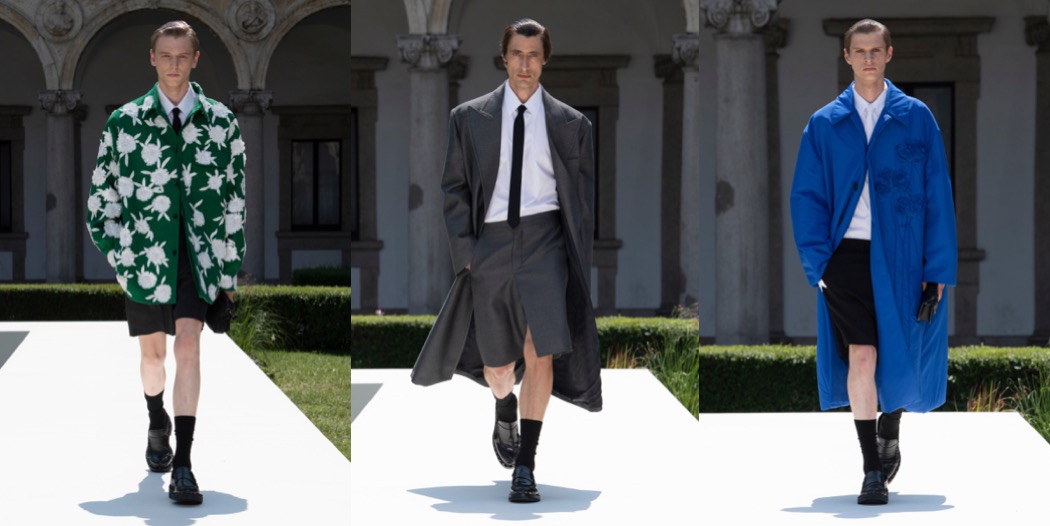
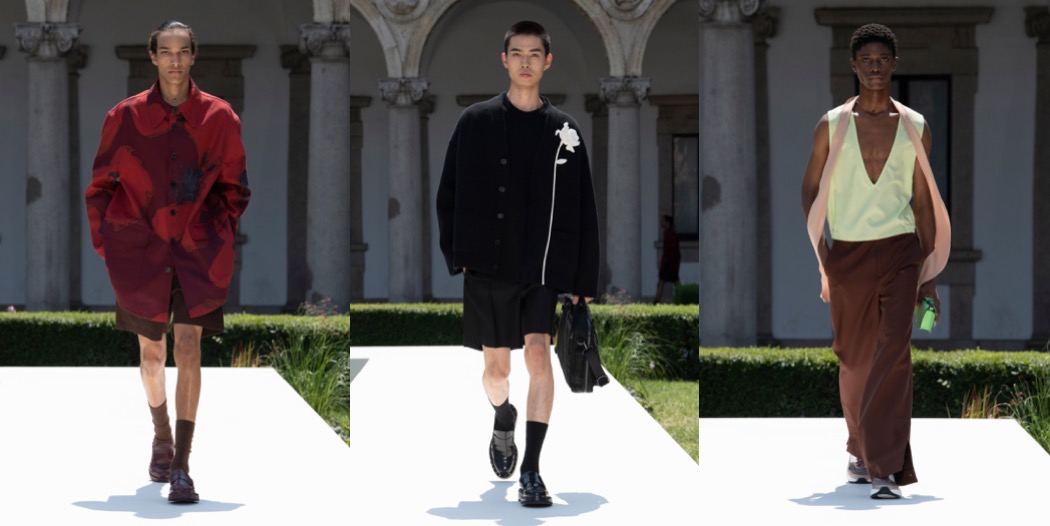
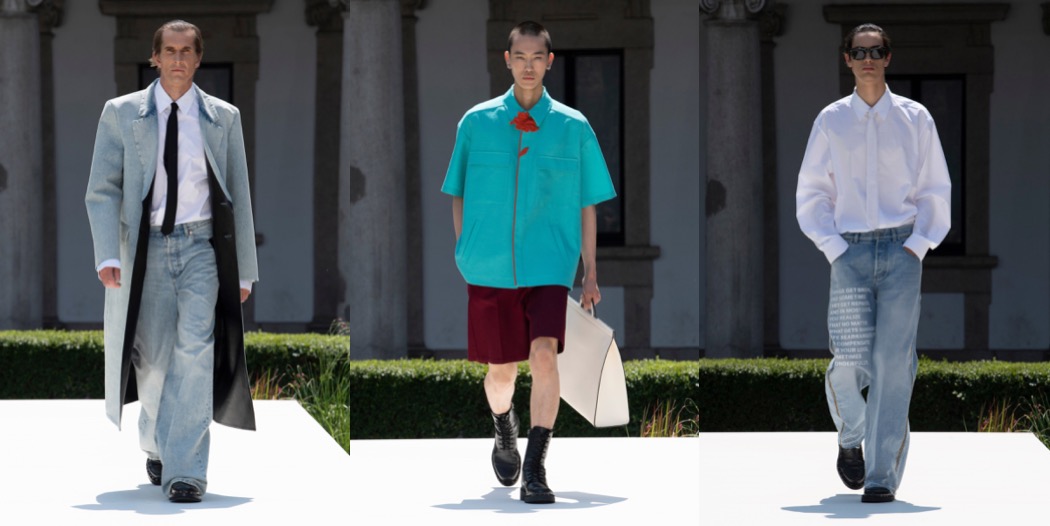
Pierpaolo Piccioli‘s spring-summer 2024 menswear collection for Valentino felt statment-less, even though it had quotes from Hanya Yanagihara’s “A Little Life” printed on some of the garments. That return to actual clothing, and not a big theme, felt refreshing, because the last couple of Valentino collections were overloaded with meanings and ideas. Staged on a regular school day in the garden of La Statale, Milan’s public university housed in a beautiful Renaissance building, guests (and students) watched the show in the hot Italian sun. Piccioli was drawn to “A Little Life“‘s take on contemporary men so much so that pink-hued copies of the book were sent out as invitations to the show. “The intimacy and humanity of the four male characters, their open vulnerability and resilience was touching and inspiring for me,” he offered. The show pivoted on Piccioli’s easing of classic masculine tropes, subtly subverted through a gentle approach. He worked on sartorial codes, softening the proportions of boxy blazers, replacing trousers with short shorts and skirts, embroidering flowers on lapels or printing blown-up blooms on breezy light jackets and straight-cut shirts. Piccioli’s artistic flair for a pictorial palette – mint green, raspberry, turquoise and hot pink alternating with black and white – emphasized a sense of individual vitality and an attitude of romantic freedom.
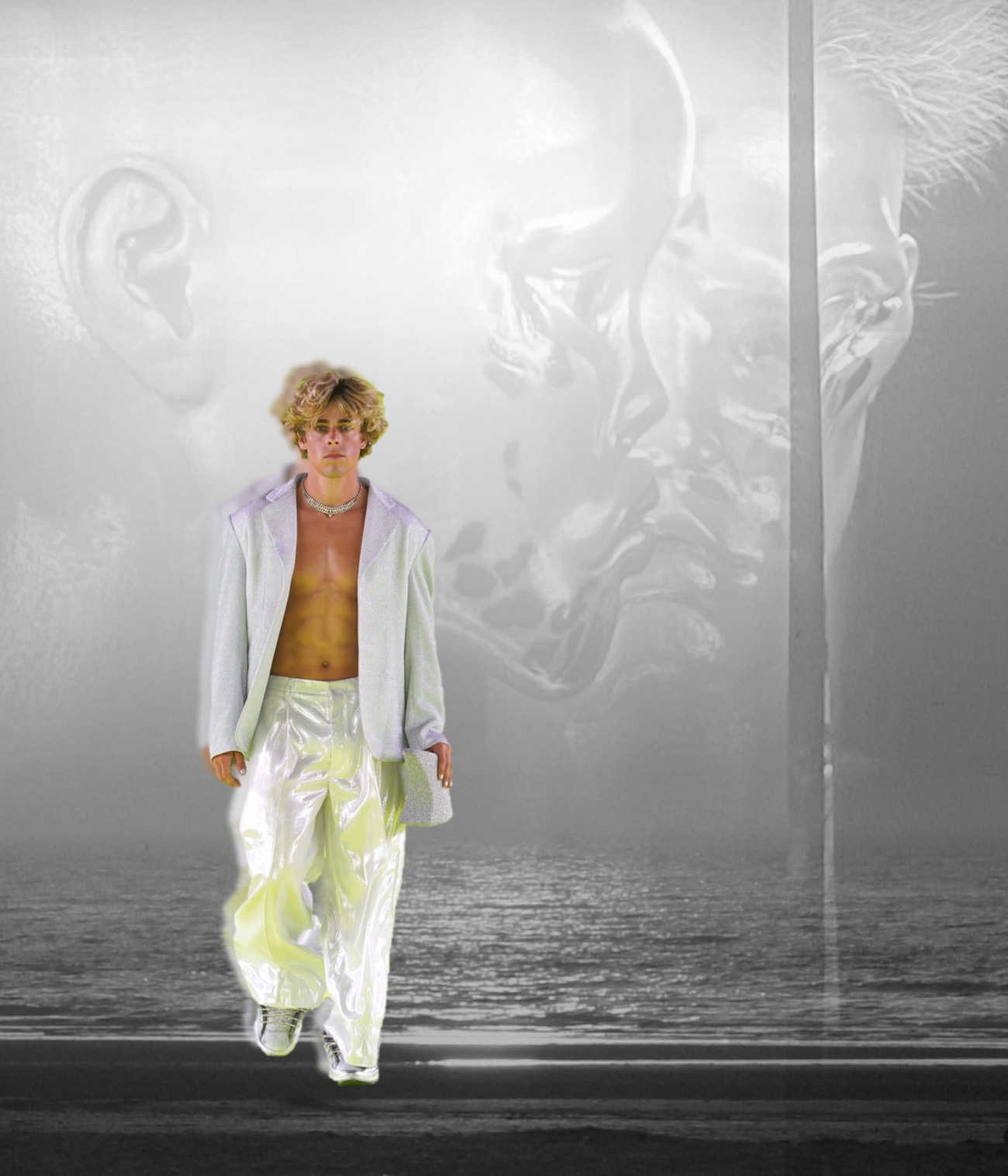
Collage by Edward Kanarecki. Don’t forget to follow Design & Culture by Ed on Instagram! By the way, did you know that I’ve started a newsletter called Ed’s Dispatch? Click here to subscribe!
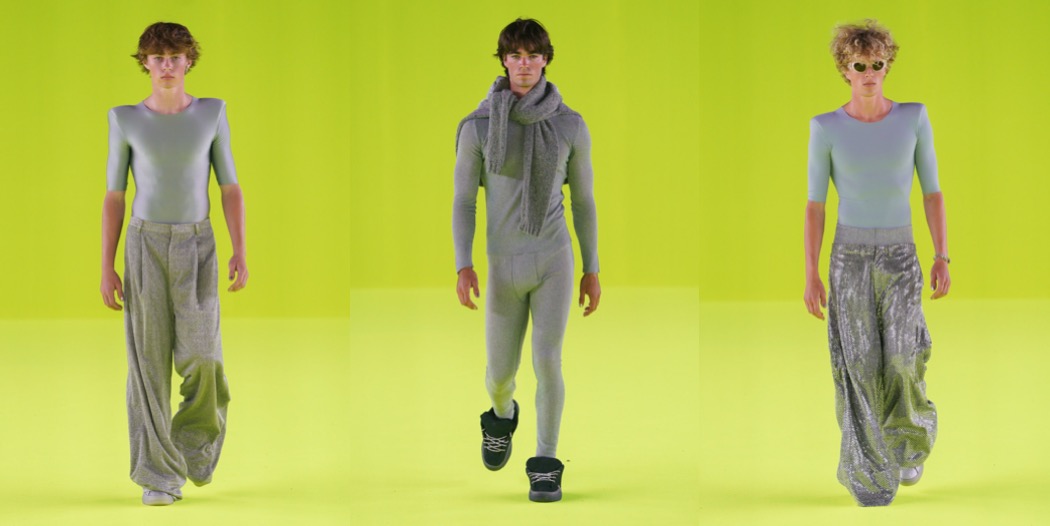
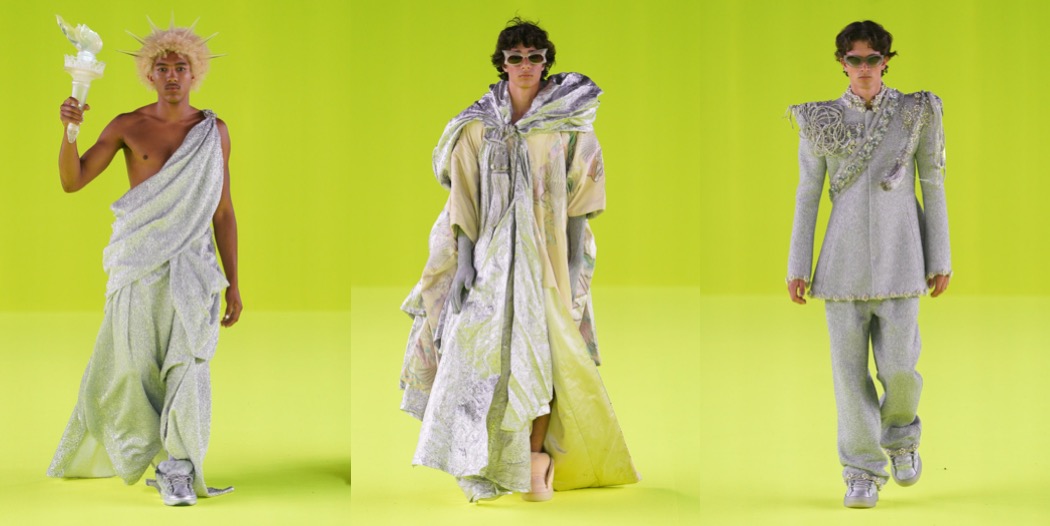
Eli Russell Linnetz is the Sam Levinson of fashion. He knows how to stir a controversy and lure the audience with aesthetics. The ERL lookbooks from the past seasons are great examples of that. But does the Californian designer know how to sustain a plot? His first IRL runway show at Pitti Uomo’s Palazzo Corsini in Florence make you question that. The juvenile faced Linnetz-cast cadre of real-life surfers from his real-life Venice Beach neighborhood walked down the neon-green venue in stardust-sequinned tailoring and silver lurex knits. The Uncle Sam-meets-Slash top hats and ’70s shaped tailored topcoats and shirts worn over starrily-spangled “wetsuits” created an impression in clothing that was only reinforced by the thwup-thwup of Huey rotors and Jim Morrison predicting “The End” on the soundtrack. As Linnetz concedes, his experience and instinct both lean towards costume as a form of messaging. It did feel like on set of David Lynch’s set of “Dune“. Accessories included hyper swollen reimaginings of the Etnies/Emerica/Globe style of early ’90s puffy skate shoes, plus some very Linnetz-specific rubber-framed eyewear that looked more like goggles than sunglasses. There was an irony embedded in ERL’s first real-world collection being so hyper-unreal; beneath that lurked a point of view about American masculine identities, hang-ups, and brittle wearable projections of power. But the general vision felt too misty and too Vetements-y.
Collage by Edward Kanarecki. Don’t forget to follow Design & Culture by Ed on Instagram! By the way, did you know that I’ve started a newsletter called Ed’s Dispatch? Click here to subscribe!
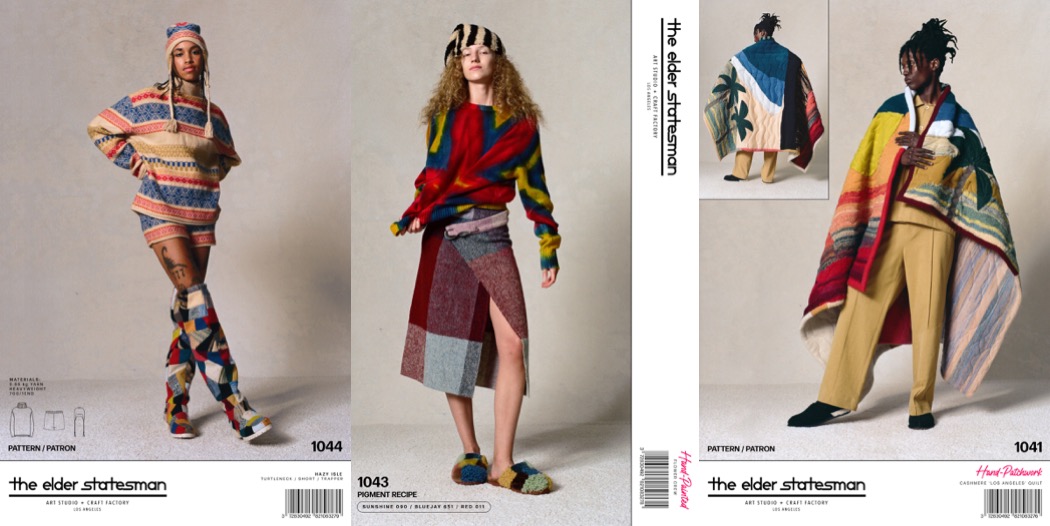
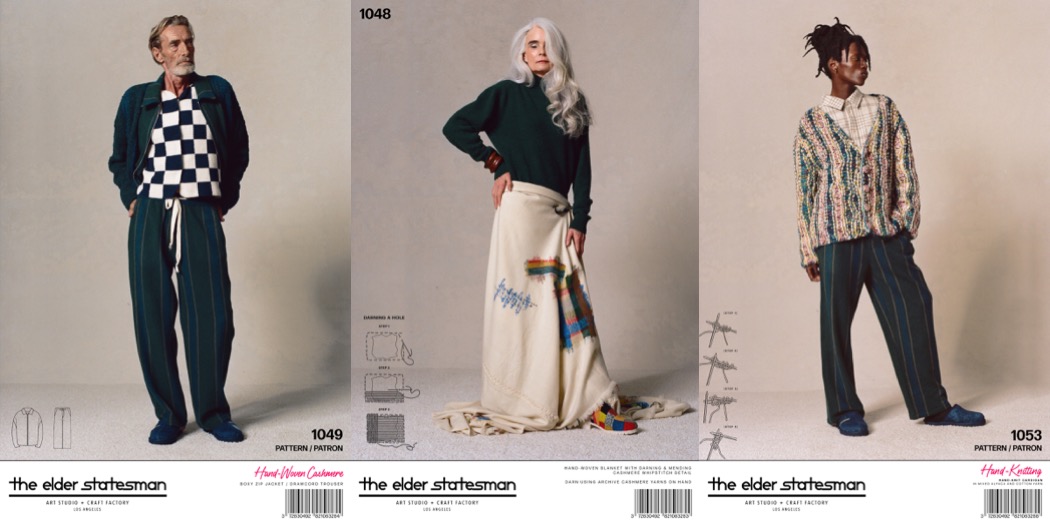
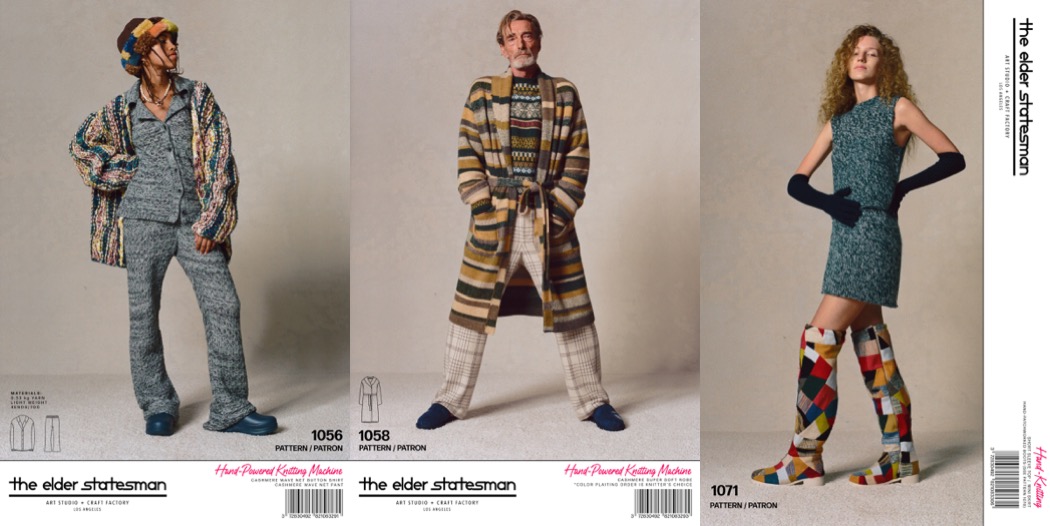
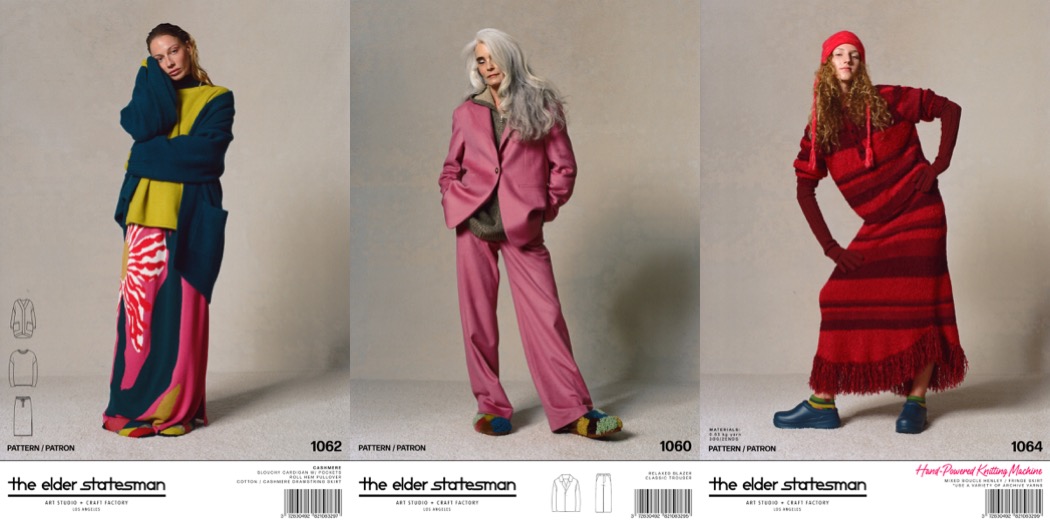
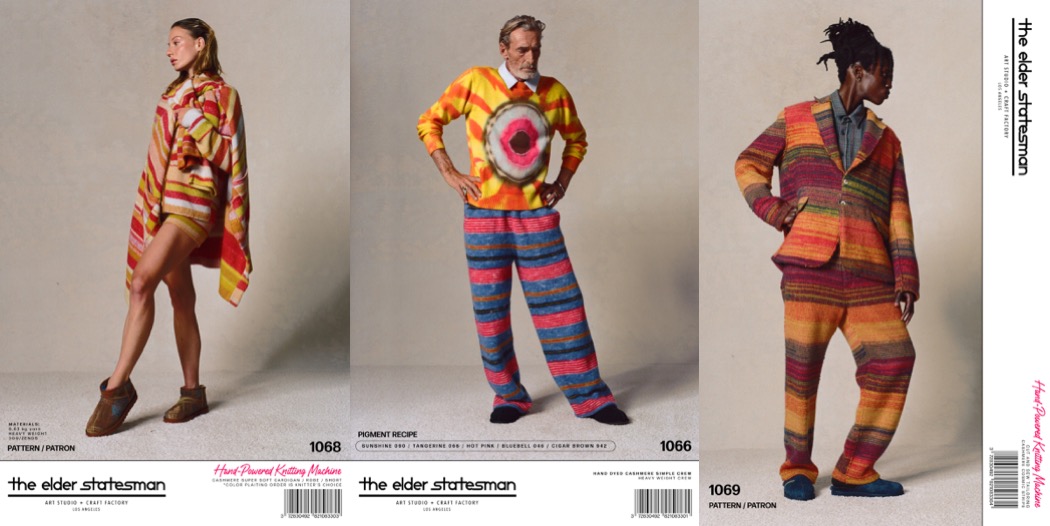
It’s back to groovy basics at The Elder Statesman. “Resort is holiday, so we tapped into a lot of our heritage, traditional kind of motifs,” Bailey Hunter, the brand’s creative director, said. “Florals, tie-dyes, stripes – all the things that we’re known for, we reinvented them in a way; and we’ve used a lot of new woven materials that we’ve brought into our library.” Materials – and yarn, especially – are king at Elder Statesmen. But the brand keeps on evolving into other categories. The yellow suit that opened the lookbook is a cashmere-cotton-wool twill made in Italy that feels like the softest and lightest denim. Another suit – the brand calls it “relaxed tailoring” – is made from Italian 50/50 cashmere and wool and comes in three colors: rose hip, dark green, and bark, in both men’s and women’s styles. A highlight of the collection was certainly the wool donegal made on a vintage loom in Italy in colorblocked squares of gray, navy, and wine. In the lookbook it appears as a wrap skirt secured with an oversized safety-pin and styled with a cashmere hand-painted crewneck sweater. Together, they’re youthfully punky and quite timeless.
A collaboration with Uggs is The Elder Statesman’s first foray into footwear. The clogs, mules, and boots made from patchworked sheepskin and decorated with “darning”-style embroidery are sure to become must-haves when they’re released later this year. A sporty tank and mini skirt made from hand-knit alpaca and cotton in various shades of blue, a wave patterned knitted cashmere shirt and pants, and a pair of knitted striped cargo pants in mixed bouclé yarns were more proof that the knitwear experimentation here is unparallelled. The bouclé cargos were worn with a black sweater featuring an intarsia illustration of eyes and the phrase “eye to eye it lasts,” a design that came from Greg Chait’s, the brand’s founder, grandmother Thelma. Chait said, “I feel like [the phrase] is about the collection.” Hunter finished the thought: “It’s about how it’s a lot better to see things in person, and see how everything feels.”
Collage by Edward Kanarecki. Don’t forget to follow Design & Culture by Ed on Instagram! By the way, did you know that I’ve started a newsletter called Ed’s Dispatch? Click here to subscribe!
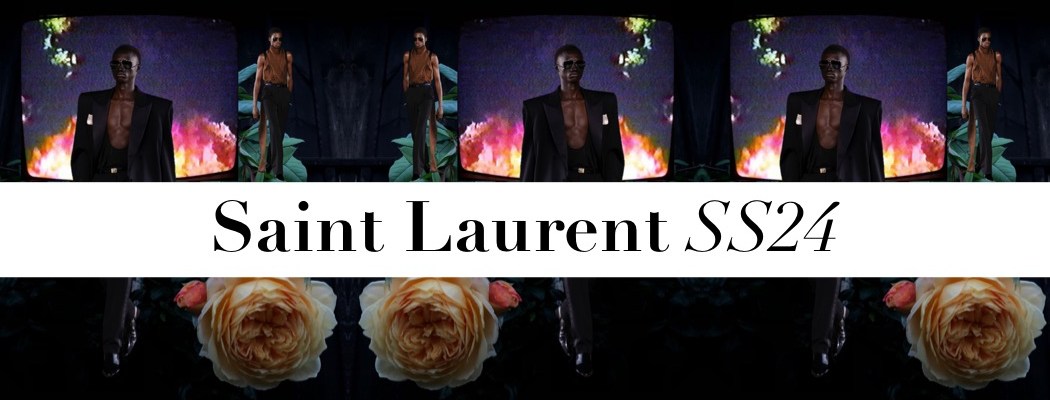
Anthony Vaccarello took Saint Laurent to Berlin, the city of Lydia Tár and Helmut Newton. The first signs as to where the designer was going with his spring-summer 2024 men’s show – a miracle of impressive tailoring broad in the shoulders and attenuated in the legs, interspersed with yet more shoulders, nakedly fragile this time, framed by gossamer silk or chiffon sleeveless shirting – was to be found on Instagram. A brief clip of the 1950 French short film, Un Chant d’Amour, a grainy black and white ode to sensuality as much to criminality, and directed by the writer Jean Genet, delivered the first vibes. Vaccarello also mentioned the name of the collection: Each Man Kills the Things He Loves. The title was, by way of Oscar Wilde, the song sung by Jeanne Moreau in a movie adaptation of one of the French writer’s great novels, Querelle de Brest. It was later filmed in 1982 by Rainer Werner Fassbinder simply as Querelle. Et voila, there you have it: Moreau, an icon of the French nouvelle vague, as Parisian as, well, Yves Saint Laurent, and Fassbinder, one of Berlin’s most legendary directors, a man who knew a thing or two about dissonant sexuality and the power between men and women as much as, well, again, Saint Laurent.
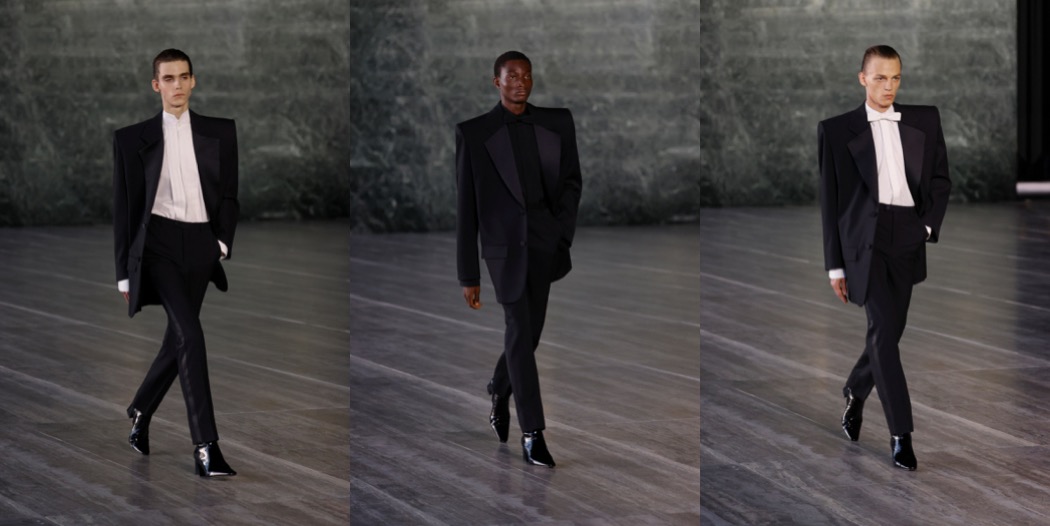
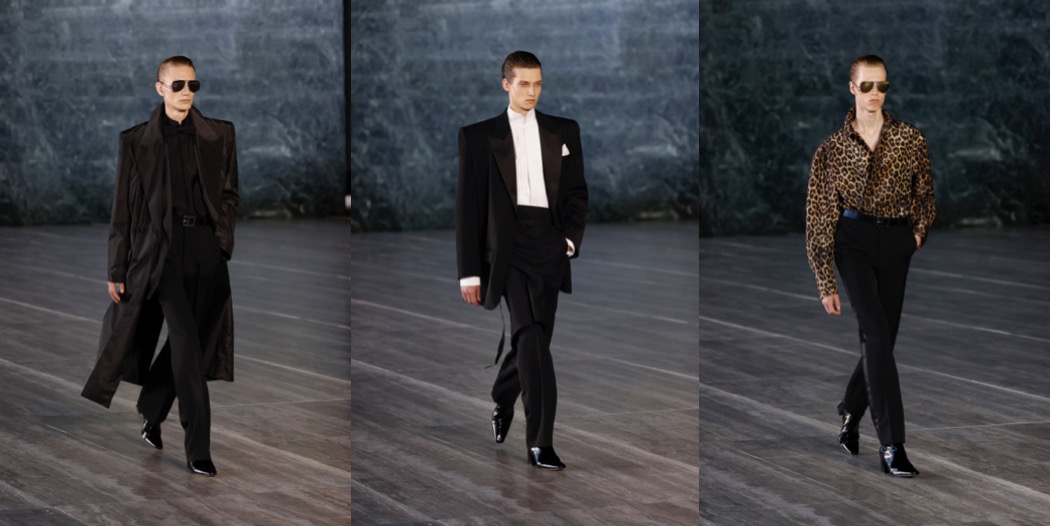
Still, what Vaccarello showed this Monday was far, far more than a clue-laden trail of reference A to B. He himself might have Berlin as part of his own personal landscape of the past – as a student in Brussels back in the day, he would hit the city’s still-going-at-noon-the-next-day nightclubs – but in many respects, this impressive and assured outing wasn’t only about the city. While there might be deft and nimble references to each locale, with each carrying a certain resonance in the YSL universe, this was, once again, Vaccarello in superbly rigorous mode, an approach echoed by his choice of venue, the structural precision of the Mies van der Rohe-designed Neue Nationalgalerie (my favourite museum in Berlin!). “When you leave the show, I want you to have the silhouette clearly in your head,” he said backstage. In other words, it’s a design approach that’s thoughtful, concise, and intent on stripping away the fuss to the perfect distillation of 50 looks, exploring – and what could be more YSL than this? – the exquisite tension between tailleur, aka suiting, and flou, all that light-as-air, fluid, sensual soft dressing, of which there was plenty in this men’s show. The exchange between his women’s and his men’s played out in delicate slipper satin tanks with deep décolletés under swaggering jackets, the matching pants cut high and narrow at the waist (ooof: breathe in!) and sliced at the ankles to show off high chunky-heeled boots. In leopard spots or polka dots (two recurring leitmotifs here) as sensually wrapped shirts or as one-shouldered tops, their bow-tie necklines trailing southwards like veils. And in prosaic black sweatshirting transformed into couture-y evening looks, draped to slide off the shoulders, with a new laidback version of smoking pants. An honorable mention too to the myriad sublime tuxedos that opened and closed this show. They also followed the impressively shouldered and roomy line of his jackets and the narrowness of the trousers. With their bow ties and high-collared shirts, and distinctly androgyne chic, they gave a bit of a Tár vibe.
Collage by Edward Kanarecki. Don’t forget to follow Design & Culture by Ed on Instagram! By the way, did you know that I’ve started a newsletter called Ed’s Dispatch? Click here to subscribe!
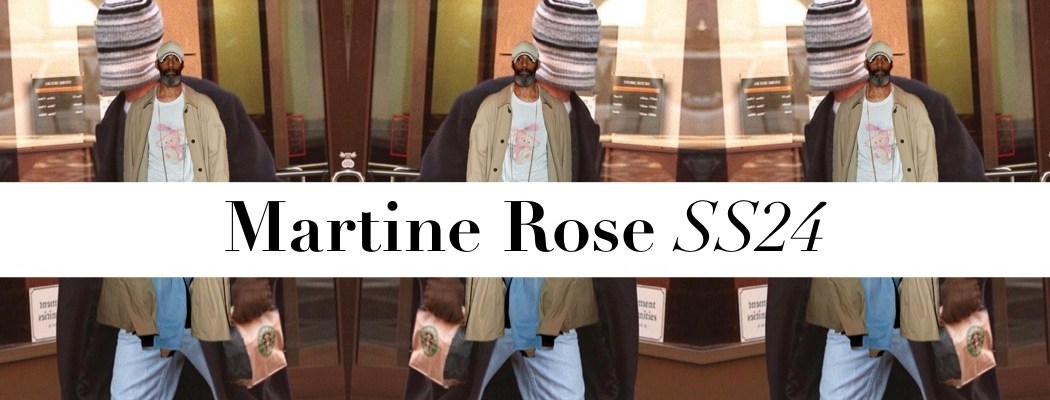
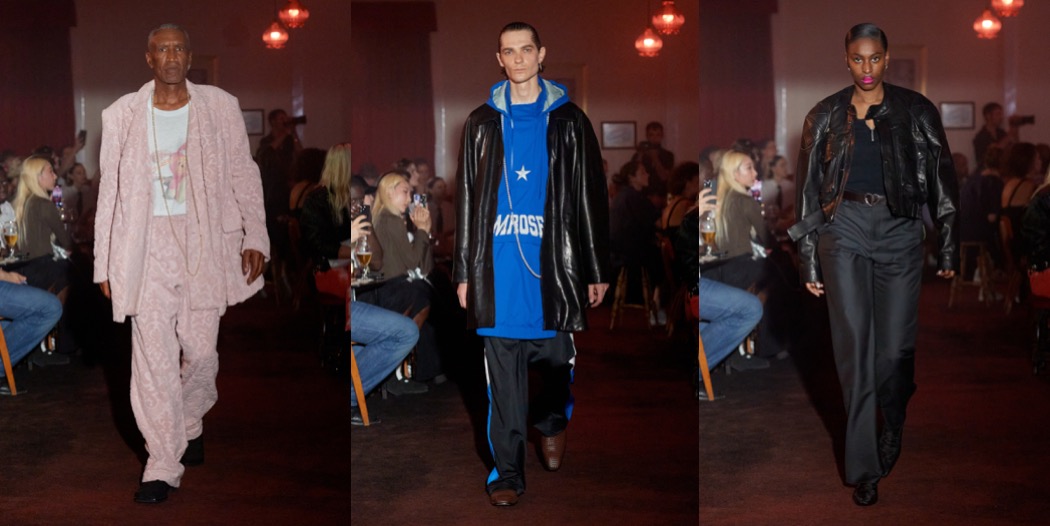
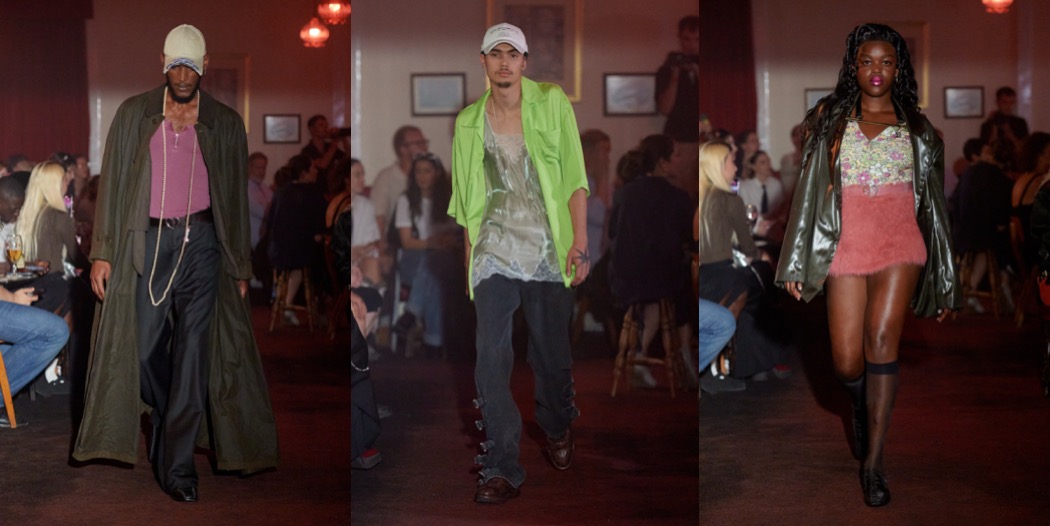
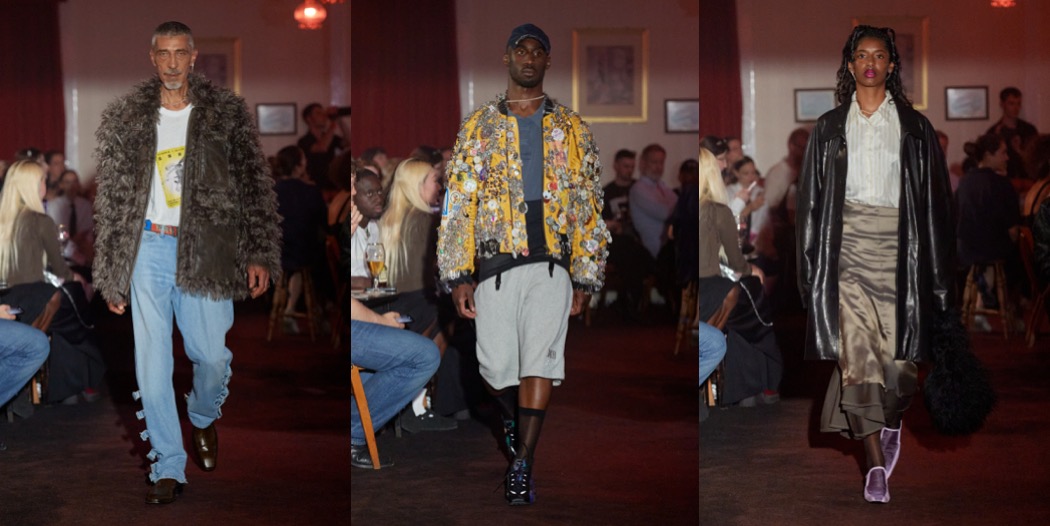
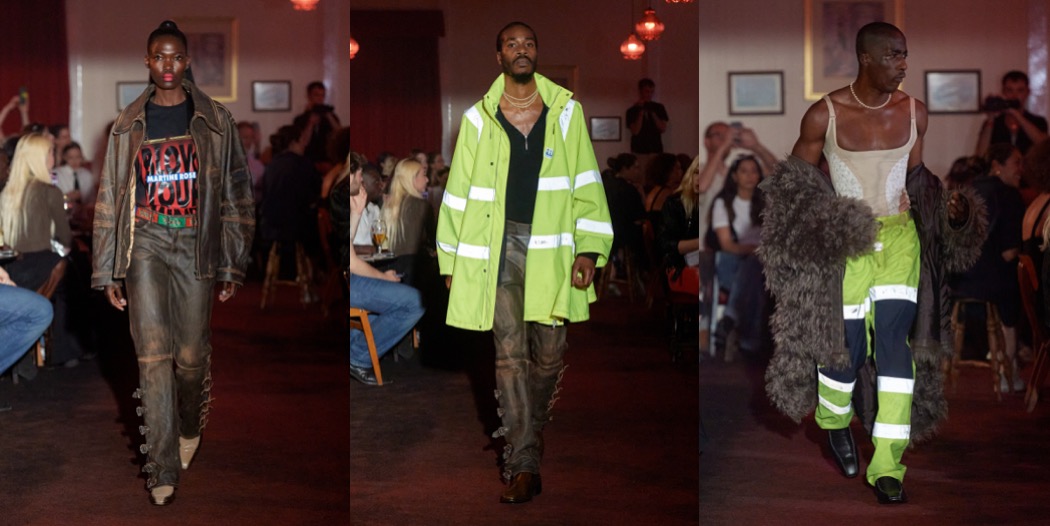
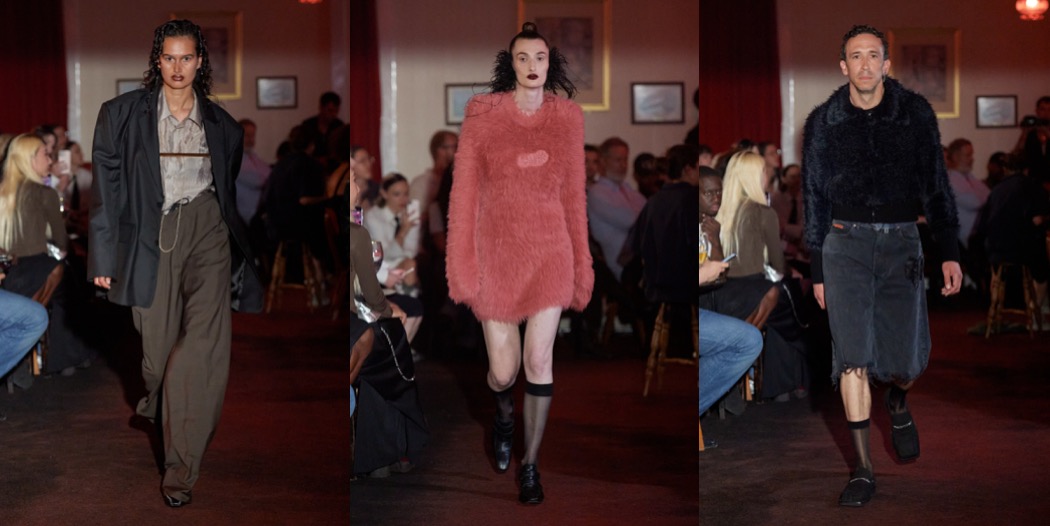
The spring-summer 2024 menswear fashion month has kicked off with Martine Rose‘s dynamic fashion show in London. “Before there were actual club venues as such, people from so many communities co-opted community centers and youth clubs to put on their club nights. All over London, wherever waves of immigrants have come in, you saw them – West Indian, Turkish, Polish, Irish – everyone has had their own community centers. They’re really important, the life-blood, ” Rose said. ”And this one – at St Joseph’s Parish Centre – is untouched. I thought it would be fun for people to sit down, have a drink, and feel pulled into participating in something.” Her living celebration of London subcultural codes opened on a blast of reggae. Out walked the totally believable Martine Rose cast of characters in clothes layered in her subversively kinky takes on men’s and womenswear. “I love playing with gender lines. I find it very sexy – I love men in women’s clothes and women in men’s clothes. It’s things that I’ve played with a long time. And I think it’s a real proposition. Not a gimmick, you know, a genuine proposal.”
Sure enough, there was a complete and recognizable wardrobe of recurring Rose signatures – her oversized tailored jackets, voluminous floor-sweeping coats, and reappropriated hi-viz workwear and sportswear. To give it a sense of lived-in ownership, she used worn-in, washed, and patinated materials.“Because I never like it when things look new. There’s a kind of make-do-and-mend – like denim we patched with gaffer tape,” she explained. Rose developed the hunched-forward shouderline of women’s leather jackets from looking at the posture of motorbike-riders. Her ideas seem always to come up through those kinds of socially-observed transferences—from the pre-existing, from gestures or half-dressed slip-ups. Her women’s skirts were inside out, with pleats bursting from under linings, creating a cool volume. Then there were her wicked twists of humor. “For menswear, I always like this tension between two poles. I’m using quite classic things like tailoring and sportswear, but the other pole has to be quite far apart. So I was looking at quite stately lady things, like Barbour jackets cut on a ’50s women’s a-line, corsetry, and pearls.” And all of a sudden, you glimpse a very British class joke going on.
Collage by Edward Kanarecki. Don’t forget to follow Design & Culture by Ed on Instagram! By the way, did you know that I’ve started a newsletter called Ed’s Dispatch? Click here to subscribe!












 Design & Culture by Ed