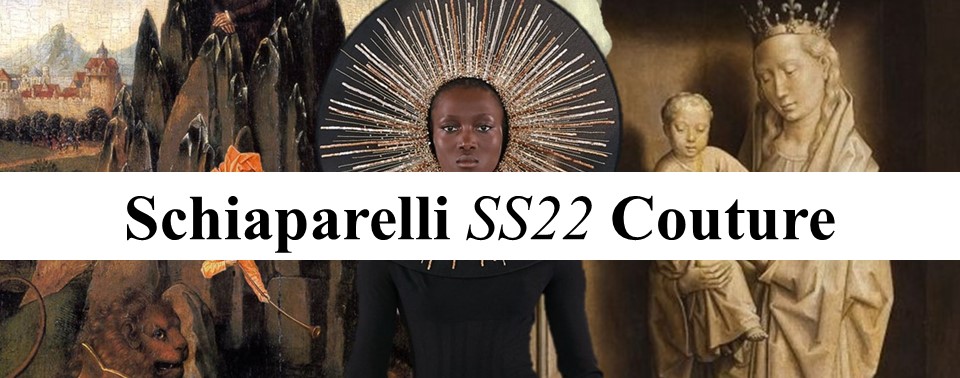
L’Appel du Vide. Schiaparelli SS22 Couture

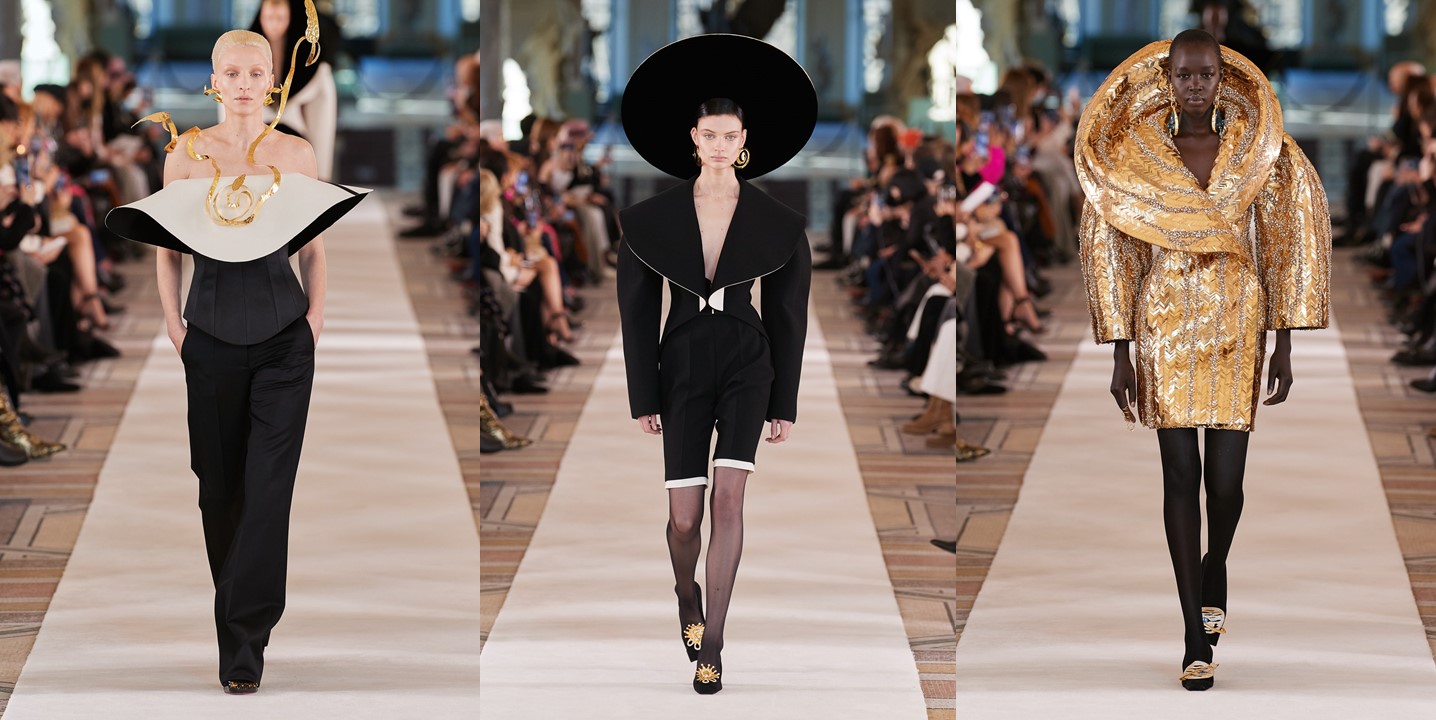
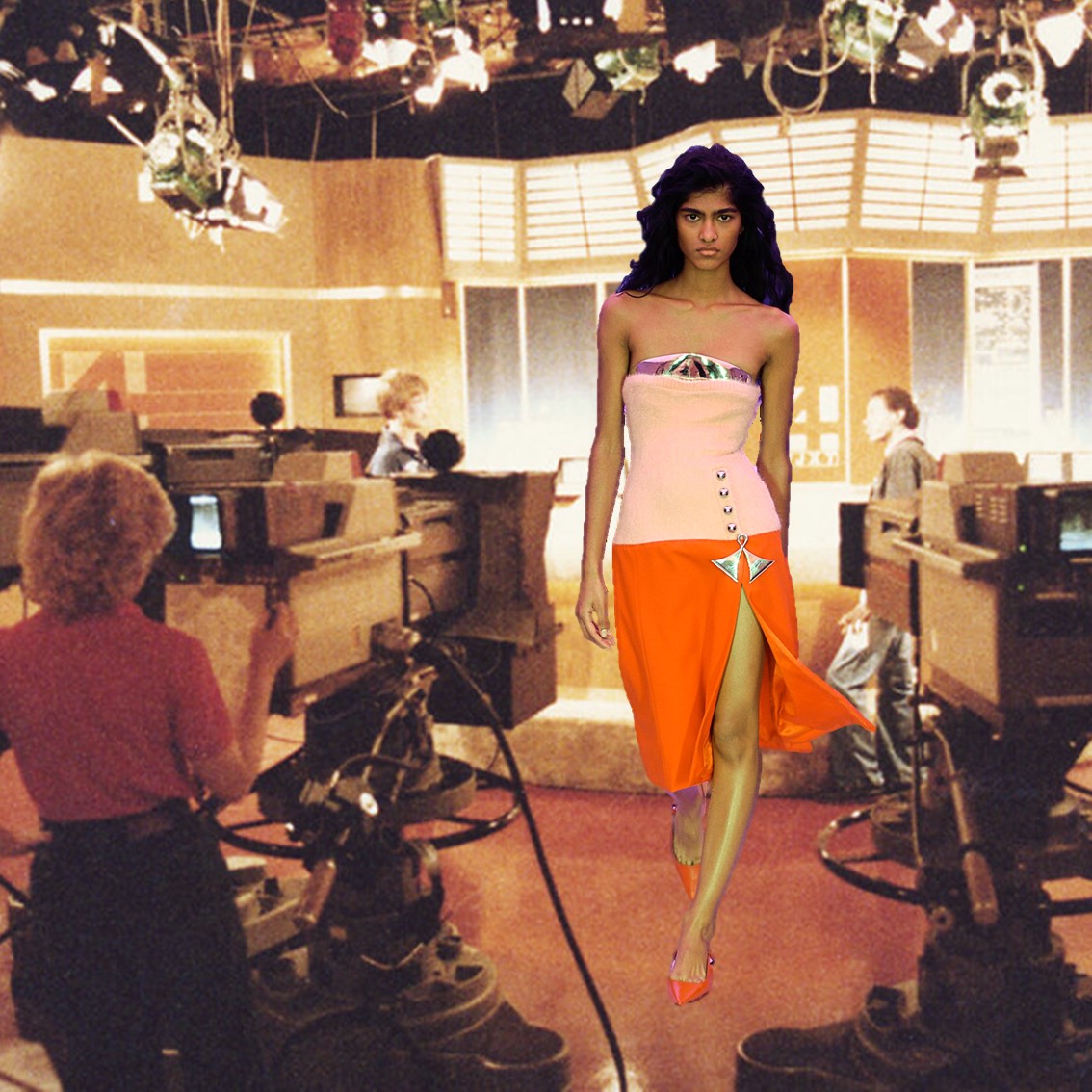
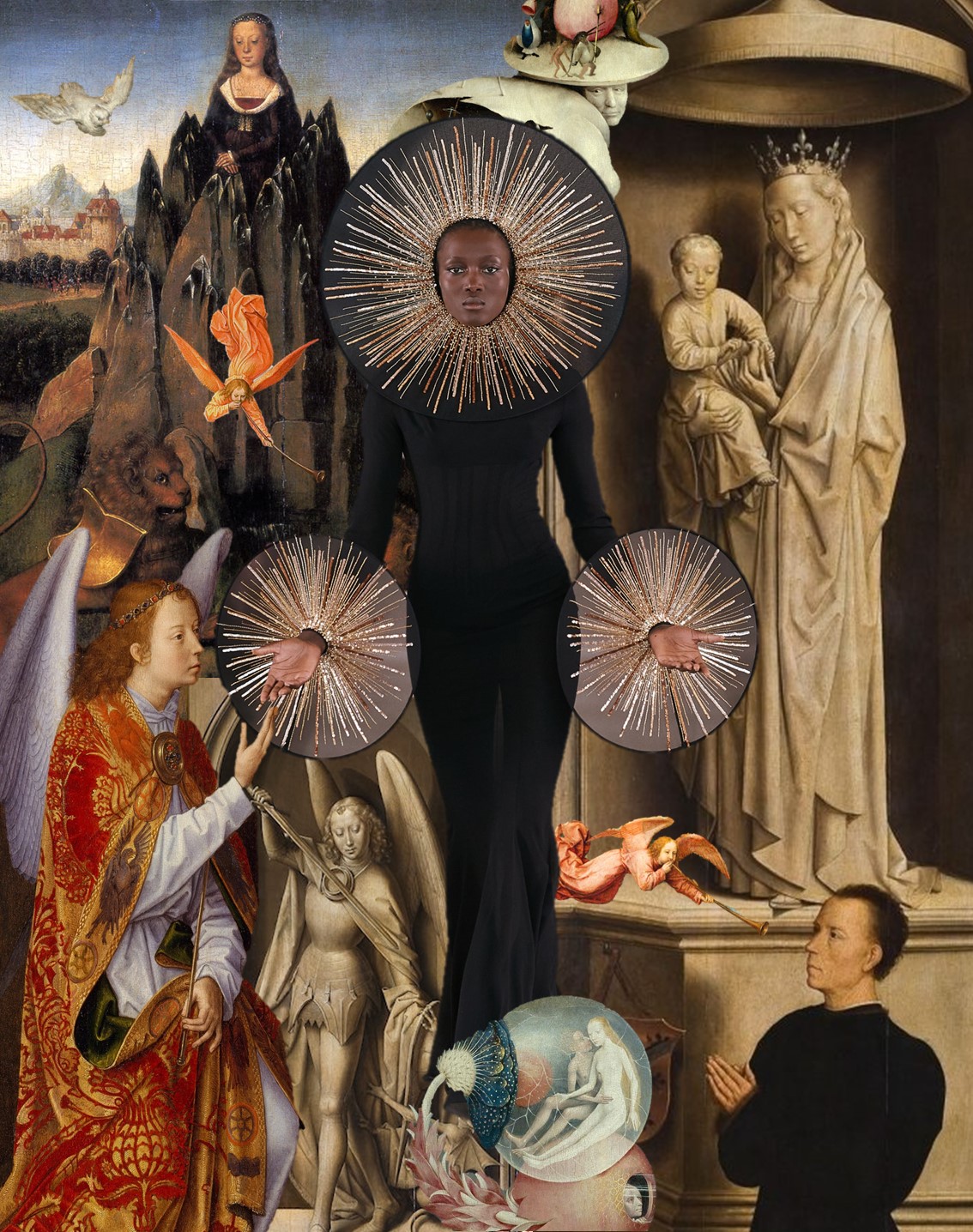
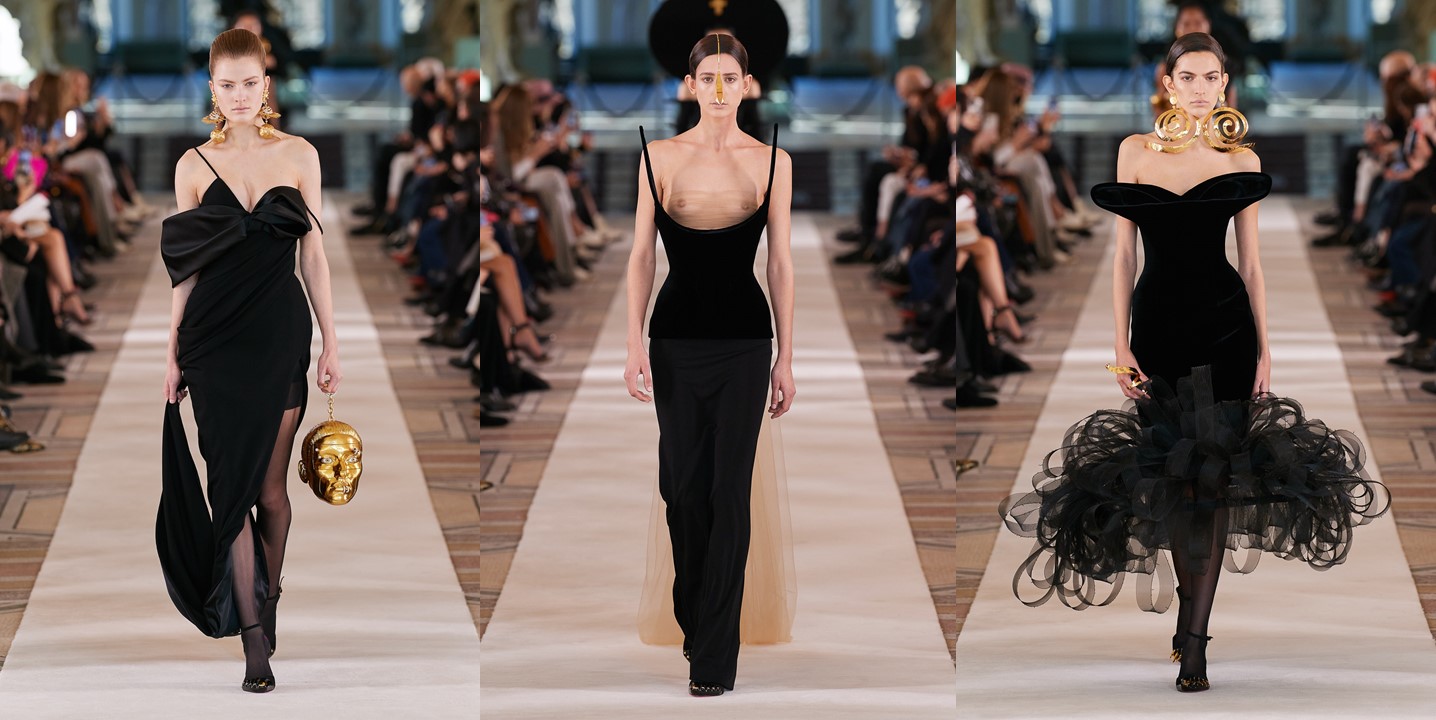
If there’s a real sense of return in the air at this season’s haute couture shows, Daniel Roseberry’s collection for Schiaparelli will be its defining memory. Passing through the Petit Palais, each of his looks was as intriguing to the senses as the inspiration behind them. “There’s this word in French for when you’re driving on a cliffside and you have the sudden urge to go off the road. It’s called ‘the call of the void,’” he said during a preview the day before. In French, the term is l’appel du vide and it’s not as hopeless as it sounds. Psychologically, it’s an intrusive thought that affirms our urge to live. “I think that’s what this spaciness felt like to me,” he explained, surrounded by orbital dresses and planetary bags in his Place Vendôme salons. “The void is the absence of this reality.” In times of refuelled space races, missions to Mars, and the metaverse, Roseberry is not alone in looking to galaxies far way. It’s a mindset that comes natural at Schiaparelli where surrealism goes hand-in-hand with existentialism. If you can use the word effortless in haute couture, that’s what Roseberry’s collection felt like: a seamlessly executed idea for a house it was just right for. “We kept saying ‘Planet Schiaparelli’: I wanted to do something that looked totally unlike anybody else. Nothing else should look like this.

Roseberry exercised his objective in creations forged in the images of the galaxy and the science fiction we relate to it. Quite literally, saturnian brass rings orbited around a black canvas corset bodice woven with black flowers in jacquard, and encircled a gilded metal bustier that wasn’t just for show. Like previous seasons’ breastplates, Schiaparelli will cast them on the client’s body in-house. A Medusa dress debuted a new technique developed for the collection in which wet gold leather had been stretched and moulded over clay sculptures of the house’s emblems-the lock, the lobster, the dove—which had then been latticed into a mind-blowing jeweled cage and encrusted with cabochon stones from the 1930s. A series of structures evoked the movement of jelly fish, which in turn evoked James Cameron’s The Abyss. A matter of exposed crin gathered around the shoulders of a minidress in black silk crepe and bounced like tentacles as the model moved down the runway of the Petit Palais. A similar effect took form around the ankles of a strapless velvet dress, and in the brass tentacles that vibrated around Mariacarla Boscono’s long black jersey dress. Interestingly, if you removed the science fiction elements, you’d be left with a series of sophisticated black dresses more lightly imbued with what Roseberry referred to as “aerodynamic” details, like the stretched-out neckline of Kiki Wilhelm’s black twill bustier.
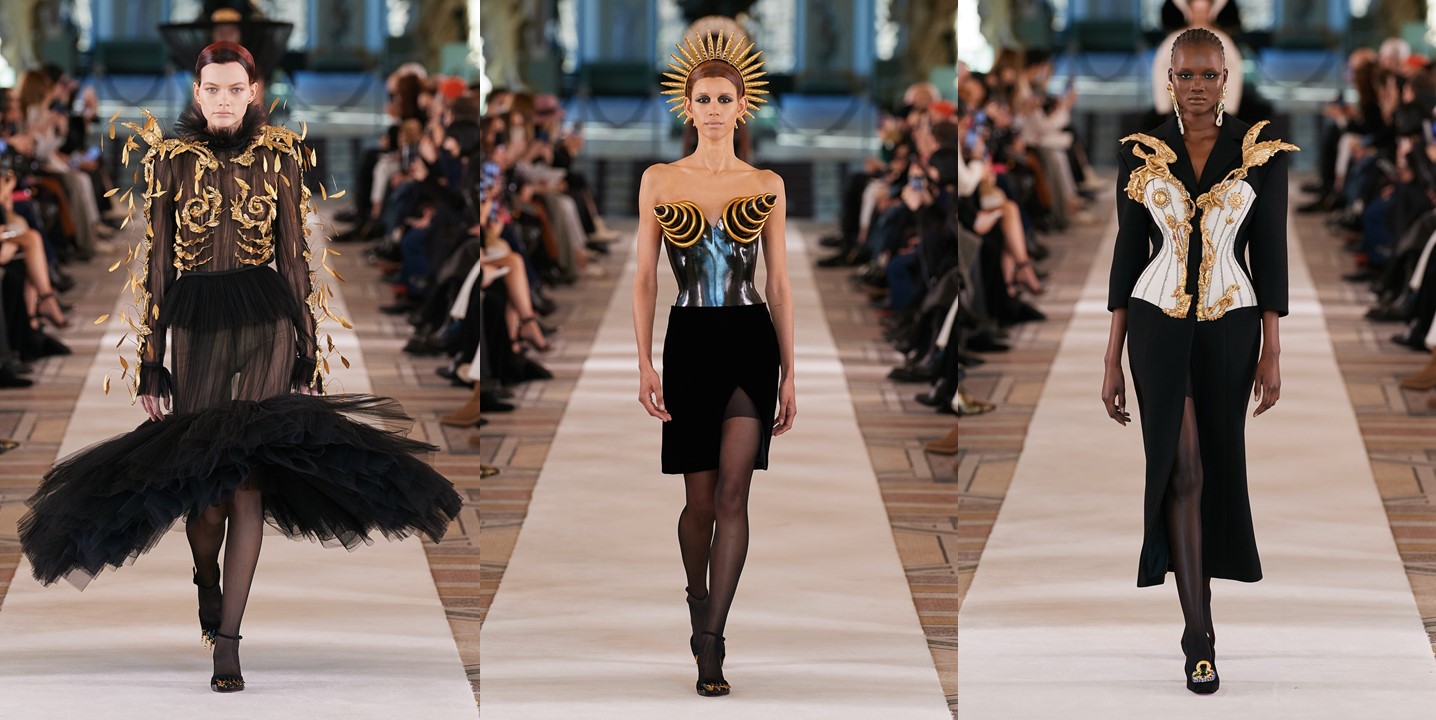
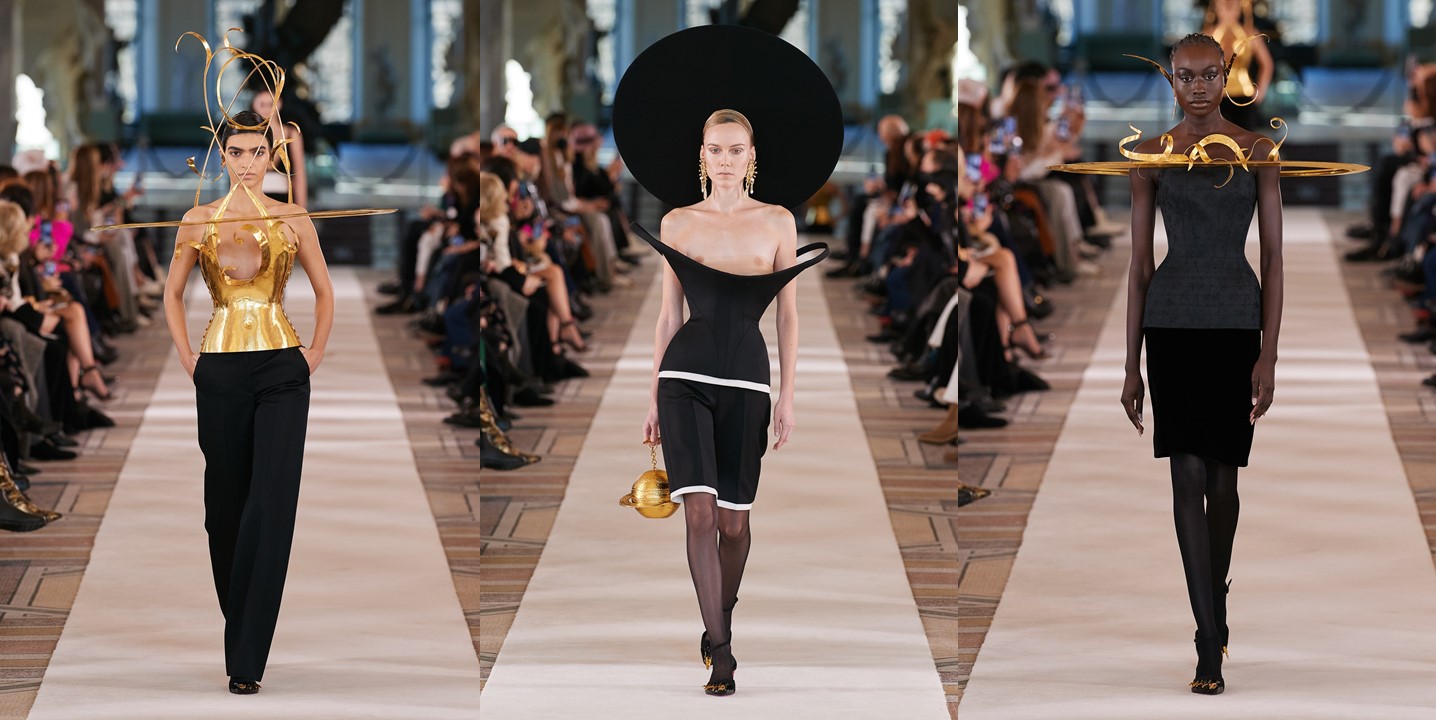
That sense of simplicity was the intention. After a year of celebrity exposure that has catapulted Roseberry’s look for Schiaparelli into the consciousness of a new audience he wanted to pull back. “Let’s take a deep breath and start refining the language,” he’d told his team. “How do we illicit the same emotional response that we get from the couture without volume and without color?” It’s why – stripped to their core – his little dresses and jackets were almost down-to-earth in a collection literally based on the opposite. It was a clever way for Roseberry to unite anticipations for Schiaparelli grandeur with expectations for something new. Of course, Roseberry isn’t dialing down on exposure. The day before the show he had fitted Julia Fox in a denim cone bra jacket to wear to the Kenzo show with Kanye West. The new couple also attended Roseberry’s show, with West in one of his masks that completely covered his face looking as existentially stirring as the collection itself. Maybe it’s Roseberry’s genuine affinity for pop culture that makes his haute couture feel so fresh. In its fusion of stupefying craftsmanship, splendor, and consistent sense of humor, the show kind of evoked a time when the likes of Christian Lacroix, Jean Paul Gaultier, and Thierry Mugler – may he rest in peace – opened Paris’s eyes to a different kind of fashion theater.
Collage by Edward Kanarecki.
Powerful Beauty. Alaïa AW22

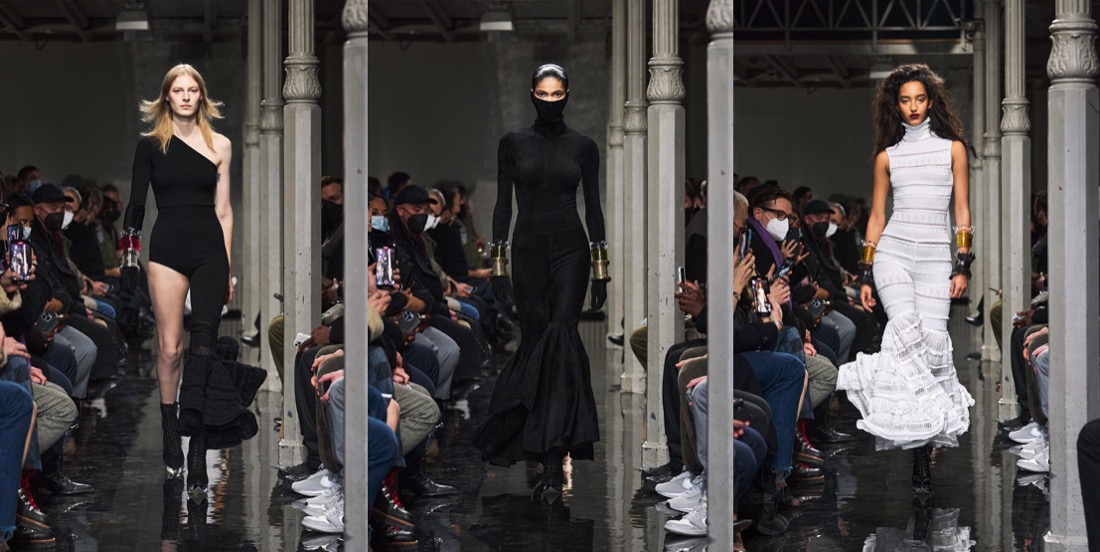
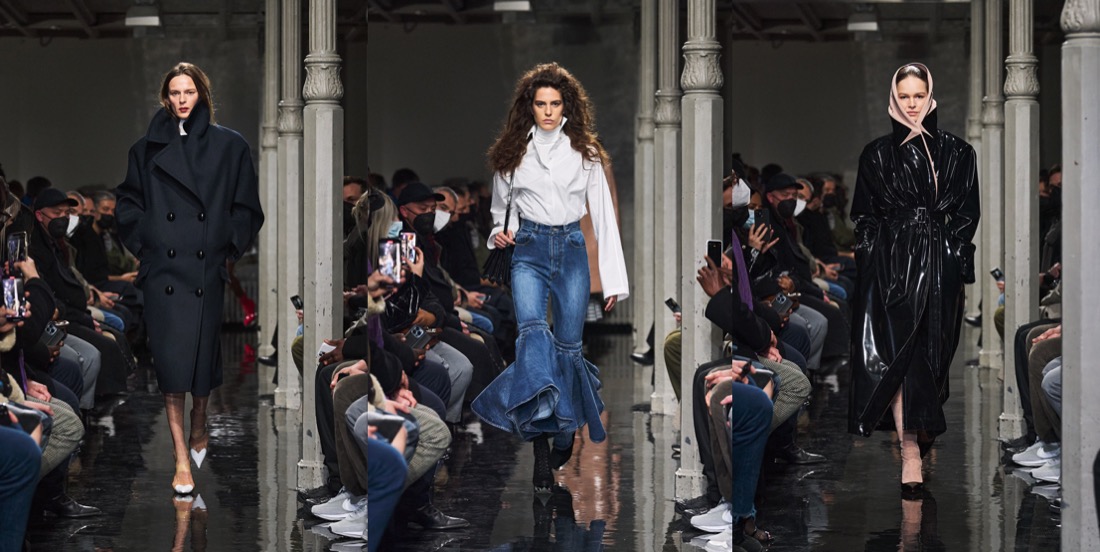
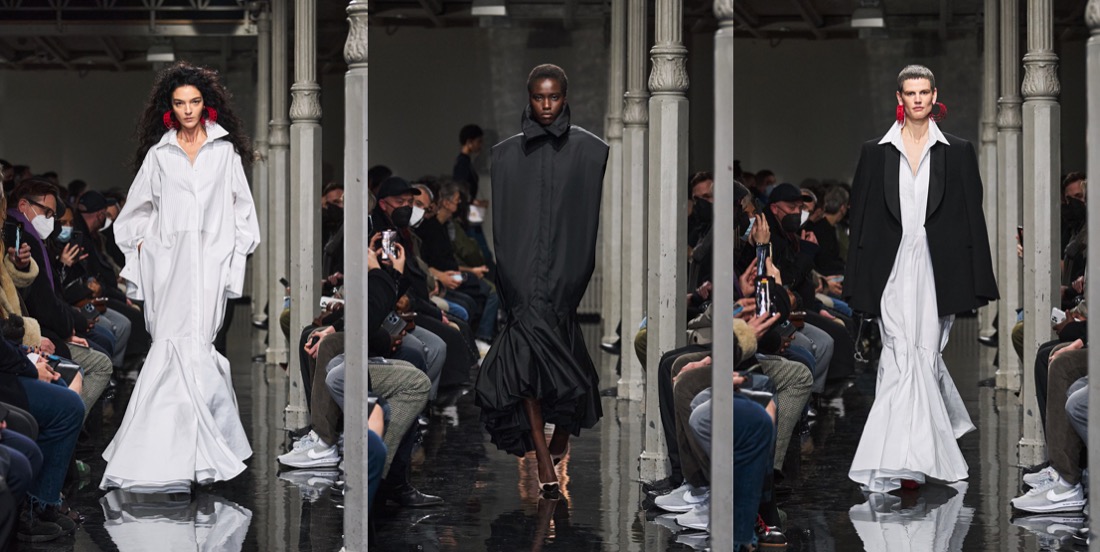
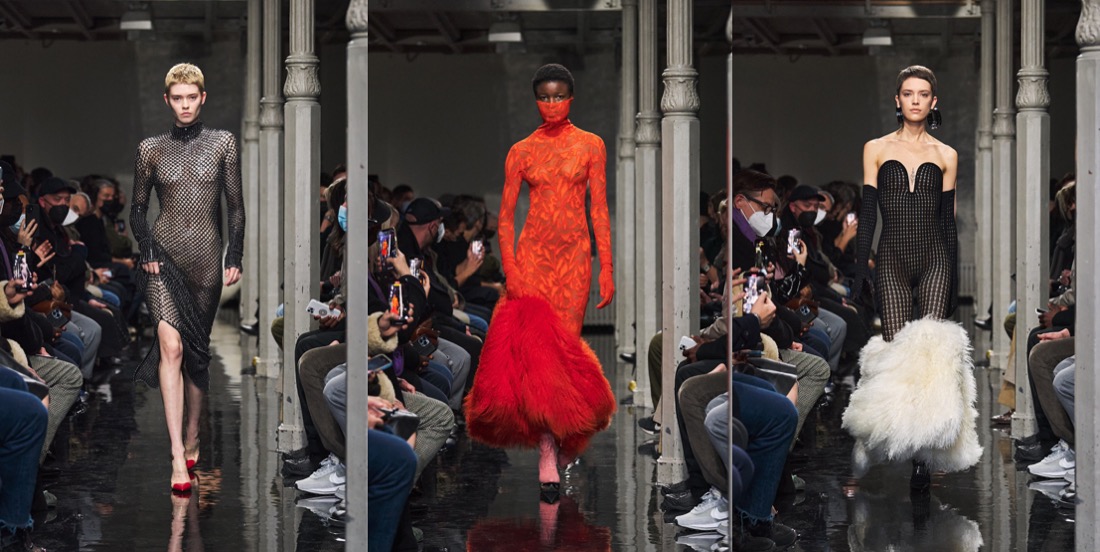
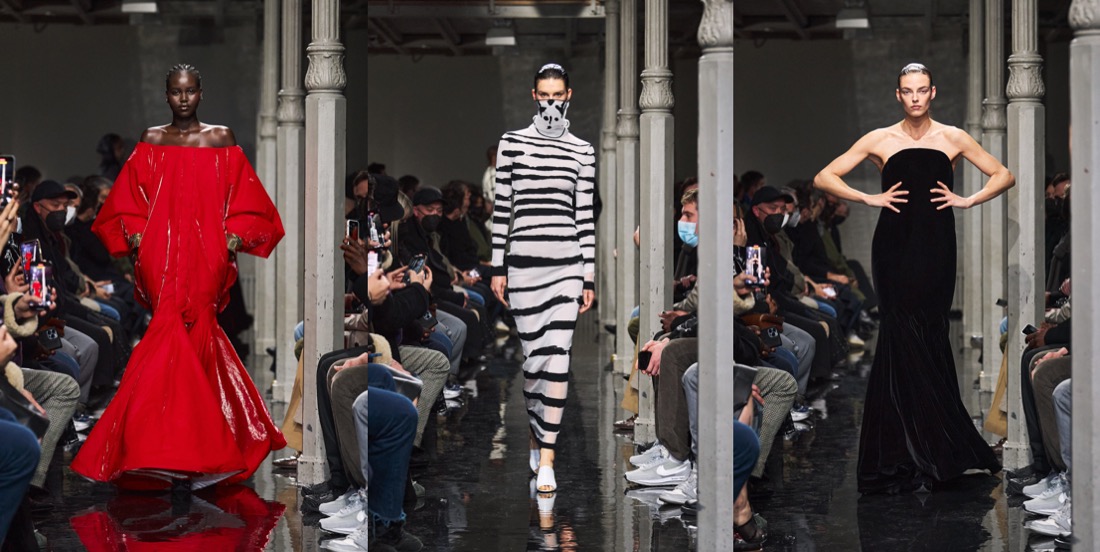
Second collections are always the most difficult to pull off, especially when done for a legendary maison like Alaïa, where the heaviness of legacy might simply overwhelm the most talented designer. Great news: Pieter Mulier nailed it. For autumn-winter 2022, “we translated the DNA of Alaïa with a little bit more of what I like,” he said after the show presented at Azzedine Alaïa’s “cathedral” (the Marais building holding the brand’s atelier, flagship boutique, foundation and the late designer’s home). “It’s basically about beauty. It’s the next step after the last collection: a push forward. I didn’t want a concept. Just beautiful girls and beautiful clothes.” Beyond Alaïa’s loyal following, Mulier is faced with bringing the brand into the consciousness of new generations. His method seems to be this: stick to the codes but turn up the volume. He did so in a collection largely dedicated to bell-bottoms derived from Azzedine Alaïa’s Spanish skirt shapes. Their presence was determined, from denim bell-bottoms to a one-legged jumpsuit bell-bottom and bell-bottoms attached to thigh-high boots that bounced up and down and looked like chopped-off bloomers. The silhouette was echoed in dresses like those of Mulier’s first collection with lively mermaid hems, and in ladylike peplums on skirts that were positively polite compared to their effervescent cousins. While jaunty bell-bottoms are sure to get attention on the daily algorithm scroll of younger generations, there were more intellectually intriguing elements to Mulier’s collection. A series of knitted dresses with face coverings executed in close collaboration with the Picasso Foundation (Azzedine Alaïa was a collector and friend of the family) interpreted ceramics created by the artist in the 1940s through impressive embroideries that turned the models’ physiques into optical illusions. “There’s a rough, pagan beauty about it. Ultimate goddesses,” Mulier said of the dresses. Exactly that component was an interesting contrast in a collection otherwise embodied by upbeat sass and glamour. They kind of cut right through the fun and made you take notice. If they inspired a surrealist streak in the collection, it was there in the biker and flight jackets Mulier morphed into body-con dresses, padding and all, or the dress made entirely out of Alaïa multi-buckle belts. A variety of coats showed what a new Alaïa could also be: big, enveloping shapes borrowed from the gentleman’s wardrobe and sculpted in thick wools, then nipped-in delicately at the bottom of the back to define a feminine silhouette. Mulier said that “the little bit more” he had added of himself to the collection’s genetics was mainly tailoring-focused. That was clear in those coats, but also in louche suits and tuxedos, which accomplished a delicately oversized line that didn’t get overwhelming. Love, love, love!

Collage by Edward Kanarecki.

Men’s – High School Lovers. Alled-Martinez AW22

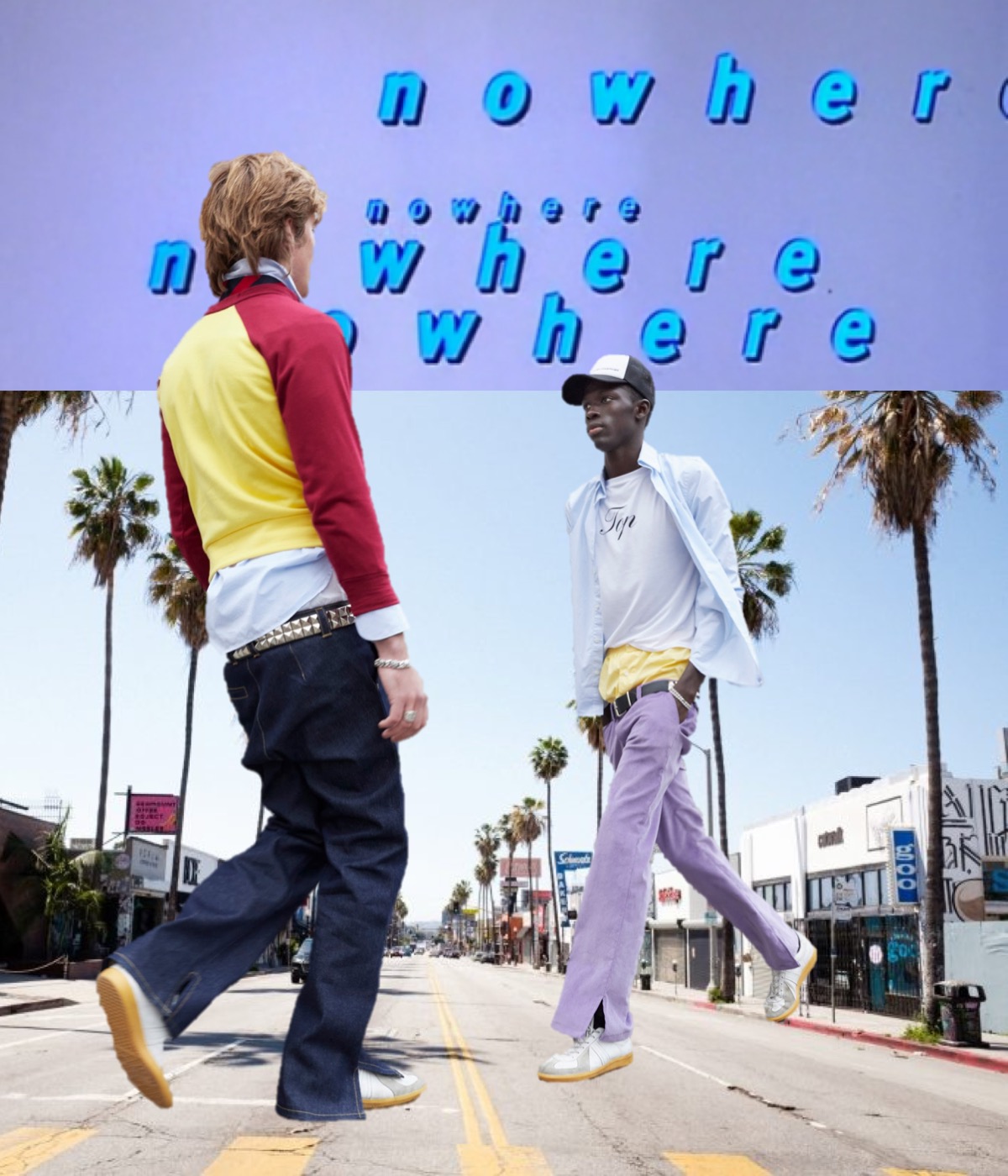
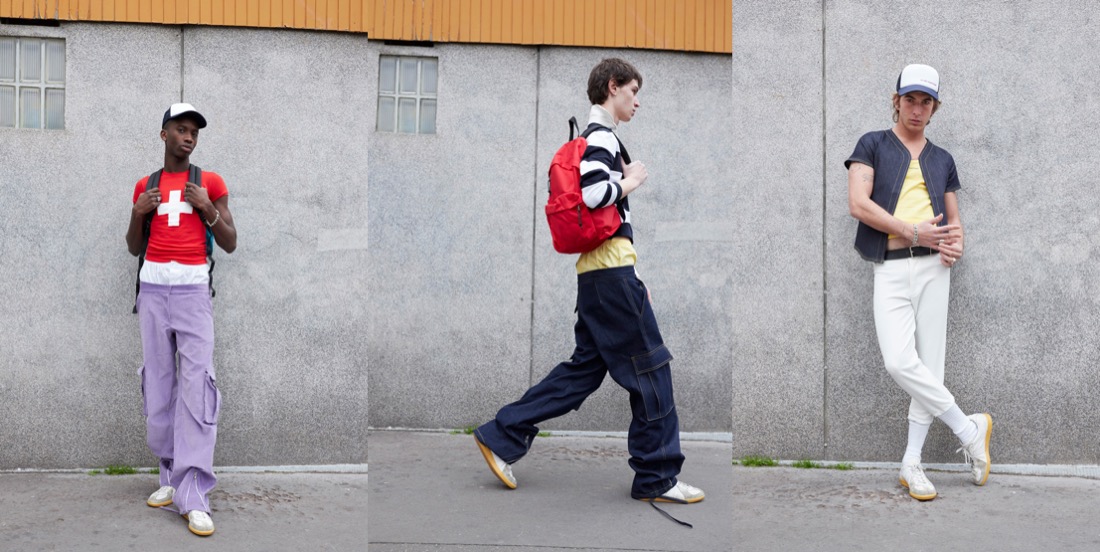
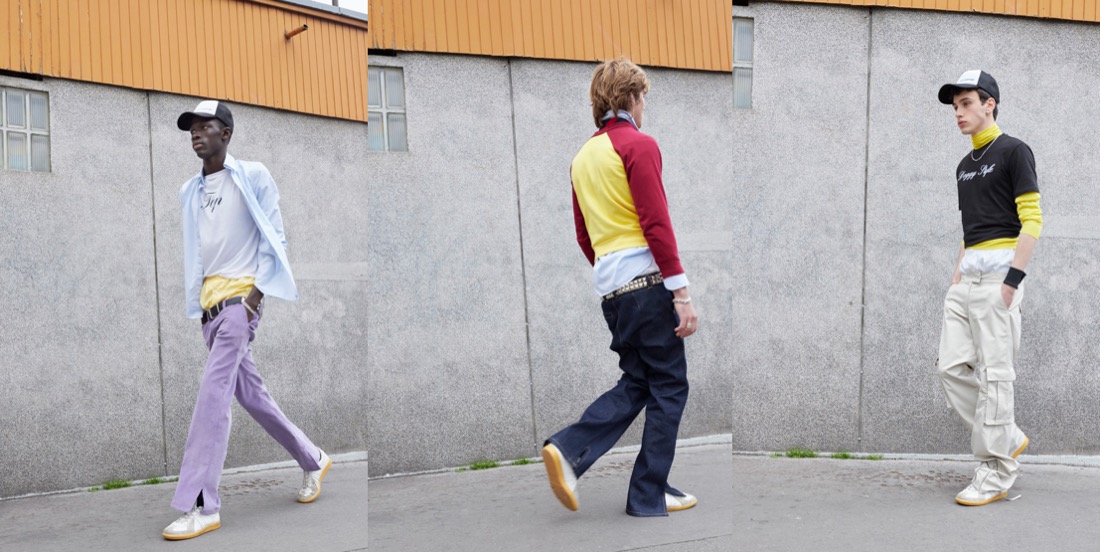
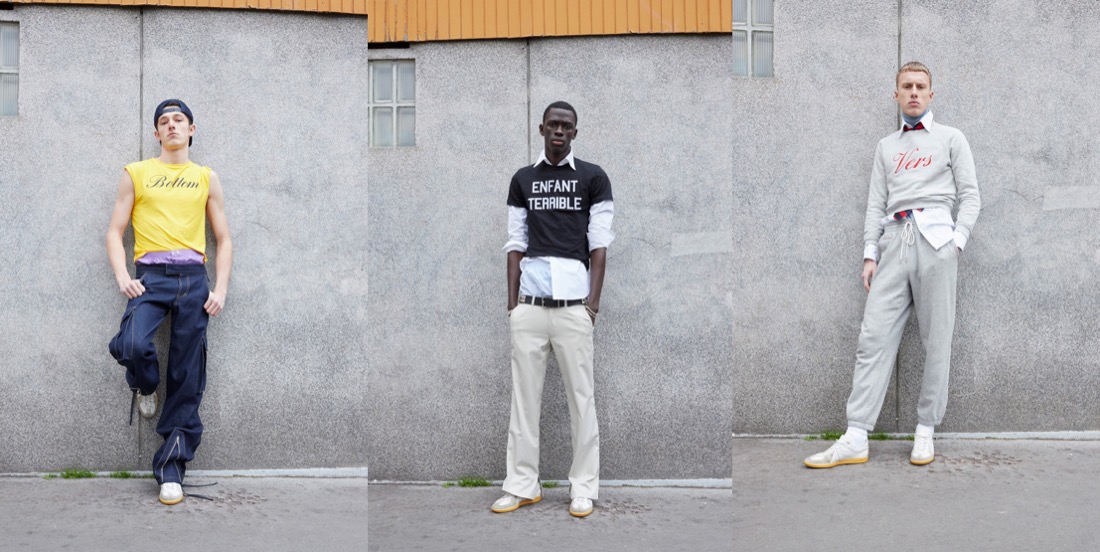
Ending this menswear season with one of the emerging Parisian brands, Alled-Martinez, which after last season‘s success continues to celebrate and embrace queerness. After telling a story of love and tragedy between two men, Archie Alled-Martinez takes a less melancholic approach for autumn-winter 2022. “I was wondering what would it be like to have been openly gay during high school,” he told Vogue, “and how difficult it was for people in my generation to be themselves growing up. When I go online now and see all these queer kids, it warms my heart.” Alled-Martinez translated the high school codes of the early aughts into his garments. There are tiny tees, and tinier, tighter trousers, and perhaps most symbolically laden for those actually in high school in the aughts, jeans shrugged down so low that boxer shorts peek out from the waistband. Bruce Weber’s Abercrombie hunks come to mind, but Alled-Martinez has a more approachable look—think of this like a Hollister fever dream. Furthering the theme, he’s made tees that say Top, Bottom, and Vers. The star of this season, though, is Alled-Martinez’s film. Beautifully directed by Pau Carrette, the film chronicles a boy’s high school loves and losses. The designer plays a track and field coach, while guys run around in their tiny A-M outfits. Unlike many of the other fashion films we’ve seen during the two-years-and-counting pandemic, this one actually has a plot and resonates beyond fashion.

Collage by Edward Kanarecki.
Vivacious. Paco Rabanne AW22

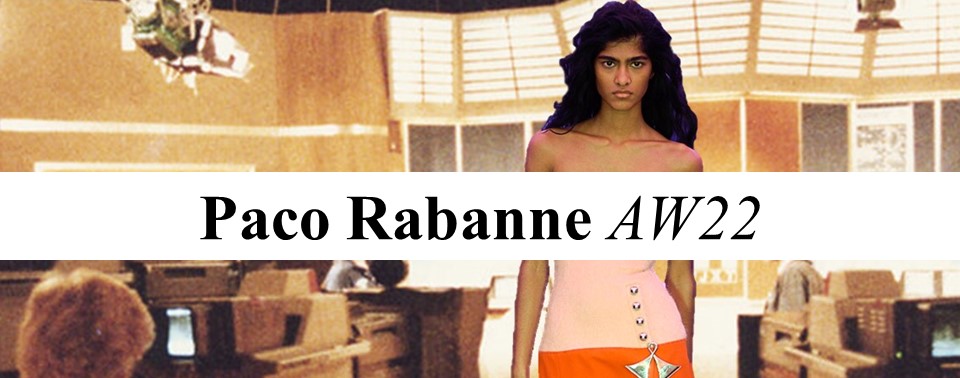
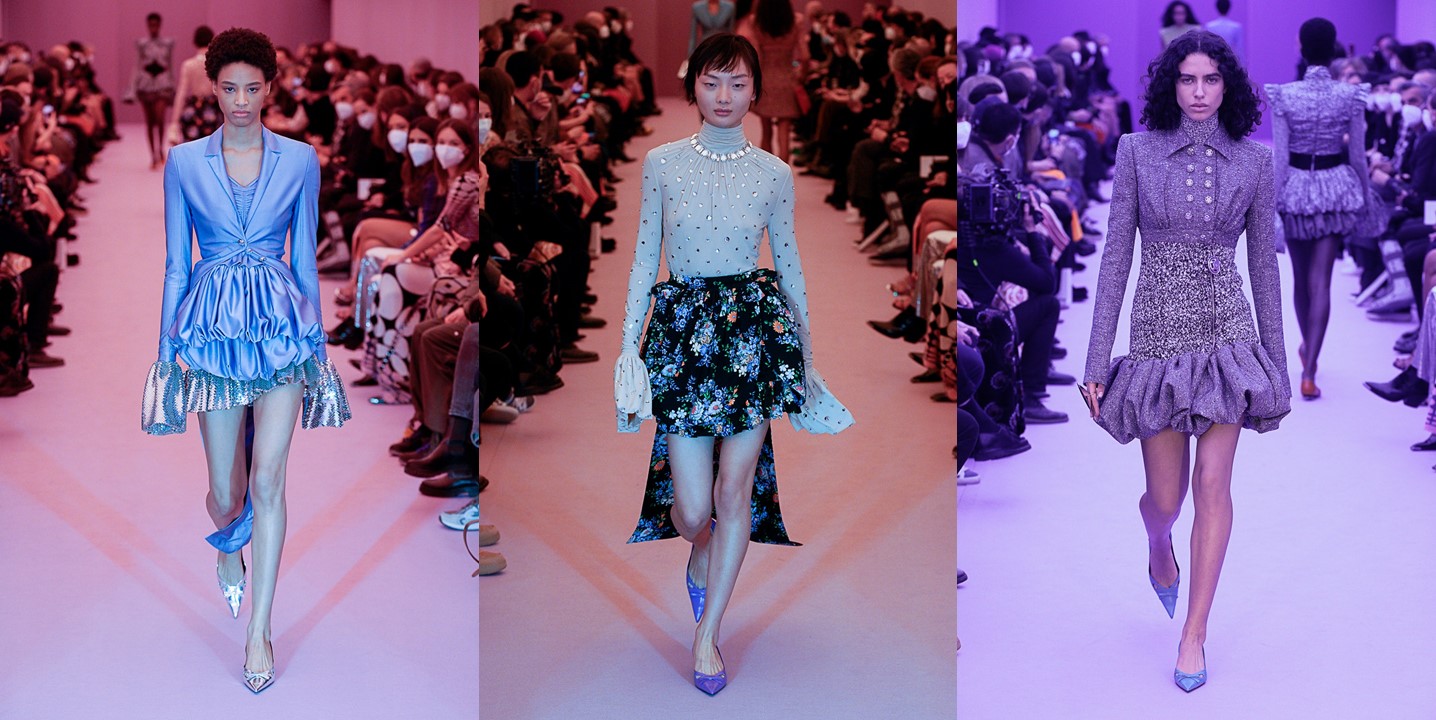
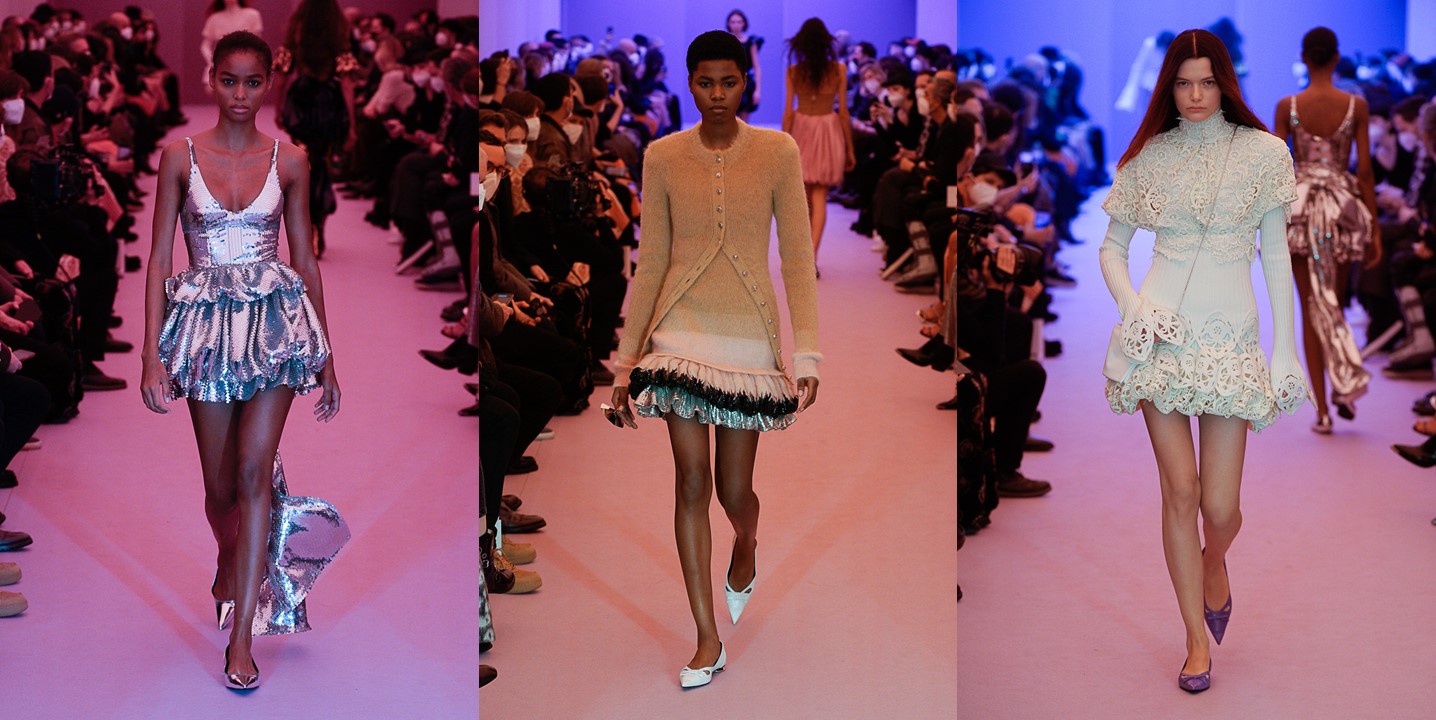
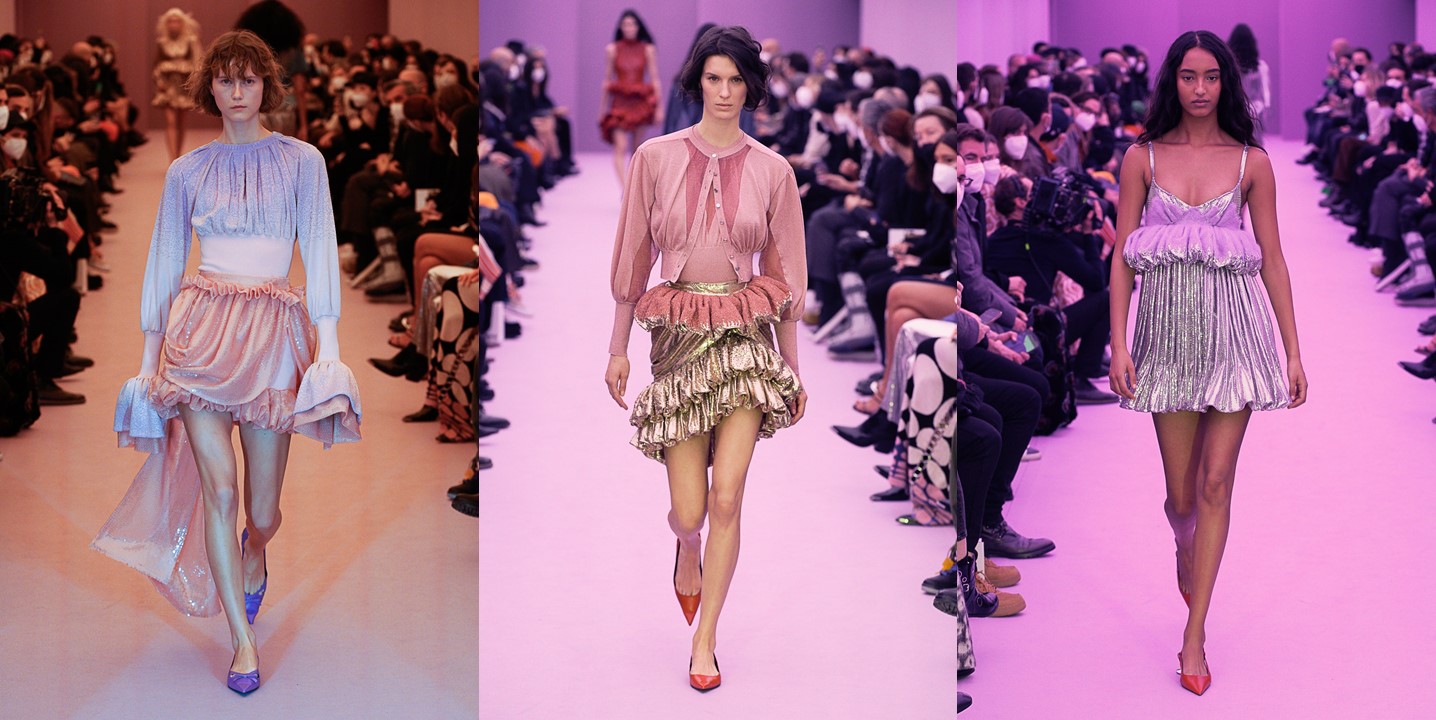
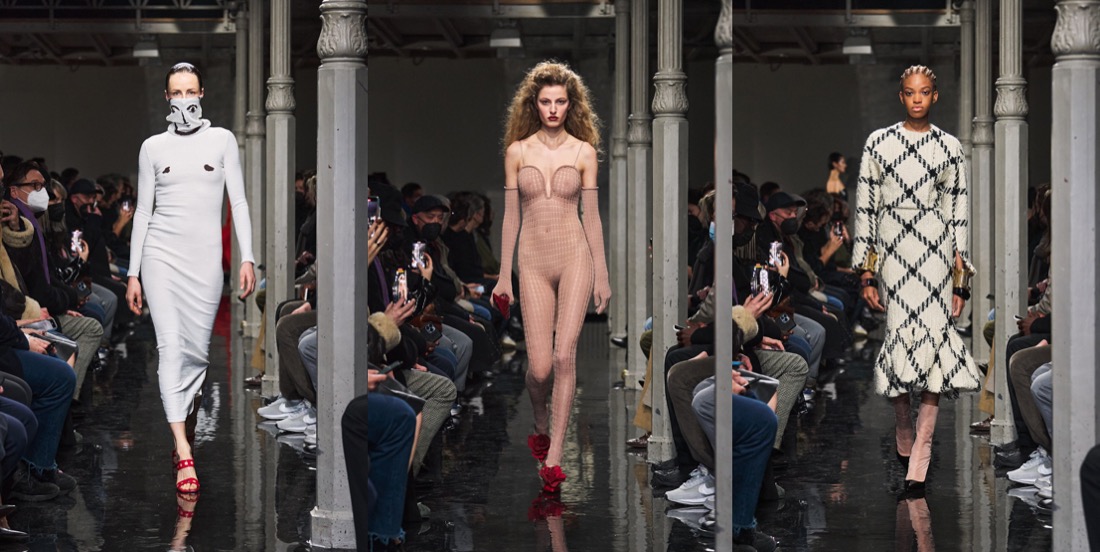
Although Paco Rabanne‘s autumn-winter 2022 isn’t officially couture, it was a suitable start of the Parisian week of haute fashion. Julien Dossena continues to expand his vocabulary for the brand, temporarily leaving behind Rabanne’s heritage chain-mail and digging into personal obsessions. Designers have been doing collections about our hankering for the human touch since Covid set in, but this collection went beyond that. “I wanted it to be conceptual in a sensorial way and not in an intellectual way,” the designer said, stripping his proverbial mood board of any reference that wasn’t about texture or volume. In a (sort of) post-pandemic world where escapism is at an all-time high, focusing so exclusively on here-and-now things like design and fabrication was practically confrontational to the human mind. “The abstract volumes came from the couture register,” Dossena said, referring to the sculptural form language associated with classic haute couture. “But super short, a bit extreme, with really cinched waists, and mixing it with knitwear to make it more, let’s say, contemporary.” On paper, that procedure sounded pretty 1980s, and many of the looks could have been hyper-takes on the decade’s vivacious silhouette. Think Nan Kempner’s style whenever she arrived to Paris. This collection also felt very Balenciaga-by-Nicolas-Ghesquiere, especially autumn-winter 2012 – Dossena was working as the in-house designer back then. The vibrant Paco Rabanne collection is an astute reminder of what we can do with the makings of the material world in a time when the human mind seems hellbent on escaping into immaterial ones.

Collage by Edward Kanarecki.

Men’s. Nigo Knows. Kenzo AW22

Kenzo might be finally be back on the right track with a new creative director. For his sharp debut, Nigo (the legend behind A Bathing Ape) invited the fashion crowd and some big names – Pharrell Williams, Shygirl, Tyler, The Cretor, and of course the couple of the moment, Kanye West and Julia Fox – to Galerie Vivienne in Paris. It was here in 1970 that a small gallery unit with cheap rent was snapped up by 31-year-old Kenzo Takada, who had arrived circuitously from Tokyo five years previously with the dream to emulate Yves Saint Laurent and become a fashion designer. The brand’s founder’s collection was cut and sewn fabrics brought from a Montmartre market. As Kenzo later recalled: “I was looking for some kind of identity as an outsider, so I wanted to bring something very Japanese into it, and that meant textiles with a lot of color and pattern.” By 1993, when he sold his company for $80 million to what would become LVMH, Kenzo had developed that formula to become one of the most beloved and distinct designers operating in Paris. He sadly passed away in late 2020 after being laid low by Covid, but had continued to work on new projects until shortly before. But the brand without its creator has struggled to stay relevant for years. Yes, there was that period, starting a full decade ago, when the Kenzo-coded tiger sweatshirts produced under the Carol Lim and Humberto Leon went from cool to hot to way overcooked. After they left in 2019, Felipe Oliveira Baptiste delivered some interesting and criminally underrated collections, but sadly they just didn’t resonate with the customers. Nigo’s creativity and clout – and of course his personal passion for and parallels with Kenzo – make him a serendipitously synchronized recruit for LVMH. His autumn-winter 2022 line-up celebrates Takada, redefines what Kenzo’s true aesthetic is, and has some really, really good clothes to offer. The key poppy print was redrawn and applied in silhouette on washed denim workwear, by velcro patch to hats, plus on waistcoats, midi-skirts, camp collar shirts and more. The cutely kawaii stuffed animal scarves, knit and fleece, were another revival. The conversation between cultural clichés was highly enjoyable: for every souvenir jacket with a map of France on the back there was a beret (always best in burgundy) stitched with the year of Kenzo’s founding. Not at all ironic, however, were the beautiful high kimono jackets in navy, gray and olive. The bibbed gingham aprons worn over suiting were apparently adaptations of a specific Japanese garment worn during the tea ceremony. This intriguing cross-section of cultures is exactly what Takada used to in his collections, always with grace and consideration.

Nigo is of the generation raised during Japan’s obsessive absorption and reinterpretation – often more beautiful than the inspiration – of the Ivy League original into American Casual and Yankee variants. During the preview he’d commented fascinatingly on the difference between building a collection with European factories (which he said created garments more “clean” than he’d wish for) compared to Japanese (who can make it “dirty”). For this reason he’d insisted all the denim in this collection hail from his homeland, even if the top-stitching on his undyed indigo was a little too “clean” to be exactly perfect. Tightly observed post-Ivy, post-Yankee, come-to-Paris pieces here included the varsity jackets and unwashed dungarees. Shortly before the show, Williams said: “The coming together of Nigo and Kenz – it’s symbolism, right? None of us would miss it. Nigo is the father of so many things that we’ve all looked up to, and that have meant so much to all of us.” Of the collection he added: “So it’s like 1950s and ’60s clothing remade in the ’80s, you know, but through the lens of the 2020s.” Which was a pretty perfect summation of this first page of a fresh chapter in the story of the house of Kenzo.

Collage by Edward Kanarecki.