

It’s so heart-warming to see that AZ Factory continues to exist and convey its founder’s legacy in fresh and innovative ways. Alber Elbaz had just launched AZ Factory when he succumbed to Covid last April. His vision for his new brand encompasssed body-positivity, sustainability, and tech, but at its heart were the women he hoped to dress. “We’re not here to transform women; we’re here to hug them,” he told Vogue Runway at the time. He had only a few months to establish a new way of doing things at the Richemont-backed company, but a year later the brand is staying true to those founding principles, and then some.
Early last month, as an exhibition of the tribute collection “Love Brings Love” featuring contributions from 44 designers opened at the Palais Galliera in Paris, AZ Factory announced it would be inviting a rotating series of talents, “Amigos” in brand parlance, to create collections for the label. The first Amigo was to be the 28-year-old South African designer and LVMH Prize winner Thebe Magugu. His collection will have two store drops this year. Magugu never had the chance to meet Elbaz in person, but he was acquainted with his work growing up in Johannesburg. “My favorite childhood memory is my mom saving enough money to buy satellite television,” he remembers on a Zoom call. “Funny enough, the first channel that came on was FTV [Fashion TV]. Lanvin shows played on repeat, and that’s how I was first introduced to the work of Alber.” Magugu’s collection stays true to the sensibility that Elbaz was nurturing at AZ Factory, but it’s equally representative of his own aesthetic.

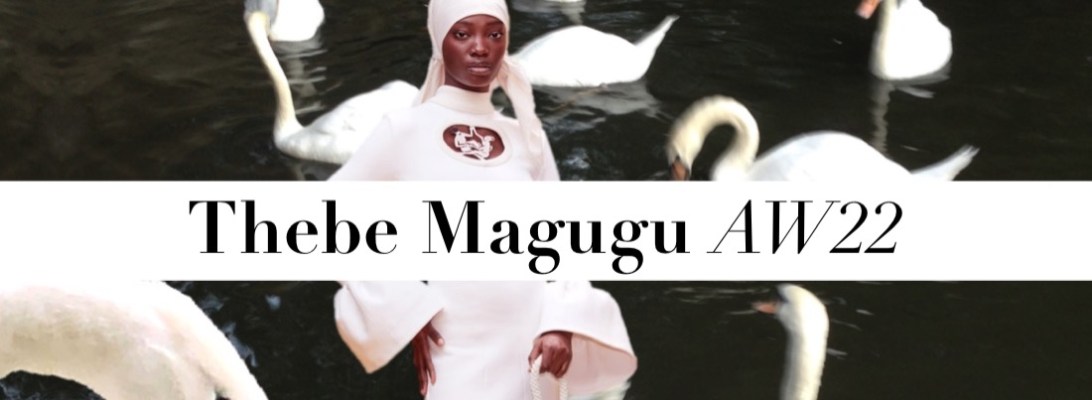
You’ll note that Magugu’s logo, a “sisterhood emblem” depicting a pair of women holding hands, features as a belt buckle detail on the handkerchief hem pleated skirts he specializes in, and again as stainless steel hardware in a cut-out at the neckline of a dress in the engineered knit that Elbaz had been developing. The look Magugu designed for the “Love Brings Love” tribute to Elbaz, an ode to a white silk shirtdress he made for Guy Laroche, one of his pre-Lanvin postings, reappears here, only with a hem that looks like it has been dipped or smudged. Moreover, Magugu sees the African continent as the link between himself and Elbaz, who was born in Morocco. “The question I posed to myself and the design team here is, ‘What if Africa was the birthplace of couture?’ I think about that a lot. The things that make up luxury – the idea of time spent creating something, the storytelling, passing something on from generation to generation – are really the same as you find in African craft, as well. We’re best known for our storytelling and our work with our hands. I thought that was a very interesting intersection that we could explore with the collection.” The intersection is most apparent in a pair of ruched-neck caftans, a typical silhouette in Morocco, printed with paintings by the Paris-based Algerian artist, Chafik Cheriet, whom Elbaz commissioned before his passing. “They really encapsulate both of our worlds,” Magugu says. “They’re playful and something that a lot of people can find themselves in with that slight African regality that I wanted to have when we started the project.”
As much as it was a melding of their sensibilities, Magugu says he picked up new skills through the process. At his own brand he typically starts by sketching, but at AZ Factory there’s more of an emphasis on draping on the mannequin. “It was an interesting challenge for me, but ultimately very beautiful.” He also learned more about Elbaz himself through the process. “In interviews I noticed how kind he was and when I got to AZ Factory I got confirmation from the team. It wasn’t a TV facade. The more I grow into the industry the more I find that kindness can lack in a lot of ways. So that’s very special to me.”
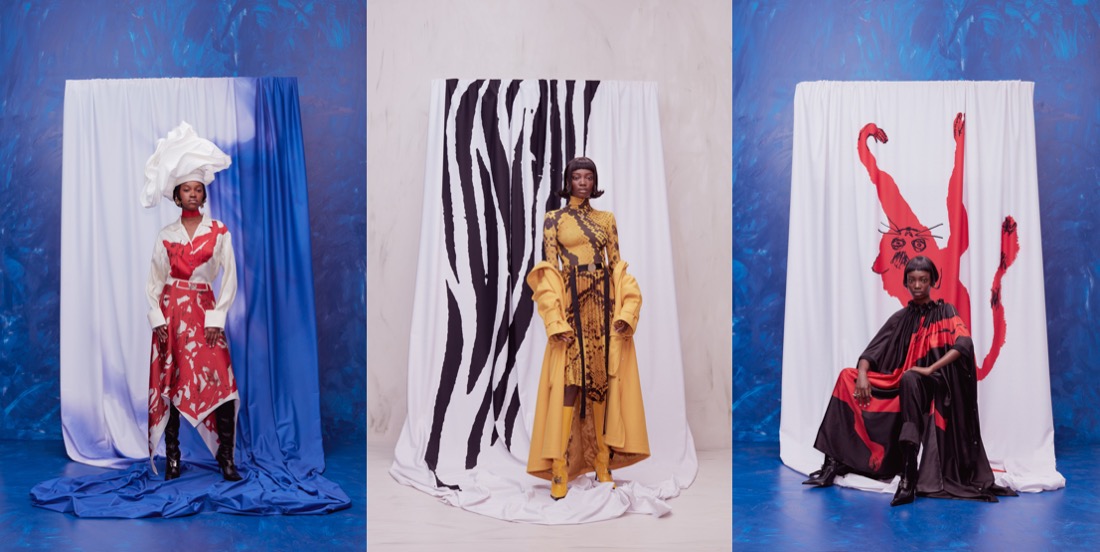


Collage by Edward Kanarecki.





 Design & Culture by Ed