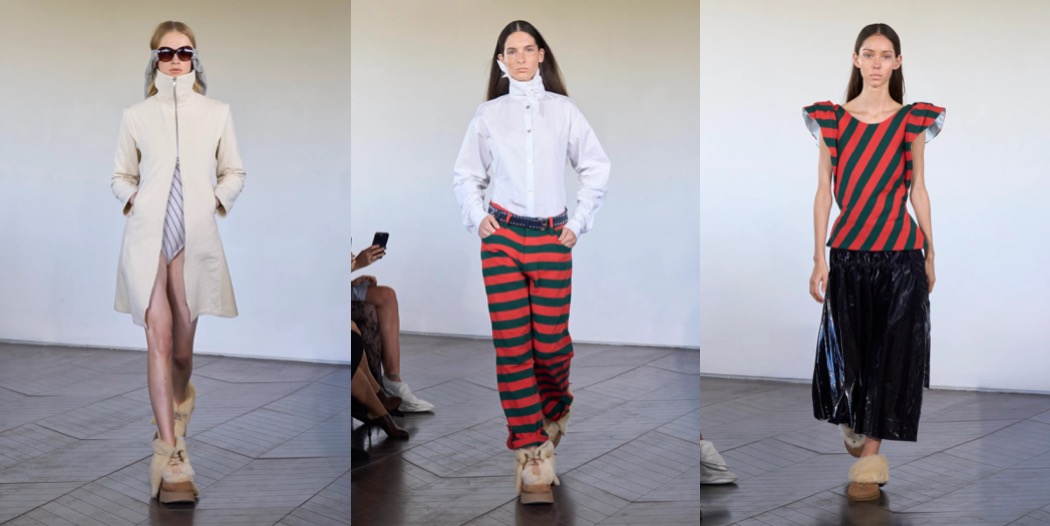
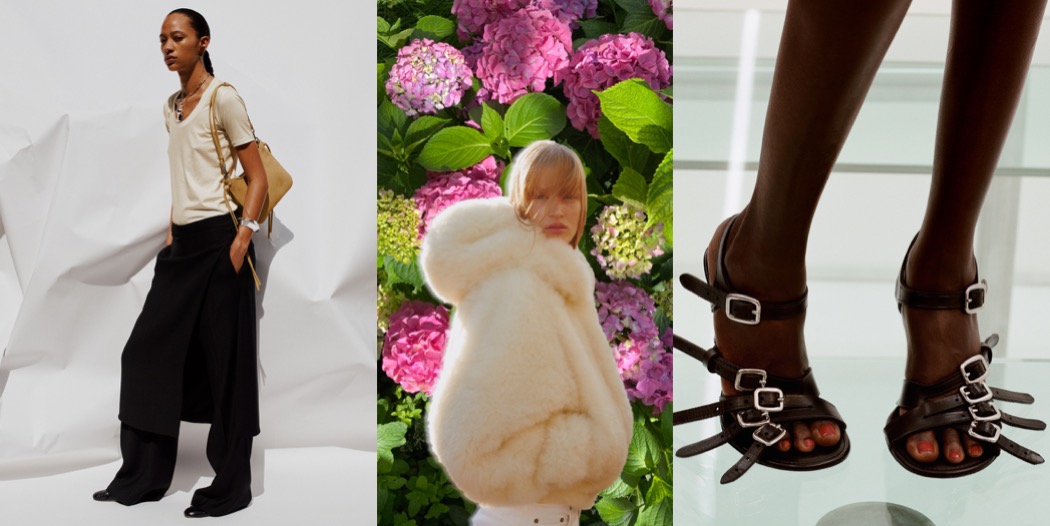
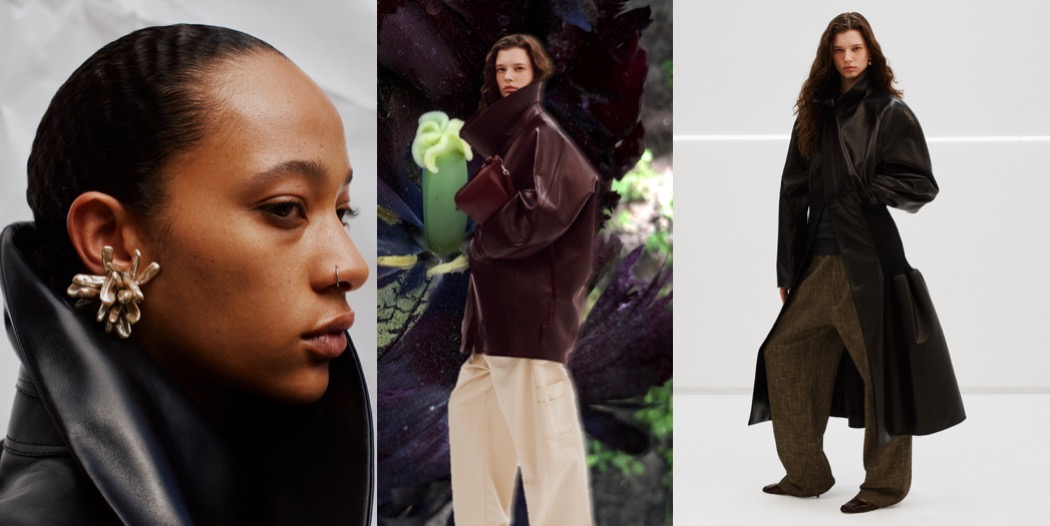
Steven Stokey-Daley served us the great, British classics, revisited and refreshed, with good humour. Cropped trenches (Burberry could take notes). Cool pea-coats. Tailored bermudas. Full-skirts in floral prints worn with work-jackets (the look gave Frazzled English Woman energy!). And then there was Marianne Faithfull. A rendition of frilly blouse she was famously photographed wearing in the late 1960s was on the runway. A lovely chunky knit “Stay Faithfull To Marianne” was there, too. The designer was quick to make it clear he hadn’t jumped on the bandwagon of her recent passing. “Maggie Smith, Kate Bush, and Marianne Faithfull have been the three women who’ve always meant so much to me,” he said. S.S. Daley reminds us than we need London Fashion Week, even if it’s in (hopefully temporary) shambles.
Collage by Edward Kanarecki. Don’t forget to follow Design & Culture by Ed on Instagram!
Hey, did you know about my newsletter – Ed’s Dispatch? Click here to subscribe!
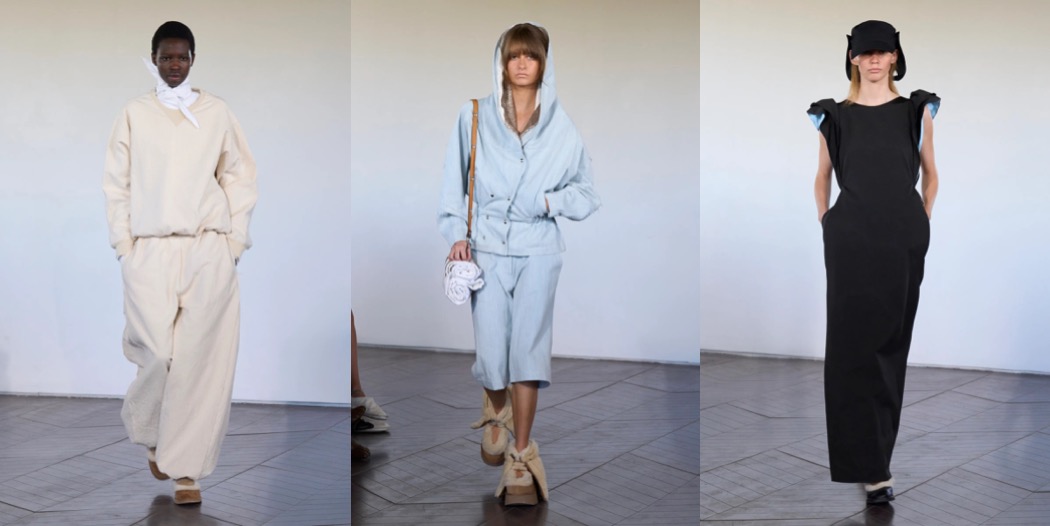
Dilara Findikoglu fired up London Fashion Week with her outing at Slimelight, the longest-running Goth nightclub in town. Lead by Lara Stone, a pack of ferociously badass women, clad in hyper-corsetry and second-skin chiffon body stockings stalked through the dark space, utterly entrancing the viewers. Entitled “Venus in Chaos”, the collection was “a divine feminine mutiny“, as the designer summed up in her press-notes. Botticelli-goth hair, a bustier covered with hundreds of shells, red velvet jackets (un)finished with punk-ish safety pins, unexpected cuts in the most “risky” places, tattered hems and ripped lace: all that created an extreme impression of total liberation from societal norms – and the pleasure of sexual self-possession. It’s easy to compare Dilara’s subversive work to John Galliano or Alexander McQueen’s, aesthetics-wise, but what makes her differ is her powerful female gaze that truly makes you believe these otherworldly women are here to break the patriarchal system.
Collage by Edward Kanarecki. Don’t forget to follow Design & Culture by Ed on Instagram!
Hey, did you know about my newsletter – Ed’s Dispatch? Click here to subscribe!
Ponte is so much more than a fashion brand. Although it focuses on clothes, these garments have more to do with a Meret Oppenheim-kind of surreal approach to applied arts than, say, haute couture (although some of the techniques conceptualized and materialized by the founder of the brand are just unthinkable). But I’m not sure Harry Pontefract, the London-based creative who views this project as “ongoing body of work” that dates back to his days at Central Saint Martins, would want to call it an art project. Ponte is… Ponte.
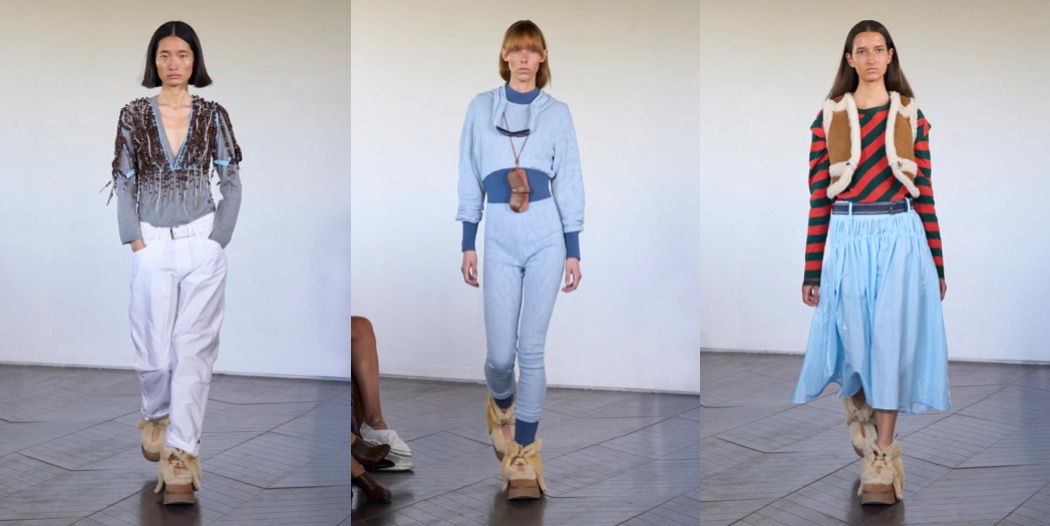
“Contradictory” seems to be a fitting term that classifies Pontefract’s practice. He might describe a look a “sort of a Chanel Catherine Deneuve suit” or “the most wrong cocktail dress in the world,” but at the same time he values the power of interpretation and believes that how people “read” his designs reveal much about themselves. The spring-summer 2025 collection can definitely be read in various ways, especially in terms of biography the object – in this case, the provenance of used materials in these striking, body-transforming coats, shawls and dresses. Look one was made with raw fleeces delivered from known sources. All the shearling came from a business down the street from the designer. The textile used for the pink shirt and pants is the lining of military sleeping bags. Vintage M65 army jackets were repurposed into not-so-basic suits. “Once you start to take them apart and they have the memories of whoever’s been wearing them in all the seams and everything, they’re such loaded garments. Even just doing something in that color, never mind out of old jackets, is going to be loaded”, Pontefract says. In the end, clothes are about codes and signals. I think not many contemporary designers have that in mind anymore. Another thing that stuns about the creative’s approach to fashion is his deep interest in the ephemeral. A dress painstakingly covered in 24 karat gold leaf and hand-felted shearlings (which were sewn to sheer tulle… mind-blowing!), will change and deteriorate in not such a long time, making one think of Ana Mendieta’s “Silueta” series. There’s something animalistic about this collection. Even brutal: like the sheepskin body covering the entire body in a intriguingly fetishistic way. “It’s human nature and it’s primal, that’s what I’d say about the collection“, summed up mastermind behind this absolutely transfixing brand.
Collage by Edward Kanarecki. Don’t forget to follow Design & Culture by Ed on Instagram!
Hey, did you know about my newsletter – Ed’s Dispatch? Click here to subscribe!
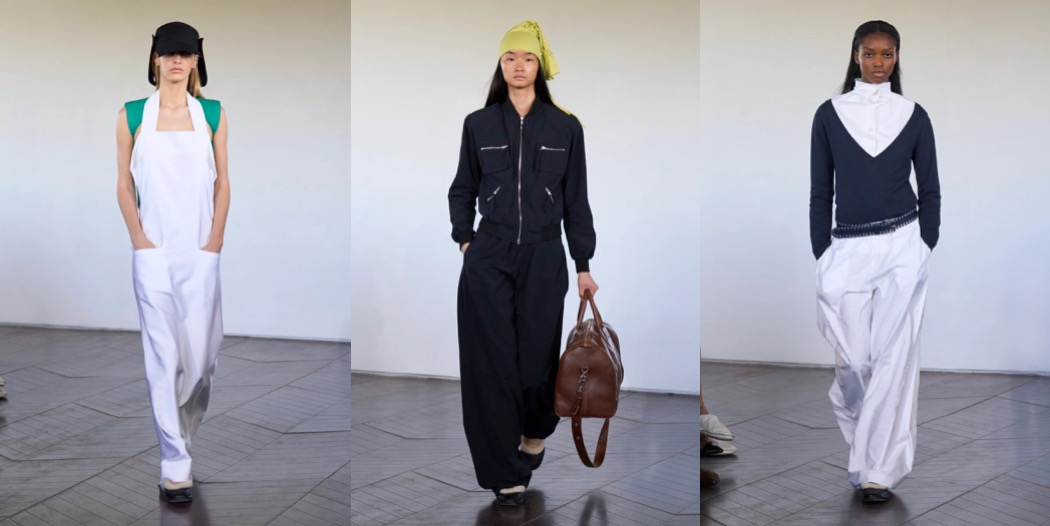
As we’re approaching 2025, everybody seems to look backwards at the last quarter of the century in fashion. But let’s also take a look at the future. Paolo Carzana, the London-based designer, makes one feel very hopeful about. The über-talented designer, a finalist for this year’s LVMH Prize, uses plants and natural pigments like burnt umber to dye his crafty, gender-fluid garments. Carzana’s signature is the raggedy, lived-in look of his garments that makes men and women look as if teleported from another century. There’s also that hazy, misty, as if seen through a broken lens, lyrical silhouette of his clothes: the pinstripes on a pair of men’s trousers look blurred, the Caravaggio-esque drapes of the dresses seem to be shaped by gushes of unexpected wind. The gauzy layering and the buttonless, zip-free poetry of Carzana’s work makes him a truly, truly unique creative who doesn’t obey the industry norms of production scaling or aggressive marketing. No other contemporary designer sees beauty and strength the way he does.
Collage by Edward Kanarecki. Don’t forget to follow Design & Culture by Ed on Instagram!
Hey, did you know about my newsletter – Ed’s Dispatch? Click here to subscribe!
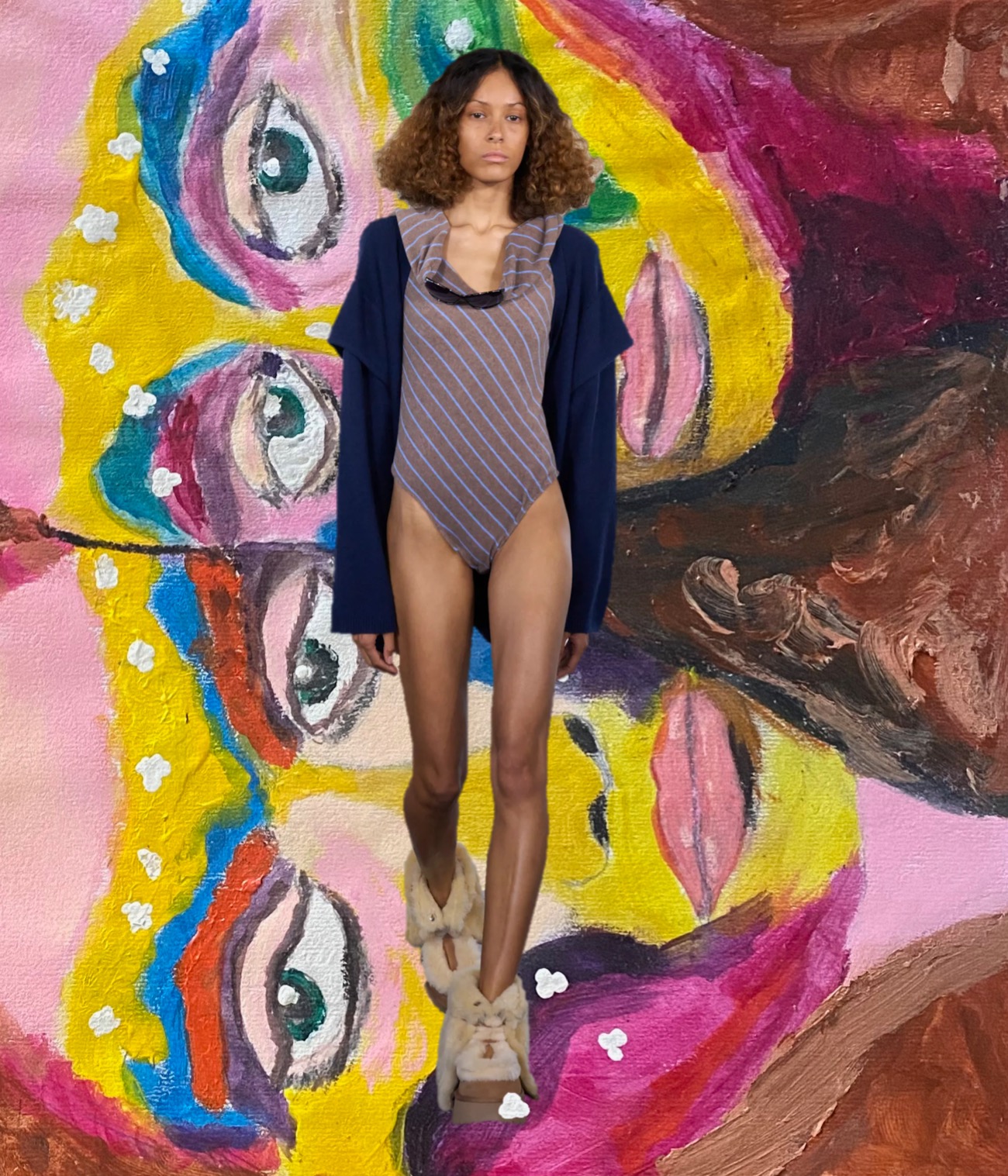
Jawara Alleyne‘s latest collection is one of the most impressive line-ups of the whole spring-summer 2025 season. It was just so touchingly evocative, oddly elegant and truly beautiful. The title of the collection, “Island Underground“, nodded to Alleyne’s upbringing on the Cayman Islands, and the mystical air that hung over the show – models walked slowly, fabric dragging behind them as if they’d just been rescued from a shipwreck – had an electric, spiritualistic energy.
For Alleyne, embarking on his journey as a designer and delving deeper into his Caribbean identity has been therapeutic. While growing up, he resented the limitations of being so far away from the world’s fashion capitals, and he looked to heroes in Paris like Alber Elbaz, Alexander McQueen, and Karl Lagerfeld: “To me, being inspired by the islands felt a little bit restricting,” he said. But his interest in reconciling these two sides of himself has now ended up producing some of his most striking work. “I think there are a lot of brands that are just pulling from culture, and so I think it’s really important for me as a designer to make sure my collections aren’t just inspired by that culture but give back,” he added. It’s worth noting that Jawara is a fantastic colorist, knotting together kaleidoscopic fabrics into highly desirable, sensually-charged dresses and crafting a series of intriguing ombré dyed looks. London sees a wave of emerging designers with a knack for deconstructionist approach to clothes, and that’s really exciting to observe.
Collage by Edward Kanarecki. Don’t forget to follow Design & Culture by Ed on Instagram!
Hey, did you know about my newsletter – Ed’s Dispatch? Click here to subscribe!