Men’s – Outsider Intellectual. Wales Bonner AW21

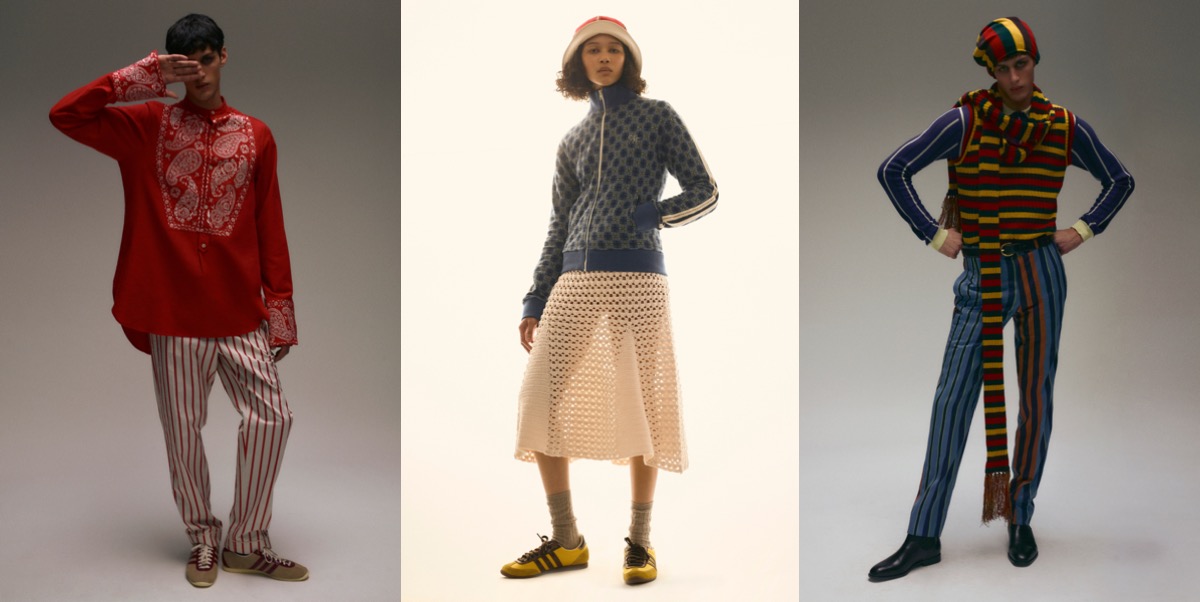
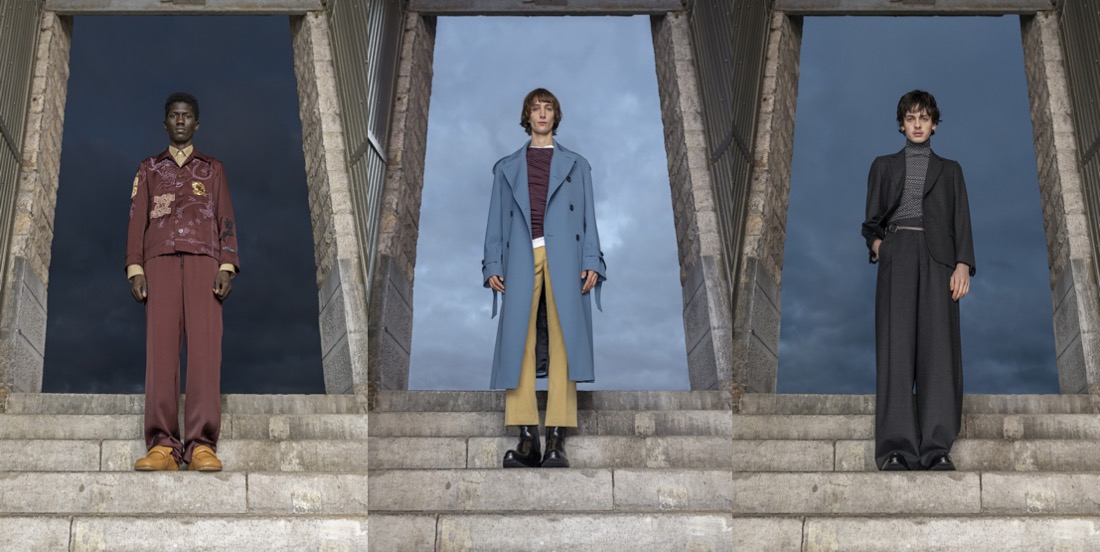
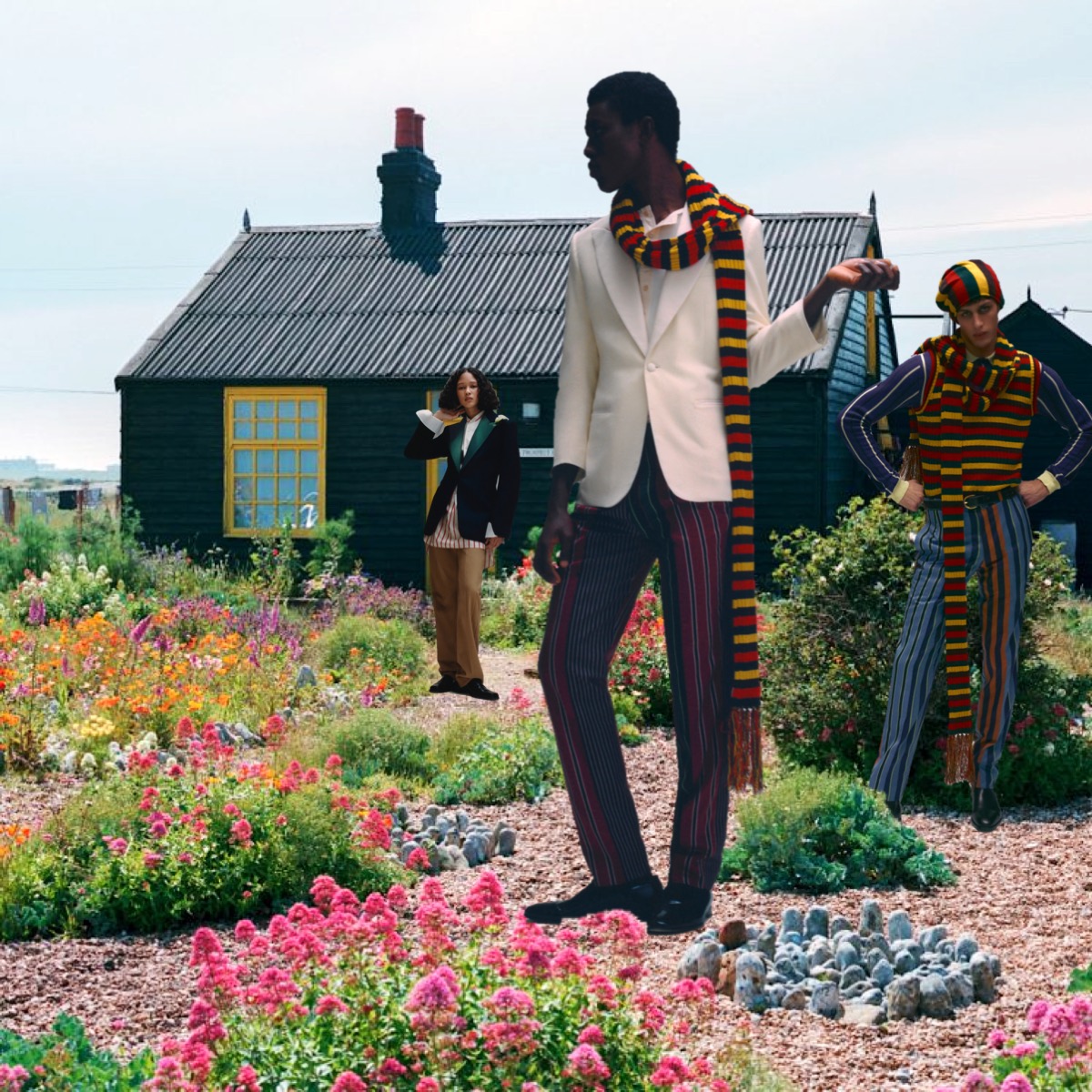
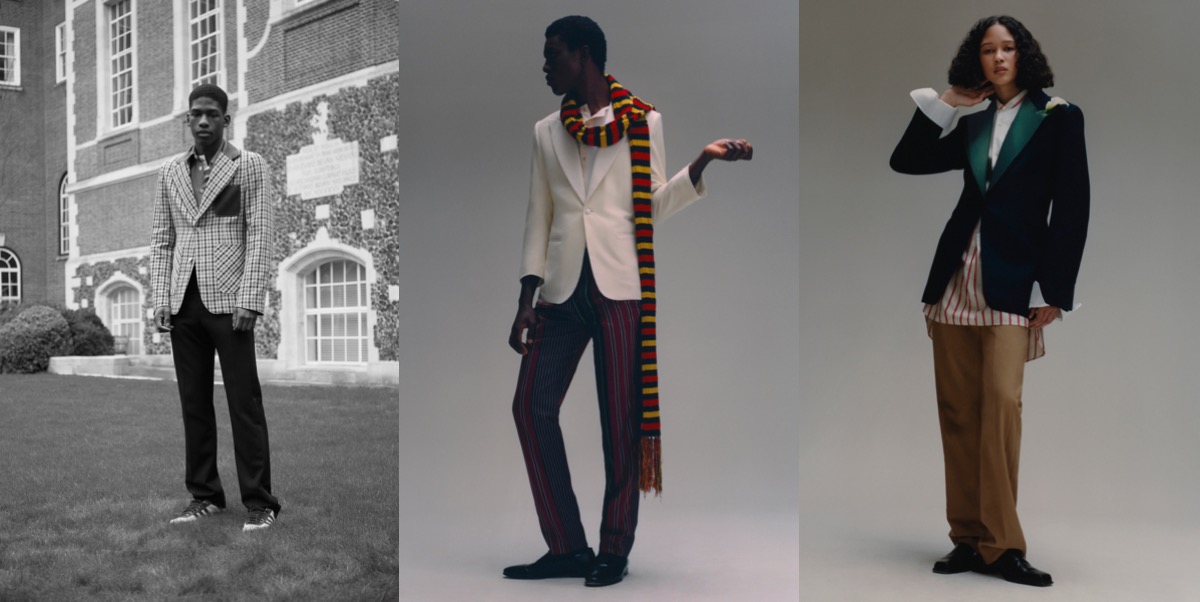
Grace Wales Bonner is one of the most convincing (and educational!) story-tellers in today’s fashion industry. Her latest collection showcased the final chapter in a trilogy, begun last January, which explores the cultural and sartorial threads that interlink Britain and the Caribbean. “This subject is the starting point for why I’m interested in creating,” said the designer, who is British born but of Jamaican heritage. “During this time I feel like I’ve really been grounding myself in this framework, and refining myself within it. These collections are about consolidating and reinforcing what is timeless to me; representing the breadth of what Wales Bonner is, and can be.” Thus far in the series the designer has looked to the second-generation Jamaicans who established London’s 1970s Lovers Rock scene to inform her designs, and then the dress of Jamaica’s dancehall and reggae stars. Here she started by exploring the wardrobes of Britain’s Black scholars in the 1980s: those who traveled from across the world to study at the likes of Oxford and Cambridge. There was a reimagining of their academic attire – of tweed blazers and knitted scarves, well-worn chinos and striped jumpers – but within that historicism, “I was thinking about how in certain spaces people create a language for themselves,” reflected the designer. “About how you might disrupt an institution from inside.” It’s a subject that has long fascinated Wales Bonner, whose brand was established with the intention of disrupting the luxury perspective, redirecting it from its often singular focus on Eurocentricity. So poets like the Barbadian Kamau Brathwaite and the Saint Lucian Derek Walcott appeared as more than just aesthetic character studies; rather, they were catalysts for considering a post-colonial movement that explored “what it is to be in another place, or from another place.” The resonant words of Braithwaite, who left Bridgetown to study at the University of Cambridge, were spoken over the immersive film directed by Jeano Edwards which accompanied the collection: “You had not come to England / You were home.” In terms of clothing, Wales Bonner imagined what she termed the wardrobe of the “outsider intellectual,” considering the structure of British traditions and wondering “within that framework, how do you create something new?” She found her answer by imbuing her distinct take on sartorial eclecticism with a gently liberated, multicultural sensibility. The designer worked with Savile Row tailors at Anderson & Sheppard on tuxedo suiting inflected with Afro-Atlantic flair and elsewhere she softened Oxford shirting, printing cotton cashmere with Jamaican “flowers of resistance” from the photograms of artist Joy Gregory. Boating striped overshirts simultaneously channeled Oxbridge classicism and West African dashikis; brushed denim was cut into crisp suits. A sense of ease was injected into even the most traditional tailoring. Woodblock prints and Indian embroidery drew on the diasporic nature of her research, and a deliberate diversity was instilled throughout. “What I was trying to connect with is a sense of expansiveness and possibility,” said Wales Bonner. “For example, in Derek Walcott’s The Gulf, he has a poem about different Indian gods. You think you’re looking at Caribbean thought, but then there are all these other influences. Once you start researching anything, you realize that nothing is simple. Nothing is one thing. So I didn’t want to make anything too neat.” That expansive notion was echoed, too, in the latest iteration of Wales Bonner’s Adidas collaboration – a partnership that has recently taken fashion by storm. “I was trying to imagine a fictional university that is a lot more multicultural,” she said of its new evolution. “Maybe what their team kits for a track program might look like.” Referring to “the origins of sportswear – when it was made in a beautiful, crafty way which feels almost tailored,” Wales Bonner leaned into Adidas’ technical resources to revive specific fabrications like ’60s jerseys and lived-in wools “to make things feel authentic,” she said. A T-shirt printed with the emblem for “Wales Bonner Adidas Originals Literary Academy” offered a tongue-in-cheek nod to the extensive footnotes which typically accompany each of the designer’s collections. But what has been proven by the sell-out success of her tracksuits and trainers is that, even without related reading, there is something uniquely compelling about Wales Bonner’s designs: the heavy-duty weight of her research injects something intangibly compelling into her clothes.
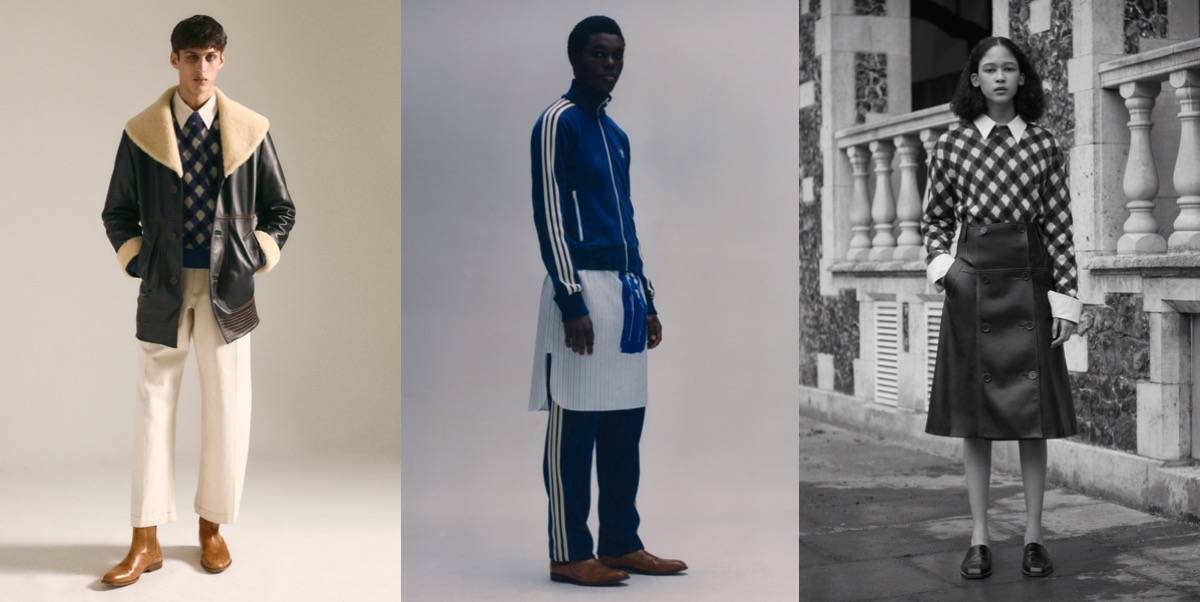
Collage by Edward Kanarecki.

Men’s – Peter Doig. Dior AW21

While everybody is obsessed with Kim Jones‘ menswear at Dior… I’m still on fence with it. In overall, I love how he implements couture traditions of the maison and, at least, makes his part amusing, comparing to Maria Grazia Chiuri’s womenswear. But his autumn-winter 2021 collection just feels regular. Maybe it’s the side-effect of working on the Fendi debut? Again, Jones invited an artist to collaborate. This time, it’s the Scottish-born painter Peter Doig, whose roving background – an upbringing in Trinidad, study in London in the 1980s, success in the ’90s, a move to Canada – is exactly the stuff that brings out the fanboy in Jones: “Peter was at Central Saint Martins with Stephen Jones, and knew all the people I’m obsessed by – Leigh Bowery, Trojan, the London club kids at that time. Stephen introduced us. He really became part of the studio for the collection, and started making things, painting hats, and designing the set, which is based on the speaker stacks he’s collected.” Stephen Jones, Dior’s resident milliner confirms: “Yes, Peter was always hanging out with us fashion-y types at school. Then all of a sudden, unlike us, he went off and became a major international artist.” The line-up is full of Doig references: yellow anoraks, orange coats, and lions; paint-dabby patterns on sweaters – that’s all material replicated from Doig’s oeuvre. “His work is autobiographical. We looked at his paintings of men, of skiers, ice hockey players, and the night sky,” said Jones. “I think he was fascinated by how closely we could replicate his brushwork in textiles and knitwear.” The cheerful shots of citrus color – translated into some of Jones’s subtle merges of casual and luxurious street-wearable outerwear – are the making of the collection. Other than that (fashion-meets-art dialogues are always compelling), I wasn’t really convinced by the whole picture.

Collage by Edward Kanarecki.

Men’s – Tourist vs. Purist. Louis Vuitton AW21

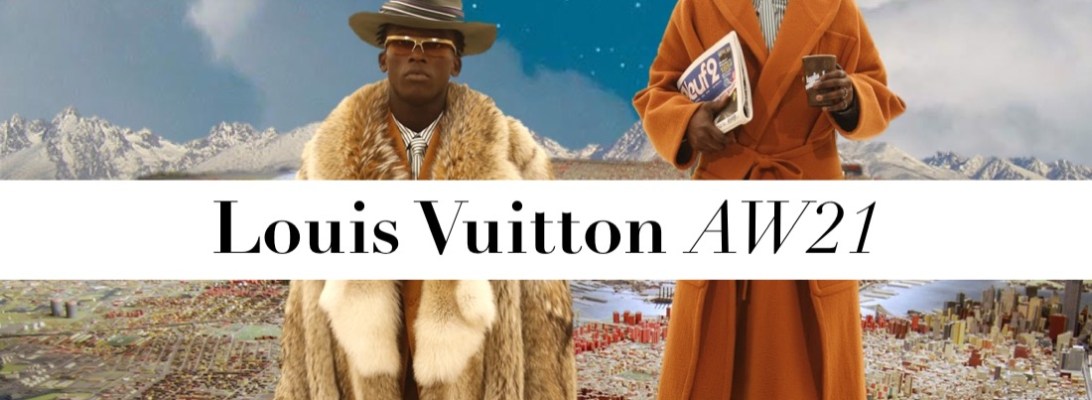
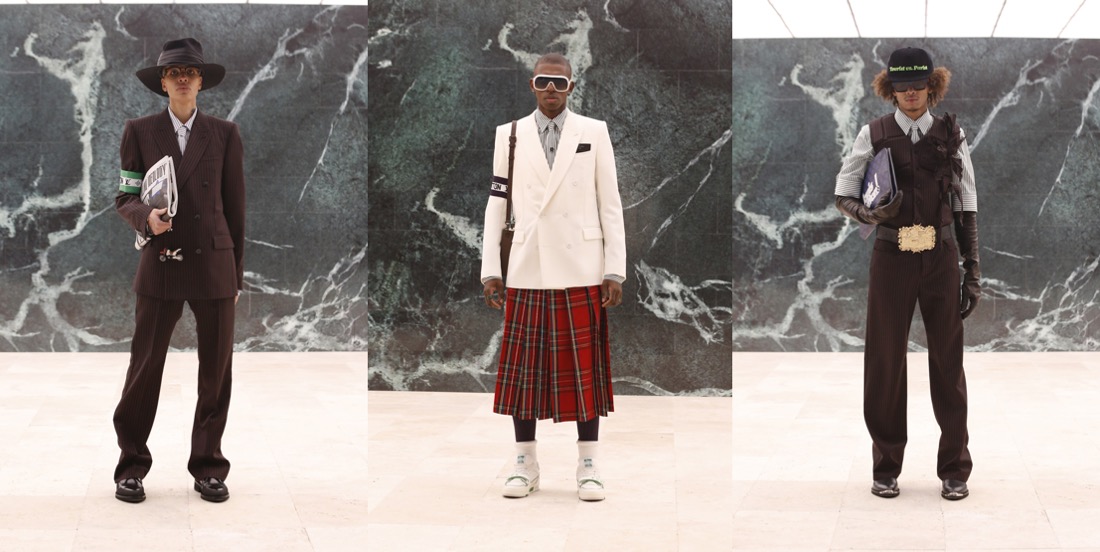
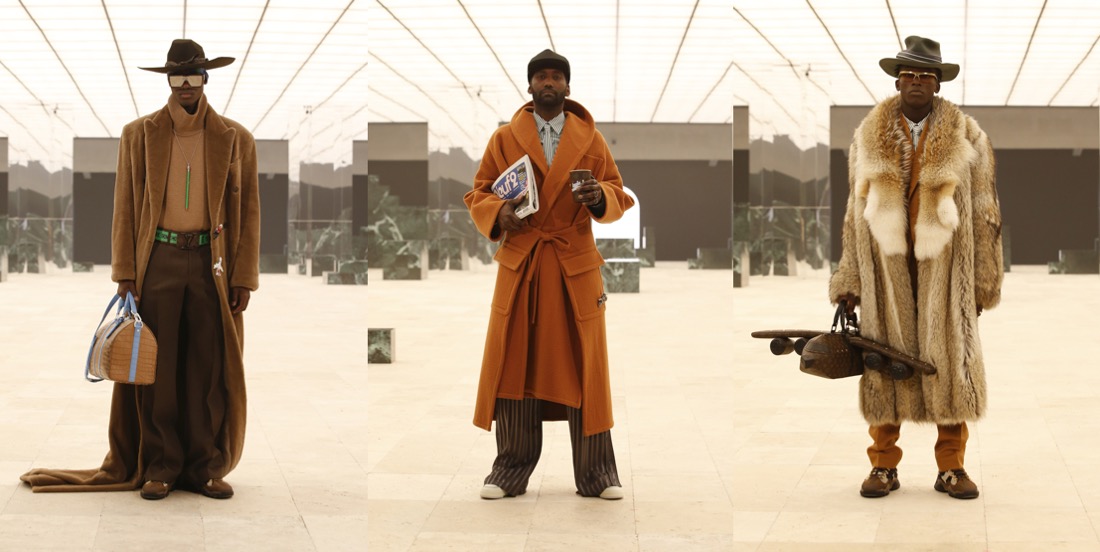
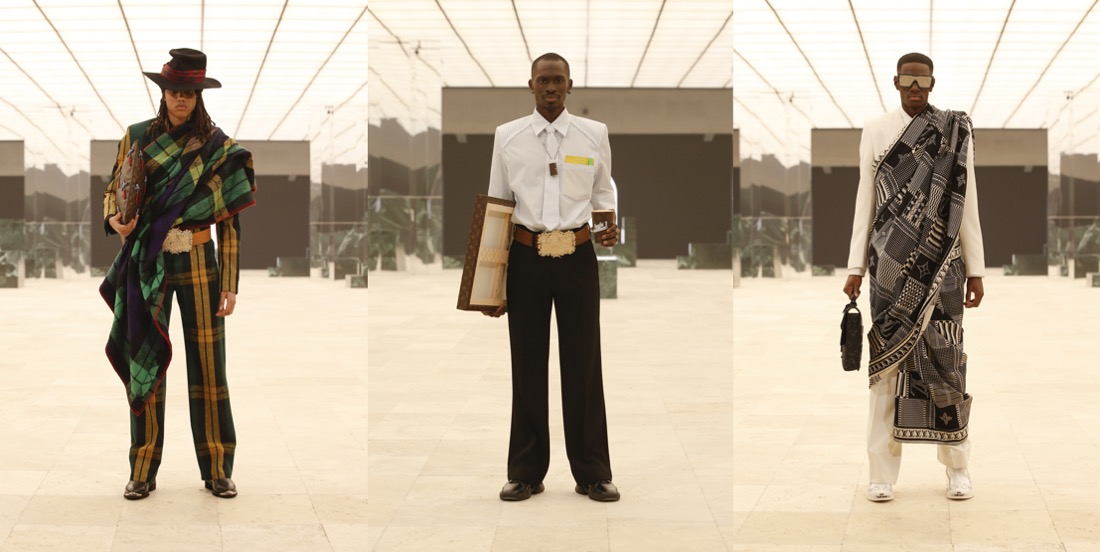
You might not be a fan of Virgil Abloh and his copycat practices, but one thing is sure: he delivers substance to Louis Vuitton‘s menswear (which sadly can’t be said of Nicolas Ghesquière’s recent seasons for women…). Abloh’s autumn-winter 2021 line-up seems to be his most personal to date, bringing conversations you would never really see at Vuitton. His sixth collection, named ‘Ebonics,’ came with a film directed by Josh Johnson that was powerfully centered on spoken word and performance, a call to radical thinking through the lens of menswear. Amongst the words delivered by Saul Williams and Kai Isiah Jamal were these: “Deconstruct the narratives… make spaces”; “Take down the walls, unravel the mysteries. Make it up to me.” And: “As Black people, as trans people, as marginalized people, the world is here for our taking, for it takes so much from us.” Abloh has mustered an educational encyclopedia of answers to the ineluctable questions that have been troubling all designers: over the point of fashion, of shows, of making clothes in the face of the Black Lives Matter movement and all the crises that blew up in humanity’s face last year. “We’re still reeling,” he said, in a telephone call with Vogue. “We sat through so many heavy conversations in 2020, some so heated that things can’t be discussed anymore. But fashion can do this. Shows can do this.” Abloh’s belief in clear-eyed boyhood innocence – that grace period before awareness of socio-cultural biases sets in – has always been an inspiration signalled in his Vuitton collections and campaigns. “I start from the wonderment of boys. When you’re a boy there’s one thing that adults ask you: What do you want to be when you grow up? And you say artist, lawyer, doctor, football player, fighter pilot. But then, if I ask what does a doctor look like? There’s a knee-jerk. That’s where we can learn.” His point, spelled out amongst the stack of literature he releases with each collection, is this: “Fashion has the power to de-program these dress codes and impact possibilities.” The multi-level consciousness, and his ambition to educate, include, and create aspiration is down-to-earth in one direction, and high-flown in many others. “Tourist vs. Purist,” the slogan he wrote when he entered Louis Vuitton in 2018 returned on bags this season. “It’s my organizing principle for my point of view when I make things. A tourist is someone who’s eager to learn, who wants to see the Eiffel Tower when they come to Paris. The purist is the person who knows everything about everything.” Abloh exerts his positionality as both – the outsider who became the insider; the man with the power to bring young people with him into the former exclusion zone of high fashion.

There’s lot to unpack, from the Louis Vuitton baggage (some of it in the shape of carrier bags, potato sacks, an LV ‘Keepall’ in the form of a plane) to the symbolic reconfigurations of masculine archetypes, to the challenging of ownership of sources that Abloh built into the clothes. “There are a lot of stories mixing cultures,” he said. “And from that, a new language will be created.” Cool, considered, chic, and flowing with floor-length coats, easy slim tailoring, African draped wraps, kilts, and Western hats – styled by the super-stylist, Ibrahim Kamara – it plainly makes for Abloh’s best collection for the house since he arrived in 2018. And his most autobiographical yet -an exploration of his African heritage and of what it means to be at the pinnacle of a career in Europe as a Black American creative director. “When I grew up, my father wore Kente cloth, with nothing beneath it, to family weddings, funerals, graduations,” he said. “When he went to an American wedding, he wore a suit. I merged those two together, celebrating my Ghanaian culture.” Add LV patterns to the cloth, drape it, then pair and compare it again with tartan checks, and the result is indeed something new. So too, the diagonal green-on-white print on a leather motocross suit. “A memory of the wax print fabric my mom had around the house when I was growing up,” he chuckled. “She was the one who taught me to sew; and she had learned it with a tailor in Ghana.” The collection is a powerful and beautiful statement. Abloh concluded, “I’m an optimist. The future is yet to be decided.

“Live” collage by Edward Kanarecki.

Men’s – Detox Moment. Dries Van Noten AW21

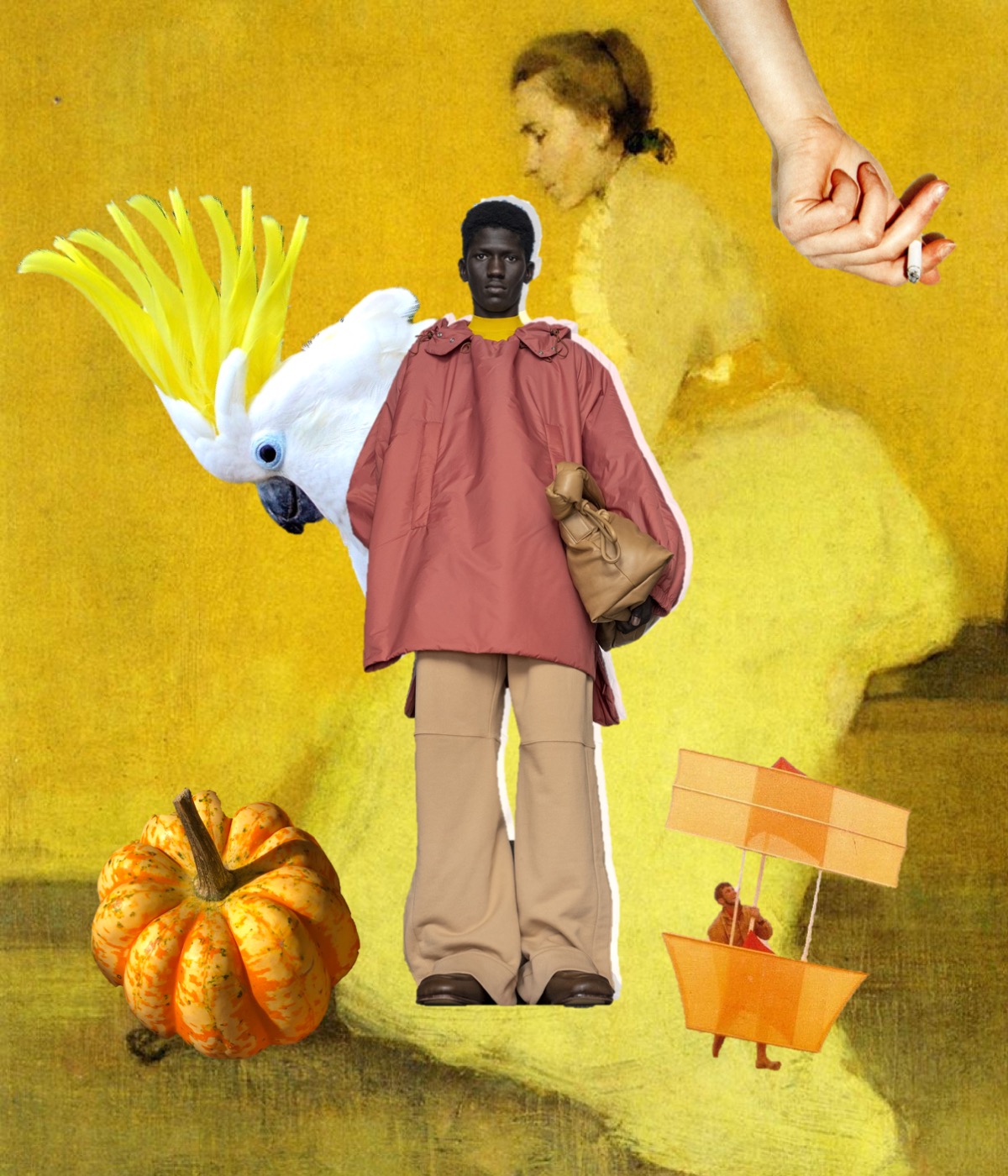
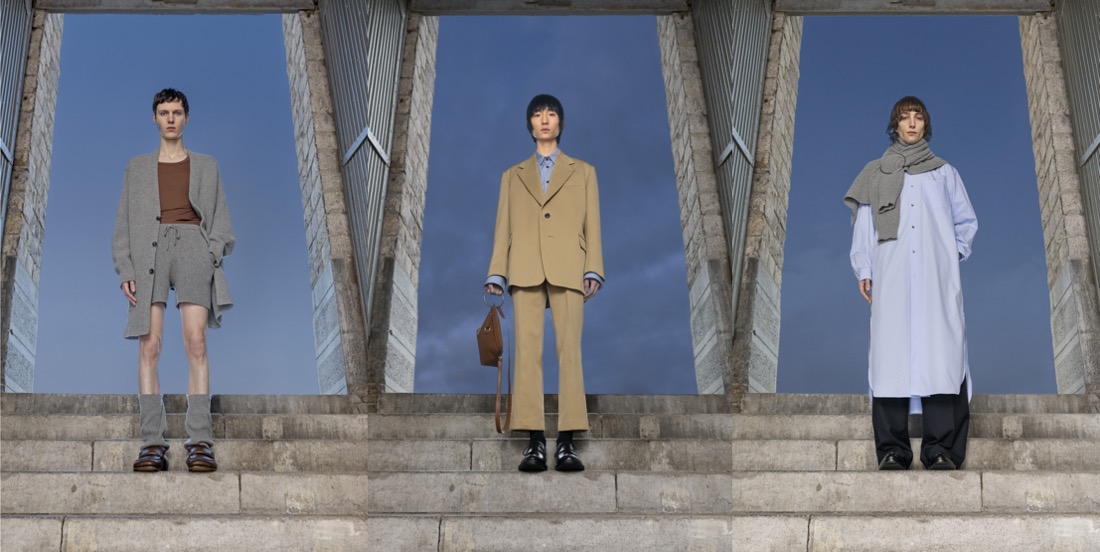
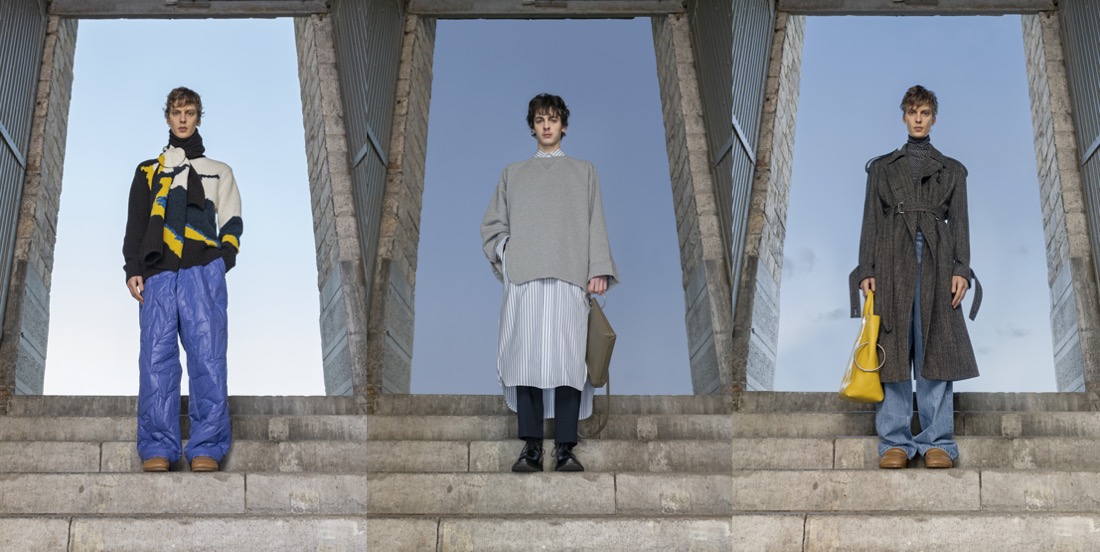
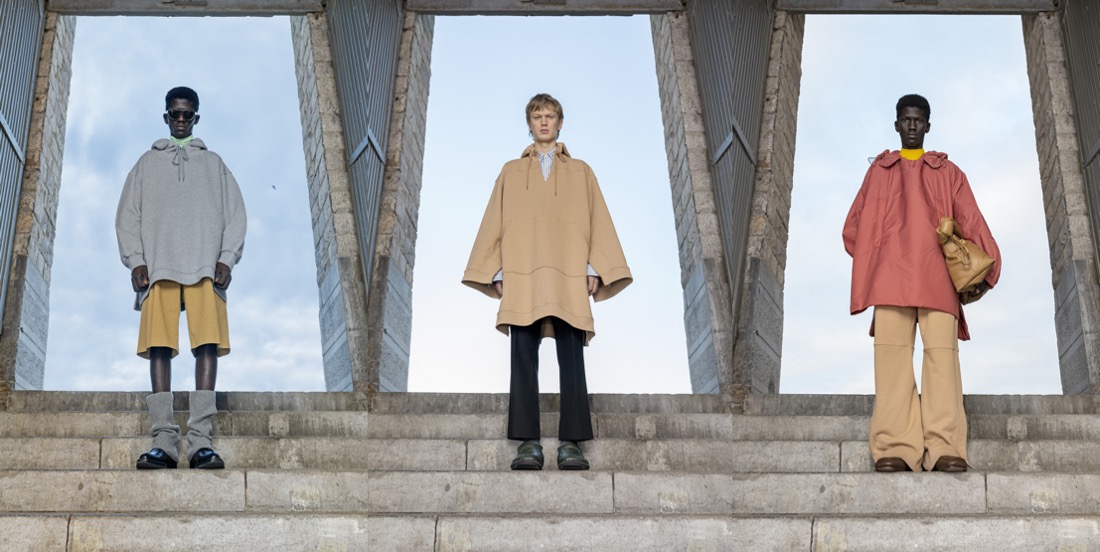
There’s a pattern in case of Dries Van Noten. After a couple of seasons full of bold colours, prints and embellishments, there comes a detox time, a sort of palette-cleanser. Men’s autumn-winter 2021 line-up is one of those more quiet, sober collections. And, of course, it’s delightful. On a preview call the designer said that his riotously colored last-season outing, plus the establishment of an effective home working strategy for his pattern-cutters, created the context for this reassessment of archetypal garments through new structures and fabrication techniques. Van Noten added: “It was really nice to be able to work on construction, on shapes, on volumes, rather than really bold colors and wild prints. It was about going to the menswear wardrobe staples, and trying not to leave them because I wanted them to be recognizable, but to look at their function, and the way you feel about some things that you think you know but which maybe you don’t.” To change the feeling demanded changing the garments. Shirts were elongated into dresses, jacket skirts and hoody hems lengthened, pant waists raised, shorts widened. Van Noten said these alterations and others in the exterior of his garments were made hand-in-hand with upgrades under the bonnet, “so it’s a pity that we don’t have the possibility of being able to touch them.” As an example he said a lot of the jackets were made in the lightest possible wool, which was lightly padded to give the appearance of structure alongside the feel of looseness and release. Similarly, T-shirts were fashioned in two layers between which delicate bolstering was inserted to create a crisp appearance while feeling slouchy. There was some pattern here, but of a type in sync with the thesis of the whole. Motifs used traditionally for ties were adapted, distorted, and upgraded for a new life across the collection. Especially attractive was a riotous botanical on a slim-fitting souvenir-style jacket above some double-dyed denim jeans and a pair of the slouchy, puffy, elastic-backed moccasins that were elsewhere topped with gaiter-like leg warmers. One point of connection across the collection were the gleaming metal rings used to secure belts, knits, and bags. This was a collection built to look sharp but feel soft – a fruitful reexamination of the essence of “essentials.

Collage by Edward Kanarecki.

Men’s – Rage. Rick Owens AW21

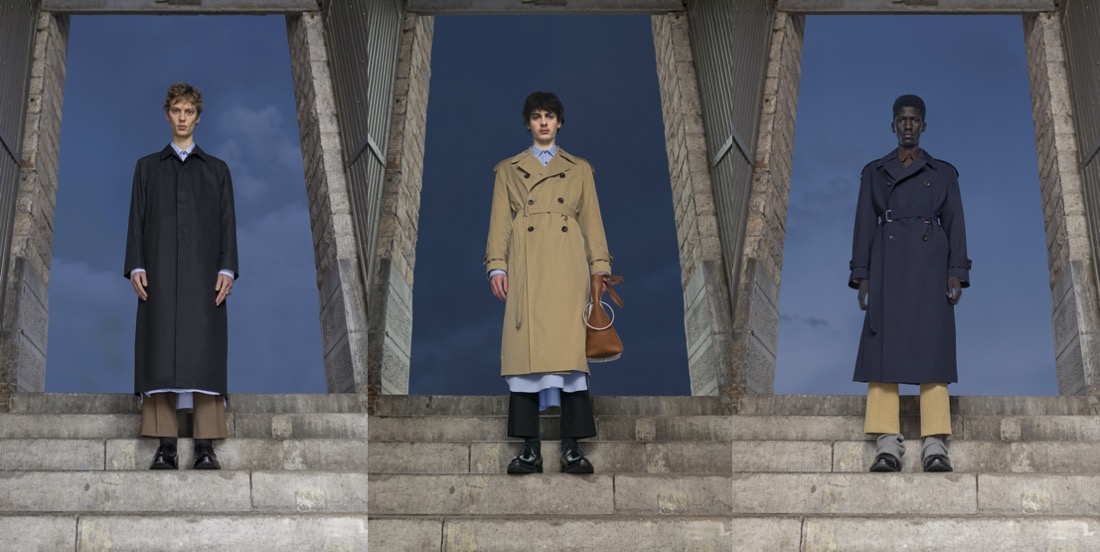
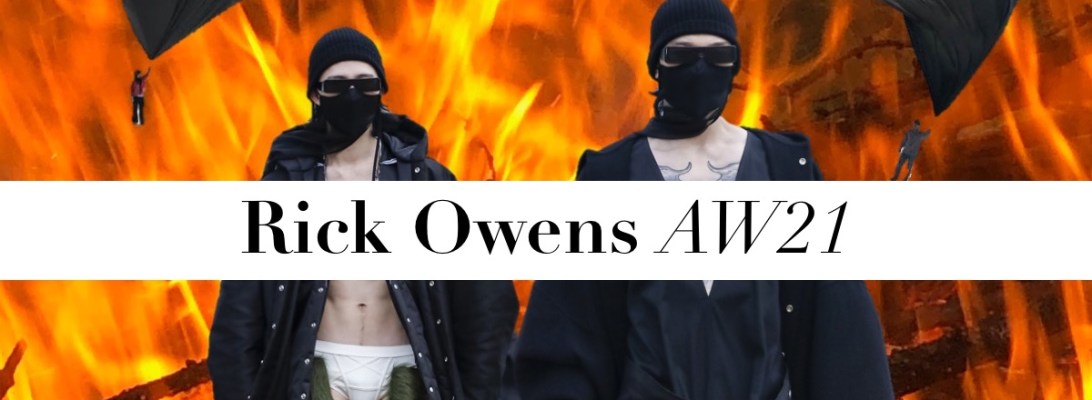
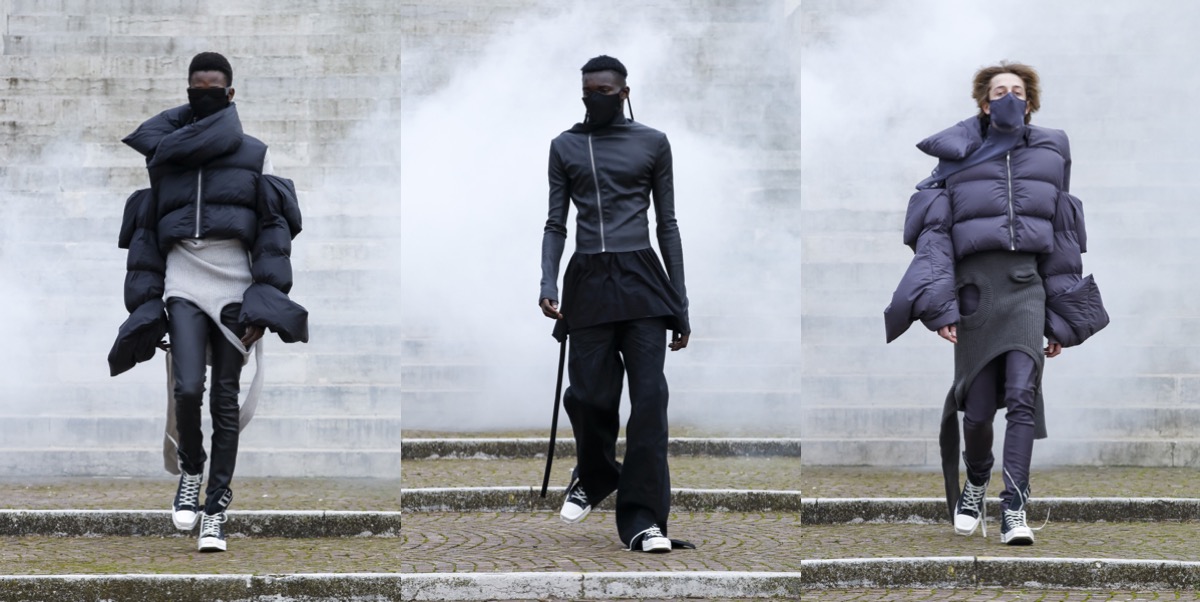
You can always expect emotions from Rick Owens. And this time, it’s rage. And sometimes, releasing rage is healing. Owens’s autumn-winter 2021 cast resembled a march of sexily sepulchral men stepping out to face their demons. Leather bodysuits – the latest chapter in his onesie narrative – sometimes enveloped, and sometimes hung half-worn as if flayed. Hooded habits came in recycled cashmere, waste plastic, or quilted material. You couldn’t make it out on the video, but the star on his newly Rick-ified Converse Chuck Taylors (this time the designer gives his man a rest from killer platform stompers) had been reworked into a pentagram. The oversized shoulders on slashed-arm overcoats and crop-top bomber jackets were meant to “mock male conservatism” in a collection Owens noted was an exploration of “male suppressed rage on every side of the moral divide.” In a preview, Owens confessed that he’d thought twice about facing rage in a collection presented just as four years of American carnage seemed to be over. “I thought this morning, does it feel a little tone deaf because now all of a sudden everything has shifted? Now that it’s all about optimism? But that dark element has not disappeared. And the fact that it came so close, this moral war, is horrifying.” Owens’s clothes are fundamentally playful provocations to conservatism and complacency. As well as a determination to remain uncomplacent about male aggression more broadly, Owens is sensitive to his own capacity for it. He said, “I’m always conscious of my own aggression. And the older that I get, I feel like I should have reached a level of serenity that I just haven’t; I get impatient, I get itchy, I snap at people sometimes. Aggression is something that I’m fascinated with because I’m constantly conscious of wrestling with it, personally. And I think that that’s true of every man.” Jackets with inbuilt gloves and masks were equipped for care of both the self and others through distance-dressing. And alongside satyr-appropriate thigh-highs and knowingly titillating bodysuits were garments designed for a broader constituency; examples included supple hooded shearlings, specially woven Japanese selvedge denim jeans, the Converse, and meandering olive cashmere knitwear. Owens said, “There’s a lot of regular-guy clothes in this collection, more than I have had in the past, maybe. I like that mix because it suggests more tolerance. I’m trying not to alienate or exclude.” This second show staged near Owens’s summer home on the Lido near Venice showcased a convincing interaction with the regular-guy world as passing locals watched the collection unfold. Showing here, said Owens, has become “like a private ritual” for him and his team because of that lack of a formal physical audience. The result was a film simultaneously intimate and grandiose. Owens observed, “I always kind of comfort myself that the world has always existed with darkness and light. And for some reason, there always seems to be enough goodness in humanity to just balance it out, and just to keep everything going. It’s close…but hope springs eternal.” By remaining sensitive to that human chiaroscuro through the creation of garments that subvert its darker shades, Owens contributes to the light.

“Live” collage by Edward Kanarecki.