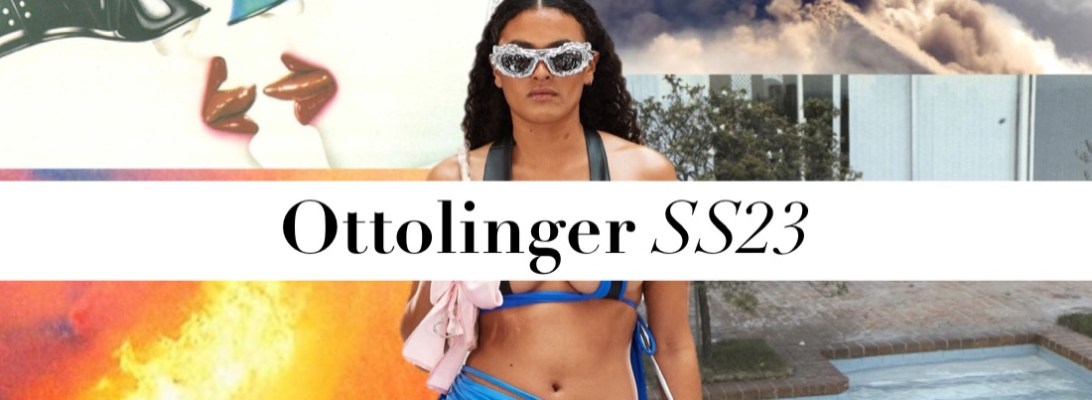
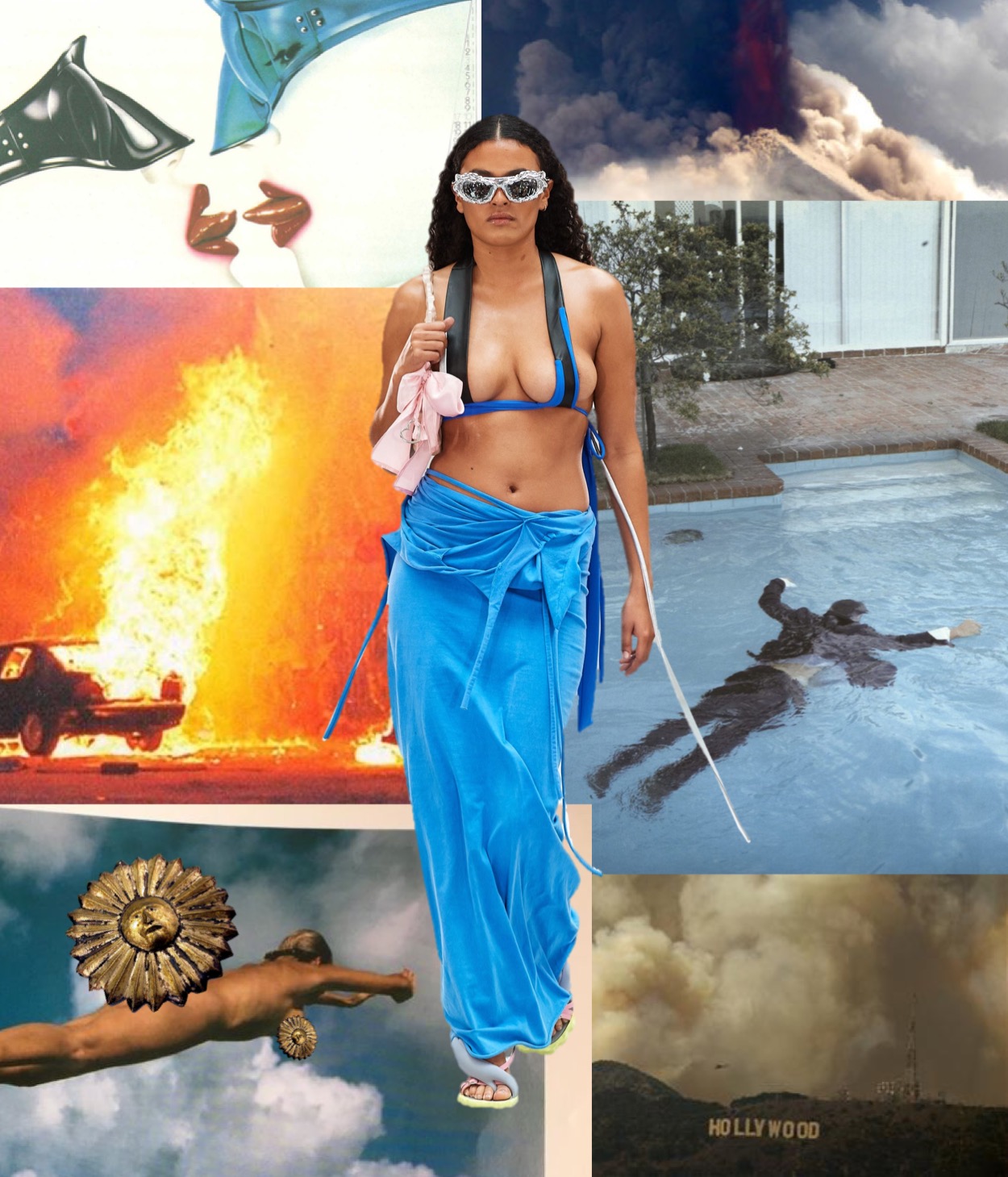
Ottolinger designers Christa Bösch and Cosima Gadient opened their spring-summer 2023 fashion show with a sharp look: a deconstructed belt–meets–bra top whose straps covered the nipples and little else, paired with low-slung leather-look trousers made from recycled polyester. Gen Z’s love of near nudity knows no bounds, and the fan base that lounged on the show venue’s mattress seats wearing skin-baring looks from the Berlin-based label would think nothing of wearing a crop top to talk shop. The designers recently launched a pre-collection that they said had allowed them to tackle more conceptual ideas in their runway shows. No longer beholden to showing denim and mesh dresses, which are their big commercial hits, this freed them up to present deconstructed biker jackets and skintight bodysuits. Ironically, though, the strongest pieces were arguably the most commercial, especially the dresses that draped and hugged the body with some rubbery-looking embellishments. Dipping items in rubber is a trait that reads recognizably Ottolinger: The punked-up court shoes, which saw a classic pump wrapped in a futuristic rubber-like casing, were as covetable as the diamanté jewelry dipped in brightly colored rubber that currently sells well on the label’s website. They’d do well to continue hammering home those codes as the Y2K trend keeps rolling and numerous other labels look to replicate their success with the sexy and the skintight.
Collage by Edward Kanarecki. Don’t forget to follow Design & Culture by Ed on Instagram!
I’m far more obsessed with Renaissance Renaissance‘s beautiful collection than with most of the spring-summer 2023 offerings coming from big names. Picture this: a rebellious princess running away from her palace by the sea. She’s traversing the desert at dusk, desperately seeking a city where she’ll meet artists, writers, poets – free spirits who will release her own and unfetter her from the rigidity of tradition. This is the story Lebanese designer Cynthia Merhej conceived of while working on her delightful spring collection. This princess is detached from European traditions – rather, she comes from Tunisia or Morocco, she’s running away to a place like Cairo, and her path is guided not by European medieval signage, but by Jinns and Arab symbols (as illustrated by a print, shown in look 12, created by a friend of the designer’s and inspired by the mythology of the Arab desert). “I wanted to go back to the root of the brand, back to my narrative roots as a storyteller. I always found it easier to express very complicated ideas in a simplified way, a simple story,” Merhej said. The complicated idea du jour? “The brand is about this tension between tradition and wanting to be a free spirit,” Merhej added, referring to her mother and herself as an example of this push and pull, but noting this dichotomy can also exist within one person.
The designer’s lineup for spring includes a recently launched category called Atelier, under which she’ll produce one-of-a-kind pieces. Each garment is made in Beirut in her atelier using couture techniques. Merhej said that now that she’s established the commercial portion of her business, she wants to make sure she continues to push herself creatively, while at the same time finding ways of nurturing the decimated fashion industry in Beirut, currently in a state of rebuilding. The pieces are also sustainable in that they’re made from deadstock materials. The first of these pieces opens the lookbook: a naturally dyed cropped cardigan knitted in a large gauge with mohair and tulle yarn by Lindsey Smith, a collaborator. “The idea was to create these kinds of knits that look like they’re degrading, the leftovers of her dress that was falling apart,” Merhej said in reference to her princess and her arduous journey. Another piece is made by hand layering pieces of lace her mother has been collecting for 25 years. The most striking item in the collection is a reversible coat as seen in looks 3, 7, and 9. One face is taffeta, and the other is covered in gathered tulle. The coats underwent a few experiments like tea dyeing or sun drying, all to give them the texture and softness of a lived-in piece. Elsewhere, in the ready-to-wear, Merhej explores her tulle fabrications, most notably on a skirt made of cotton and covered in tulle, which she also designed attached to a ribbed knit top as a dress. Other highlights include ankle-length linen skirts, a pleated button-down shirt fitted at the waist (a common focal point in Merhej’s work), and a rounded kimono-sleeve tailored jacket, which is returning from last season given its success. Again, this is a truly beautiful collection, with subtle echoes of 1990s Comme Des Garçons and Romeo Gigli.
Collage by Edward Kanarecki. Don’t forget to follow Design & Culture by Ed on Instagram!
Valentino‘s resort 2023 collection was conceived as a precursor to the spring 2023 outing which we’ve seen about two weeks ago. Stripped of the stagecraft of the show, it was representative of Pierpaolo Piccioli’s line of thought, both conceptual and visual – and it honestly felt more convincing. “Fashion shows are there to solidify the narration around your values and your identity,” Piccioli said. “Resort is the moment when fashion speaks its own language. There’s no storytelling here, just work on construction, cut, silhouettes, color. It’s just moda, fashion, in its purest self. Of course, for me, clothes are always about how real people inhabit them.” For Piccioli, there’s no moda without humanity. He named the collection “Surfaces“, emphasizing the visuals of an all-over, head-to-toe silhouette where textures and shapes were turned into a sort of minimal continuum. While Piccioli has been toying around with minimalism for quite some time as a way to highlight the individuality of the wearer – “you reduce the excess on the garment to spotlight the attention on the face,” he said – it’s actually a concept rooted in Valentino Garavani’s 1960s aesthetics, when lines were pure, volumes were close to the body, and decoration was kept to a minimum. Fluidity was an element of sensuality that didn’t detract from the purity of design. Resort was in conversation with those style fundamentals. At the spring show Piccioli indulged in fluidity and movement enhanced by an abundance of sequined shine, but here he kept the silhouette neat, slim, and very short. Trim contours and head-to-toe maximalist surfaces were in evidence, for example, in a black macramé lace slip dress paired with matching thigh-high legging-boots, or in a mini shift dress encrusted with white lace, which somehow stretched into matching stocking-boots edged with leather. A day-evening ensemble, comprised of a dramatic long drawstring circle gown in amethyst faille, cinched with a marigold sash and worn with an oversize double-breasted blazer in cinnamon taffeta, was contrasted by a pristine white cotton shirt with macramé details. It highlighted not only the designer’s eye for color – no PPPink, thanks god – but also the cool spirit of versatility, the mixing of codes, and the couture flair that he’s persistently after. Punk or bourgeois, timeless or not, it definitely sparks joy.
Collage by Edward Kanarecki. Don’t forget to follow Design & Culture by Ed on Instagram!
I’m having a hard time in understanding what’s Nicolas Ghesquière‘s Louis Vuitton is about lately. Once a leader in fashion that was both ergonomic and absolutely intriguing, for seasons now the designer does some of the most gimmick-y fashion – and not in an ironic way. Also, I can’t picture who is actually wearing Louis Vuitton’s women’s ready-to-wear, expect for celebrities who are trapped by life-long contracts. The last show of Paris Fashion Week doesn’t feel like a cherry on top, but an event to which people feel forced to go to… because it’s LV after all. The show’s location was Cour Carrée. Ghesquière invited his longtime friend French artist Philippe Parreno to create an installation, and together with the Hollywood production designer James Chinlund they created a set that felt a little as if a spaceship had landed in the heart of Paris and the aliens had set up a fun fair for locals to see the special attraction. “It’s the first time I designed a collection in dialogue, in correspondence, with someone,” Ghesquière said at a preview, adding that Parreno’s sculpture was in fact “kind of a flower, a carnival flower.” Its massive proportions inspired the supersizing that happened on the runway. The cloche clés key holder that accessorizes many of the brand’s bags was enlarged, as were its Vachetta leather luggage tags, and the wallet that Ghesquière wears on a chain attached to a belt loop became a portfolio that the models clutched to their hips. Most of it looked silly. Something similar was happening with the cumbersome clothes. You might recognize the giant zipper pulls on HoYeon Jung’s opening look from one of the first Ghesquière collections. The designer reported that they’re the largest ever manufactured, and the process of zooming and exaggerating one element of a garment led to the scaling up of other parts as well. Which explains the hyperbolic neckline and hips of Jung’s crop top and skirt, and the oversized straps dangling from the inner hems of vests and jackets, like sportswear panniers. “There is always that game of what is real and what is manipulated,” he explained. “Being with Philippe and working through the eyes of an artist,” Ghesquière said, “sometimes I had the feeling we were a little childish. I think I was maybe more free to break some boundaries for myself.” Releasing your inner child is fine. But I wish Nicolas delivered fashion that’s substantial and not so pointlessly painful for the eye.
Collage by Edward Kanarecki. Don’t forget to follow Design & Culture by Ed on Instagram!
Miuccia Prada, with a Miu Miu show on the last day of Paris Fashion Week, proved that she knows where she’s going – comparing to other designers and brands, big and small, who in majority presented some of the mildest and direction-less collections in years. Even though Miu Miu orbits around a similar theme for the third season in a row, it’s refreshing to see Prada’s “sister” brand in such assertive and distinct mode. Those mini-skirts are still going strong, just like leathers in various shades of browns and beiges. Corporate tailoring continues to be aggressively cut-up and raw. But there are a couple of novelties that will definitely become the next Miu best-sellers (and are both easy styling tips as well as vintage shopping inspirations). A gray cap-sleeved T-shirt worn over a beige jumper worn over a gray long-sleeved T-shirt worn over a white T-shirt, they were all very ordinary garments, but certainly delivered a mood. And styled this way, they didn’t look so normal at all. “I’m very serious but also fun. I am both,” Miuccia said backstage of the show. That duality was reflected in this line-up. She showed some clothes so simple they weren’t clothes at all: primitively cut fabrics fixed to the body with fastenings, like an apron skirt tied at the hip or pieces of nylon fashioned into ponchos, dresses and skirts with drawstrings. Strands of nylon were tied around the lower hip of pleated skirts with drawstrings and worn like cummerbunds, and a bandeau top held together by a nylon strap with a plastic clip buckle seemed to have been repurposed from the performance wardrobe. Miu Miu is on a roll, delivering a kind of fashion that resonates with the sexy, subversive, product-focused tastes of the digital generations – even through a simplified lens. Prada framed her show in fittingly odd projections by Chinese artist Shuang Li, who had sharks bouncing off planets and walls, and a soundtrack featuring a spoken-word love poem by the same artist. If there was an upbeat mood in the room, it came from above. “I went through a really… friends died and so on,” Prada said. “Recently, I’m in a good mood, for personal happenings for my friends.”
Collage by Edward Kanarecki. Don’t forget to follow Design & Culture by Ed on Instagram!