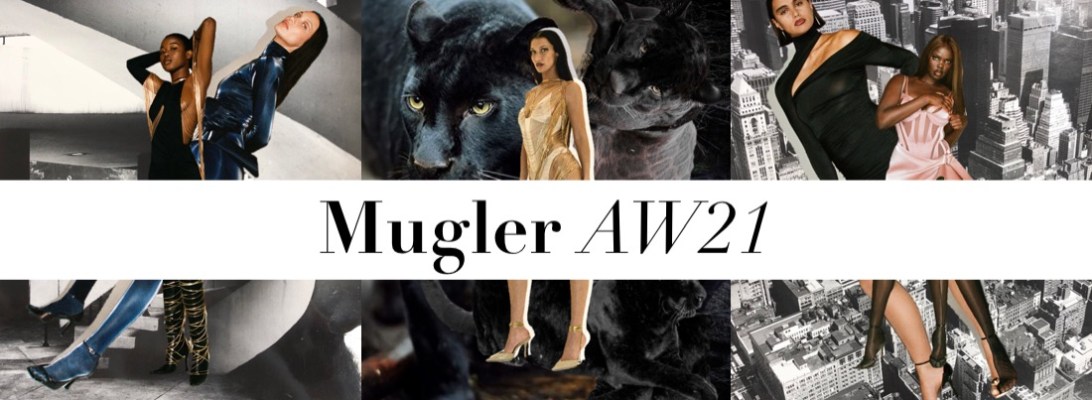
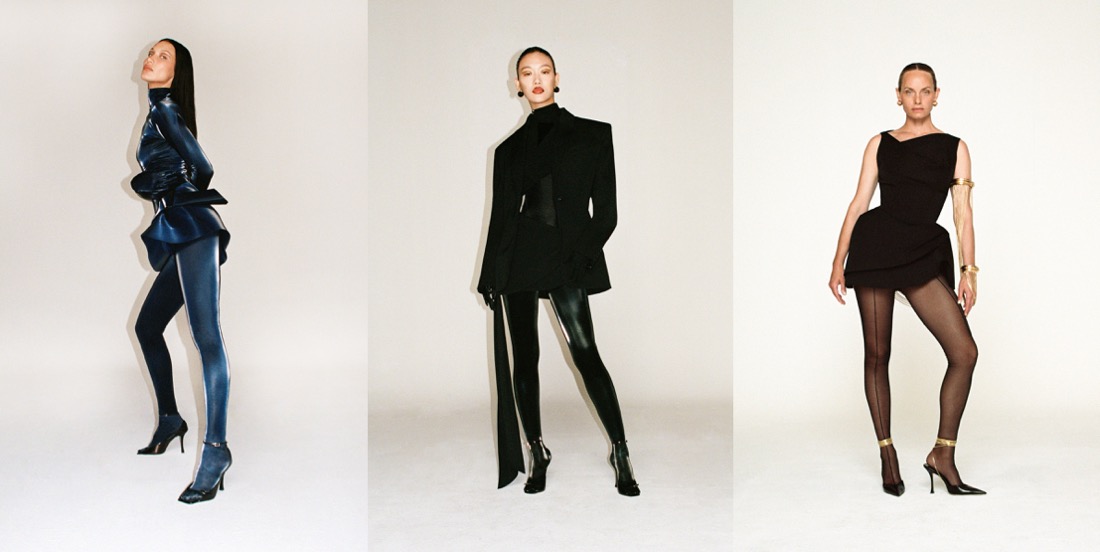
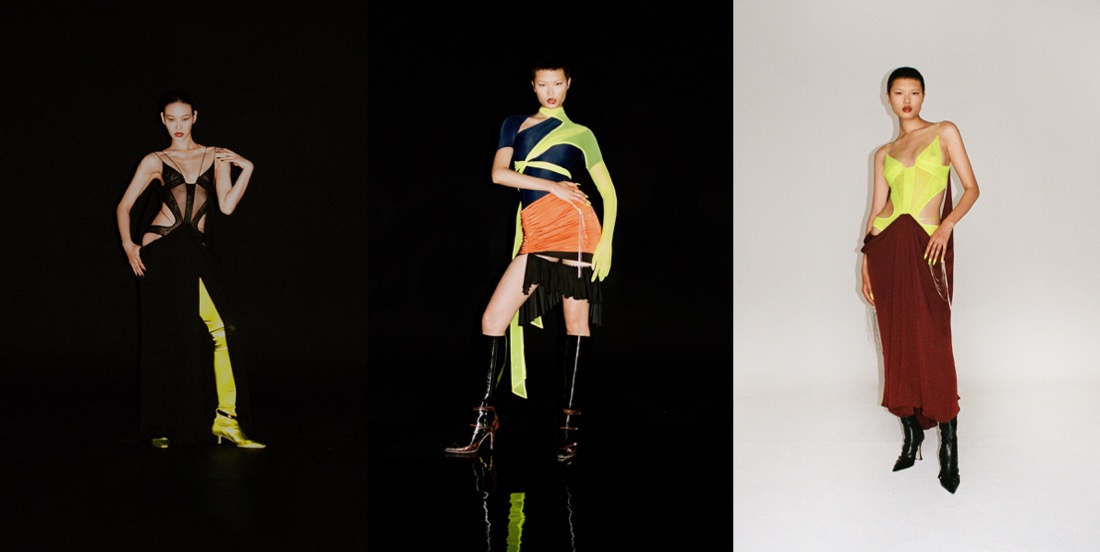
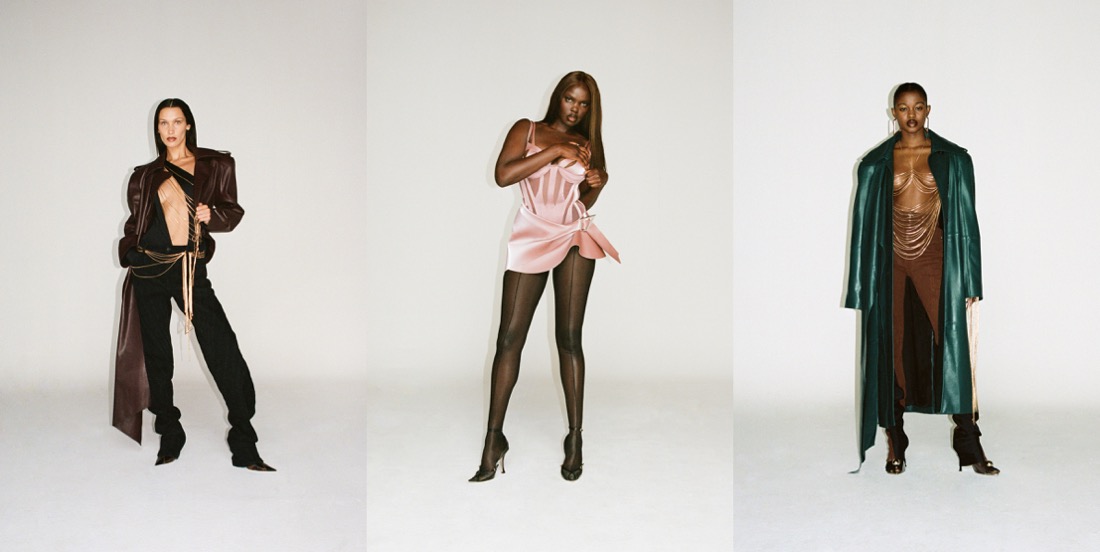
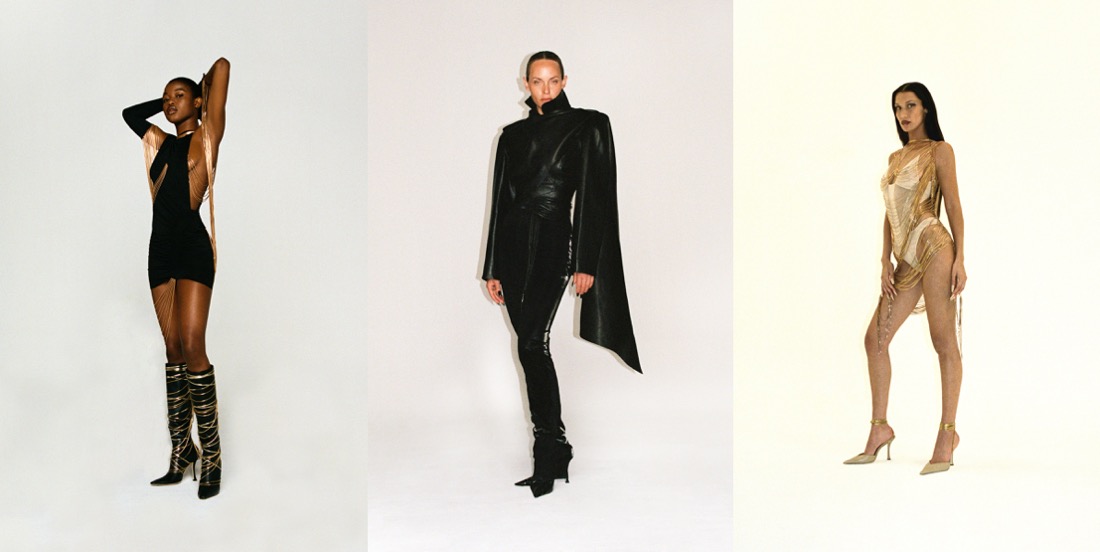
It’s getting sultry hot in here! Casey Cadwallader, the young American designer, has reignited the Mugler flame since his arrival at the label in 2018 by adapting the brand’s curvy, body-con aesthetic for the athleisure generation. Where Mugler’s corsets were rigid – his iconic 1992 motorcycle-chassis corset was made from plastic, metal, and Plexiglas – Cadwallader’s are built with two-way stretch. “You can tie your shoes, sit in a taxi, you can breathe,” he said in a preview of the autumn-winter 2021 collection. Material innovation and an embrace of extremes are essential to Mugler’s current success. There’s a pair of ass-less pants in the new lineup, but Cadwallader indicated that he might not have designed them if customers weren’t already wearing the part-sheer, part-opaque (read: mostly sheer) tights he’s been making for the last couple of seasons “without clothing.” The news at Mugler this time around is how he’s evolving his hyper-sexy vibe. In previous collections he’s leaned on black, but here he played with stretchy knit color-block layers to great effect, mixing emerald, ultramarine, bordeaux, and bright orange in one look and highlighter yellow, navy, and orange in another. His other experiment was born from a vintage Mugler bauble with a spray of flexible gold snake chains that he found at a flea market. “I loved how the chains moved,” he said. “I was looking for movement this season.” He sourced modern versions of the chains and made body jewelry from them. Bella Hadid models an intricate necklace top with a bodysuit in the brand’s new video, though Cadwallader’s fans are just as likely to wear it solo.
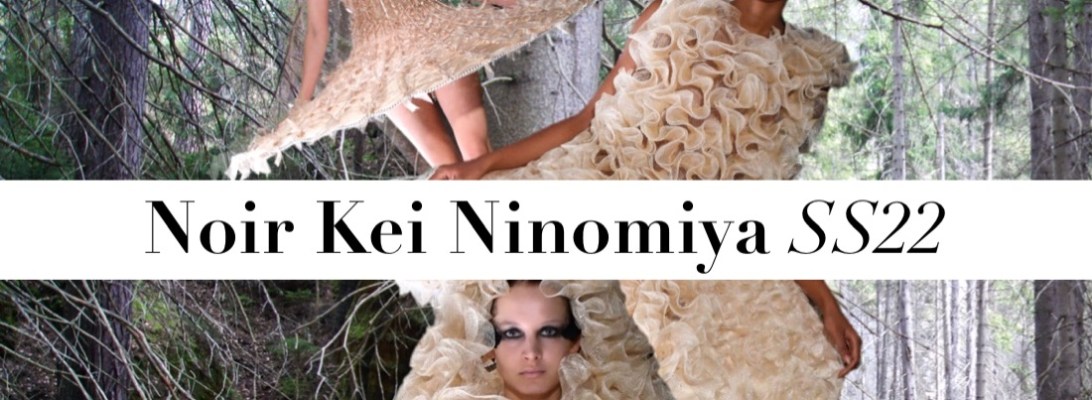
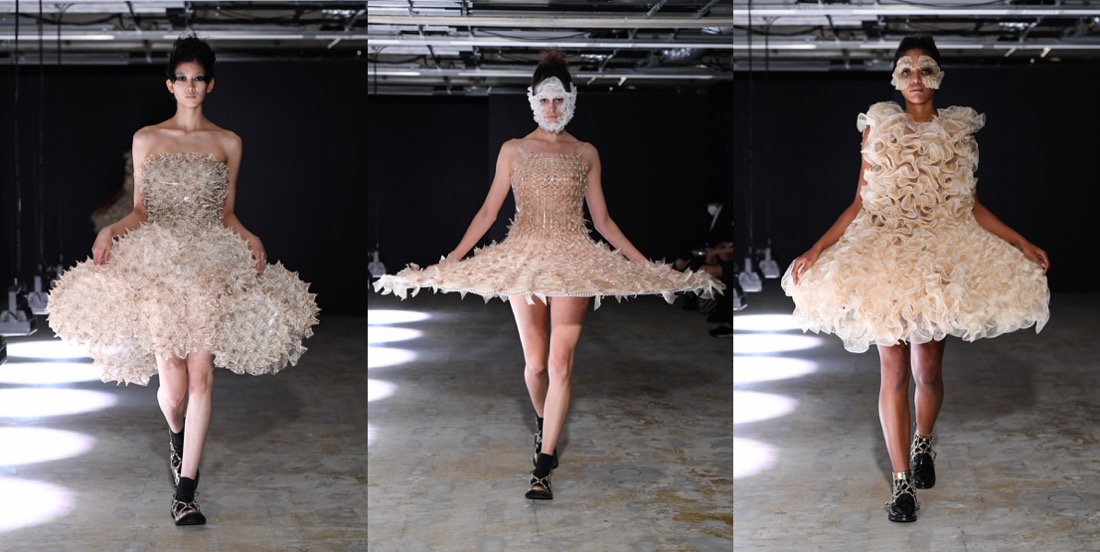
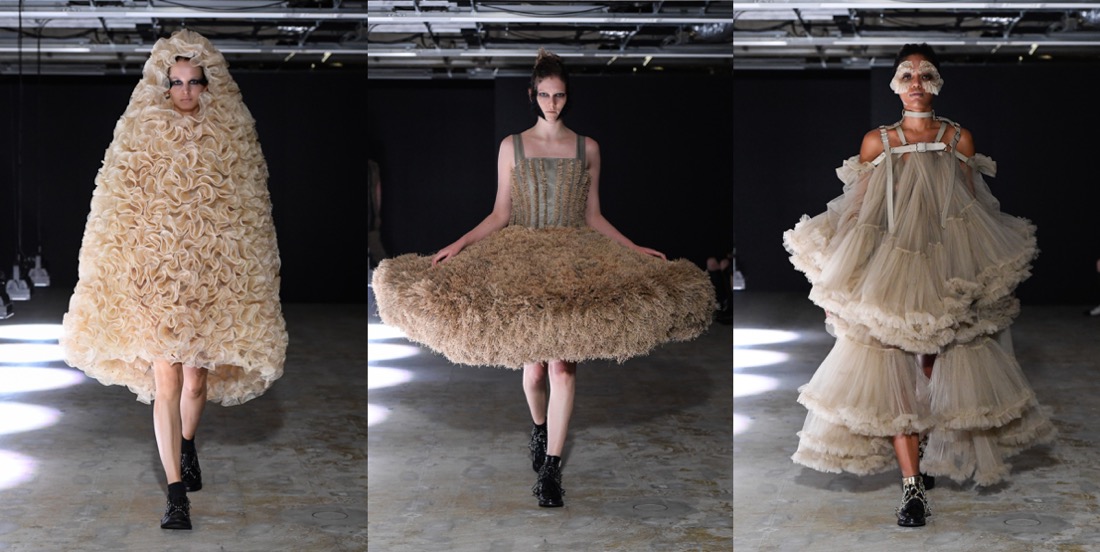
“For this collection, black is expressed through shadows,” said Kei Ninomiya in his spring-summer 2022 notes. “I wanted to express the ephemeral strength and beauty of things that are present around us although we cannot see them clearly.” The show was held in Aoyama, Tokyo, at the Commes des Garçons headquarters. Ninomiya has experimented with non-Noir color previously, most often via brilliant botanical worn installations that were absent today. Instead he expressed his notion of black’s shadow by creating a series of pieces in beige. The idea of something casting a paler shadow than itself implied a reversed polarity of some kind, and the paler procession of pieces did indeed mostly cover the still-breathtaking territory we have seen Ninomiya explore before. Sometimes, as in Look 15, they also looked to break new-for-Noir ground. Two more novelties were the use of woven hemp in rope-adjacent, wearable structures and the first written branding, beyond the garment label itself. The name of the brand was used to make rough white-on-black stripes and checks, which was fine enough on pants, shirts, and cycling shorts. When applied to a more sculptural piece, however, such as Look 9, this branding felt pretty extraneous. Noir Kei Ninomiya is a brand that doesn’t need logomania – those stunning, mushroom-y garments do the talking.
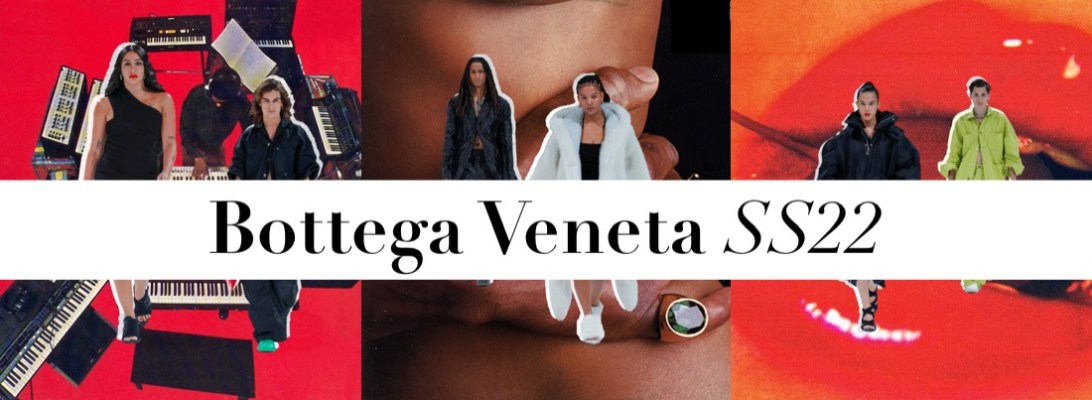
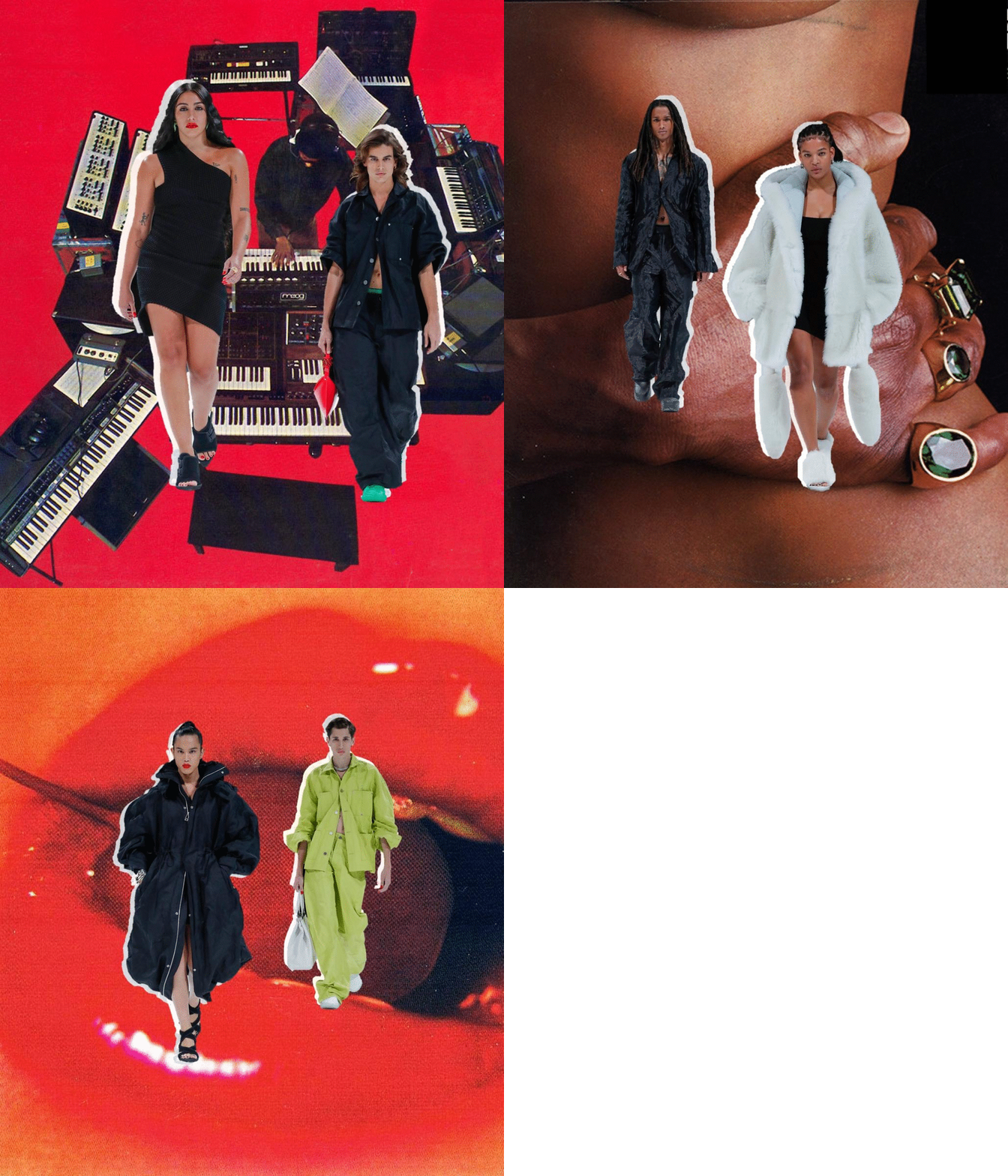
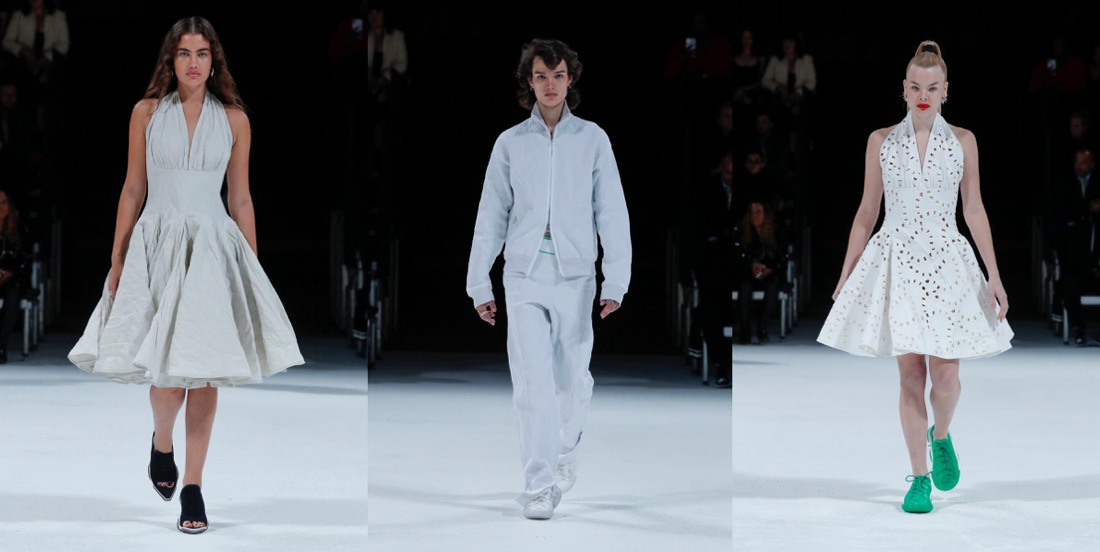
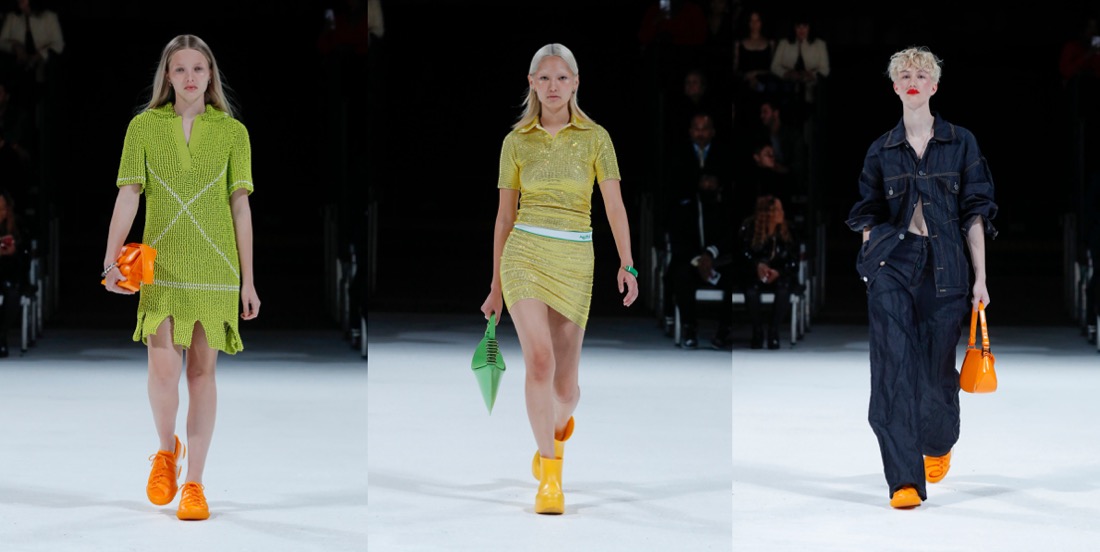
Early on in the pandemic, Bottega Veneta announced a new show model: Milan was out, and off-schedule, salon-style shows were in. Creative director Daniel Lee would take his collections on the road and engage with both local talents and local audiences in the cities where the brand posted up. First was London, his home base, last October. A show at Berlin’s Berghain nightclub followed in April. Salon 03 (read: spring-summer 2022) was staged at Detroit’s Michigan Theatre, a 4,000-something-seat movie palace built amid the city’s spectacular automotive-fueled boom in the 1920s that was converted into a parking garage during its even more spectacular 1970s bust. Mary J. Blige and Lil’ Kim were among the stars who jetted in to watch. From New York, a planeful of reporters, magazine editors, and stylists, plus the young designers Peter Do and Hillary Taymour, made the trip too. For many, if not most of them, it was their first time in the Motor City. Curiosity about Detroit, and about what Lee and company could get up to there, were the attractions. “I’m obsessed with Detroit,” Lee said after the show. “I first came here six years ago and fell in love with the place. I’m from Leeds; it’s the industrial heartland of the U.K., and Detroit being the industrial heartland of America, I feel this kind of connection.” Then there’s the music thing: “Detroit really is the birthplace of techno, and techno was the music that I was growing up to and going out to. I wanted to use my position to shine a light on all of that.” The day’s events included a culture tour that made stops at the mid-century Hawkins Ferry House in Grosse Pointe; the world’s first and only techno museum, Exhibition 3000; and the studio of furniture designer Chris Schanck, who is among the Detroiters who contributed to Bottega’s three-month pop-up shop at a decommissioned firehouse in the city’s Corktown neighborhood. The techno creatives Moodymann and Carl Craig were responsible for the sonic components of the show. Lee has made a strong impression in his three years at Bottega Veneta. Fashion’s first-movers were quick to pick up his softly constructed Pouch bag and wear his square-toed heels, and the trickle-down effect has been noticeable from the accessories floors of high-end department stores to the high street. That hemlines have risen and fashion has turned toward sexier silhouettes are arguably part of the Lee effect too. Given his choice of venue, he said he asked himself, “What’s American?” It was definitely the sportiest collection he’s shown so far, with tennis whites, dark-rinse jean jackets and skirts, and tracksuits engineered in a crosshatch check knit meant to imitate the house signature intrecciato motif. A pair of white dresses had the 1950s halter-neck va-va-voom of Marilyn’s famous Seven Year Itch dress, only Lee paired them with sneakers. In spite of the sportswear and workwear influences, there was a lot of interest at the level of the fabric. “For me,” said Lee, “Bottega Veneta is really a house of technique.” The season’s elevating, couture-ish details came in the form of intarsias and embroideries of a Tyrone Lebon photograph of Mica Argañaraz circa spring 2020 in nothing but Bottega’s sparkly pumps – a clothes-as-canvas kind of proposition. And much of the outerwear was shot through with metal threads, which gave the anoraks and blouson jackets and the pants they were worn with the glossy color and kinetic dimensionality of John Chamberlain’s old car sculptures.
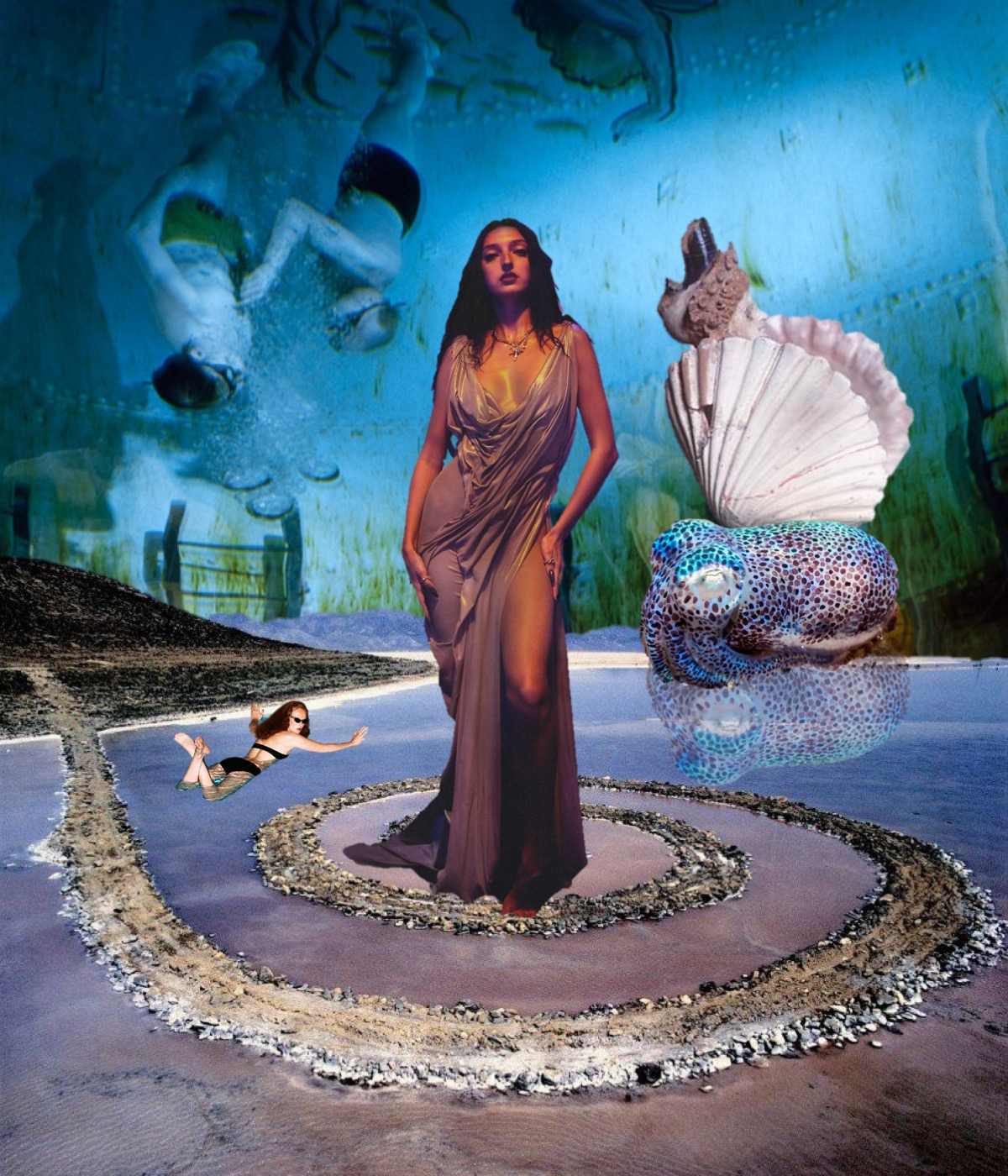
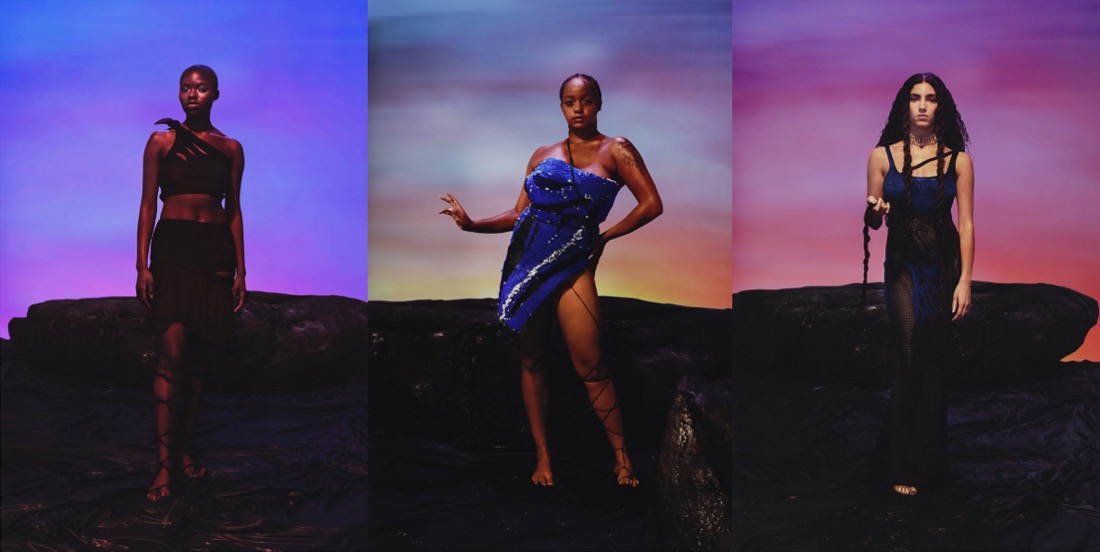
Much of mainstream fashion wants what Dimitra Petsa has – just look at the many major designers cribbing her wet-look, Greek-goddess aesthetic (one of the recent Dior collections comes to mind). But if 2020’s lockdowns and fashion’s subsequent recalibration has taught us anything, it’s that emotion can’t be faked and a new generation of fashion lovers and customers are looking for a personal connection to their clothing. Di Petsa‘s ready-to-wear, presented at Paris Fashion Week for the first time as a guest of the Fédération de la Haute Couture et de la Mode, contains the same level of passion and fury as her one-off gowns. The proof isn’t only in the sensitive way she drapes her jersey to cradle the bosom, slide down the hips, or pool on the ground around the wearer’s ankles – she describes her process both as “the body emerging from something” and as a method of “accentuating the naked body, not covering it up” – but in the many women from Greece and the U.K. who went to Paris to help make Petsa’s vision real. She’s called her collection Nostos-Touch; the touch part is obvious, representing the idea of wanting to be embraced but being wary of its consequences. Nostos is Greek for “homecoming,” sort of like Odysseus after a long journey through the Mediterranean. Petsa is less concerned with the trials of that mythic man and more with the Sirens he finds along the way. She tapped into this darker side of femininity, the idea of mermaids caught in nets, of constraint and dangerous freedom, with a moody palette of cobalt, navy, burgundy, and gold. Even with its complicated drapery and cutouts, this collection is her most wearable offering yet, made from cotton jersey and Tencel and adorned with custom marine blue rings, bracelets, and necklaces. At Paris Fashion Week, the Petsa Poseidonesses came together in a performance centered around the musician Lola Lolita. Models writhed, swayed, and lay down while Lolita commanded the ceremony. Petsa says she wants to move away from Western perceptions of Greek culture. Even those with a long memory and long scholarship of ancient cultures may be hard-pressed to remember the pre-Greeks, but many of those who do have hypothesized that the earliest cultures on the Peloponnesus were matriarchal. One hopes Petsa’s customers are willing to join her on this journey through time and womanhood – but if not, these are still some of the most beautiful sexy dresses and separates this season.
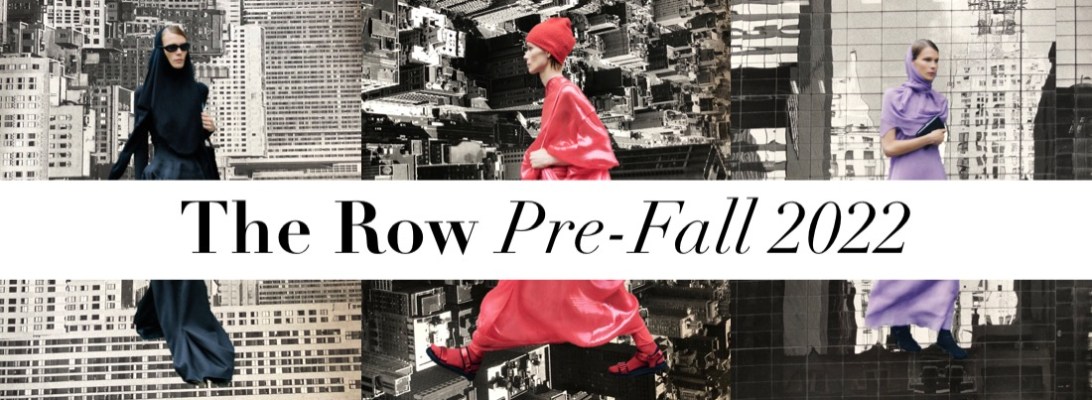
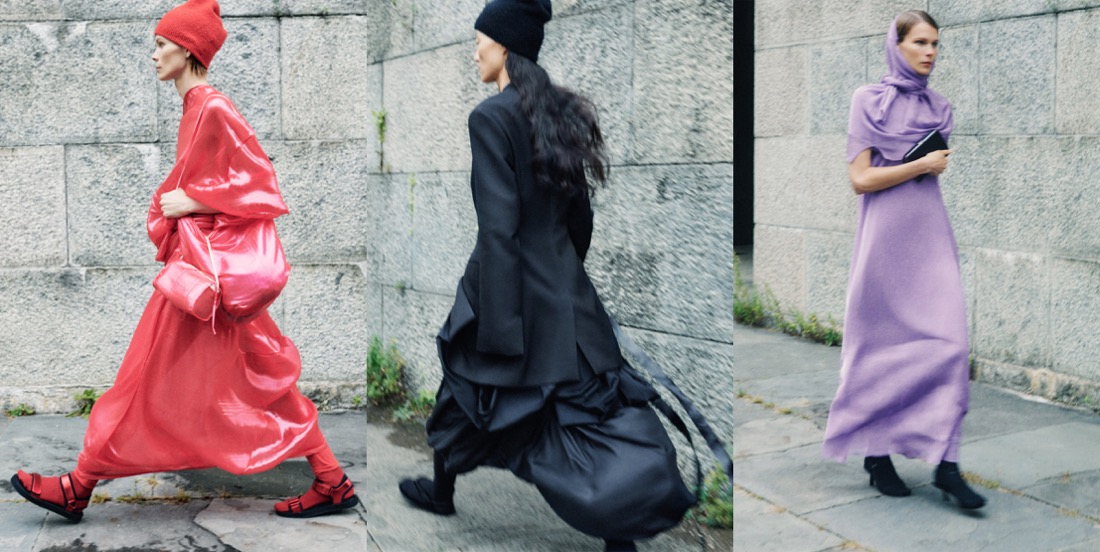
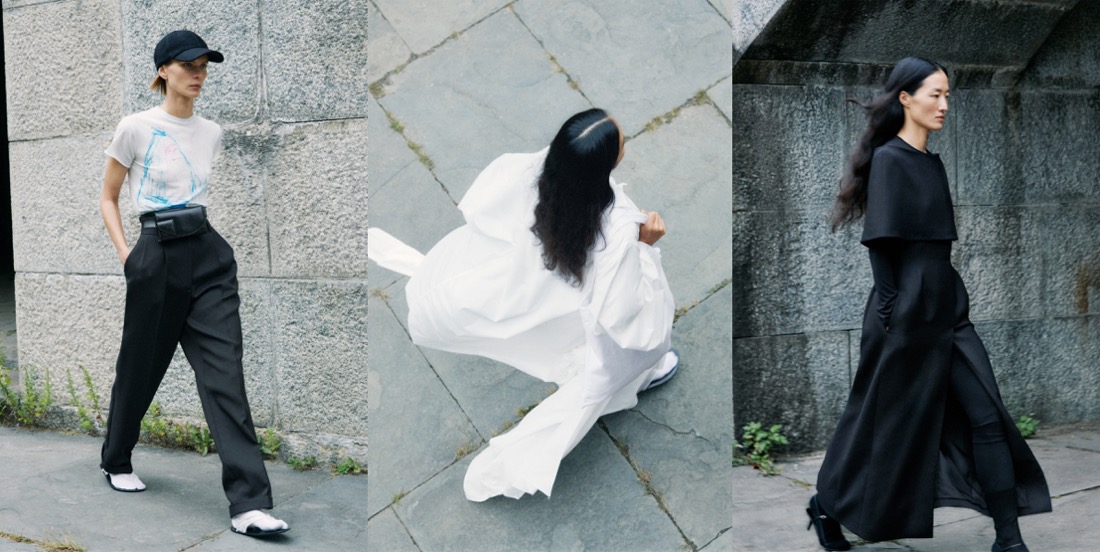
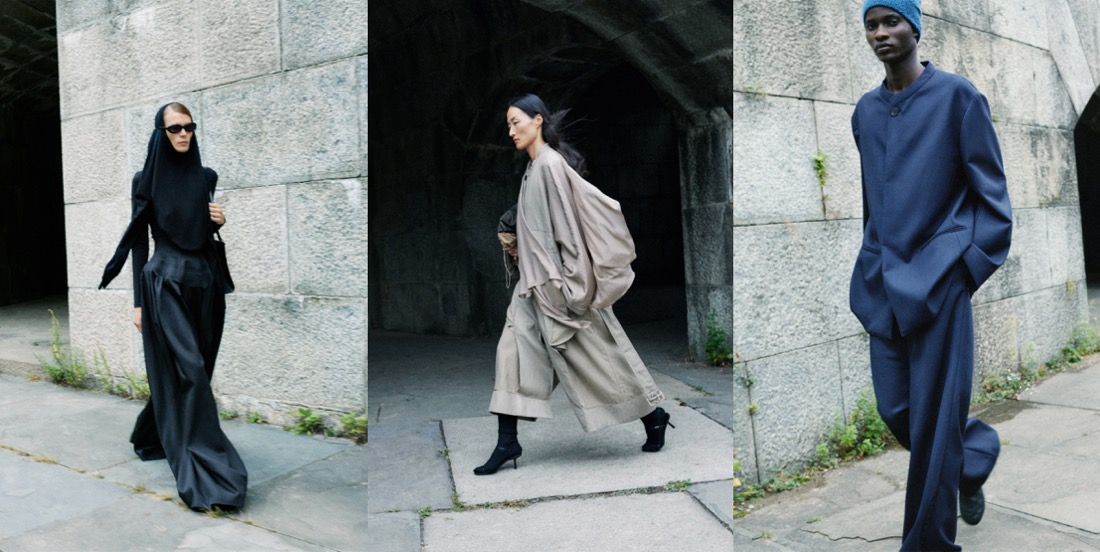
This is one of these The Row collections that are just… perfect. And extremely relevant. Ashley and Mary-Kate Olsen have never been the type to discuss the deeper meaning of their collections, and they’re not about to start now, but the opening look of their pre-fall 2022 offering definitely meets the turbulence of our current moment. It’s a grain de poudre jacket worn backwards, its single button fastened mid-spine and its lapels framing the shoulder blades. “Adaptability” is definitely one of their running themes here. Other tailored jackets can be worn inside-out, and on the accessories front there are reversible tote bags and cotton voile “protectors” for leather styles. After a season of more oversized, relaxed shapes, the waist has come back into focus for the Olsens. Their elongated and slightly nipped jackets cut an elegant line, and many of the looks are accessorized with leather belts featuring useful add-ons for cell phones and ear buds. Elsewhere, there are generous, pillowing volumes, as in the red nylon cellophane top and skirt of look two, which are cut with bubble hems to accentuate their material’s airy lightness. Extending a newfound interest in color, they showed metallic viscose knit separates in bright lilac or red worn layered and even wrapped around the head like scarves, and a trench in a crimped aqua tulle, shown with a matching bag. They also embraced humor. A couple of shrunken T-shirts (paired with excellent boned-waist trousers) are scribbled with children’s drawings; officially they’re part of The Row’s kid’s line, but they’ll be sold in women’s sizes too. The final look is the other side of that reversed jacket. It’s a back-to-front world, but The Row can help you hold it together.














 Design & Culture by Ed