I found Alessandro Michele‘s runway debut for Valentino a disappointment on many levels. I don’t get the reasoning behind sending down the runway over 80 looks that are so terrifically archaic and deadly retro. Yes, it’s Michele’s prime aesthetic, but it can easily (and quickly) get exhausting. Near the end of his tenure at Gucci, you literally felt an overdose of nostalgia. I really hoped Michele would channel his quirk for the past it in a contemporary-looking way. Let’s remember his Gucci debut was an unexpected gender revolution. But at Valentino, he totally missed the opportunity to show a breakthrough. Also, what’s the actual point of remaking Valentino Garavani’s 1970s and 80s garments in 2024? First, there’s a vintage market for that. Second, it looks absolutely stuffy and dusty without even a drop of irony in the styling.
Collage by Edward Kanarecki. Don’t forget to follow Design & Culture by Ed on Instagram!
Hey, did you know about my newsletter – Ed’s Dispatch? Click here to subscribe!
It’s a new dawn for Valentino. Gone are the days of Pierpaolo Piccioli’s minimalist sensibility and sharpness of cut. Alessandro Michele’s “surprise” debut collection for resort 2025 is an unabashed return to Valentino Garavani’s 1960s and 1970s opulence and over-the-topness. Is this nostalgia something people really want in 2024? Many wrongfully described the collection as “so Gucci”. The deja vu feeling is valid, but rather it’s “so Alessandro Michele”. But let’s be honest, this line-up could easily pass as any of Michele’s previous collections for the other Italian brand, and you’re really not the only one constantly mistyping Gucci instead of Valentino. More than 170 looks, none really memorable or distinct, is either a result of Michele’s prolificness or his overt maximalism – something I thought he would rethink and refine during his hiatus. When the designer arrived at Gucci, his debut collection – contrived at light speed pace – was a revolution-in-the-making and it shifted the way people dress for seasons ahead. His Valentino debut lacks that radicalness, and feels like a missed opportunity in making a strong point. The dense, thick retromania of this collection makes one feel simply tired.
Collage by Edward Kanarecki. Don’t forget to follow Design & Culture by Ed on Instagram!
Hey, did you know about my newsletter – Ed’s Dispatch? Click here to subscribe!
Gucci’s in the middle of a seismic change. Alessandro Michele’s aesthetic and visual impact is still all over the brand, while Sabato De Sarno, the recently appointed new creative director, will show his first collection in September. The Gucci design studio has a rare opportunity to go carte blanche. Like in case of their last indie-sleazy menswear collection, the in-house designers of the mega-brand are enamored with Tom Ford’s era, but revisit his slim-lined heritage through a quirky, Michele-lens. Heart-shaped faux-fur collars on coats and heart-shaped panniers on party dresses; crystal-trimmed portholes on a black shift and slip dresses constructed from see-through sequins; high-drama faux fur chubbies and low-key boyfriend jeans and button-downs; and on the accessories front: oversized double G buckles, a horsebit handbag revived from 2003, metal spike heels about half as high as their ’90s progenitors, and a couple pairs of mukluks. The casting told a story about heritage, too. Amy Wesson, Guinevere Van Seenus, and Liisa Winkler all walked vintage Tom Ford runways. At the end of the show, design team members by the dozen emerged on the green-carpeted show venue to take a group bow. The point was made: Gucci is far more than whomever occupies the creative director seat. Still, it’s a crucial role, the instinctive force that stitches a collection into a unified whole that’s greater than the sum of its parts.
Collage by Edward Kanarecki. Don’t forget to follow Design & Culture by Ed on Instagram!
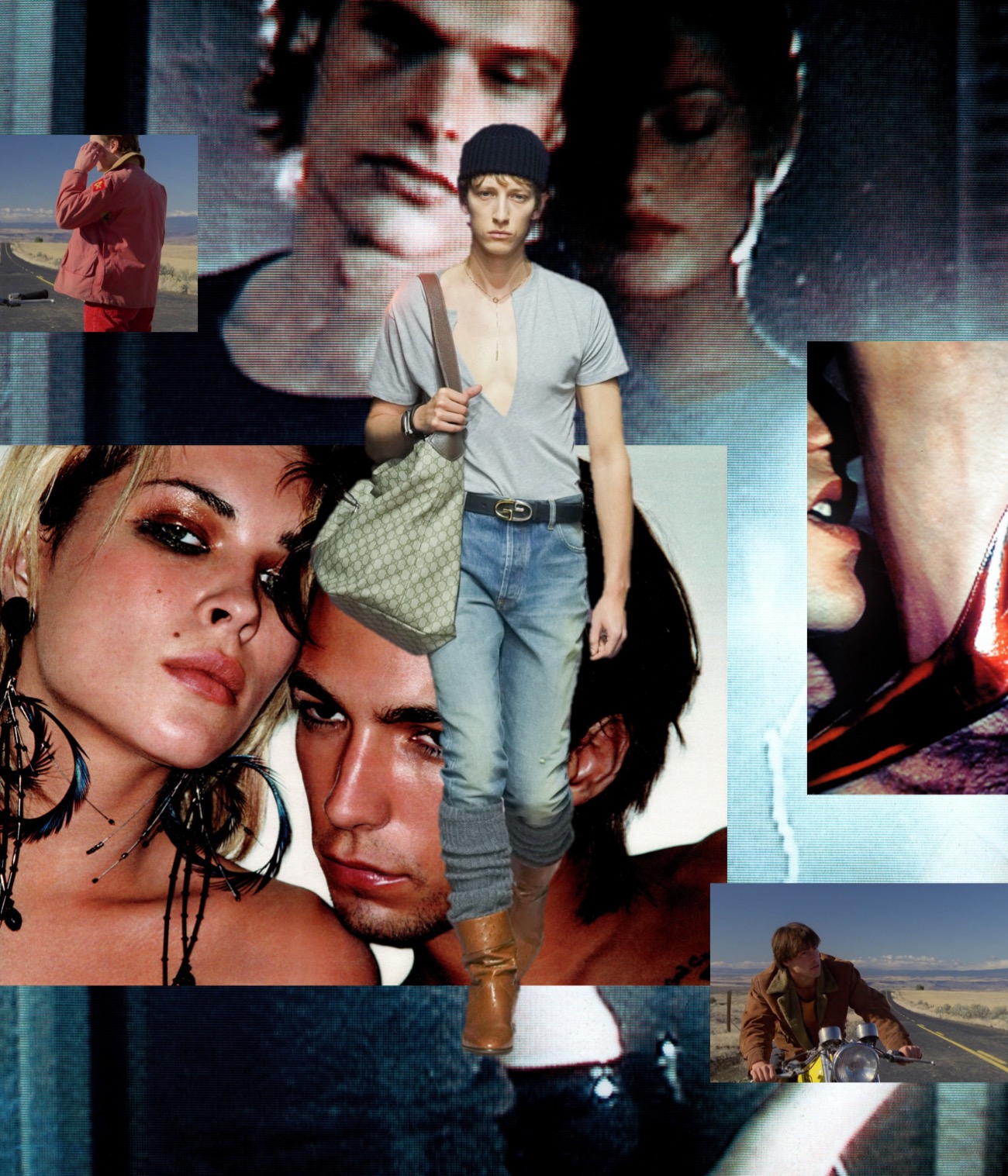
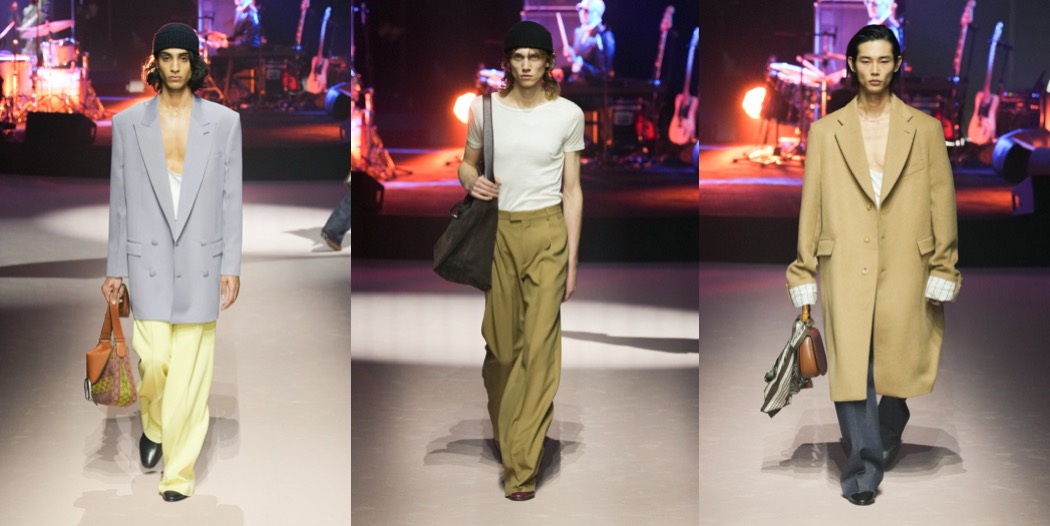
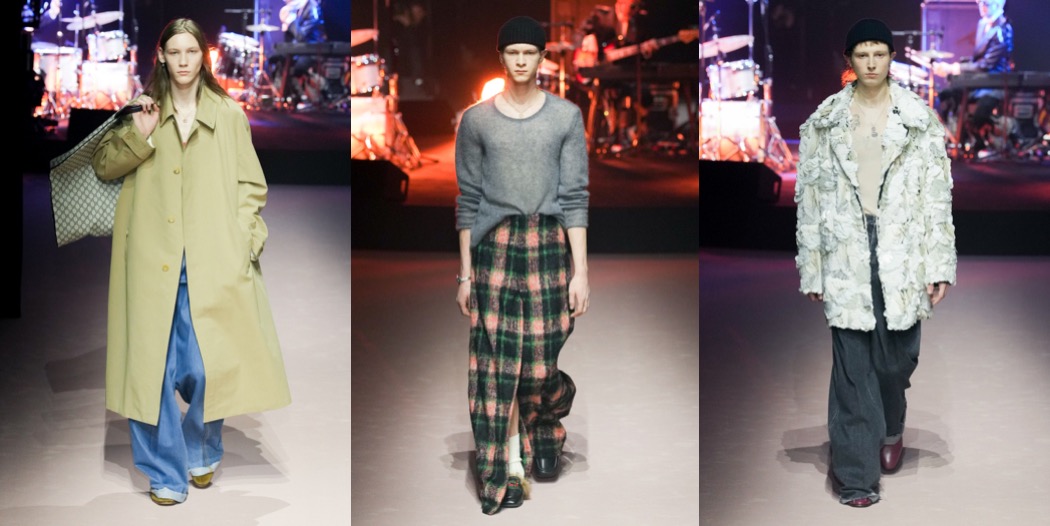
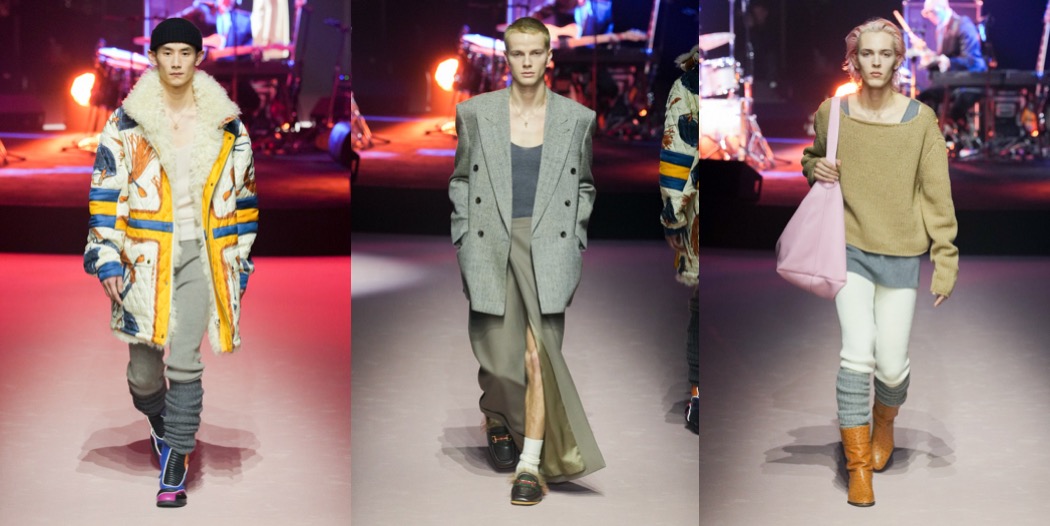
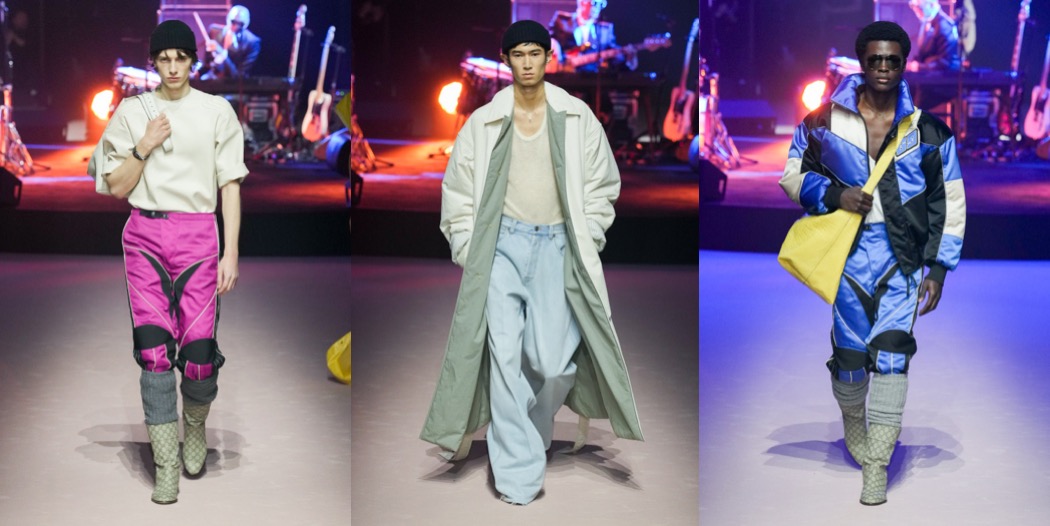
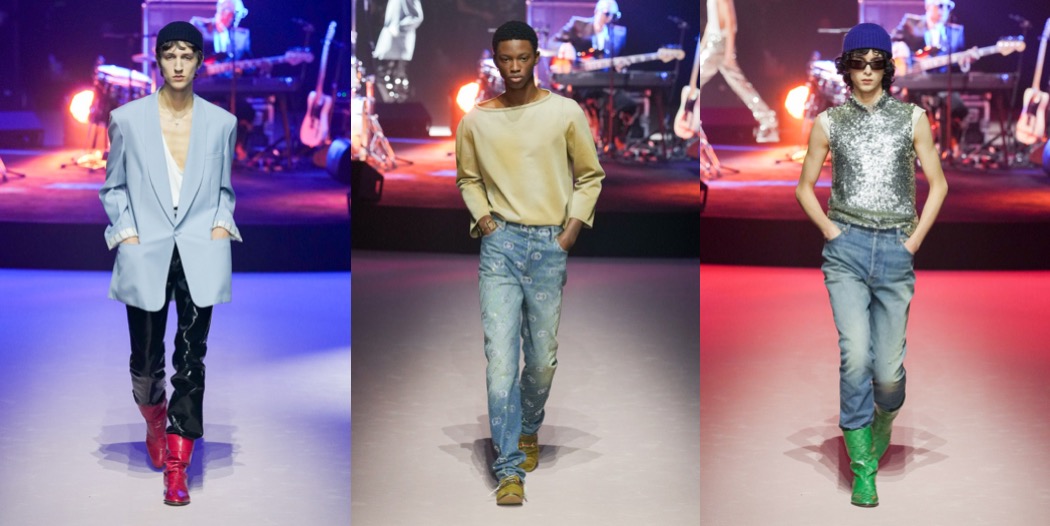
The menswear Milan Fashion Week started with the first Gucci show without Alessandro Michele’s creative direction. The designer’s abrupt exit in the end of 2022 left the brand in a confusing position. Michele’s Gucci definitely needed some rest – those last collections were just over-the-top, feeling more like a parade of costumes. Nevertheless, the designer created an inclusive wonderland with his vision for the Italian brand. And the studio-designed autumn-winter 2023 collection foreshadows the end of that colorful world that kept the industry dreaming for the last seven years. Skinny boys are in, bland indie-sleaziness is in, subtle (but very subtle) echoes of Tom Ford are in. The first look said it all: a white T-shirt with oversized chinos, From this beginning unfolded a collection that Gucci said in its notes was an act of improvisation, a freestyle “reflection of the individualities represented by the multifaceted creatives and craftsmen who inhabit the house of Gucci.” In other words, a collection that lacked overall coherence. After the opener we drifted into a section of volumized tailoring which was possibly purposefully banal. Suiting with detachable arms and legs, a rugby shirt worn above an unpicked trouser-like skirt, oversized vintage-design womenswear bags with Tom Ford era hardware and hilariously described “vintage-like” silk scarfs used ’90s-style to patch denim were more dynamic elements. We saw the occasional horse bit loafer, apparently distressed. Around halfway through, the collection began to come freighted with identity beyond the jackets featuring a 1953-issue logo boasting of outlets spanning “Florence-Rome-Milan-New York” (plus those near-ubiquitous pirate’s boots and sailor’s beanies). Volume was replaced by indie sleaze in a section epitomized by a look featuring black patent-sheened five-pocket pants, and a sheer scarlet shirt that strangely echoed the first ever look put out by Michele. The furry leopard bag and pink boots that accompanied it added a touch of hustler-ish glunge. Moto pieces, knitwear, and pastel sportswear were thrown in to evoke a purposefully peripatetic, thrown-together aesthetic. Thick socks worn over jeans is a thing to consider, though. Still, this isn’t a good moment in Gucci’s history.
Collage by Edward Kanarecki. Don’t forget to follow Design & Culture by Ed on Instagram!
In the minutes before Gucci’s spring-summer 2023 show, an email came in. “Welcome to Twinsburg,” read the subject line. Alessandro Michele’s concept this season was a reflection on identity and otherness. Michele, it turns out, is the child of an identical twin. “I am the son of two mothers,” the show notes began. Mum Eralda and Mum Giuliana “shared a genetic solidarity but, above all, they shared an intimacy which was inaccessible to others.” There’s something captivating, even uncanny, about twins – we’ve all seen the photo of Michele and his friend Jared Leto, tuxedoed doppelgängers at the 2022 Met Gala. The Gucci creative director played up the intrigue here, dividing the audience in two via a partition lined floor to ceiling with portraits of twins and look-alikes by Mark Peckmezian and staging two simultaneous shows without either half understanding until the last models made their way down the runway. Then the wall of photos lifted, revealing another set of bleachers and another set of models wearing identical looks. For the finale, the twins emerged from opposite sides of the set, stretched their arms across the runway, and joined hands.
In true Michele fashion, the collection’s 68 looks didn’t need doubles to make an impact. He worked his way through strict tailoring, souped-up activewear, Hollywood Boulevard glitz, embroidered chinoiserie, red carpet glam, and country quilting, among other motifs. The sequined jacket that announced FUORI!!! was Michele’s nod to an early 1970s magazine produced by the Fronte Unitario Omosessuale Rivoluzionario Italiano, and the stuffed animal handbags were Gremlins, stars of the 1980s black comedy of the same name. A helpful fellow journo pointed out that the Gremlins had a propensity for multiplying, which gets back to Michele’s explorations around identity. He pointed out another twinning detail in the men’s garter pants that revealed a bare expanse of upper thigh. Garters are historically associated with women’s hosiery; we aren’t used to seeing that part of a man’s anatomy. Highly eclectic visual allure and conceptual interpretations aside, it’s the solidarity of twins that Michele was really tapped into. In his post-show press conference, he seemed troubled by the climate crisis, growing anti-gay sentiment, and the renewed threat of nuclear war. “Clothes are not enough,” he said, adding that the filial atmosphere backstage was “therapeutic” for him and his team. “When we are many, we are much stronger,” he argued. This show made you believe it.
Collage by Edward Kanarecki. Don’t forget to follow Design & Culture by Ed on Instagram!