La Grande Bellezza. Valentino AW21 Couture

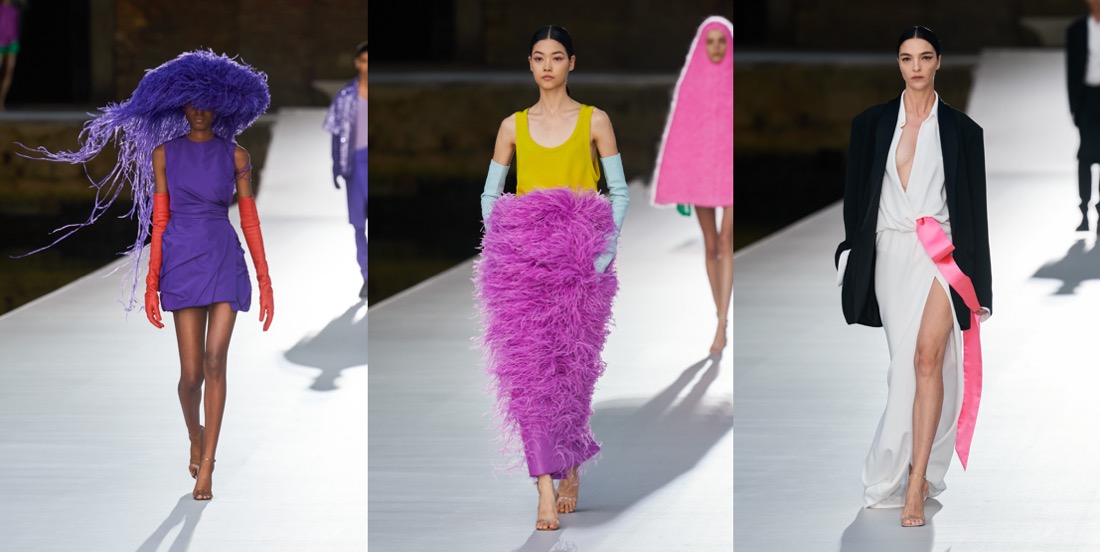
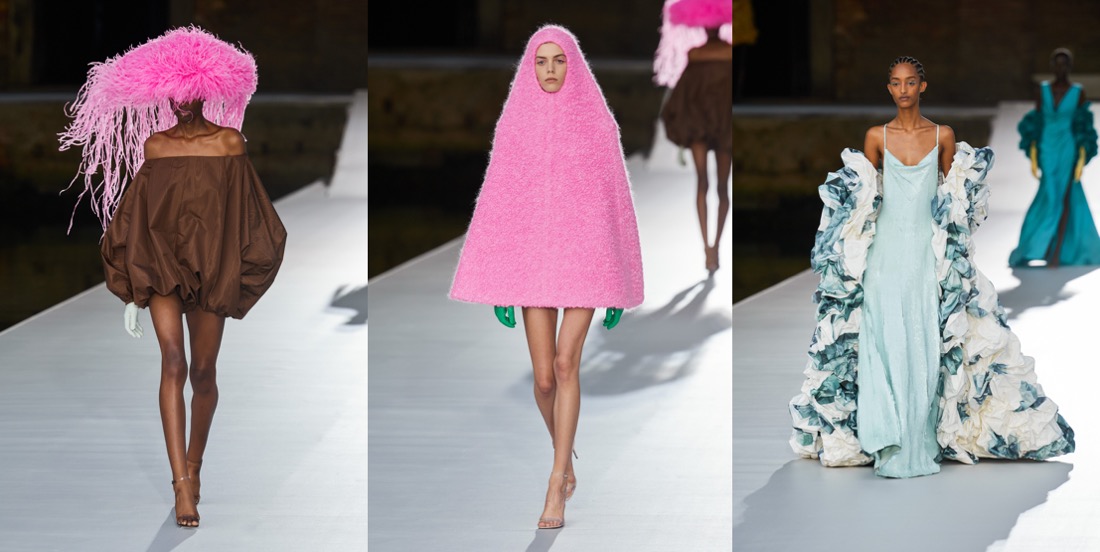
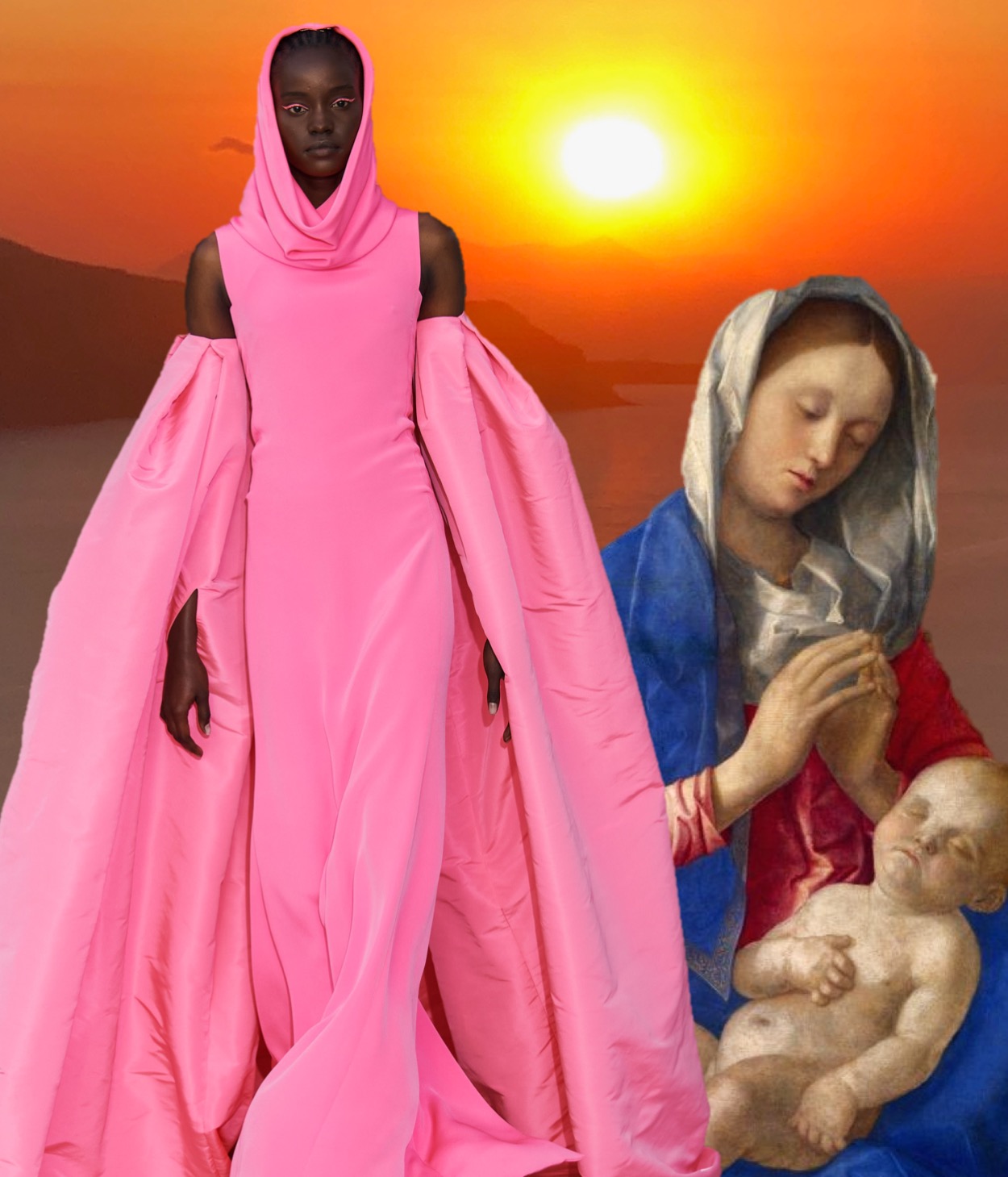
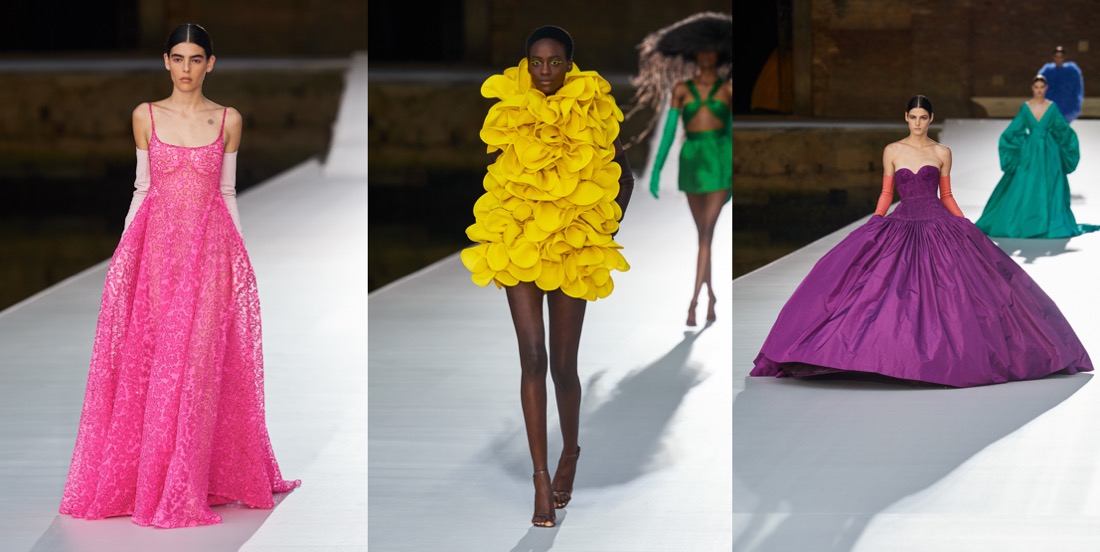
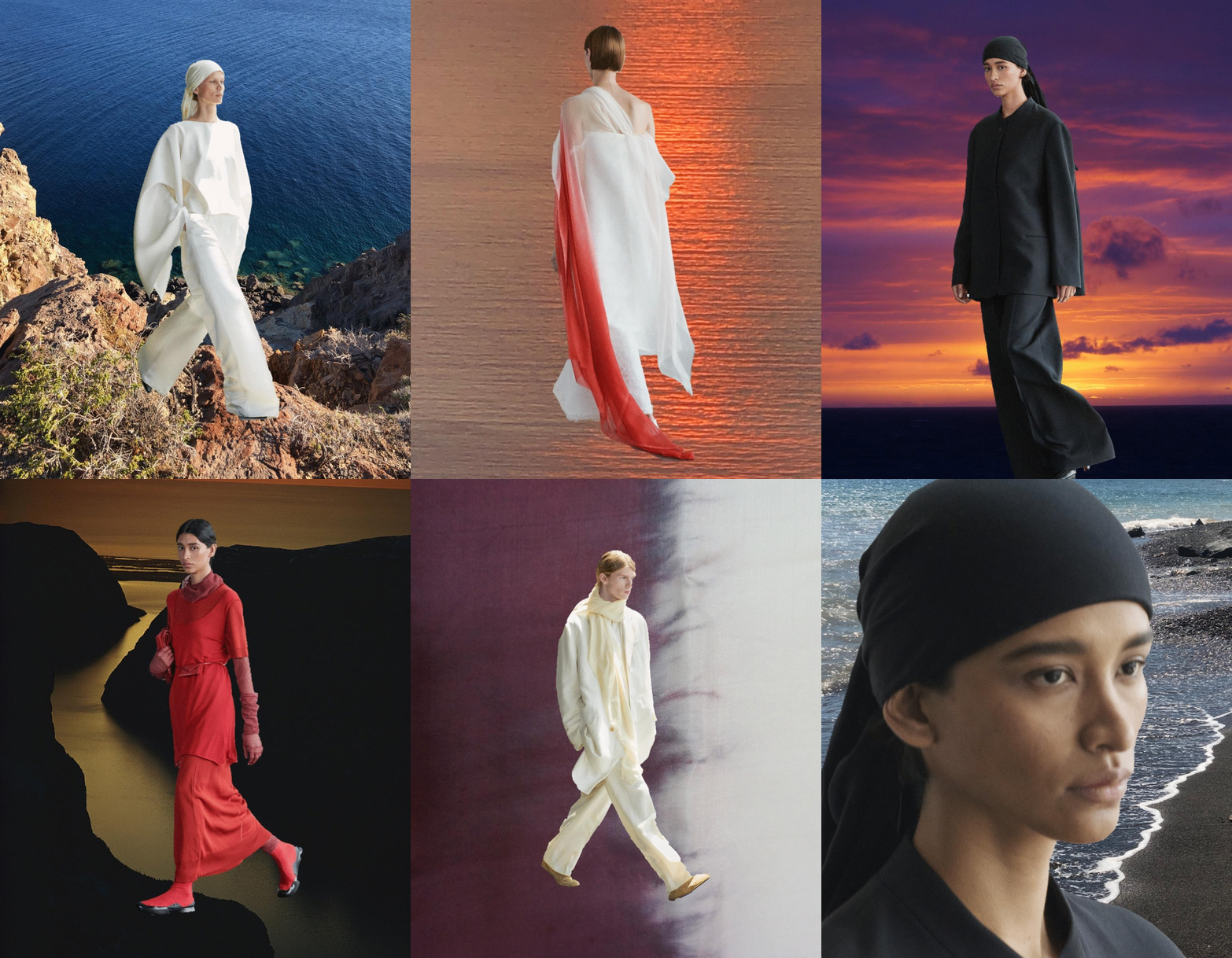
What a show. What a feeling. What a symphony. Celebration of great beauty. Valentino’s creative director Pierpaolo Piccioli set his sublime couture collection in the Gaggiandre, or ship building yard, of Venice. He was drawn to the place’s haunting beauty which he likened to a De Chirico painting with its arches and robust columns. In Renaissance times this place represented the hub of the city’s trading machine, a sophisticated production line that was said to churn out a boat a day. This being Venice and the Renaissance, of course the place – now part of the Arsenale where the city’s art and architecture Biennales are showcased – is as beautiful as it was once productive, having been built (between 1568 and 1573) by Jacopo Sansovino, one of Venice’s most revered architects of the period. Piccioli set his snaking runway under Sansovino’s soaring arches where the ships were once sheltered to be repaired, so that it appeared to float over the water. Guests were bidden to wear white. Luckily everyone did as they were told, and the effect, as the golden light of early evening streaked the water, the stone, tile, and brick, was undeniably poetic. To add to the spine-tingling moment, the collection was serenaded by the British singer Cosima, whose plangent voice gave a powerful twist to Calling You from the 1987 movie Bagdad Cafe, that opened the show. Piccioli brings the ultimate level of gasping wonder to fashion’s color wheel, setting flamingo pink, chartreuse, violet, cocoa, and mallard green ball gowns one after another, for instance. Or he might throw a raspberry double-face balmacaan over darker pink pants and an orchid pink crepe shirt, or a lilac cashmere cape over violet pants, frog green sequin t-shirt, and pea green gloves, and then ground the look with eggplant shoes with the heft of Dr. Martens. These last two ensembles, by the way, are part of the menswear offerings in the collection, in case you were wondering, and very persuasive they were too.

There were 84 looks in the show, and each one was a different proposition, from puffball micro minis, (shaded with Philip Treacy’s giant trembling ostrich frond hats that moved like jellyfish), to trapeze silhouettes, skirts that hit the mid-calf or hovered above the ankle, and slinks of satin and crepe cut to spiral round the body like affectionate serpents. From ball gown to micro mini the effect was one of commanding elegance. The fashion history sleuth will find echoes here of Madame Grès, of Cardin, and Capucci, as well as note taking from Mr. Valentino’s own magnificent oeuvre, but Piccioli takes these iconic moments of design history and makes them uniquely and persuasively his own. Also unique were the artist collaborations, curated by Gianluigi Ricuperati, who assembled a roster of 17 painters, including Jamie Nares, Luca Coser, Francis Offman, Andrea Respino, and Wu Rui. Art and fashion have often united in symbiosis – think of Warhol and Sprouse, or Schiaparelli and Dalí – but here the effect was a celebration of creativity, the hand, and of the nonpareil Valentino workrooms whose talented artisans evoked the source artworks through various cunning means. There were elaborate collages of textiles, for instance 46 in all for Look 6, Kerstin Brätsch’s The If, 2010, (as the Valentino show program notes helpfully noted, alongside the names of the craftspeople in the ateliers who have made them). Meanwhile, the five pieces by Patricia Treib, combined in the ballgown of Look 68, called for 140 meters and 88 different textiles, and took 680 hours to complete. On close inspection even the fine lines of Benni Bosetto’s pencil strokes (Untitled, 2020), that appeared to have been drawn directly onto the pale satin of Look 46, turned out to have been suggested by subtle hand-stitching (a stunning 880 hours of work, if you are counting). The ball gown and cape that closed the show, Look 84, were scrolled with motifs drawn respectively from Jamie Nares’s It’s Raining in Naples, 2003 and Blues in Red, 2004, requiring 700 hours of work, 107 meters of fabric, and custom screens for the hand-printing as it had to be done on such a large scale. The effect was appropriately magisterial. Summing up: total magnificience.

All collages by Edward Kanarecki.
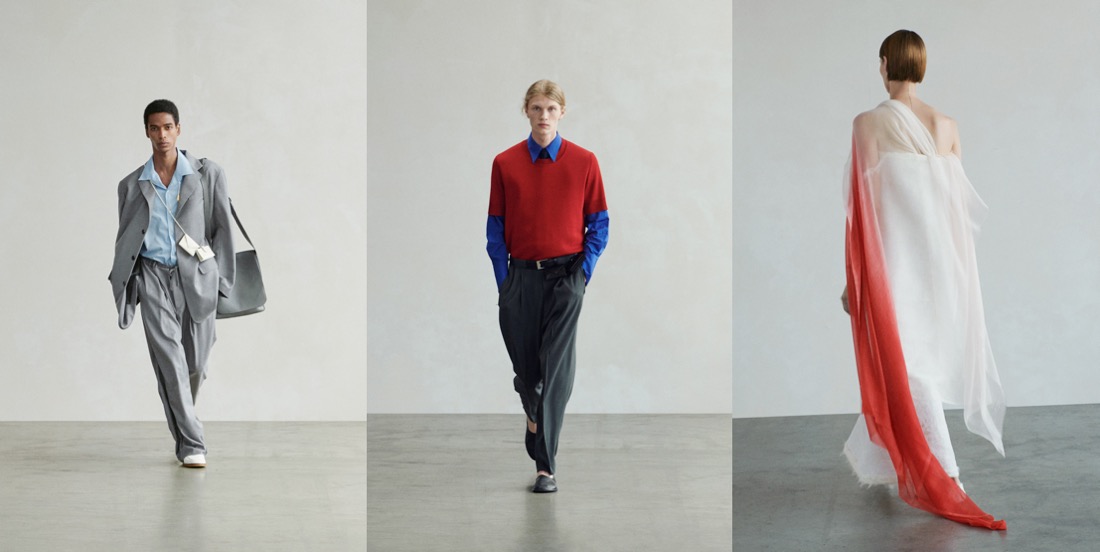
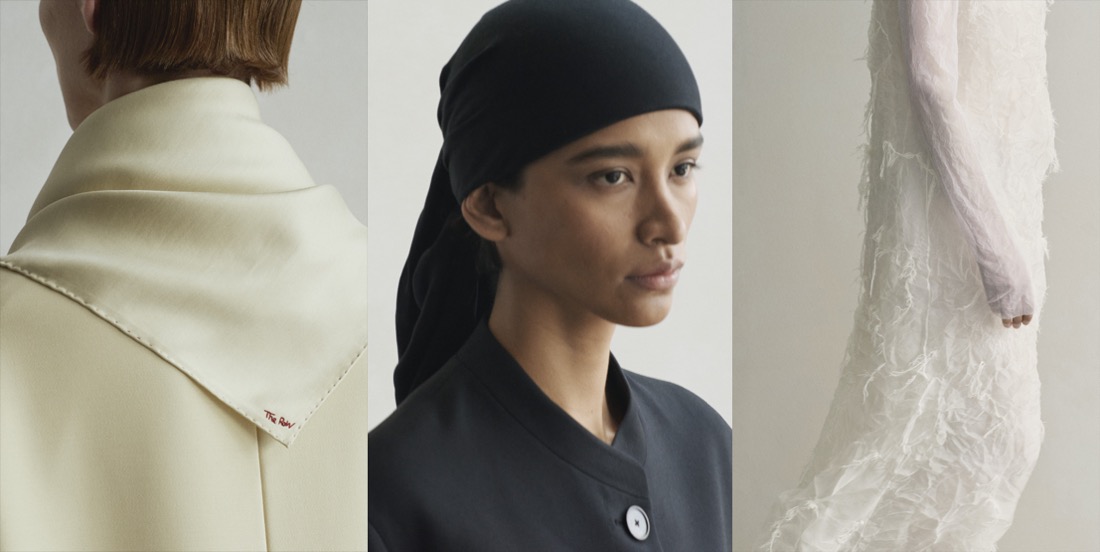
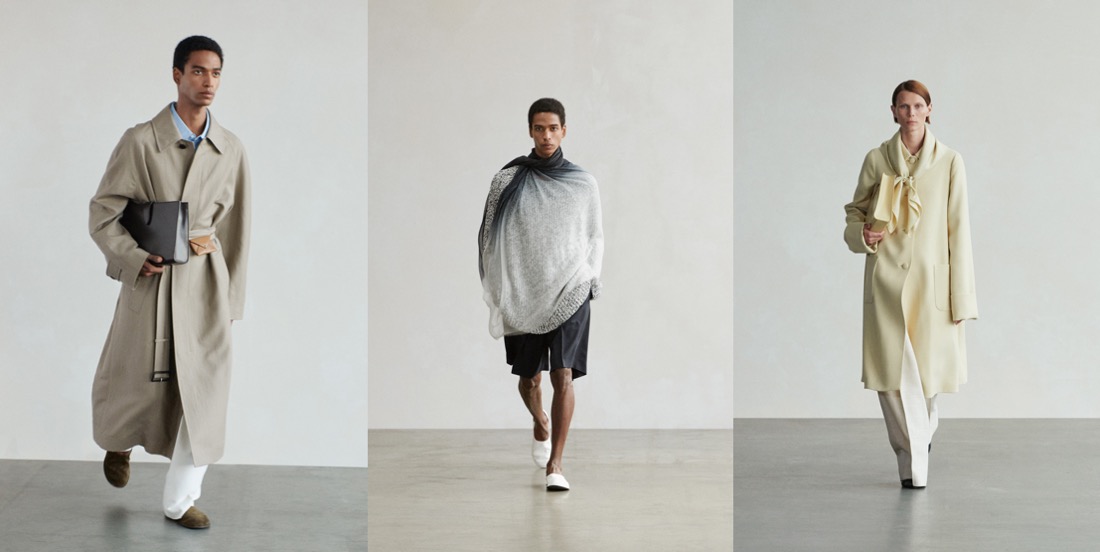
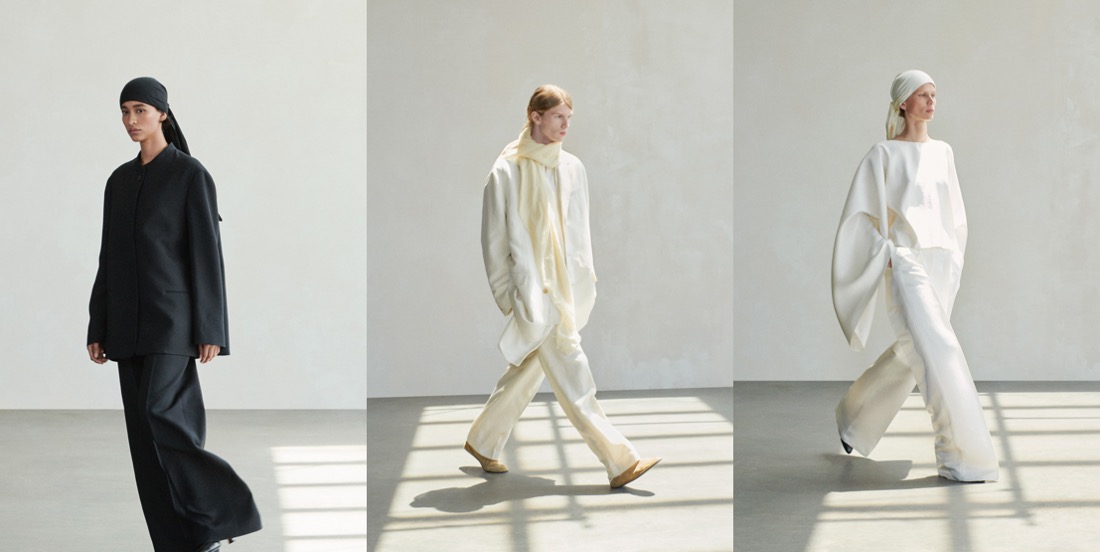
Lust For Essentials. The Row SS22

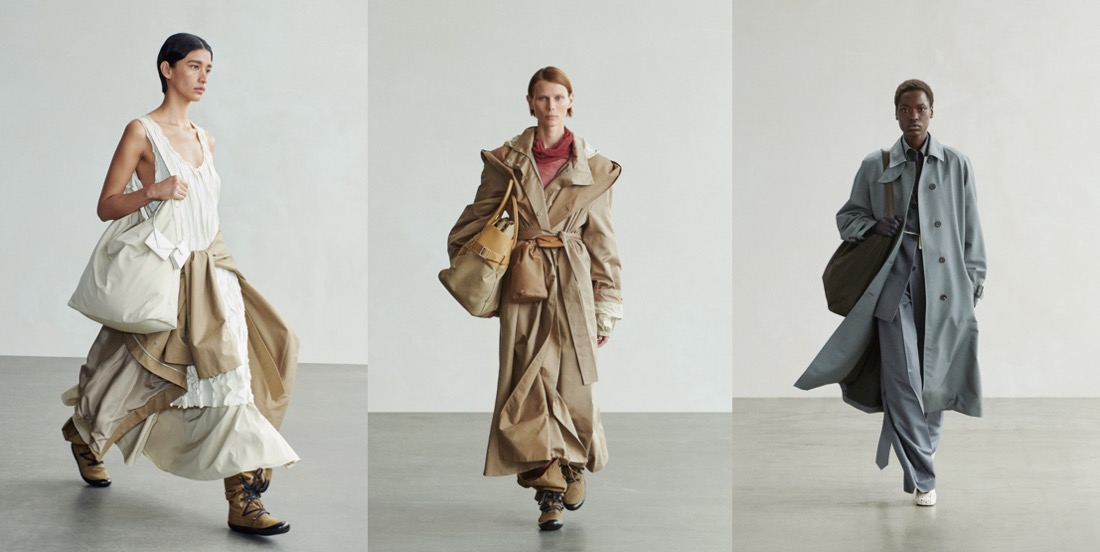
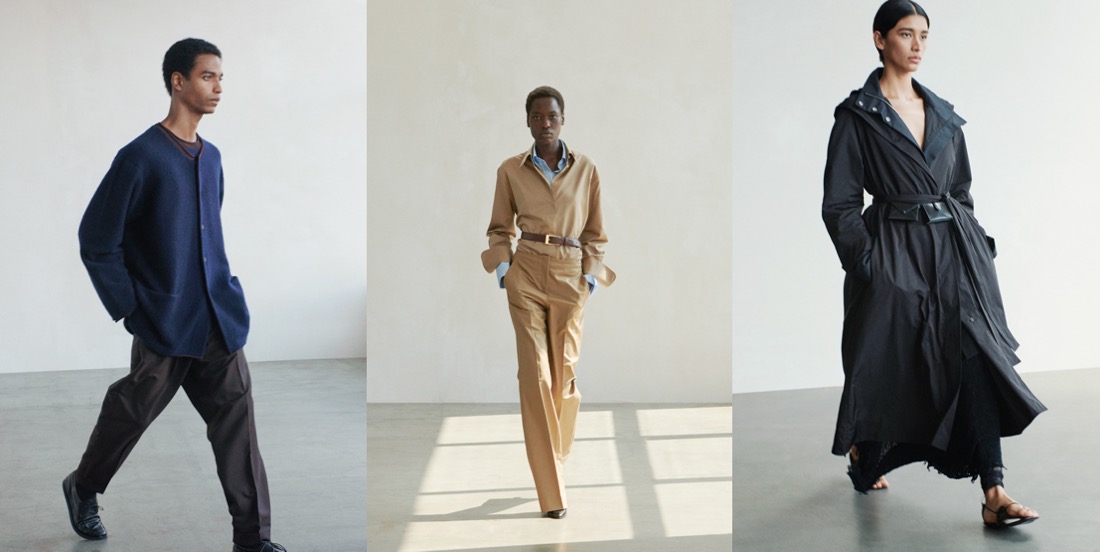
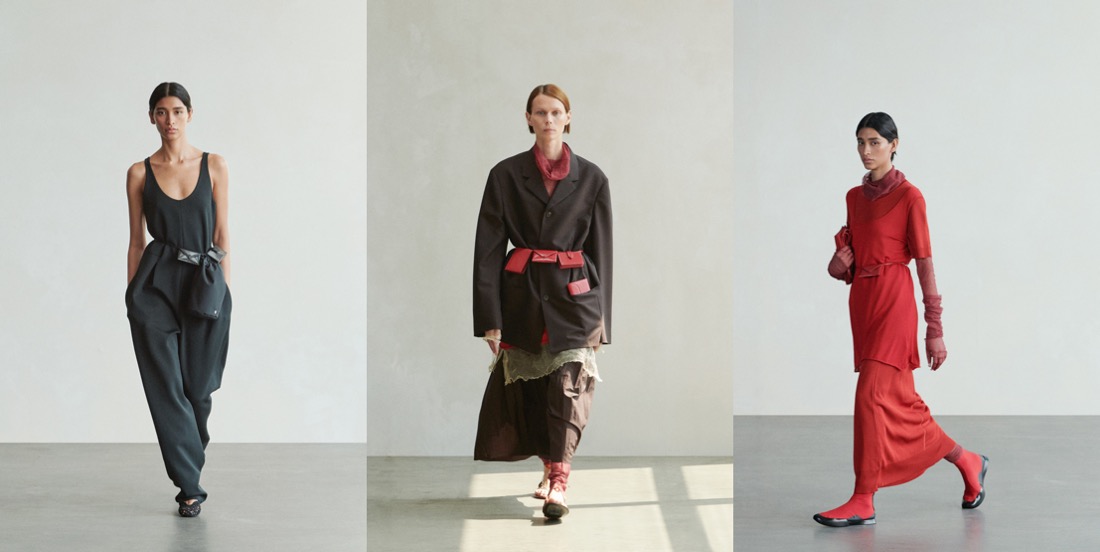
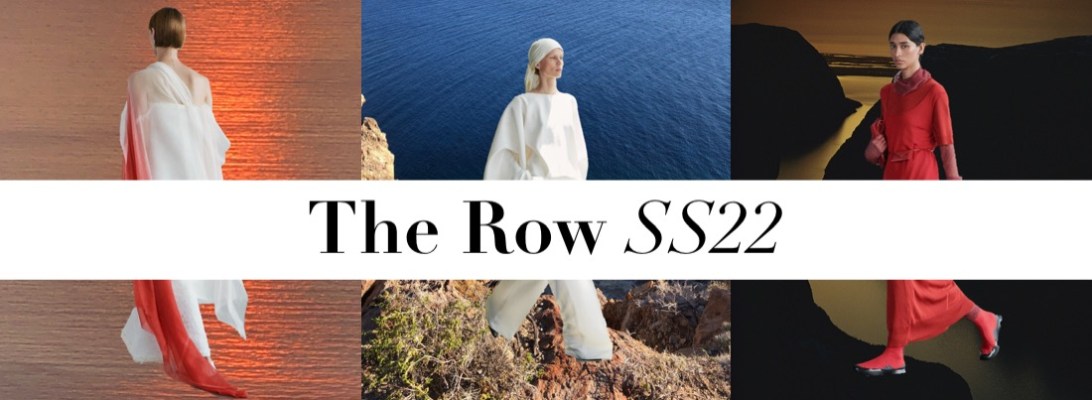
Ashley and Mary-Kate Olsen are holding their course, even though most of the designers this season move towards a hedonist mode. Skimp is not in The Row’s vocabulary, and it isn’t likely to be in the future. None of us have been untouched by the pandemic, though, so how has the experience of lockdown changed the Olsens’ design POV and what does The Row’s take on re-emergence style look like? Something unexpected emerged most vividly midway through the lineup in the form of separates for women and men in shades of red and blue, the brightest colors ever to find their way into a collection from the Olsens, who prefer to work with neutrals and classic black and white. There were also the arty details here and there, like the delicate thread belt that accented the drawstring waist of a pair of casual pants or the fringed raw-edges of a fully knit skirt made with three different yarns. A few pieces were hand-painted, a nod, maybe, to the artists and art collectors that number among their clients. The accessories offering has expanded and there was a notable element of fun, as seen in the tiny card cases and coin purses suspended from belts and in the stretchy ankle boots that looked like a cross between scuba socks and wrestler shoes. Overall, the proportions are roomy and the silhouettes are layered – luxe comfort is the key. The Row fans will fall in love with a pair of pressed khakis whose low-slung, flared profile recalled the ’90s, and a jumpsuit with a tank top upper half that was the barest of all the looks assembled here. Pre- or post-pandemic, perfect essentials never go out of style.

Collage by Edward Kanarecki.

Be The Queen. Viktor & Rolf AW21 Couture

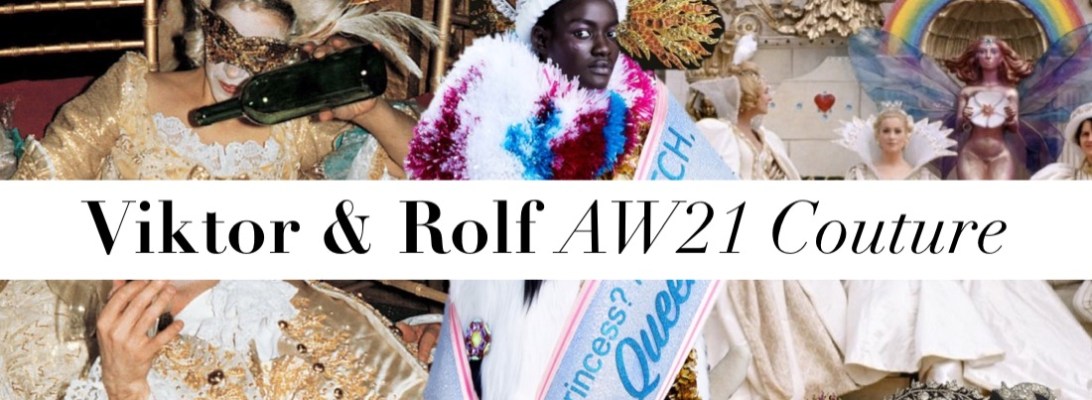
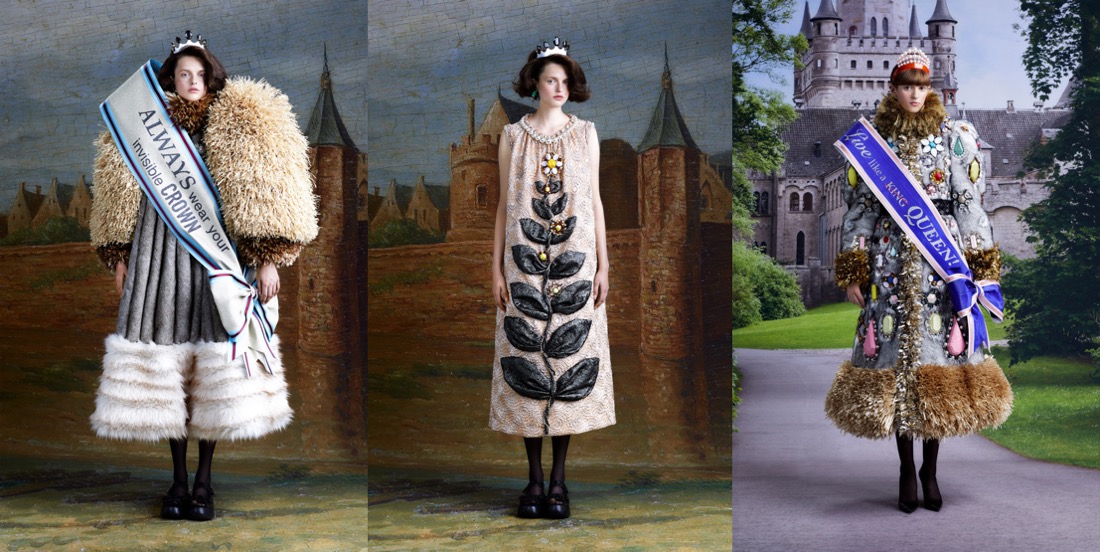
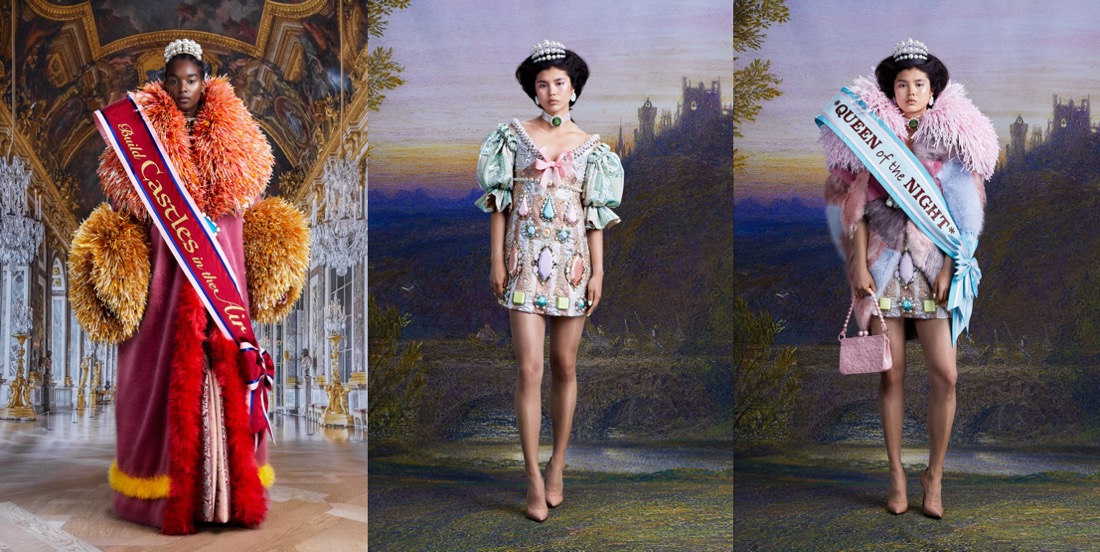
Viktor Horsting and Rolf Snoeren do couture that instantly becomes viral. That is certainly the case with their latest Viktor & Rolf collection, which at first glance, might seem to tread familiar ground, with coat shapes resembling those from their Russian doll collection for autumn 1999, and slogan sashes from spring 2019. The pair carried over their interest in jeweled embellishments here, though in different dimensions and styles; and in keeping with their dedication to reducing waste, many of the pieces are patchworked—as are the concepts behind the garments. As Snoeren put it, “there’s all kinds of elements from all different worlds.” The first theme that comes across is a royal one, and, with continuing buzz around The Crown and the Oprah interview, it’s quite topical. What the designers couldn’t have known is that Young Royals mania would start to heat up at almost the exact time they presented their collection. Many tropes are referenced in the lineup, ranging from fairy tales to cartoons. There are medieval-style brocades and an “ermine” cape. A raffia “fur” is a fantastic take on high/low. Tiaras and crowns of plastic are a clue that everything is not what it seems, which is confirmed, without subtlety, with the queen-themed sashes. “We wanted everything to be bigger than life,” noted Horsting. “It’s like a play on queens or royals. We wanted to be uplifting and joyful and – fun is not the right word – but colorful, sparkling, positive. You are your own creation.”

Collage by Edward Kanarecki.
Here Comes The Light. Fendi AW21 Couture

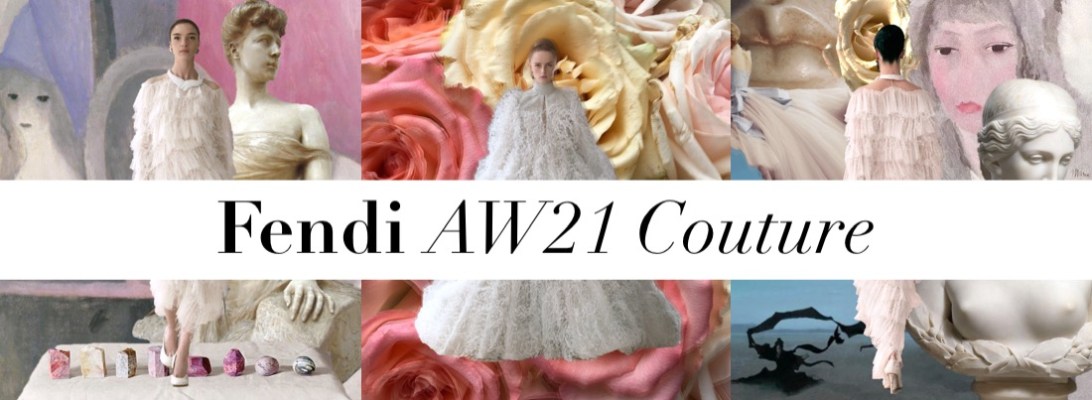
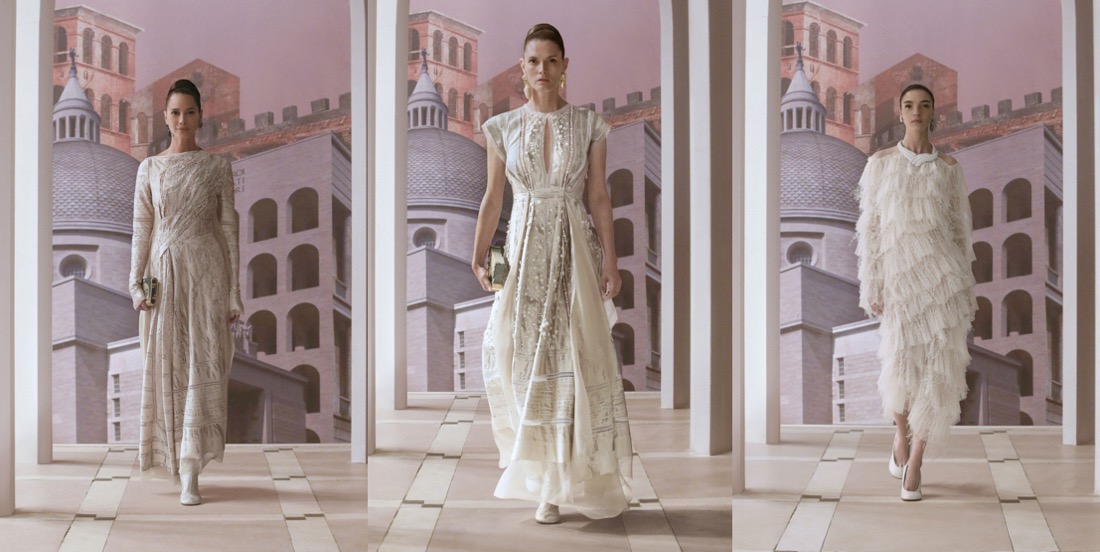
Kim Jones‘ second haute couture collection for Fendi was captured in an emotive film, which saw the likes of Kate Moss, Christy Turlington, Malgosia Bela and Amber Valletta gaze enigmatically into the camera as they wafted around a Roman theater set in dresses evocative of the stone and statues of the Eternal City. It was shot by Luca Guadagnino and scored by Max Richter. In the age of social media when big, beautiful dresses go viral, the direction Jones is setting for Fendi epitomizes a popular understanding of haute couture as something the eye can easily identify: bold ballroom silhouettes, sumptuous surface decoration and (very) famous faces. “It’s being optimistic about being able to socialize properly. I thought it was a nice moment to say that,” he said. Couture clients, Jones pointed out, “go to Fendi for something extravagant.” Two seasons into his tenure, his couture expression is manifesting itself in decoration and fabrication above all. His glamorous evening dresses serve as canvases for this finery, like the mother-of-pearl embellishment and recycled fur mosaic work that graced this collection. Watching it unfold, it feels like a formative process, as if all that intarsia and all those embroideries have been locked inside him for so long, waiting for the day when they could burst out into bona fide couture. Comparing to his heavy, over-worked January show, this one radiates with lightness and elegance that isn’t forced. To me, it felt like the mesmerising ambience of Rome. The film was inspired by Pasolini’s neorealistic Roman cinema, every architectural era of the city visible on its mock horizon. The fabrics and textures were informed by the buildings and pavements of Rome, some employed in statuesque lines that underscored the theme. Jones’s evolving exercise in the decorative aspects of haute couture made for eye-catching effects like the allover petal work of Moss’s oversized dress, or the marbling of Valletta’s swathing gown. Most compelling were the silhouettes that really took form, like the hypnotizing construction of a mosaic bolero jacket that resculpted the body through the volume-specific grammar of haute couture, or the dress worn by Mica Argañaraz, which demonstrated a similar idea in flou. “We had a lot more time to work on this one. We’ve actually had a full season. So, it’s a lot more worked into, and I think people will see a lot of difference in it. The people here, when they see what we’ve been doing, they can’t believe it’s the second one I’ve done. They say it’s a lifetime’s worth of understanding,” Jones concluded.

Collage by Edward Kanarecki.

JPG Gone Sacai. Jean Paul Gaultier AW21 Couture

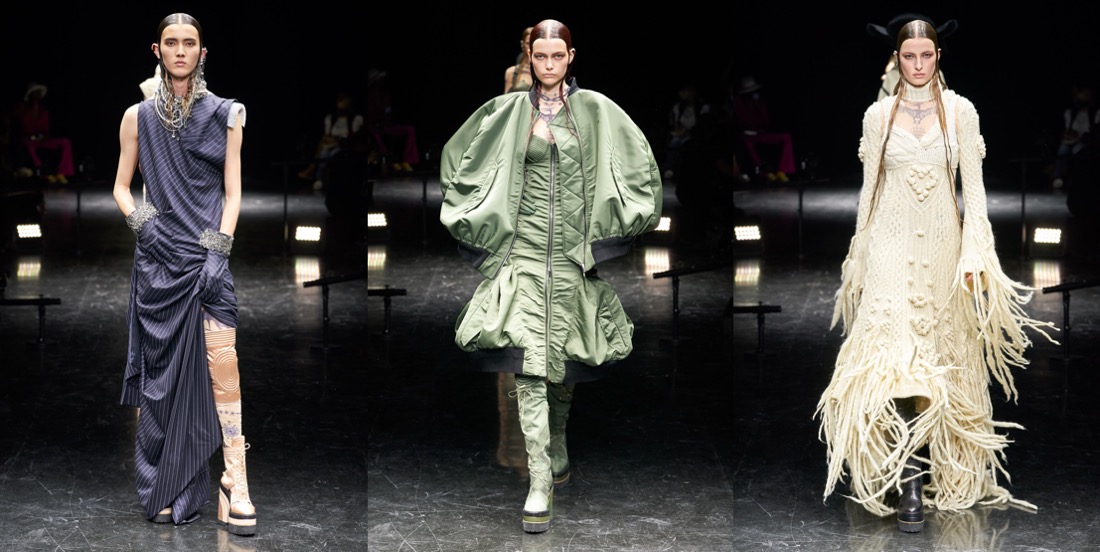
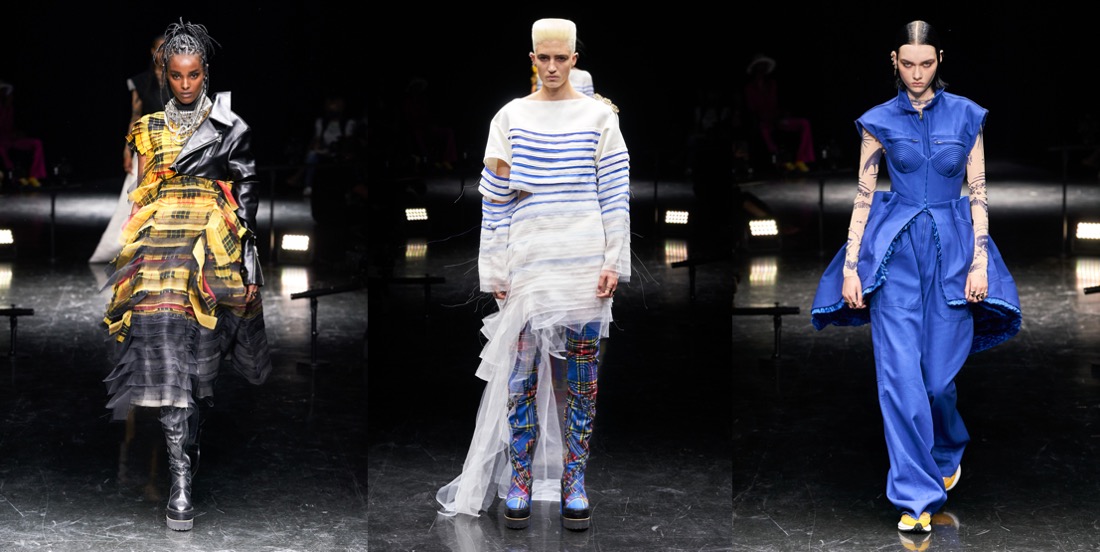
Luckily for the fashion world, Jean Paul Gaultier is back. And his new, collaborative take on couture makes his brand feel fresh and relevant. Sacai’s Chitose Abe is known for her genius for grafting two different garments together to create a sui generis ensemble, so the idea of grafting her sensibility onto that of Jean Paul Gaultier – a designer that she has long admired – seemed like the basis for an exciting dialogue. It was one that Gaultier himself suggested as part of his elegant disruption strategy following his “retirement” from the conventional fashion system. “It was a very intimate, more friendly proposal,” recalled Abe backstage before the unveiling of her Gaultier takeover, “an invitation to come over for tea. It didn’t feel like two companies coming together, but instead like two people.” Haute couture wasn’t something that Sacai had necessarily thought about before, but she acknowledged that it was “a really spectacular experience. The level of perfection is something that Jean Paul and I share,” she explained, “and it made the process so smooth.” Her couture touches included the hidden luxury of dozens of tiny ruffled flounces buoying up the inside of a skirt, and the stripes of Gaultier’s iconic blue and white matelot sweater worked with insertions of satin organza, or seeming to evaporate into wisps of chiffon. Abe knows Gaultier’s work so well that she admitted she didn’t even have to consult the archives. “I didn’t want to take the archives too literally,” she added, “but to make it Sacai and very, very up to date.” So for look number one, Gaultier’s iconic autumn 1984 conical bra emerged from a deconstructed man’s navy pinstripe suit reimagined as a corset and overskirt, and worn over the tattoo print mesh second-skin pieces that reappeared throughout the collection and represented a collaboration with the tattoo artist Dr. Woo. It helps, of course, that there are some shared codes between Gaultier and Abe that she worked into the collection like a love for tartan, a refined take on punk, the co-opting of traditional men’s suiting fabrics, and the reimagining of the trench coat and Aran sweater. That tartan was redone as a sophisticated assemblage of chiffon pieces worked into a fluttering dress, and those pinstripes were reinvented as a high waisted dress crafted as though it was made from an enormous pair of trousers, the abundance of fabric pleated into fullness. The trench coat was re-conceived as a skirt with the volumes of an Elizabethan farthingale, and samples of different ivory Aran knits were patched onto a chiffon dress. On close inspection, the military braid turned out to have been embroidered from safety pins. Gaultier joined Abe for the finale runway walk and delighted the crowds on the street outside when he joined her on the balcony of his imposing Belle Epoque HQ with the models crowding the windows around them. Can’t wait to see who Jean Paul invites next season.

Collage by Edward Kanarecki.