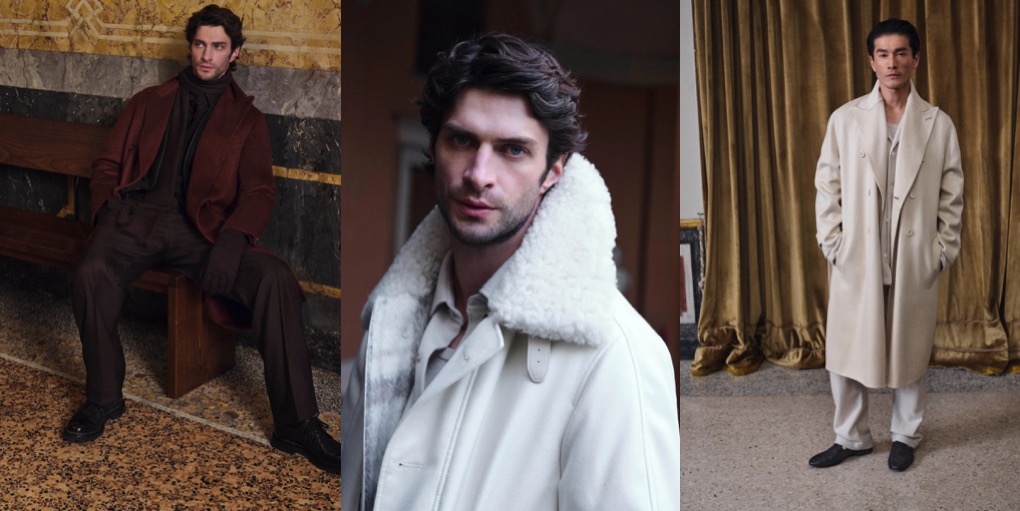
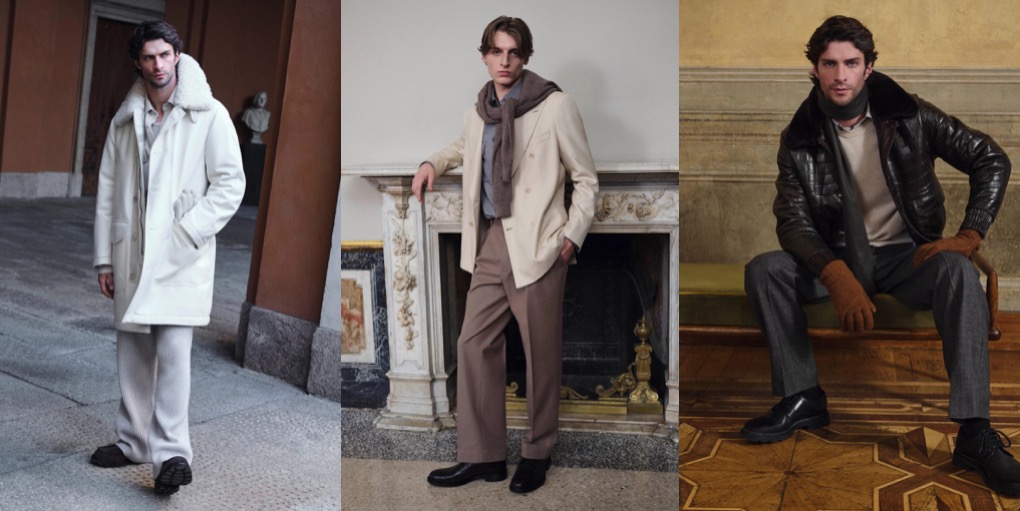
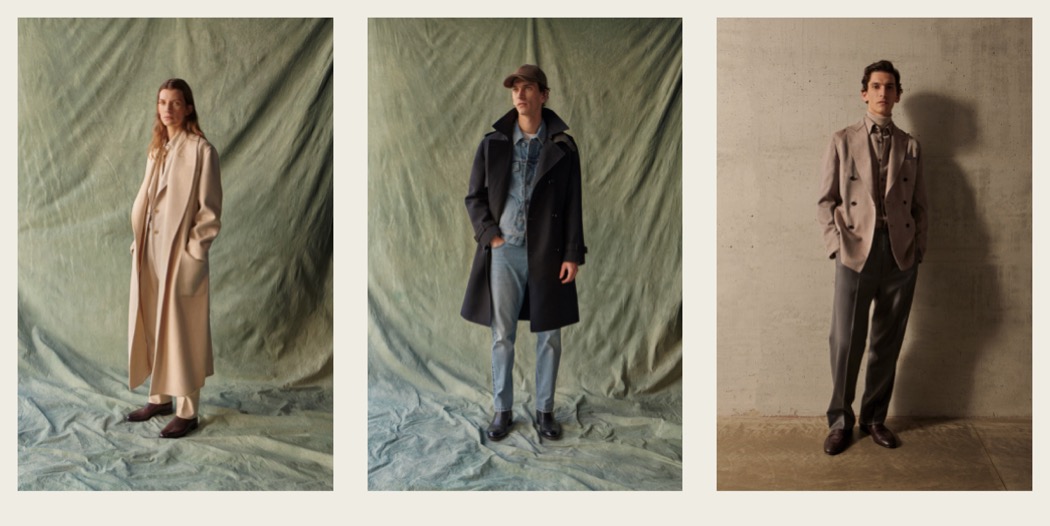
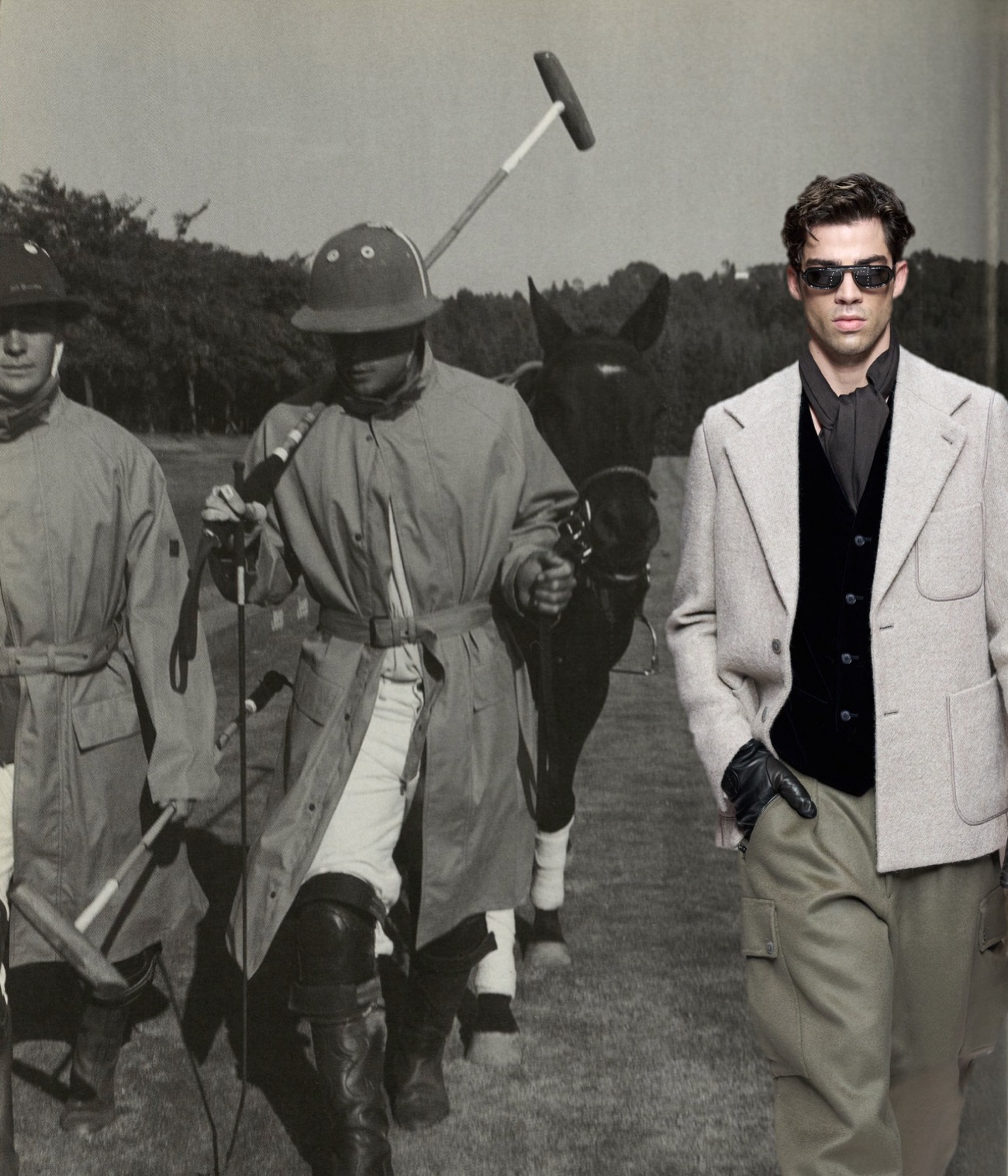
It seems to me that no one embodies the art of sprezzatura in Milan’s menswear quite like Norbert Stumpfl at Brioni. Poignant, laid-back, seductive, and undeniably luxurious, the Austrian-born designer’s vision for the Roman house ticks all the right boxes for me. The men featured in the autumn-winter 2025 lookbook are draped in sumptuous shades of ochre and burgundy, exuding irresistible chic in their cashmere coats and loosely tailored, pyjama-like suits. The thin, fringed scarves, tied nonchalantly around their necks, lend the collection an air of refined cool. Brioni is for the man who brunches at Giacomo Bistrot and dines at Il Solferino, yet never takes himself too seriously.
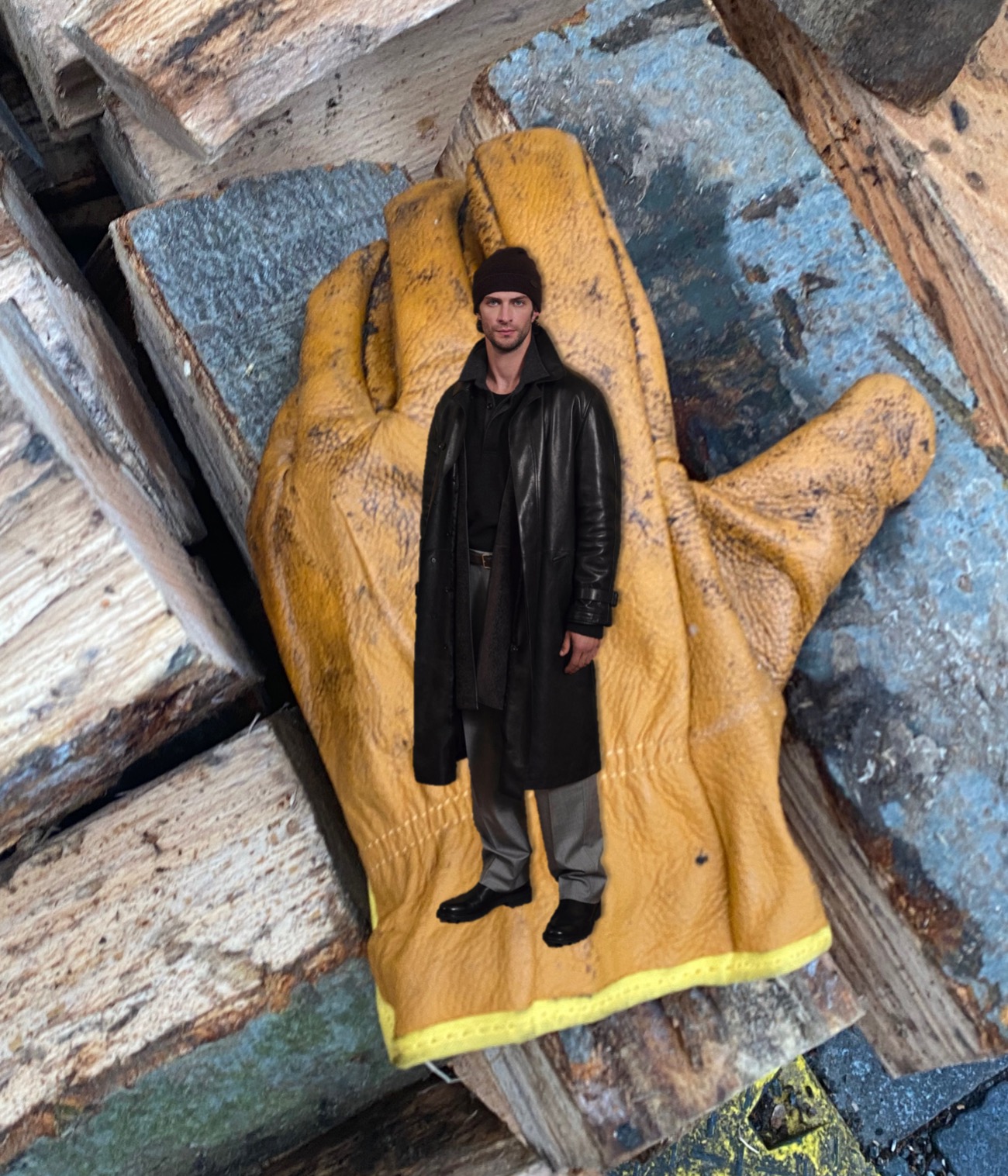
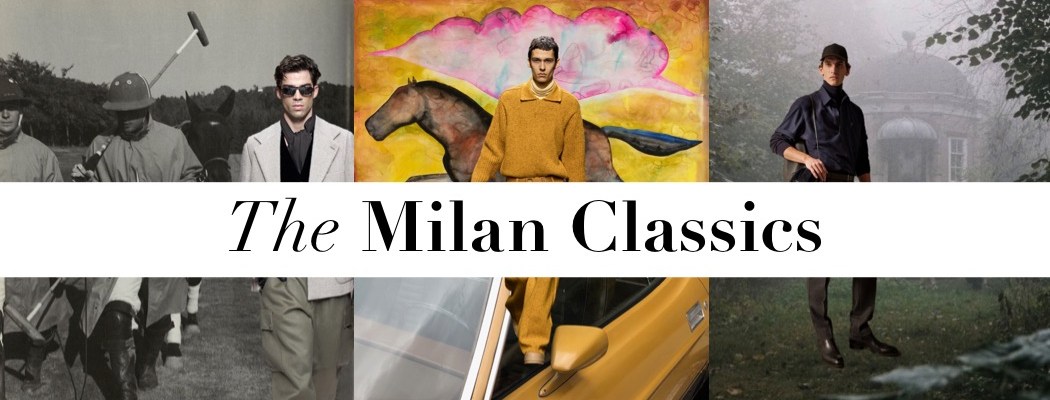
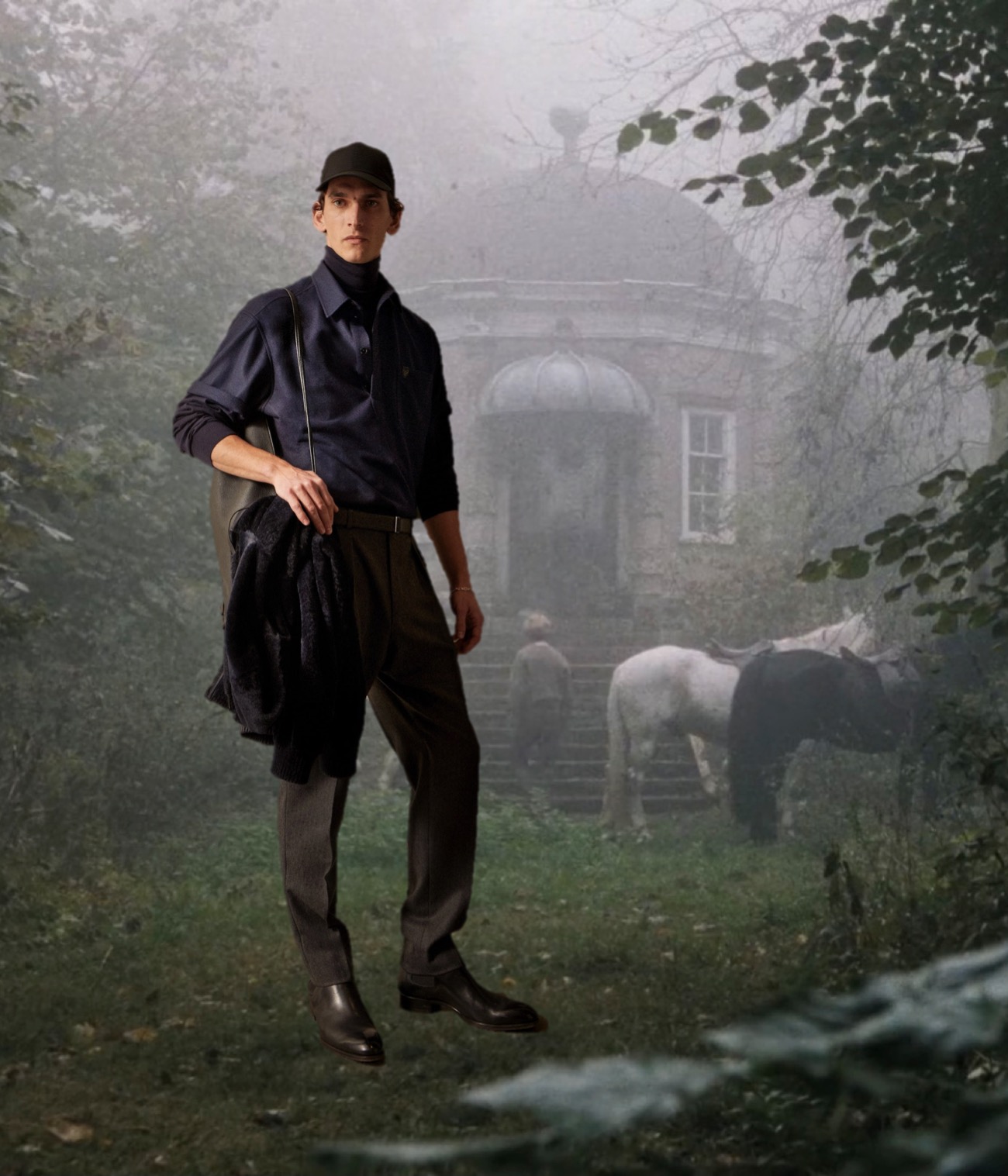
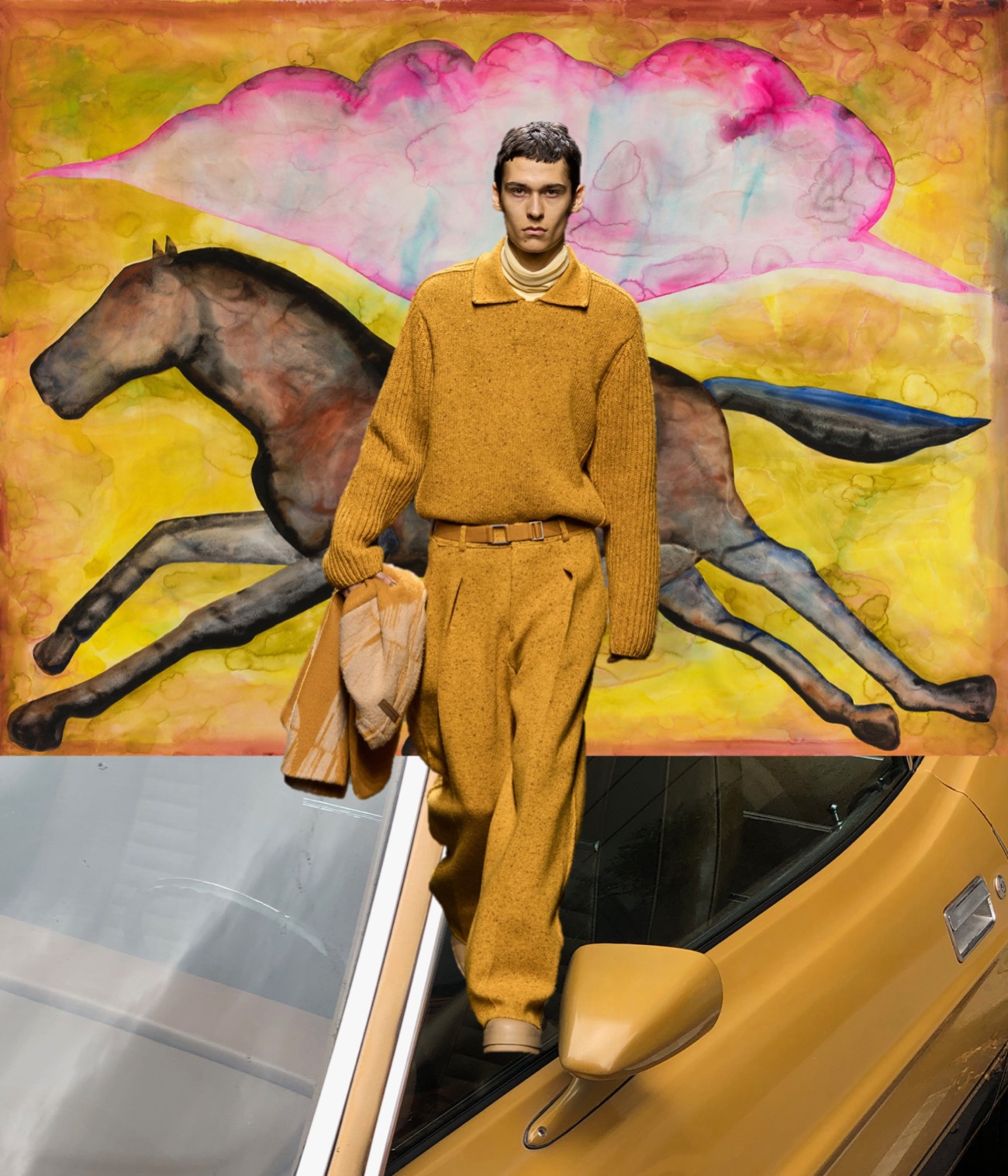
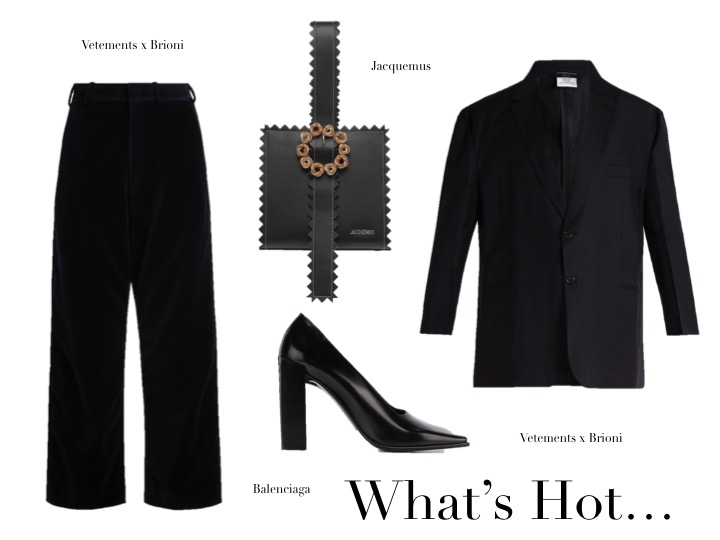
Collage by Edward Kanarecki. Don’t forget to follow Design & Culture by Ed on Instagram!
Hey, did you know about my newsletter – Ed’s Dispatch? Click here to subscribe!
This Milan Fashion Week, the three Italian brands known for exquisite tailoring and eternal elegance – Brioni, Giorgio Armani and Zegna – have really nailed it with absolutely gorgeous collections filled with investment pieces and simply beautiful garments. You can’t go wrong with the classics!
Brioni’s Norbert Stumpfl declared this season: “I have the most excellent team of artisans behind me, and what they are able to achieve is a dream come true for me”. He has every reason to feel so elated, as what Brioni stands for is an idea of luxury which is as refined as it is private and understated. “As a designer, I don’t need to scream,” he said. Every season, the unbelievable quality of fabrications and execution seems to reach new heights, a sort of limitless research whose results never cease to amaze. For autumn-winter 2023, cashmeres were proposed in varieties so weightless, a whisper probably would be heavier. Vicuñas and alpacas were more ethereal than a passing cloud; deerskin, suede and nappa were as soft to the touch as the skin of a newborn. Going through a Brioni collection makes for an almost preternatural sensorial experience. The same sense of rarity and sophistication was expressed in the subtlest of color sensibilities, with tones so suave they brought to mind Caravaggio’s chiaroscuro. No wonder Brioni is a Roman house: if there’s a place where the light is glorious, resplendent of every possible hue from gold to amber to topaz, that’s Rome. Stumpfl captured it in the sensuous fall palette, which emphasized the ease and fluidity of the soft tailoring that Brioni masters. This season, the play on proportion was subtle as usual, with a tad more room for enhanced comfort in longer jackets, fuller trousers, lighter and rounder shoulders. “Brioni’s style is almost invisible, not overpowering,” said Stumpfl. “It gives you comfort and confidence at the same time. We definitely enjoy spoiling our customers.”
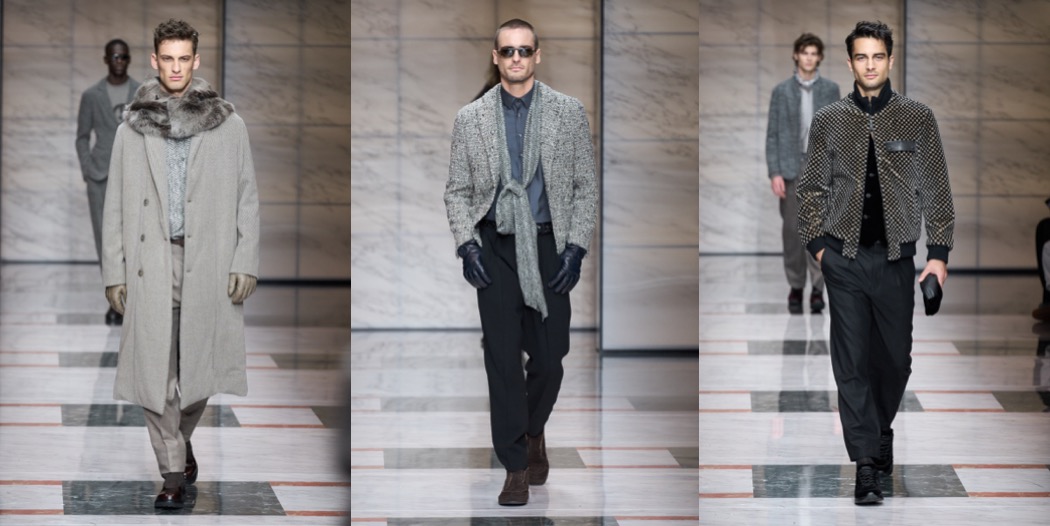
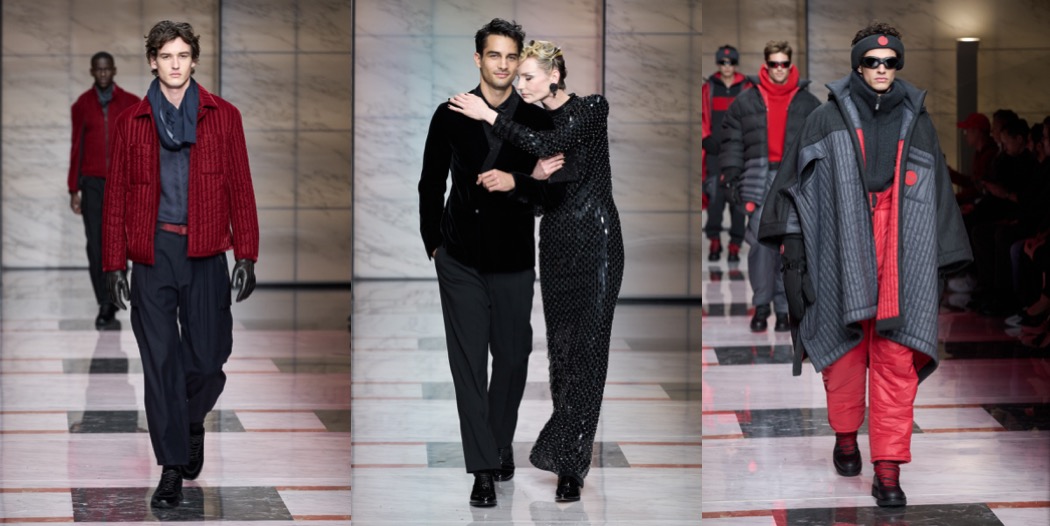
Shortly before Giorgio Armani’s now traditional runway show sports-diffusion interlude, Milan’s 88-year-old master menswear architect discreetly showed his hand. Out came two three-piece suits, one blue and the other black, in a silky looking material whose movement suggested they were almost certainly shot through with technical ingredients. Each was delicately to (the point of imperceptibly) crinkled with raised rivulets of irregular lines. As later confirmed in the notes, this was a Giorgio collection that took subtle inspiration from the architecture of Milan. The narrow paneling in leather bags, lightly padded jackets, a mixed-material sweatshirt, and even some of the ski pieces reflected the ground-floor rustication you will see in many of the city’s pre-war buildings. The geometric gridding and zigzags worked into jacquard knits mirrored the many beautifully marble-inlaid communal spaces in buildings across the city. And the richly textured gray wools, velvets, and cashmeres used in the opening sequence were this collection’s equivalents of the finely carved gray stone doorways through which you must pass to see them. This was the conceit, but it was not overplayed. You gradually suspected that the audience was positioned as his portieri, or doormen, in order to observe a steady procession pass the runway threshold dressed in a manner characteristic of Armani’s this-season conception of Milan-born menswear. That contemporary version naturally related back to his mid-’70s conception of it, but the refurbishment was full of fresh pleasures and unusual touches. Business or casual, evening or day, and post-ski weekend too, almost every inhabitant- arguably except for the pair in full length faux-fur animalia coats and wraparound sunglasses – were patently inhabiting Armani’s architecture of style.
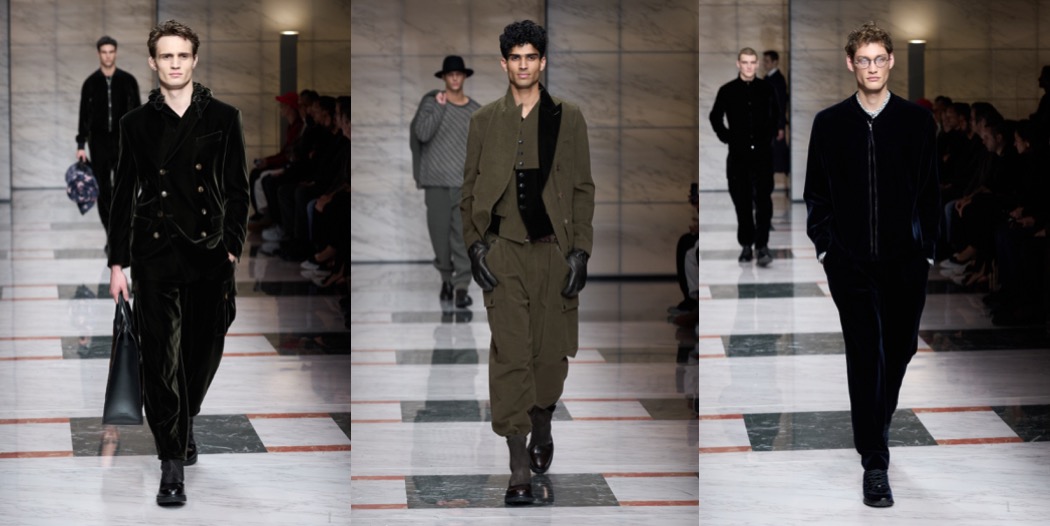
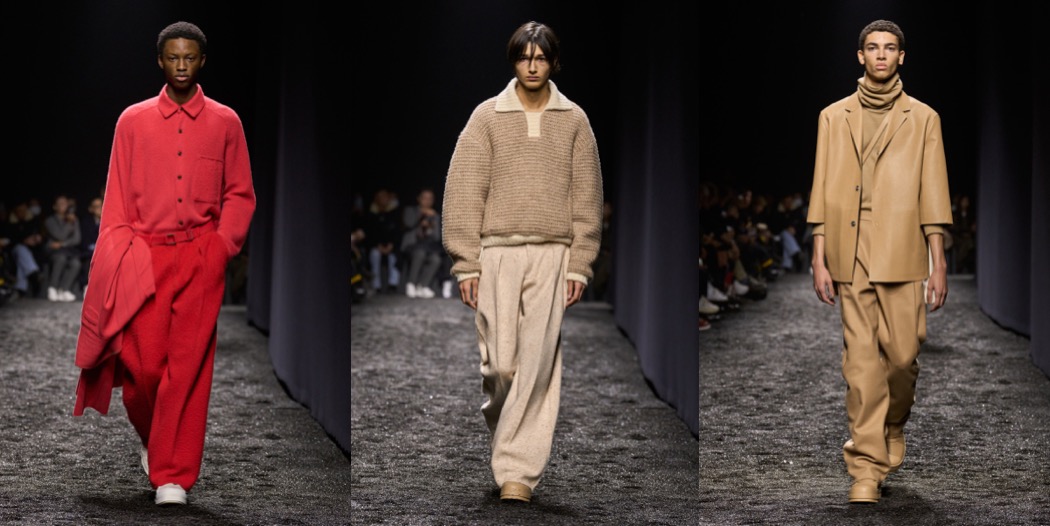
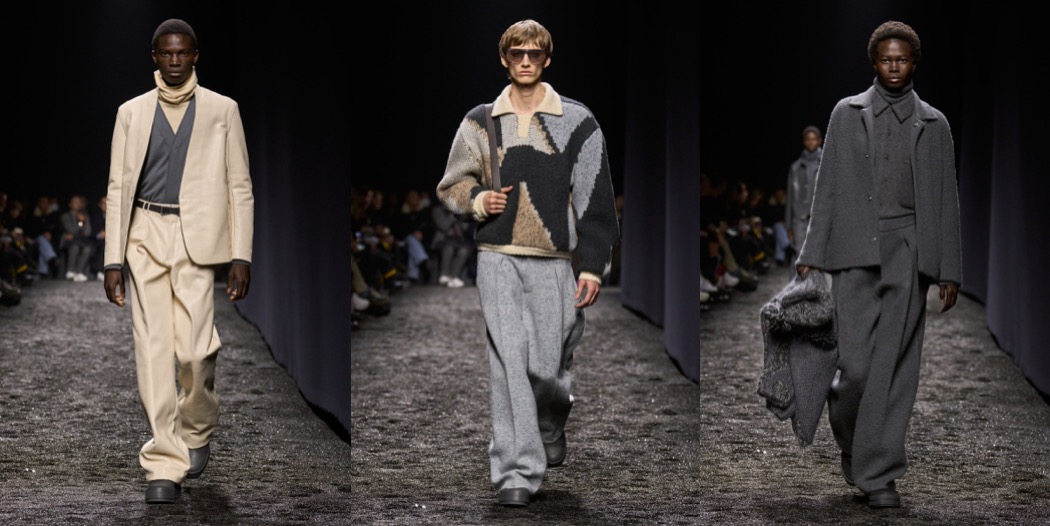
Alessandro Sartori’s lifelong study of fabric development and tailoring means that he is possibly uniquely qualified in his depth of technical knowledge as a fashion house creative director. And as the captain of Zegna, which has long been committed to vertical integration and material innovation, he is also uniquely placed to push forward the hardware of fabrication while developing his own fashion software. These attributes synced in a Zegna show that displayed the complementary relationship between both. Starting with the technical – without getting too technical – Sartori named the collection the Oasi of Cashmere as a nod to the house’s century old nature reserve as well as his ambition to broaden the fiber’s traditional application as yarn in knitwear in order to apply it in multiple fabrications. Those successfully achieved by Zegna and its owned-affiliates today included bobbled casentino, fluffy pile, sturdy bouclé, hardily rain-resistant wool-like melton, light flannel, and so many more that the house asserted that a full 70% of the runway garments here were cashmere. The remaining material was mostly recycled Zegna ‘Use The Existing’ wool, which was the chief protagonist especially in an opening gray section that employed chore coat, “tailored” (but construction free) jacket, and short-sleeved jacket as template shapers of top-half silhouettes. There was also a strong raw-hemmed collarless jacket in more recycled wool, this time undyed. Another early highlight included a hand-folded and painted leather jacket padded with down worn over a cashmere casentino shacket. The designer’s thriving template is currently based on a strong and consistent silhouette combining a wide leg-shape and a more form-fitting top half (at least when not layered with outerwear). Now the house is broadening its offer – without diluting quality – to give Zegna-heads infinite opportunity to add new elements to their wardrobe that will work in tandem with the old. Another upcoming opportunity – teased in look 21’s shirt and carried overcoat – will come when he reveals the fruits of a two-years-in-development collaboration with Greg Chait, of The Elder Statesman, in Paris next month.
All collages by Edward Kanarecki. Don’t forget to follow Design & Culture by Ed on Instagram!
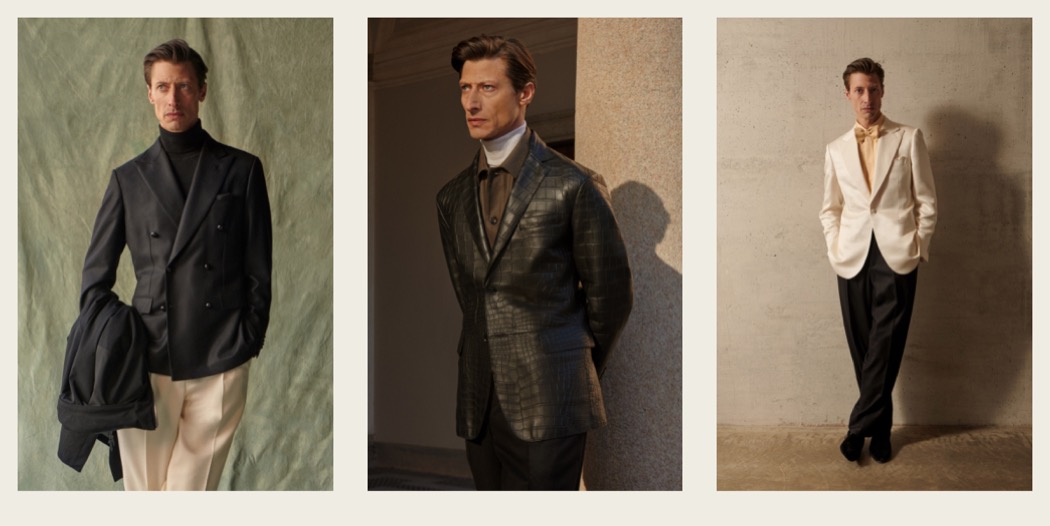
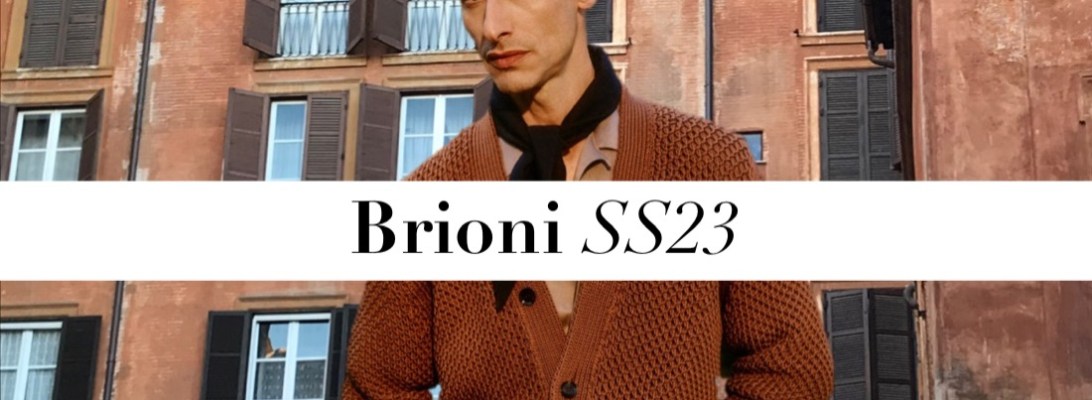
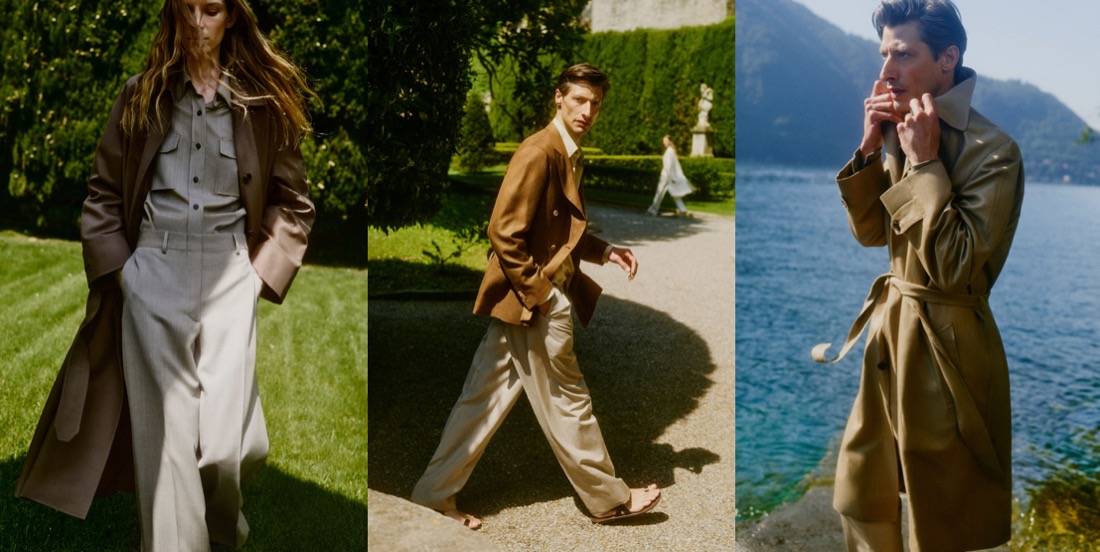
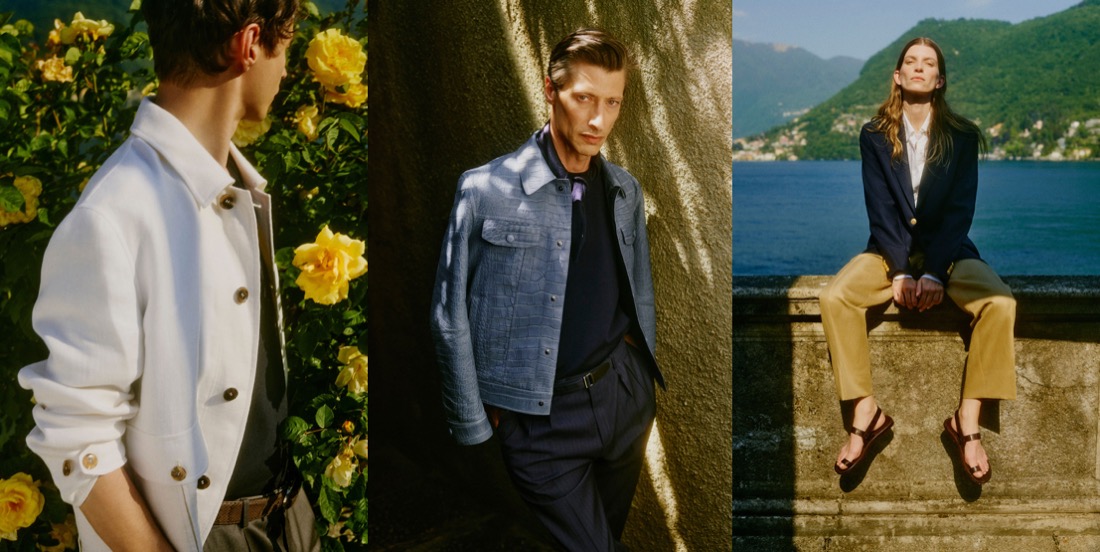
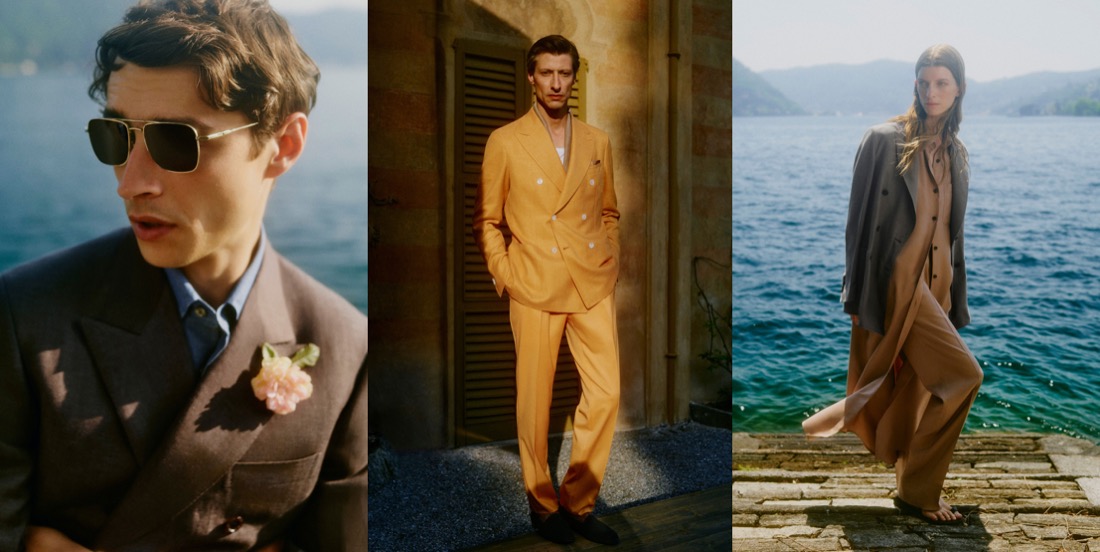
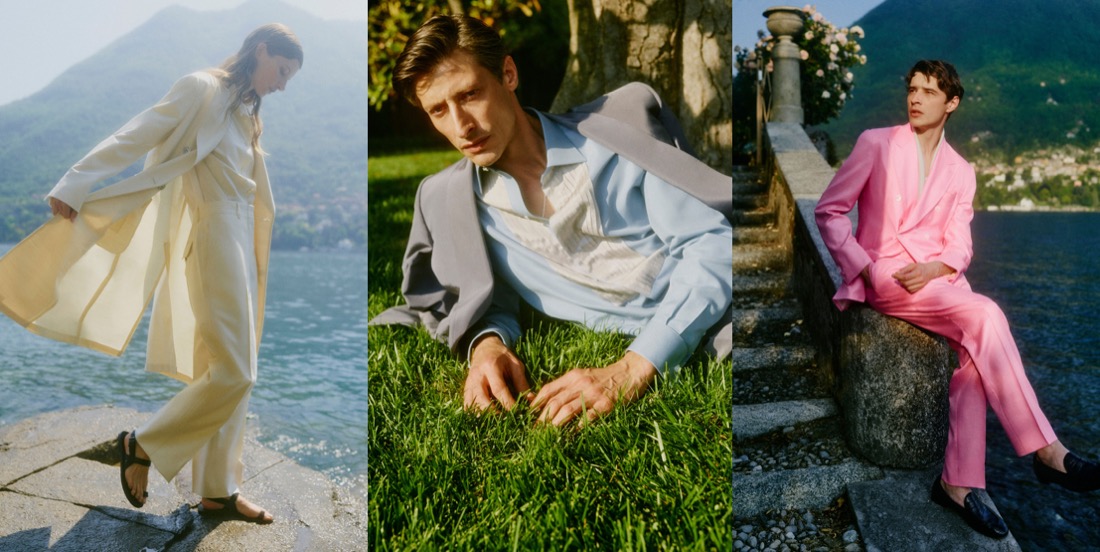
Norbert Stumpfl came across a mid-’50s newspaper with pictures of Brioni’s collections of that time: “They looked incredibly modern,” he said during his spring-summer 2023 presentation. ”They made tailored jackets out of jersey, trousers in leather, traditional masculine suits were made with sumptuous women’s evening wear fabrics.” This spirit of modernity is what he wanted to propose in the spring collection, presented in the verdant private cloisters in one of the hidden locations Milan is famous for. Expanding on the idea of individuality, Stumpfl offered an anecdote: “One of our young clients choose a pale pink suit to propose in,” he said. “It made me so happy, it felt so nice, and it was proof that Brioni is the go-to label to celebrate the most special and intimate moments.” The sentimental gesture of the young customer inspired him to draw the line: for spring, he said, “no business, no ties, but supple, formally informal tailoring for young men.” Playing on subtle contrasts, pajama suits were made in silk knitwear; blousons in matte crocodile felt as malleable as jumpers; a shirt’s fabrication, light as air, was used for an equally weightless unlined soft tailored suit. Reprising the house’s tradition of using women’s fabrications for menswear, a trench coat was made in satin de cuir, a heavenly smooth, sumptuous fabrics with a discreet, inconspicuous shine. Stretching the remarkable skills of Brioni’s tailors and artisans, a three-pieces suit was entirely made by hand as if it were a couture piece. But the jewels in the collection’s crown were the evening tuxedos, made in precious silk jacquard woven on antique looms by Setificio Leuciano, an historic artisanal company which was purveyor to the Royal Palace of Caserta. The edited women’s offer was as elegant and breezy as the men’s, with masculine silk shirts elongated to become a dress worn over soft straight pants, and ankle-grazing evening coats impeccably cut. Brioni is imbued with a quintessentially Roman mindset: lightness of spirit, a perfect eye for beauty, and the natural allure of nonchalance which comes from millennia of proximity with the world’s most stunning artifacts.
Collage by Edward Kanarecki. Don’t forget to follow Design & Culture by Ed on Instagram!
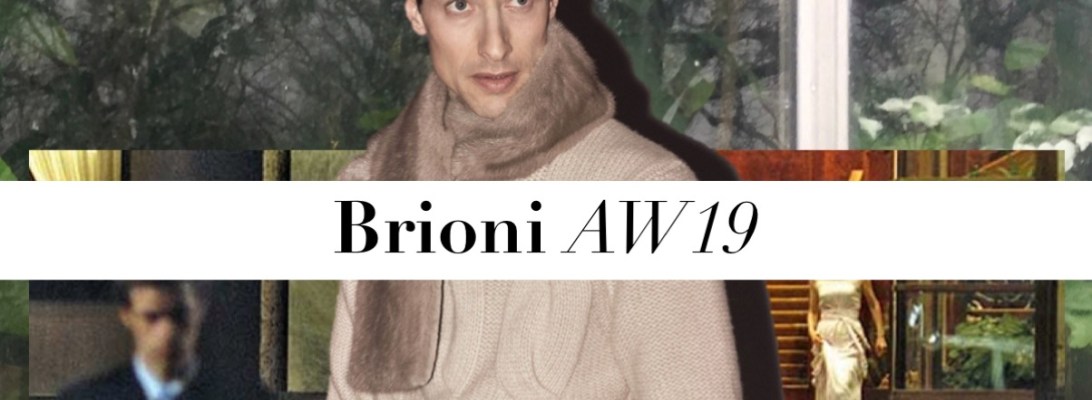
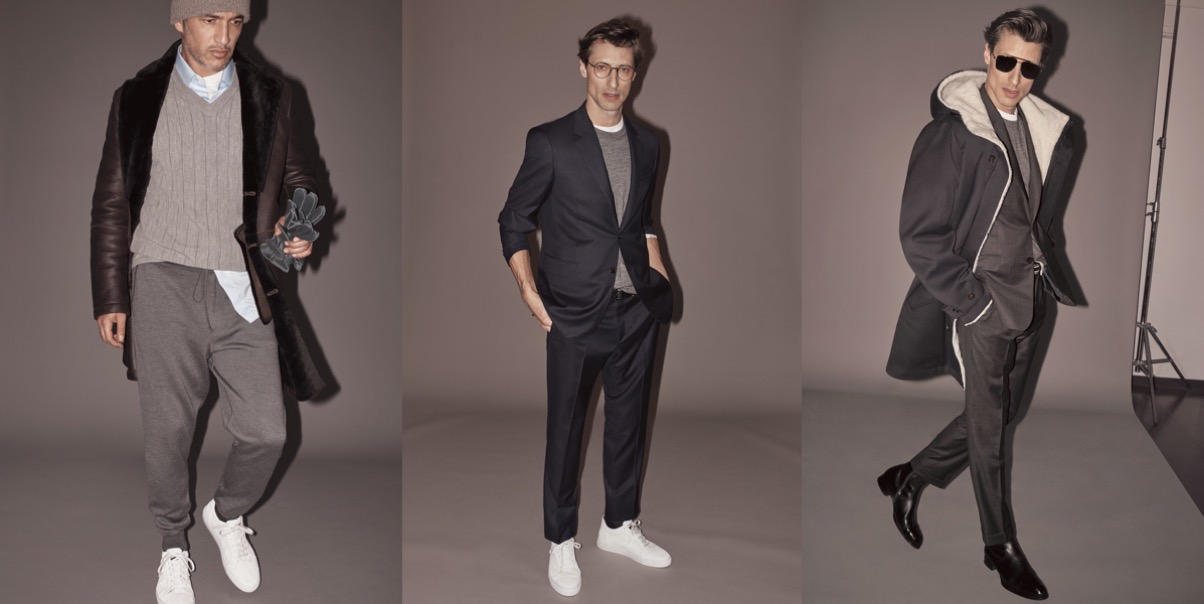
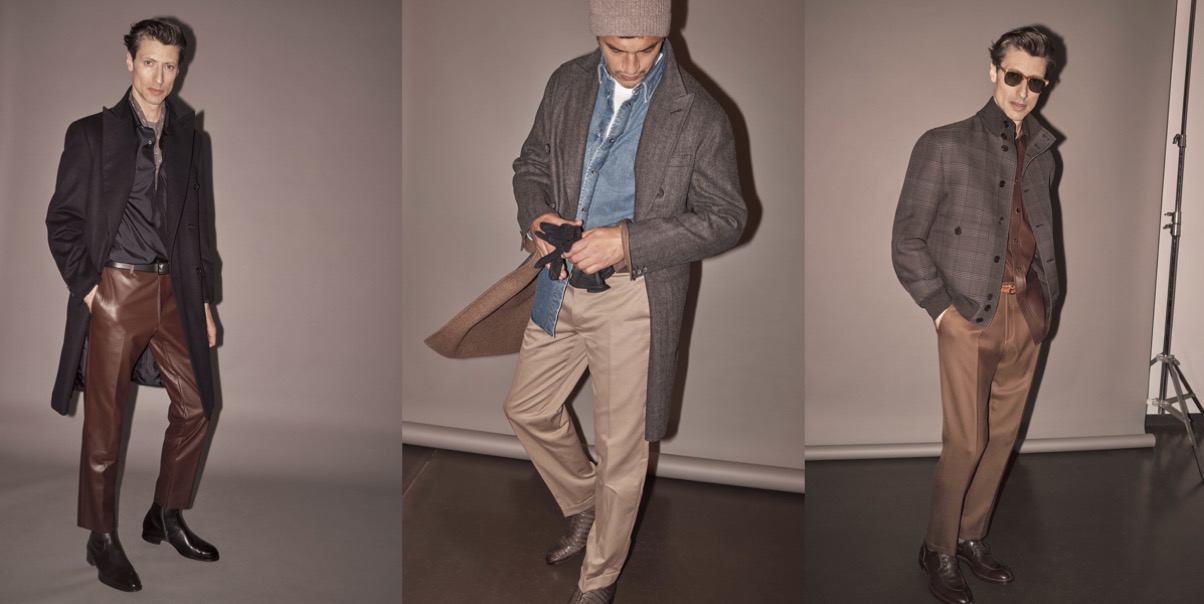
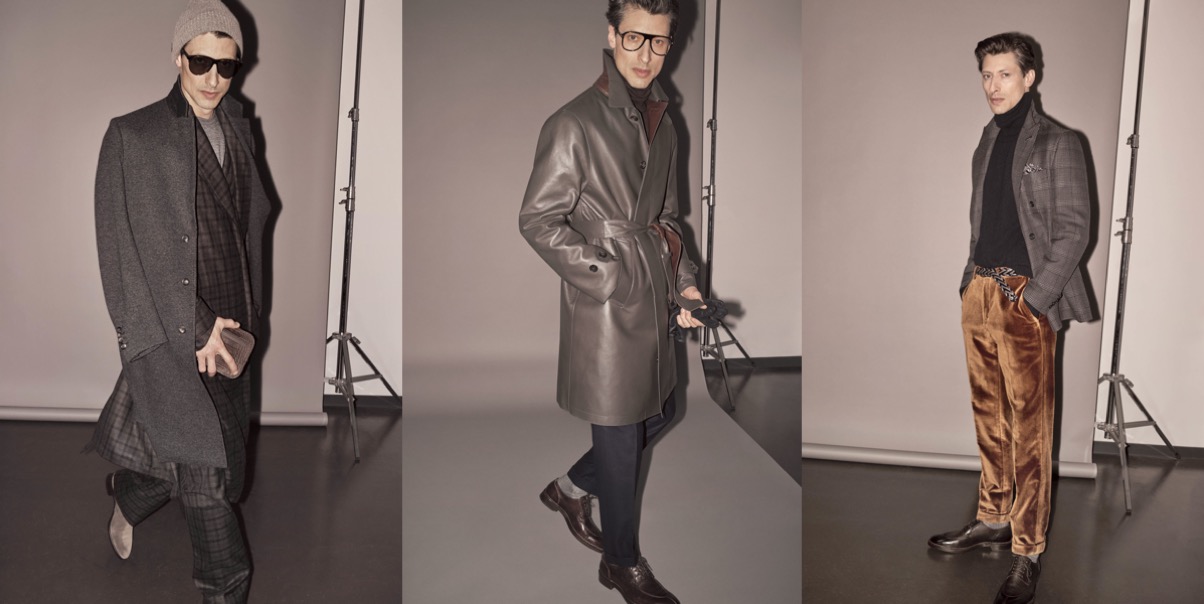
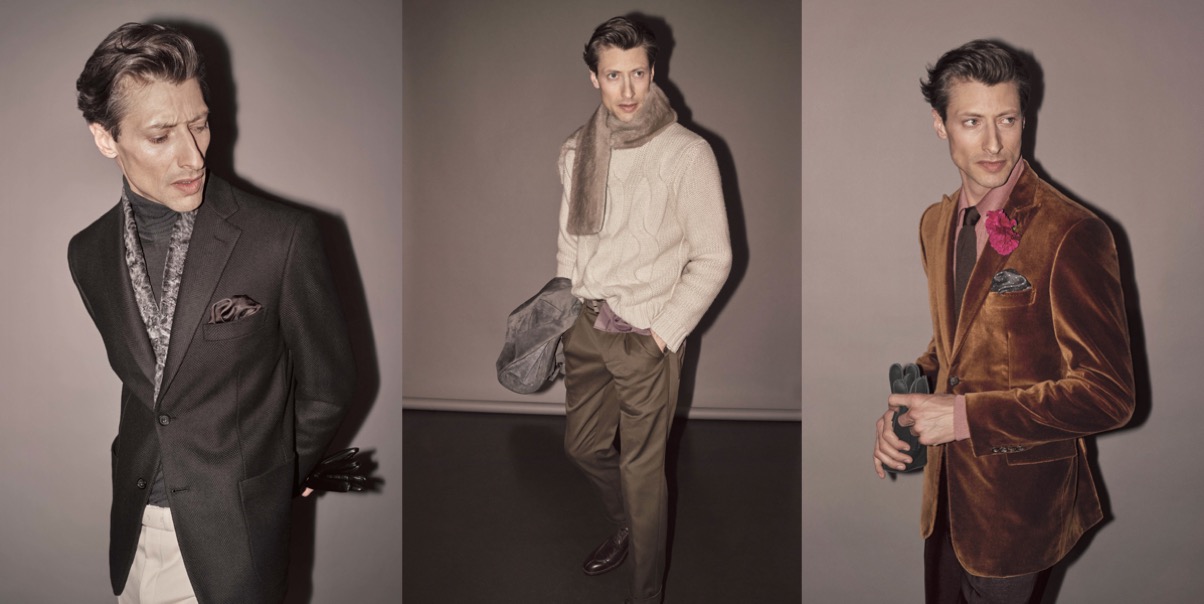
With the sudden rise of Jeff Goldblum and Daniel Day Lewis as the new style mavericks, it’s inevitable that zaddy (read: ‘stylish daddy’) style will hit top menswear brands this season. Brioni‘s autumn-winter 2019 look-book is the best evidence for this phenomenon, starring two mature models (who as well might not be models at all) and impressively good clothes. Well, it’s Brioni – quality and tailoring are the brand’s top priorities, so it would be quite disturbing if the Italian house didn’t do garments that make your jaw actually drop. Still, the label seemed to have an identity crisis for a moment: it had three different designers in the last three years (Justin O’Shea, Brendan Mullane, Nina-Maria Nitsche) and none of them got it entirely right. Norbert Stumpfl, who used to work at Haider Ackermann’s Berluti, Kim Jones’ Louis Vuitton and Lucas Ossendrijver’s Lanvin, can’t be a wrong choice with such major stints. Problem with a house like Brioni is that it’s small in the fashion world, but big in the world of money. The designer wants to do something intriguing, noteworthy, but then, he has to deliver fifty or more classical suits and dozens of crisp white shirts per season. In his debut, Stumpfl clearly highlights that he will be loyal to Brioni’s customer base, but won’t be scared of giving the brand a twist. His elegance isn’t stiff, but comfortable and warm. Just look at all the velvets, cashmeres, suedes, and Astrakhan furs appearing in the collection. The guys look incredible wearing Norbert’s dark-brown woollen coats and leather pants. It’s not like, you’re 50 looks in and you see the same damn thing. In 33 outfits, the designer serves looks from morning till evening, straight from a zaddy‘s wardrobe. Very rich zaddy, I guess.

















 Design & Culture by Ed