Motomami. Dion Lee SS23

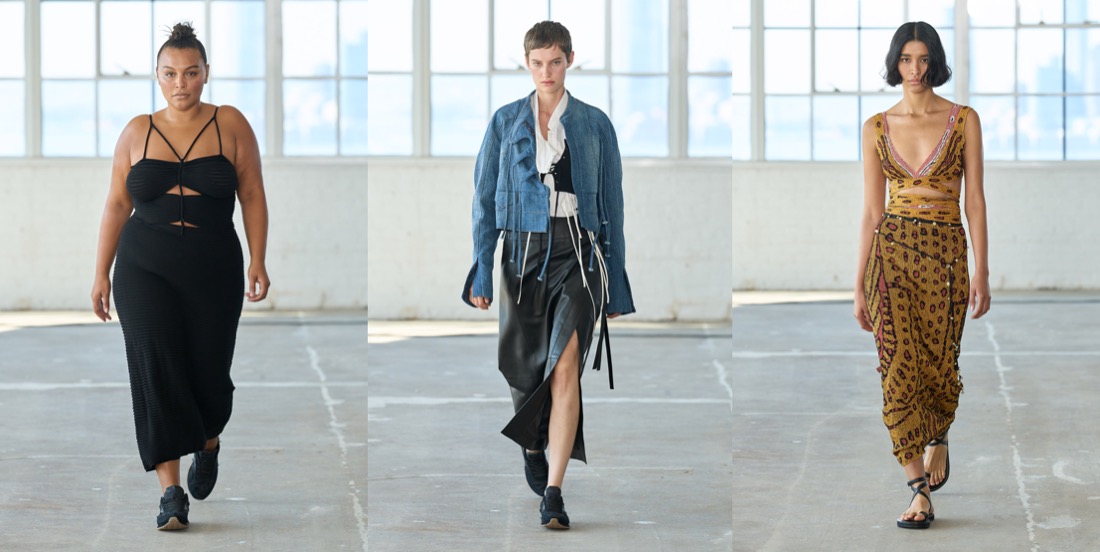
The scene at the Dion Lee spring-summer 2023 was like a look book by the New York–based Australian designer come to life. In the space a lineup of influencers, models, and more stood around in full looks by the brand. All tall, slender, and muscular. All very cool. All, of course, very Dion Lee. The label’s offering usually teeters between day and night. Its knits and cargos feel both rave ready and casual enough to wear during the day, while its miniskirts, leather separates, and dresses feel dressed up enough for an evening out – perfect for a day-to-night-to-day lifestyle. But for spring Lee expanded on both ends of the spectrum. His very chic and well-cut tailoring and denim (in a just-right, grayed-out wash) offered a more dressed-up daywear assortment, while his floor-length slinky knit dresses and skirts and metallic fringe separates introduced a true evening selection. Backstage after the show, Lee pointed out that this season he honed his interest in patterns of anatomy. “I like to place things on the body in a way that relates to the structure of our form,” he said in reference to his cutouts and layering. This is something Lee does extremely well. He understands the human shape, particularly the muscular and slender type he prioritizes in casting, and knows precisely what areas of the body to uncover or enhance. His clothes are incredibly sexy; they’re alluring and exact, aggressive but curiously inviting. It would be interesting to see him build around other body types, as one often sees his clothes out in the city, and they tend to adapt well to different shapes. Lee also experimented with moto language over the summer (perhaps a nod to Rosalía’s Motomami – he outfitted her tour). These padded and more industrial fabrications worked surprisingly well with his recurring monstera leaf motif, which now bleeds past tops and dresses into footwear and handbags. He said he looked to establish a relationship between nature and what he sees in his daily city life. The designer also introduced a scuba capsule, the bodysuit of which wouldn’t look out of place in a club – it’s Dion Lee, after all.

Collage by Edward Kanarecki.
Don’t forget to follow Design & Culture by Ed on Instagram!

NET-A-PORTER Limited

Sunlight. Marni SS23

The appearance of Italian brands on the New York Fashion Week schedule brought major action to the city. First Fendi kicked off the fashion marathon. Then, Marni‘s Francesco Risso delivered one of his finest collections for the brand to date. Making Marni’s NYC debut on a Brooklyn street nestled under a bridge, the trains audibly rumbling overhead, was a natural step for Risso, who has appreciated the city’s creative spirit for years. Everyone from Paloma Elsesser to Tyler Mitchell to Lara Stone appeared on the runway; a cast of models and friends walked to a live soundtrack written by Dev Hynes and performed by the String Orchestra of Brooklyn. Gorgeous, hallucinogenic, searingly bright colors; distressed mohair; papery leathers; mystical cobwebs of beads; and psychedelic panne velvets, the pieces punctuated every now and then by enormous and the chicest-ever squashy courier bags, their no-nonsense utilitarian shape turned off-kilter by their puffy aeration. The collection was a signature Marni line-up, but also felt very new-gen New York. “I’ve been wanting to explore for a while,” Risso said. “It means understanding things from a different perspective, connecting with different people. It feels refreshing. There’s a lot of learning as well, and I’m up for that every fucking second. Ever since America opened its borders last December I’ve been here, I don’t know, maybe 20 times. Still,” he went on, “it’s not really news, because everyone is out in some other realm in some way or other.”

Risso’s arrival stateside feels like it comes from a place of curiosity, of challenge, of risk: how can we get out of the moribund, straight-back-to-business way of doing things? The answer: maybe destabilize and decentralize it all, stop putting the designer on a pedestal, start to rethink all the relationships between brand, creator, audience, and those actually buying the stuff. Come together, join forces. “It’s not the ’90s anymore,” he said, “when brands spoke in very defined ways. Now you have to talk universally.” In regard to that last assertion, with his spring 2023 collection, Risso put his clothes where his mouth is. With a color palette inspired by the changing light over the course of a day in the Italian countryside (something he observed while holidaying in his homeland), he offered up a strong lineup that felt more streamlined and minimalistic than those he has done lately, despite the intense colorations and textures going on. Filmy rib knits contoured close to the body, some with “sleeves” trailing from the waistband or extra neckholes, which created circular décolleté cutouts, regardless of the gender wearing them. “The body is completely the protagonist in this collection,” Risso said. “Everything is built in jerseys, knitwear, things that, actually, go with the body rather than against it. Even the leather is the softest leather that exists.” The collection had other conceits based on the circle, be it the swooping looped trains on the dresses or the groovy abstract sunrises rendered on satin tees and minidresses. As for Risso, he is already thinking about where on earth the sun might rise on his next Marni collection. He’s in no rush to go back to Milan, not until the brand’s 30th anniversary in 2024 at least. Travel does more than just broaden the mind, in his view. “I can’t wait to be on the other side of the planet,” he said, “but, also, to see how it can burst the bubbles that we like to create in fashion.”

Collage by Edward Kanarecki.
Don’t forget to follow Design & Culture by Ed on Instagram!

NET-A-PORTER Limited

Magical Realism. Altuzarra SS23

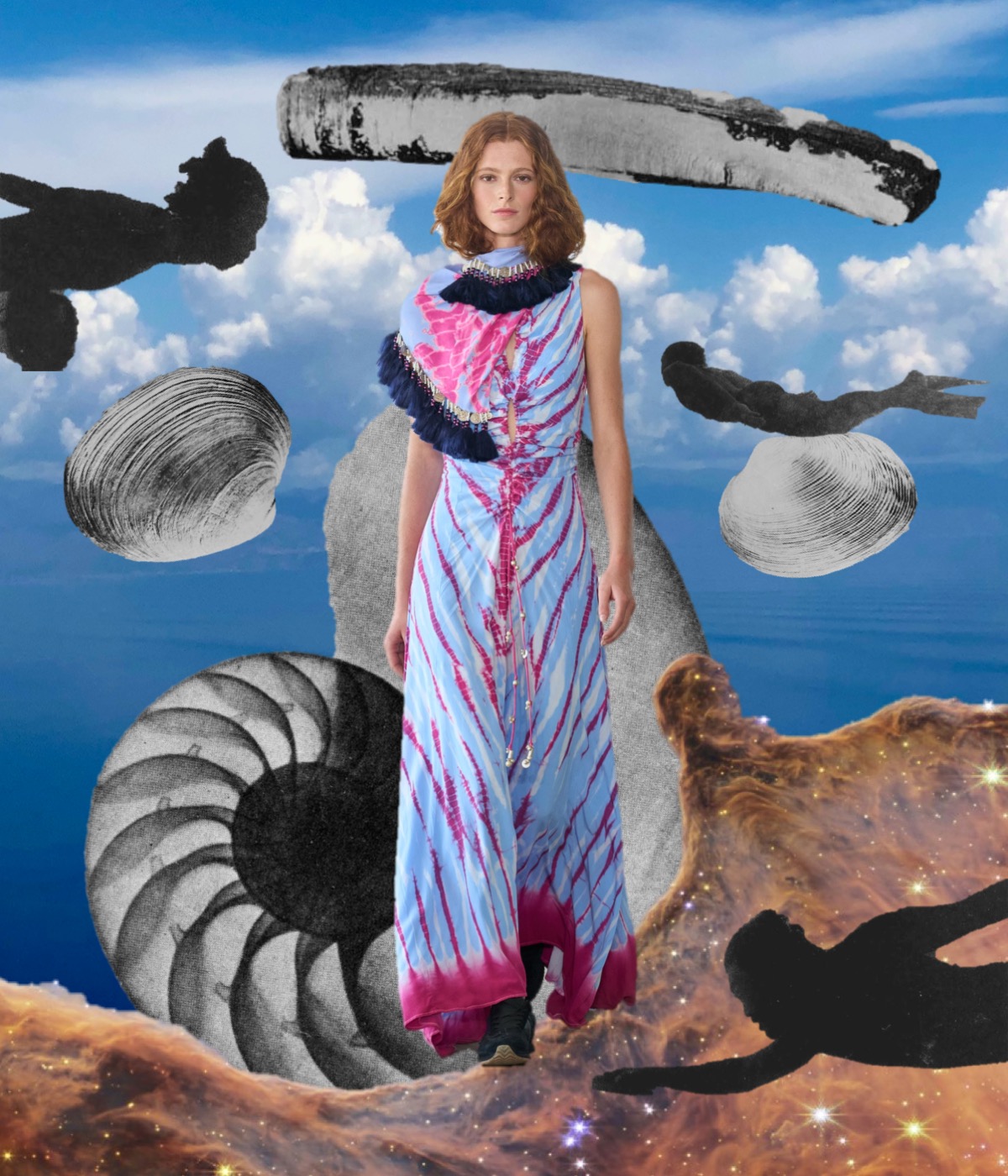
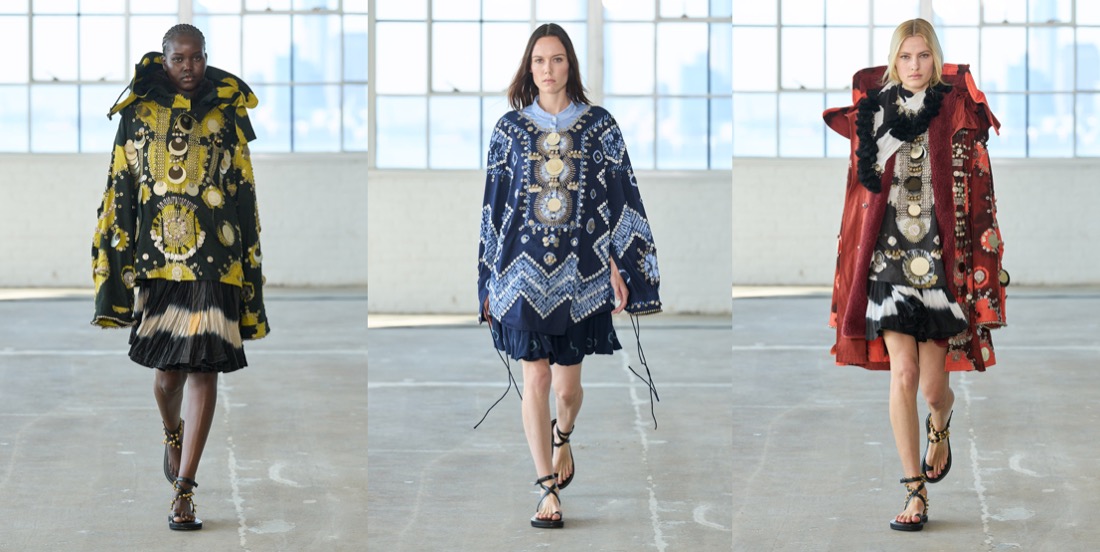
I haven’t seen an Altuzarra show in a while, but I follow Joseph Altuzarra‘s side project, Altu, which is a genderless label offering timeless essentials in a cool, off-duty, gritty aesthetic. To sum it up, it’s quite the opposite of the ultra-feminine style of the designer’s main label. But it seems to me that developing Altu let Joseph take a new perspective at Altuzarra. The spring-summer 2023 line-up shows a more relaxed, laid-back approach, and I like it. Well, maybe the first part of the collection is too isnpired with last summer’s Prada silhouette, but the second section is truly eye-pleasing. “The world feels so alien and scary. I’ve been interested in how people in the past have made sense of things,” Altuzarra said at a preview. “Finding tangible reasons for why things are happening is what people would do, and that’s what I’ve been expressing through the collections.” For spring he said he wanted to explore “this idea of a trip and nature as an entry point for psychedelic experiences.” A couple of books, The Teachings of Don Juan and Desert Solitaire, both written in the late ’60s and both delving into mysticism, proved inspirational. The show played out like a journey – or maybe a vision quest – starting with preppy-ish classics like striped shirts, cable sweaters, and minis that Altuzarra tweaked and twisted until they looked neither preppy nor classic. He topped them with boxy blazers or parkas, and accessorized the looks with retro Keds sneakers. The shibori-dyed dress of look 19 is where woman meets nature. Tie-dye and coin embroidery are two Altuzarra signatures, and he doubled down here, sending out a parade of exquisite dresses whose intricate craftsmanship is near unrivaled in New York. Most ambitious was the series of body-skimming numbers that were first tie-dyed, then pleated and twisted; their patterns looked like exotic skins. Other dresses were sewn first, then dyed. “It’s all done on a final garment. You basically can’t mess up, because if you do, you have to redo the whole thing,” he said. They take almost two months to make.

Collage by Edward Kanarecki.
Don’t forget to follow Design & Culture by Ed on Instagram!

NET-A-PORTER Limited

La Piazzetta. Emilio Pucci AW22

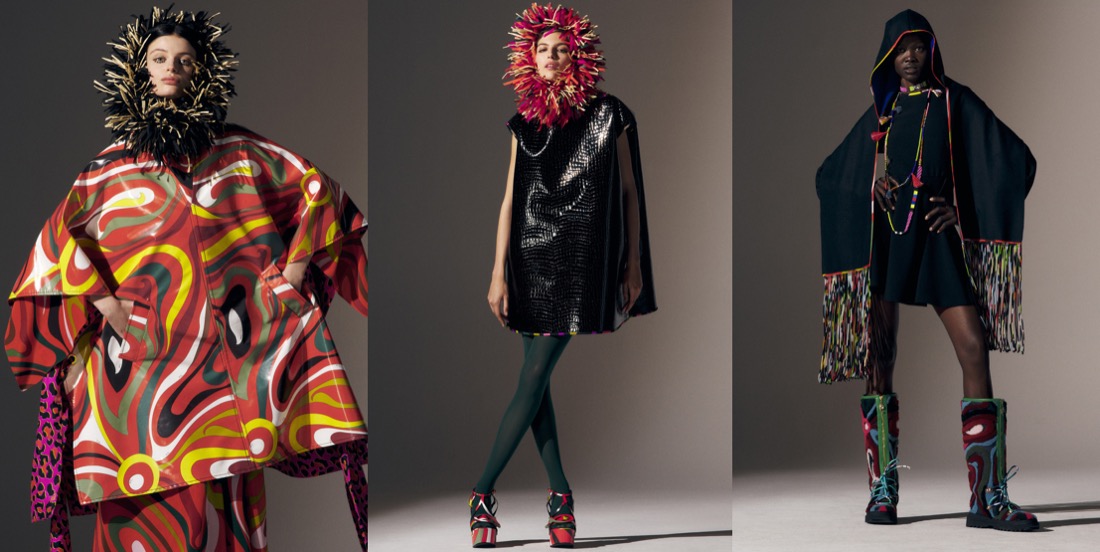
True to her Italian roots, Camille Miceli called Emilio Pucci’s winter collection La Piazzetta, hinting not only at Capri’s famous handkerchief-sized hotspot, but also at the notion of the city square as part of Italian culture, a space open to communality and connections. These values and the idea of la famiglia, another established building block of the Italian lifestyle, are the drivers Miceli is embracing to charge Pucci with a bold new energy. For her second collection for the brand, Miceli drew from her own family and circle of friends – a motley crew of characters, talents, and generations – generously sprinkling it with her abundant joie de vivre. “My Pucci woman is an urban bohemian, she loves to travel, she’s in constant movement,” she says. “It’s the mother, it’s the daughter, it’s the grandma – as long as they enjoy life, they’re part of the community of Pucci.” Festive, bold, and colorful, the collection keeps all the label’s fundamentals alive, while introducing a few novelty notes to the mix. Knitwear was a new addition, offered in a rainbow-colored capelet with an undulating hem, or in a fringed hand-knitted, patch-worked poncho worked with horizontal intarsia. Miceli said that she was “happy to have achieved something that is Pucci, without being logo-ed by the prints in a big way.” She also used black as a thread throughout the collection, using prints as pipings, side inserts, foulard ribbons, and fringes, while widening the color palette with “some more options that reflect its character without being necessarily full-on printed.” Fringes are a Miceli signature, as they “bring frivolity to the garment,” she explained. They also give the feel of the energy and glamour that is the quintessential combination of the Pucci-Miceli connection. The Pucci woman, whatever her age, is on the move, going around in activewear-inspired zippered blousons in shiny recycled nylon printed and tiny pleated printed kilts, and weathering rainy days in protective hooded waxed ponchos boasting the lysergic Marmo pattern.

Parties are the Pucci woman’s natural habitat, and Miceli wants her to shine under the discoballs. Leggings with disco ruffles are a tribute to the effervescent charm of Raffaella Carrà, an Italian showgirl famous in the ’80s who reminds the designer of her teenage years. Miceli’s affinity for the label’s high-style bohemia was conveyed in long printed chiffon dresses with ruffled décolletages, in more sinuous, body-con options wrapped in stoles, or else in leopard-printed satiny numbers – a new introduction as “Emilio only did zebra at the time,” said Miceli. Bravissimo!

Collage by Edward Kanarecki.
Don’t forget to follow Design & Culture by Ed on Instagram!

NET-A-PORTER Limited

Men’s – Tableau Vivant. KidSuper SS23

Look 21 in KidSuper‘s spring-summer 2023 collection – a half-realized, elusive portrait on a pink sweater and pale cords – was based on an original painting called Con Artist. It was one of 23 Colm Dillane paintings, which in turn inspired the 23 looks in his KidSuper collection that were auctioned off by Christie’s Lydia Fenet live during his show. As each model walked, the audience had its chance to bid. The big spender was Russ – a close friend of Dillane – who apparently walked away with several paintings including the night’s headline sale, The Girl That Breathes Life Into The Inanimate (Lot and Look 23). After a fierce bidding war, Fenet eventually banged her gavel after Russ’s $210,000 bid went unmatched. In total, the paintings ‘sold’ for $529,000. This was all in itself a piece of performance art designed ingeniously to stretch the boundaries of the fashion show as visual theater. Dillane said afterwards that as he’d prepared for his first on-schedule Paris show, he’d been to some others and had been struck by the divide between audience and subject. “And I was like, how do I get people to interact and participate, and make it an experience. And I had always wanted to do an art show as a fashion show. And thinking about participation in an art show, that’s where the auction idea came from.” The auction was designed to animate the fashion show through artistic intervention. It was clever, fun, and funny. Apart from the clues to the process we were subject to in the names of some of the paintings, Fenet – who is absolutely masterful at extracting serious sums of money with the lightest of rhetorical touches – was apparently representing an auctioneer named Superby’s. We got no indication of her commission. When the final painting – named The Finale – emerged stretched on its frame, there was a hole where the on-canvas face of one of its subjects “should” have been. A model’s painted face loomed through it. Just as Fenet’s gavel went down, the canvas whisked from the frame to reveal itself as the upper layer in her tulle pentimento dress. This show raised many interesting ideas, including the notion of clothing reproduced with original artworks acting as wearable editions of those pieces.

Collage by Edward Kanarecki.
Don’t forget to follow Design & Culture by Ed on Instagram!

NET-A-PORTER Limited