
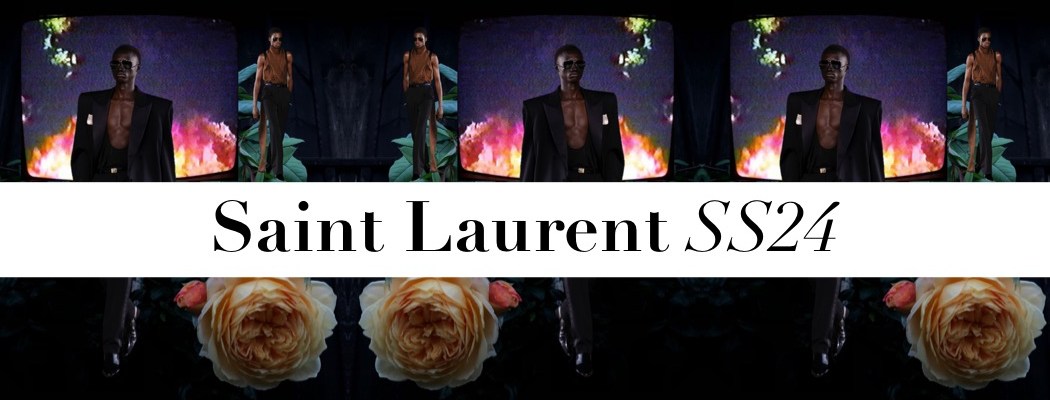

Anthony Vaccarello took Saint Laurent to Berlin, the city of Lydia Tár and Helmut Newton. The first signs as to where the designer was going with his spring-summer 2024 men’s show – a miracle of impressive tailoring broad in the shoulders and attenuated in the legs, interspersed with yet more shoulders, nakedly fragile this time, framed by gossamer silk or chiffon sleeveless shirting – was to be found on Instagram. A brief clip of the 1950 French short film, Un Chant d’Amour, a grainy black and white ode to sensuality as much to criminality, and directed by the writer Jean Genet, delivered the first vibes. Vaccarello also mentioned the name of the collection: Each Man Kills the Things He Loves. The title was, by way of Oscar Wilde, the song sung by Jeanne Moreau in a movie adaptation of one of the French writer’s great novels, Querelle de Brest. It was later filmed in 1982 by Rainer Werner Fassbinder simply as Querelle. Et voila, there you have it: Moreau, an icon of the French nouvelle vague, as Parisian as, well, Yves Saint Laurent, and Fassbinder, one of Berlin’s most legendary directors, a man who knew a thing or two about dissonant sexuality and the power between men and women as much as, well, again, Saint Laurent.
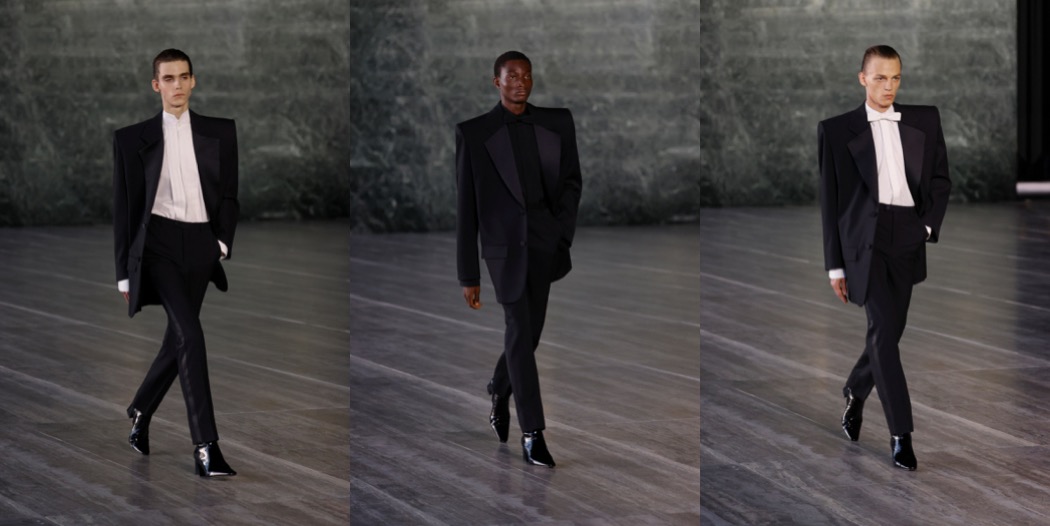


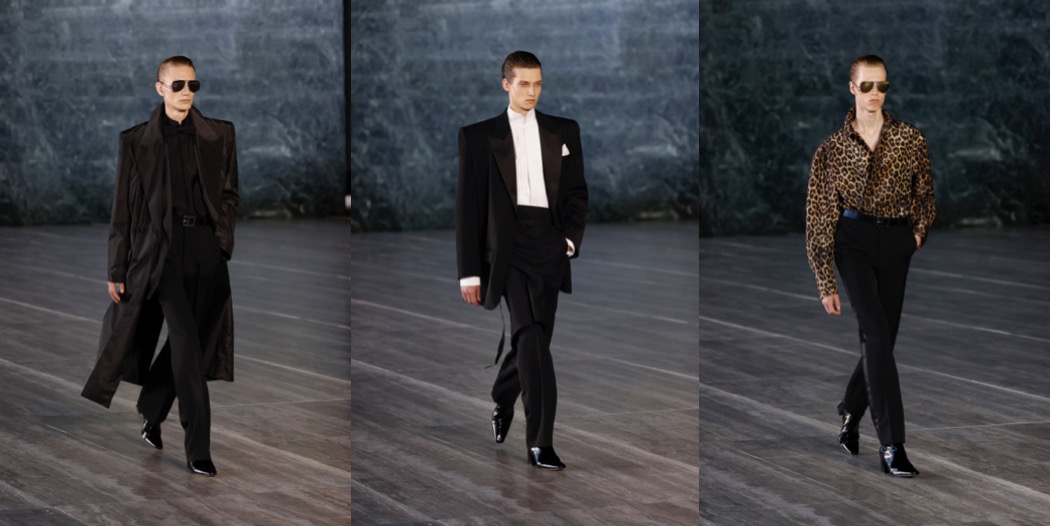
Still, what Vaccarello showed this Monday was far, far more than a clue-laden trail of reference A to B. He himself might have Berlin as part of his own personal landscape of the past – as a student in Brussels back in the day, he would hit the city’s still-going-at-noon-the-next-day nightclubs – but in many respects, this impressive and assured outing wasn’t only about the city. While there might be deft and nimble references to each locale, with each carrying a certain resonance in the YSL universe, this was, once again, Vaccarello in superbly rigorous mode, an approach echoed by his choice of venue, the structural precision of the Mies van der Rohe-designed Neue Nationalgalerie (my favourite museum in Berlin!). “When you leave the show, I want you to have the silhouette clearly in your head,” he said backstage. In other words, it’s a design approach that’s thoughtful, concise, and intent on stripping away the fuss to the perfect distillation of 50 looks, exploring – and what could be more YSL than this? – the exquisite tension between tailleur, aka suiting, and flou, all that light-as-air, fluid, sensual soft dressing, of which there was plenty in this men’s show. The exchange between his women’s and his men’s played out in delicate slipper satin tanks with deep décolletés under swaggering jackets, the matching pants cut high and narrow at the waist (ooof: breathe in!) and sliced at the ankles to show off high chunky-heeled boots. In leopard spots or polka dots (two recurring leitmotifs here) as sensually wrapped shirts or as one-shouldered tops, their bow-tie necklines trailing southwards like veils. And in prosaic black sweatshirting transformed into couture-y evening looks, draped to slide off the shoulders, with a new laidback version of smoking pants. An honorable mention too to the myriad sublime tuxedos that opened and closed this show. They also followed the impressively shouldered and roomy line of his jackets and the narrowness of the trousers. With their bow ties and high-collared shirts, and distinctly androgyne chic, they gave a bit of a Tár vibe.


Collage by Edward Kanarecki.
Don’t forget to follow Design & Culture by Ed on Instagram! By the way, did you know that I’ve started a newsletter called Ed’s Dispatch? Click here to subscribe!


 Design & Culture by Ed