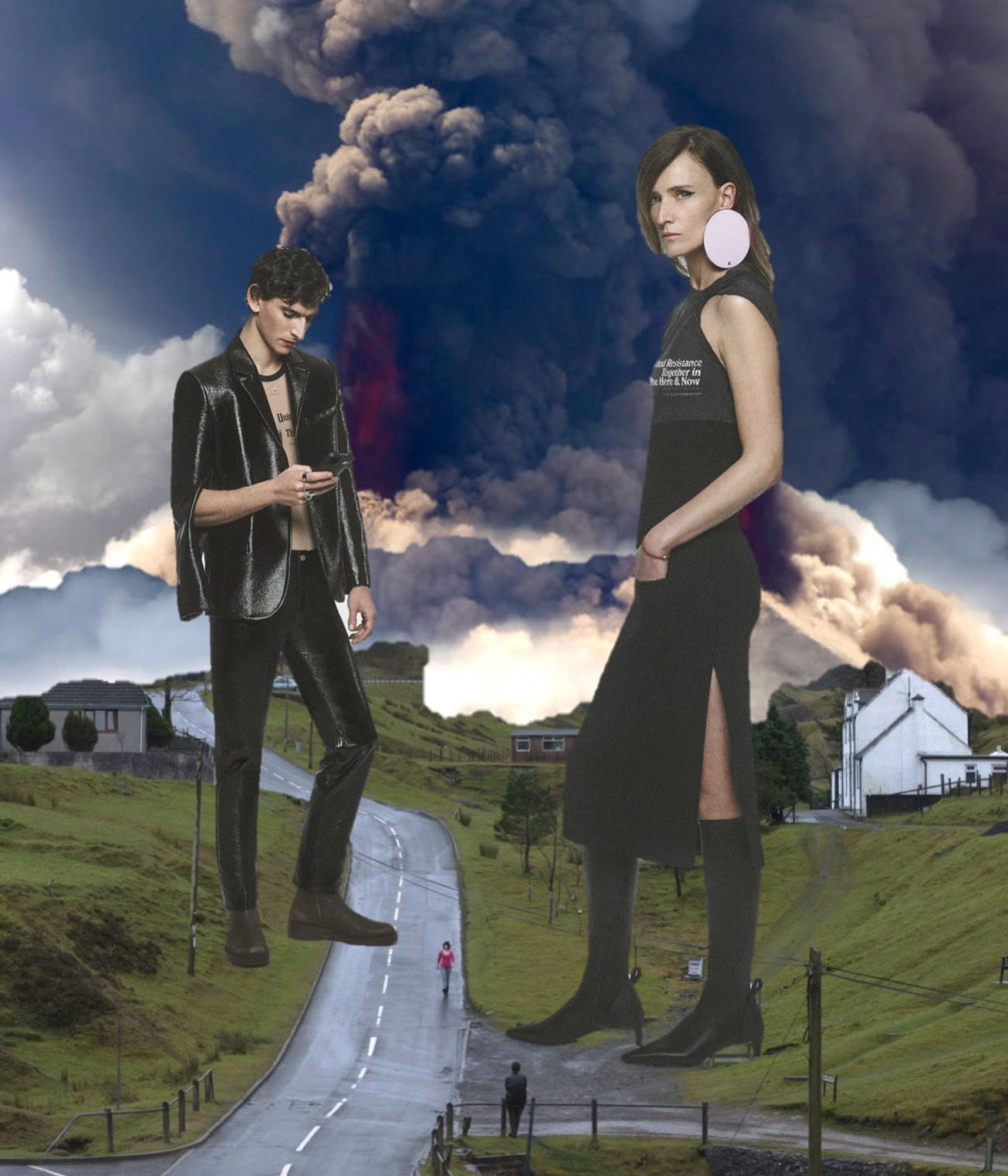
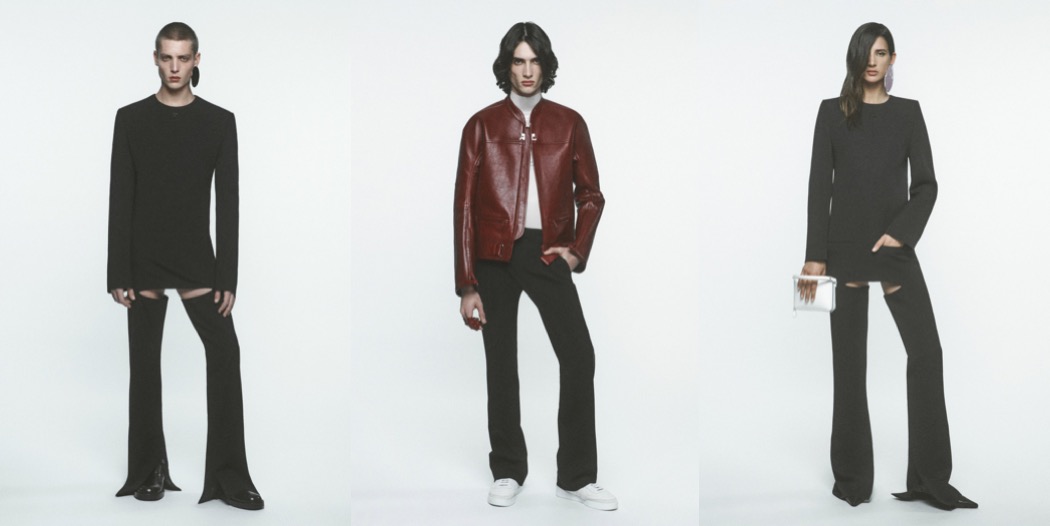
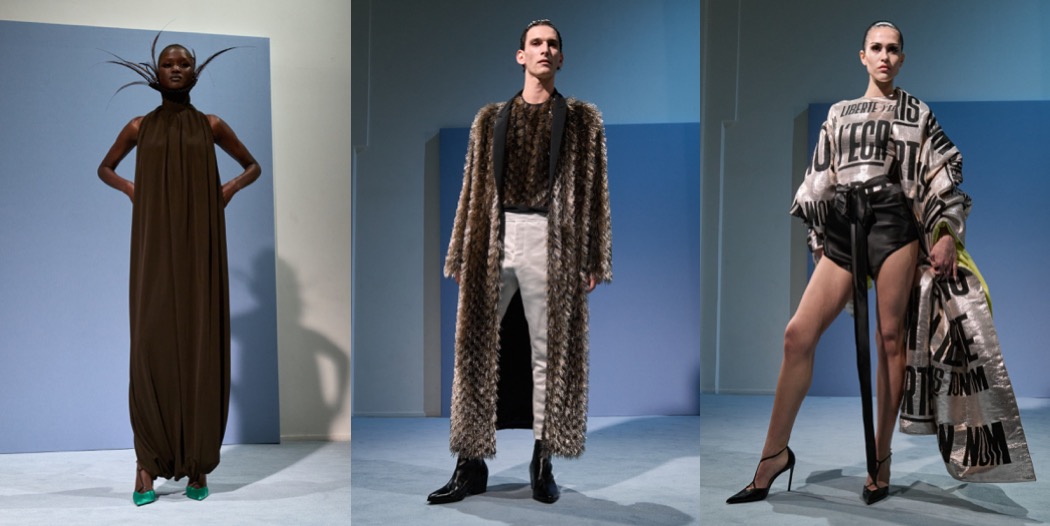
Courrèges is gradually becoming a brand with a contemporary feel that offers some truly desirable clothes. All that thanks to Nicolas Di Felice, who with every season redefines what this French label is to a modern-day audience. The most important aspect the designer orbits around is the functionality of clothes seen through the lens of social observation. In the men’s autumn-winter 2023 (and women’s pre-fall) line-up, his thought process was triggered by watching the phenomenon of people hunching over their phones. “I’m really working on kind of a new silhouette that is really, like, bending,” he said. “It really seems like nothing, but actually it’s something, this reflection of us on our phones.” Somehow, that idea bloomed into a sexy and cool wardrobe. Technically, Felice’s inspiration of the staring-at-screens impact on human posture brought about a slight forward-tilt of the shoulder line – and the ingenious idea of inserting an invisible zipper extending to the elbow on the inside of tailored sleeves, “so you don’t have to ruin you clothes!” The lines of Courrèges are sharp, mostly dark, and cleverly sliced by Di Felice to adapt the original space-age minimalism of the founder for the new generation. That’s another of his talents: witness what he’s named “mini-skirt pants.” It looks like a plain black long-sleeved tunic, but there’s a narrow gap, high up on the thigh; a flash of flesh where the hem meets the pants. An incendiary item he proposes for all genders. Très cool.
Collage by Edward Kanarecki. Don’t forget to follow Design & Culture by Ed on Instagram!
Back in the 80s and 90s, nobody did a (fashion) show like Thierry Mugler. In 2023, Mugler, the brand, lead by Casey Cadwallader, delivers an equal level of showmanship. “We’re showing during couture week because we’re bad. At Mugler we do whatever we want,” the designer stated before the choreographed mayhem kicked off. “We’re quite an outlier in the way we do things,” he added. What went down: a runway frenzy that idolized the talents and bodies of models and friends of the house simultaneously merged with live-captured dolly footage of said models and friends, which was consumed on a vast screen erected at the top of a set of stairs. And all over the internet, obviously. Crews of men on movie dollies slid on tracks filming the wildly whooped-at cast: Arca, Ziwe, Mariacarla Boscono, Shalom Harlow, Eva Herzigova, just to name few. There was hair swishing galore. A synchronized handbag-swinging lace-bodysuited dance troupe occupied some center steps. Then one by one, each Mugler supermodel climbed aboard another dolly, on which they could pose around a pole for the return journey. This second crew had a low-down camera which zoomed up crotch-wards, deploying a technique which might be termed up-skirting – had there been any skirts in evidence. Magnified on the monolithic screen, these oooh-aaah fragments were flashed in a live-streamed mix. What about the fashion content? Categorizing it as a collection of leather and lace doesn’t quite cover it. One thing to be said: Whether manifesting as baggy-topped leather chaps suspended under a hip-grazing heavy-duty chrome-zippered bodysuit, or a bisected one-leg, one-sleeve motorcycle suit, or indeed anything Cadwallader did with stretch black lace – it all miraculously stayed in place. And that is quite a technical achievement. It’s tricky to compare Cadwallader’s Mugler with Manfred Thierry Mugler’s original haute couture extravaganzas. In 2023, as far as being inclusive to bodies and identities, Cadwallader for sure outdoes the master. But Mugler was the outlier in his time: the man who foresaw fashion shows as cinematic spectacles. It’s a great continuation of the legacy.
Collage by Edward Kanarecki. Don’t forget to follow Design & Culture by Ed on Instagram!
“I want to do lightness because for me, couture always seems quite staid and heavy,” Kim Jones said regarding his Fendi spring-summer 2023 couture offering. “I wanted a floatiness. Elegant but youthful.” Jones also added that this collection was “a continuation” of his autumn couture, and a response to Fendi clients’ requests for evening dresses. What he offered was a discreetly modernized redefinion of statuesque goddess-dressing: slim silhouettes, in pale evanescent colors, 1930s style. You could barely tell that some of the silvered dresses which had overlaid printed lace-patterns, a bit like tablecloths, were leather, decorated with scanned-in prints. Or the glinting “chain-mail” gloves. “I wanted to really work with the couture techniques,” Jones said. “What they can do now is so advanced.” The concept of the swoops and drapery lightly referenced an archival Karl Lagerfeld for Fendi silk dress that Jones had studied; a glancing echo of the classical staturary of Rome, of course. Jones layered it over delicate constructs of lace-edged silk bras and slips. It’s all very pretty. But while Jones’s work blooms and evolves at Dior Men, his Fendi’s womenswear feels too reserved and steeped in comfort zone.
Collage by Edward Kanarecki. Don’t forget to follow Design & Culture by Ed on Instagram!
This season, Pierpaolo Piccioli took Valentino haute couture to the club, leaving behind the highly elevated feeling he so succesfully conveyed in the last couple or years. His venue, at night, was a famous Paris joint under the Pont Alexandre. His point about standing for inclusivity is definitely intended to be heard by the wider world of young people. “Of course, I love it that haute couture is about the magic of impossible challenges,” he began. “Of course it’s about craft, and we talk about that all the time, but I also love it when couture feels effortless. It’s all about the feeling of having something for yourself. It’s kind of democratic in a way, in the idea of showing this freedom of being whoever you want to be.” On his inspiration board were photos of clubs in the 1980s, ranging from Studio 54 to London’s New Romantic Blitz Club, the Club For Heroes one-nighter and the Taboo, hosted by the outrageous performance artist Leigh Bowery. What all these scenes, underground or jet-set, had in common was that they were hotbeds for generating fashion and havens for what used to be called ‘gender-bending.’ “The difference was that then, it was behind closed doors. Now it’s something we have for life. It’s today’s way of freedom,” he argued. “So I love the idea of a club, but it’s a club for today. Thinking of inclusivity as welcoming people for who they are, and who they want to be. So it’s invitation to be free to be what you want ro be, mixed with the codes of Mr. Valentino in the ’80s.” Still, haute couture formalities were observed in a way – Valentino’s creatures of the night weren’t presented as a wild crowd of dancers, but as models walking on a runway, haute couture standards of solemnity preserved. What emerged from the darkness were pops of color, dark Parisian sexy black transparent lingerie dresses, and many varieties of strategic body-exposure. In 89 looks, Piccioli put forward individualism in tiny pelmet skirts or cutaway bodysuits implanted with giant bows worn with floor-trailing capes, a dress with cutout polkadot portholes, and white shirts and ties styled with micro-minis (one with a dramatic red sequin trench). In overall this wasn’t my favorite Valentino couture moment, but Piccioli definitely had some working on it.
Collage by Edward Kanarecki. Don’t forget to follow Design & Culture by Ed on Instagram!
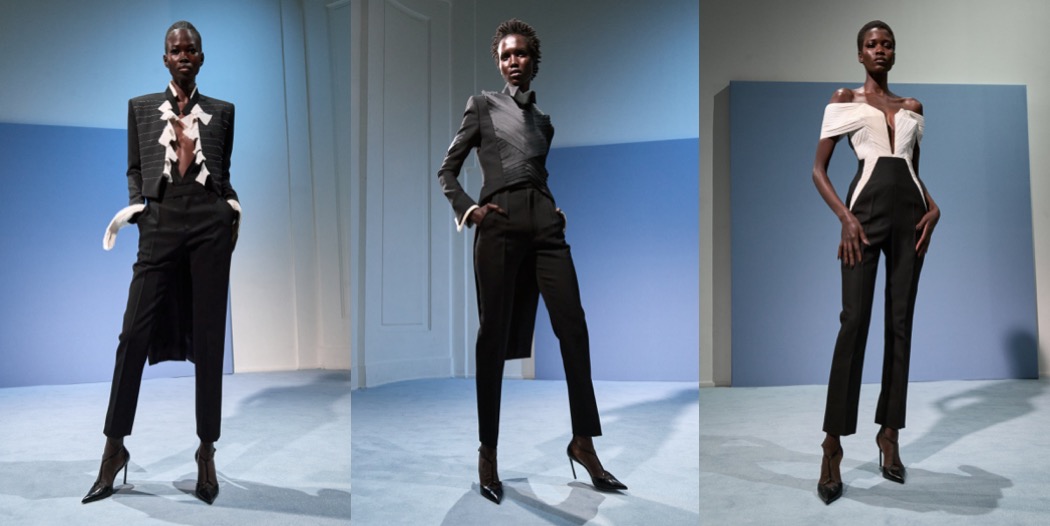
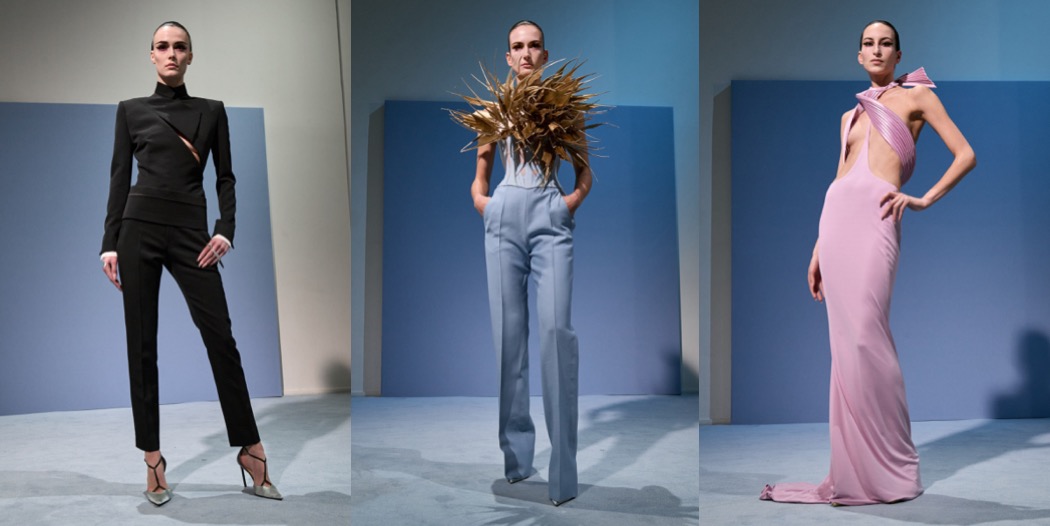
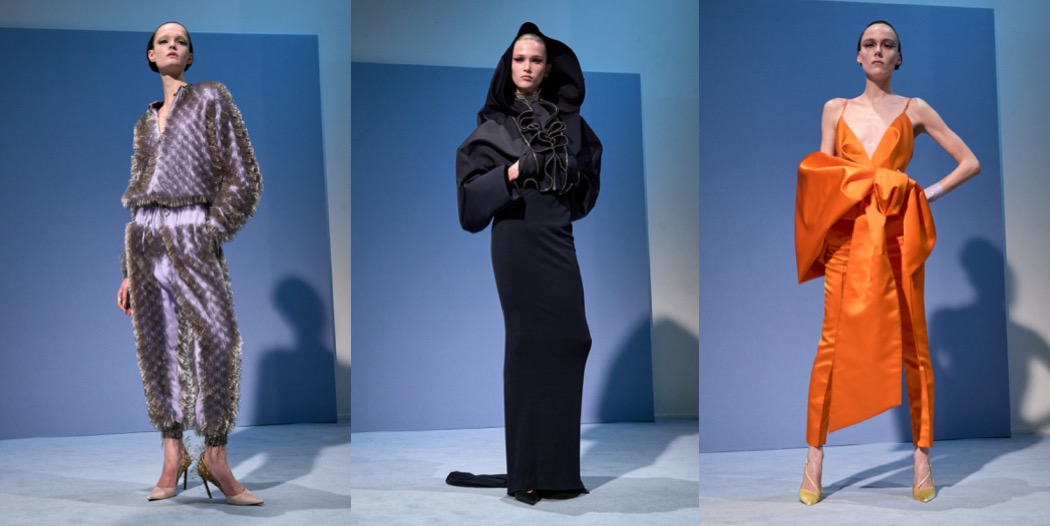
Oh Haider, we’ve missed you. The news of Haider Ackermann being the next guest designer for Jean Paul Gaultier‘s haute couture dialogue felt unreal. Until the first model appeared on the ice-blue carpet under the roof of Gaultier’s house. Everything came together: the sense of the haute values of design being the point of it. The models who really delivered a show and poses. Gaultier’s haute couture house ateliers who expressed it in body-sharp tailoring, and crisply-scissored drape. And of course Haider Ackermann, the designer who with his signature style and incredible artistry could lead a couple of snoozy Parisian houses (Givenchy, for instance). Ackermann is the fourth of the designers to have been tapped on the shoulder for a one-season collaboration, since Gaultier retired. He follows Olivier Rousteing of Balmain, Glenn Martens of Y/Project, and Chitose Abe of Sacai. Ackermann, the most grown-up guest thus far, was perhaps aesthetically the least likely yet to have been invited to respond to Gaultier’s storied metier. As he admitted just before the show, “I don’t have a sense of humor at all! I have my gravity, and he has his generosity and joy – we are two worlds apart. But at the same time, we have many things in common. Because we both love women, we adore women, respect women.” The convergence he found began with Gaultier’s tailoring. “To go back to the essence of his work, which was perfect. People forget how immaculate his tailoring was. His work was magical. So I tried to go back to the pure lines, to find a calmness and moment of grace. Because I believe his work was magical.” When the women began to walk out, they slowly and with a deliberate collectivity embodied the spirit of old-world couture stances, pausing to strike poses in front of photographers as if they were in an Irving Penn shoot. The pace and the intimacy of the staging meant that every single lingering silhouette and detail could be taken in close-up. The whiteness of the cuffs on immaculate black trouser suits, cut sometimes with tailcoats and conceptual plackets of frogging, sometimes reduced to pure minimal outline. One skinny-trousered two-piece came with a diagonal slash across the jacket and a hip-level obi-cummerbund – a stunning aesthetic fusion of Ackermann and Gaultier in one look. On top of that, Ackermann proved himself as a colorist and a dressmaker, draping extraordinary serpentine gowns and varieties of chic coat dresses with contrasting linings. It made it sink in how rare it is these days that outstanding drama and chic minimalism go together. Somehow, high fashion now has a need for being loud and gimmick-y. This, without turning backwards or being in the least camp, made a progressive case for the sensational powers of haute couture in the modern world. That was Ackermann’s intention: to bring the subject of haute couture back to the clothes. He did that superbly. “I knew Jean Paul liked my work, but I never thought this would come my way. I’m already a long time in business. It’s usually like, okay, give it to the younger ones,” he said. “And so, to design is one of the most wonderful feelings. I really love my job, and this made me love it even more. It’s been like a love affair between me, and the ladies in the atelier.” The arrangement with the house is for one season only. “It makes me sad to leave all this behind. But if I’ve created 10 minutes of grace when everyone can forget about their problems, and I’ve honored Monsieur, and something that’s also necessary for fashion in 2023, then I’ll be happy.”
Collage by Edward Kanarecki. Don’t forget to follow Design & Culture by Ed on Instagram!