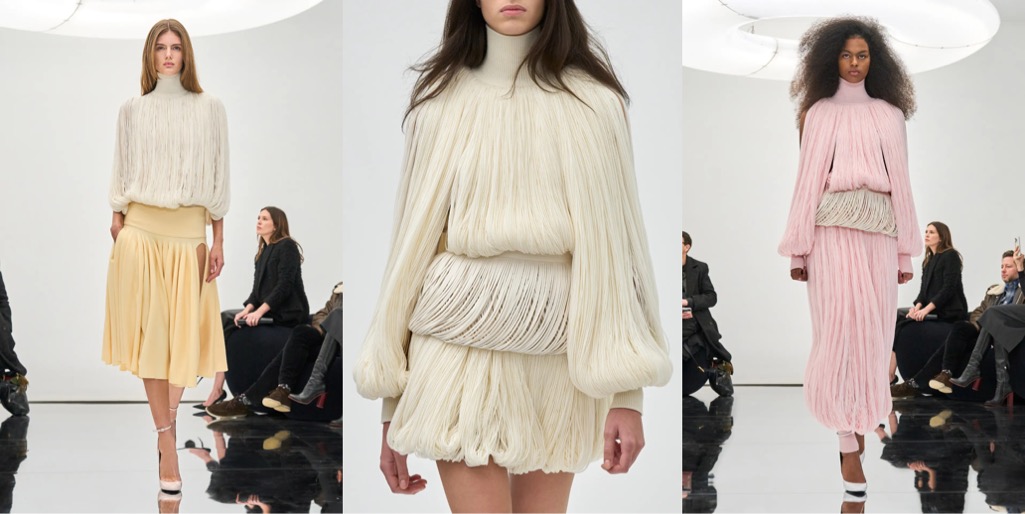
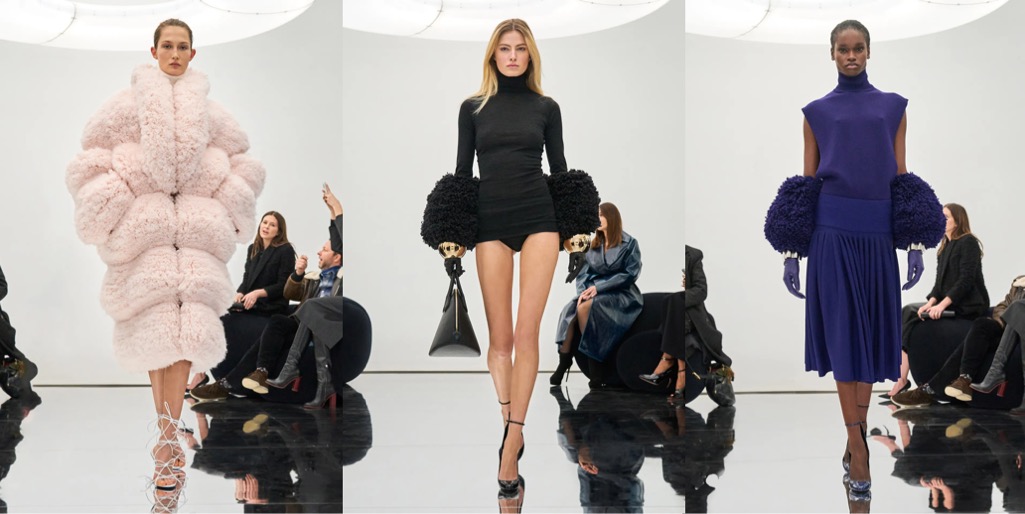
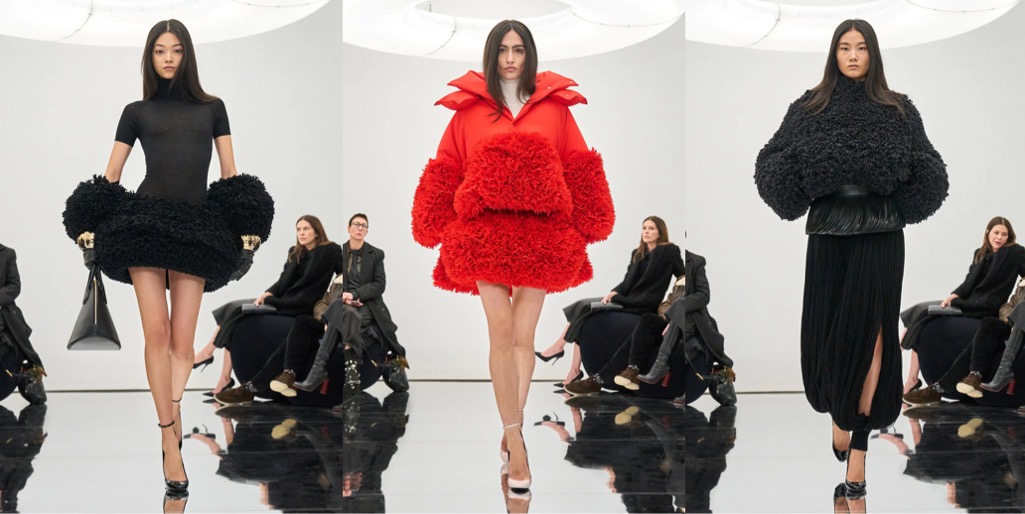
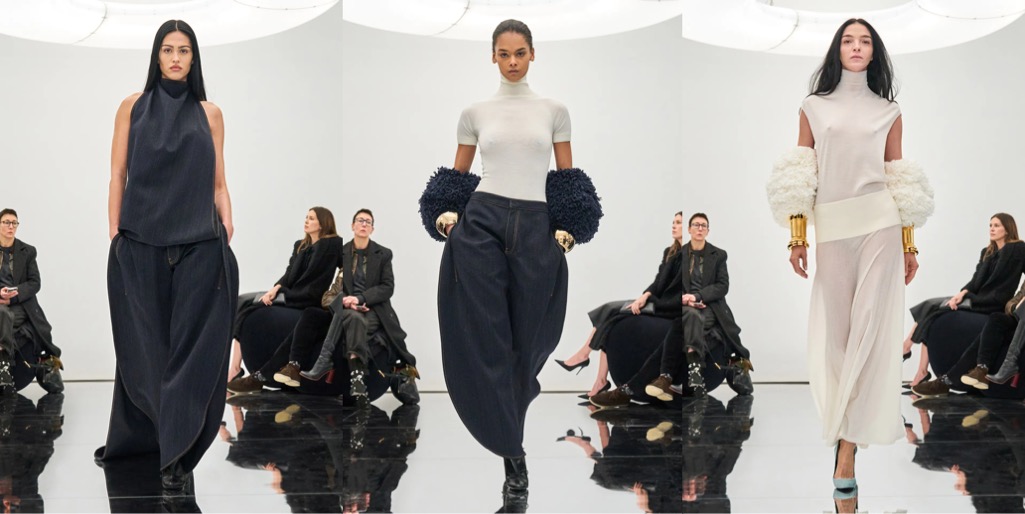
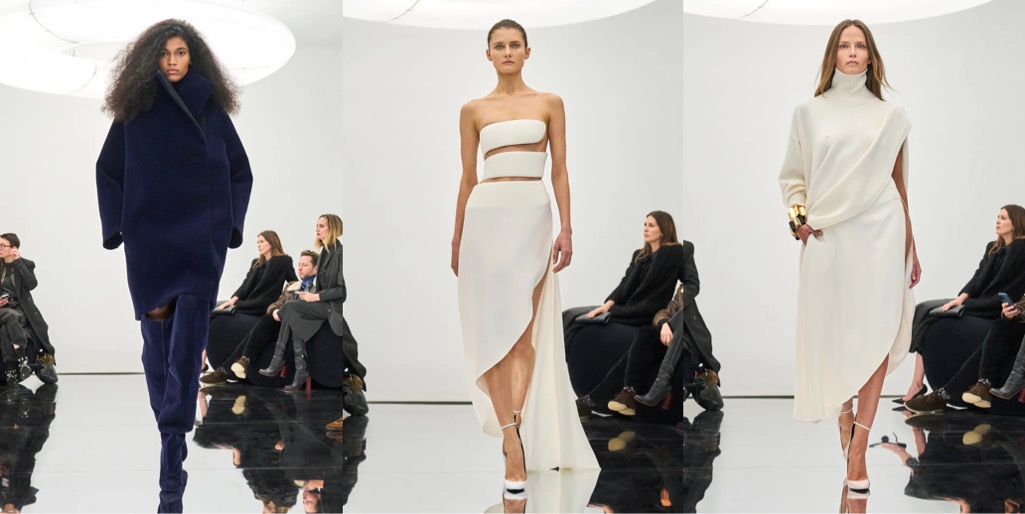
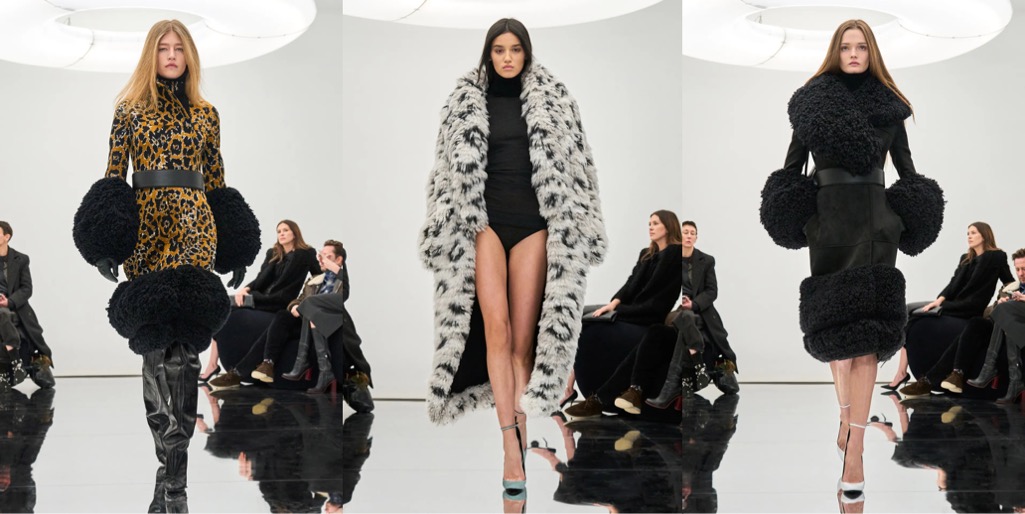
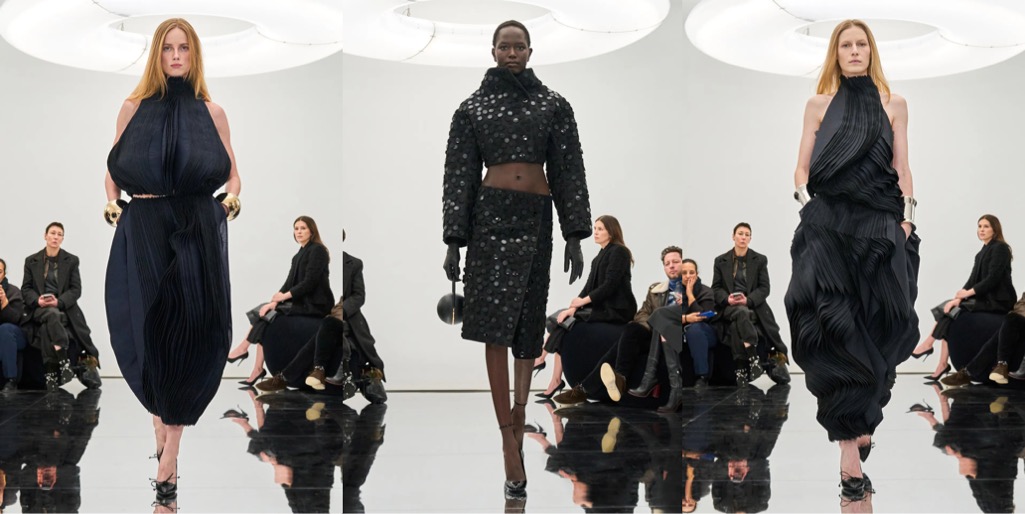
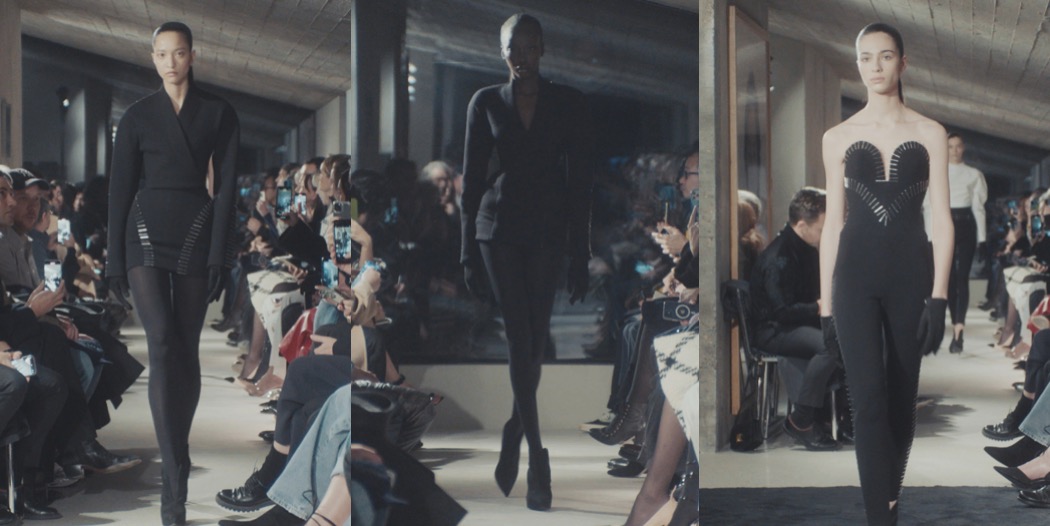
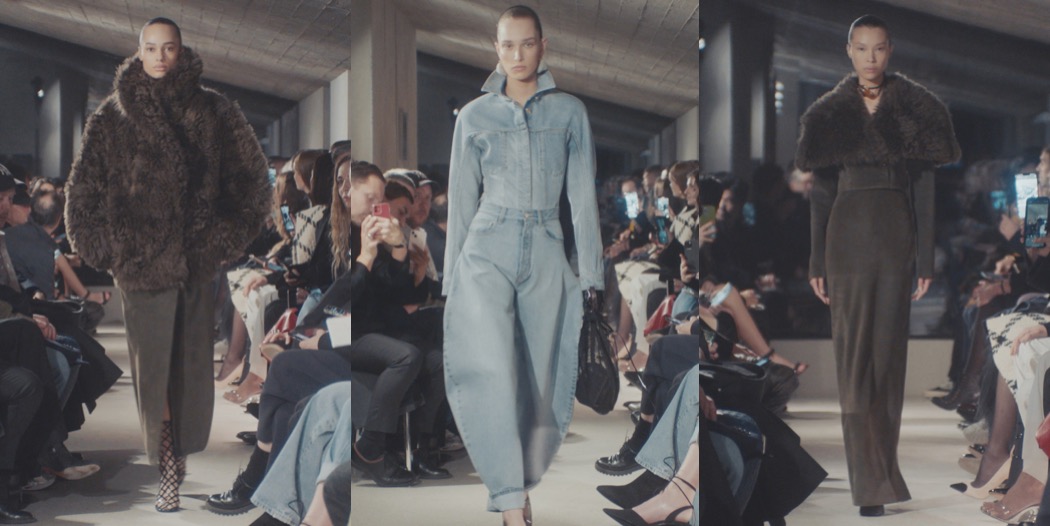
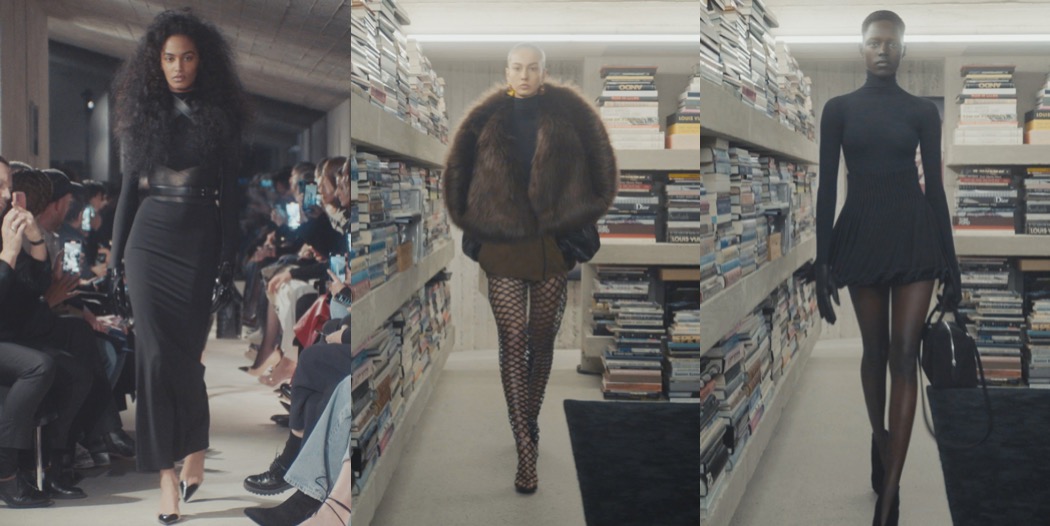
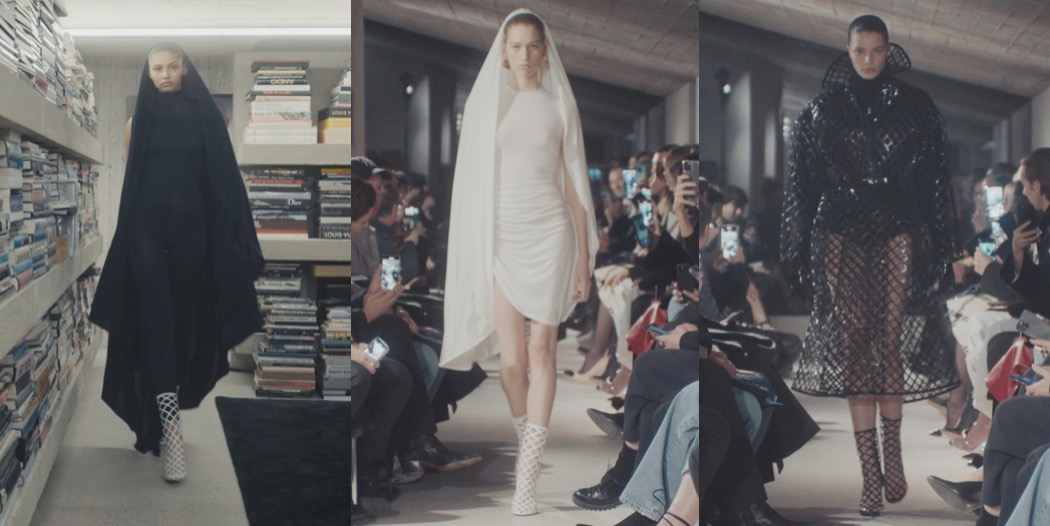
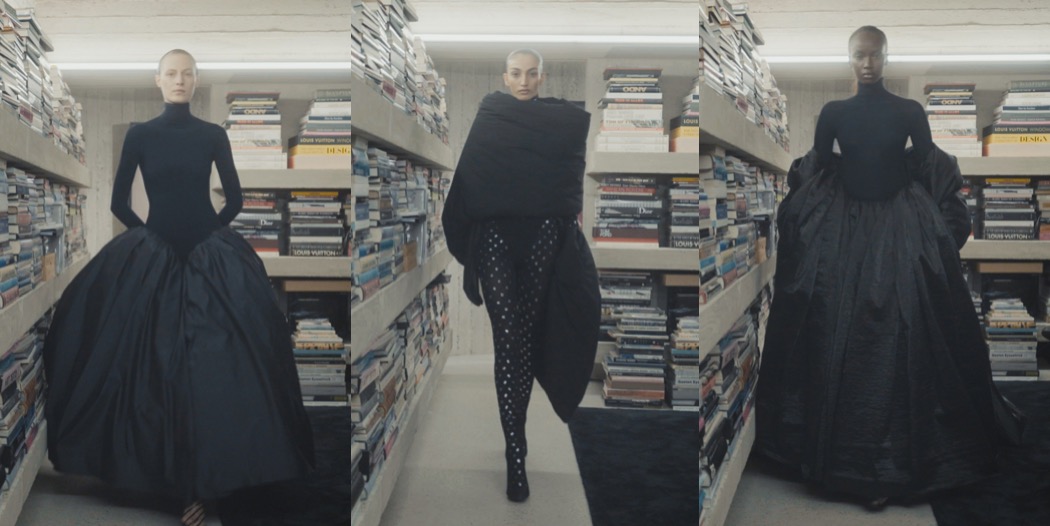
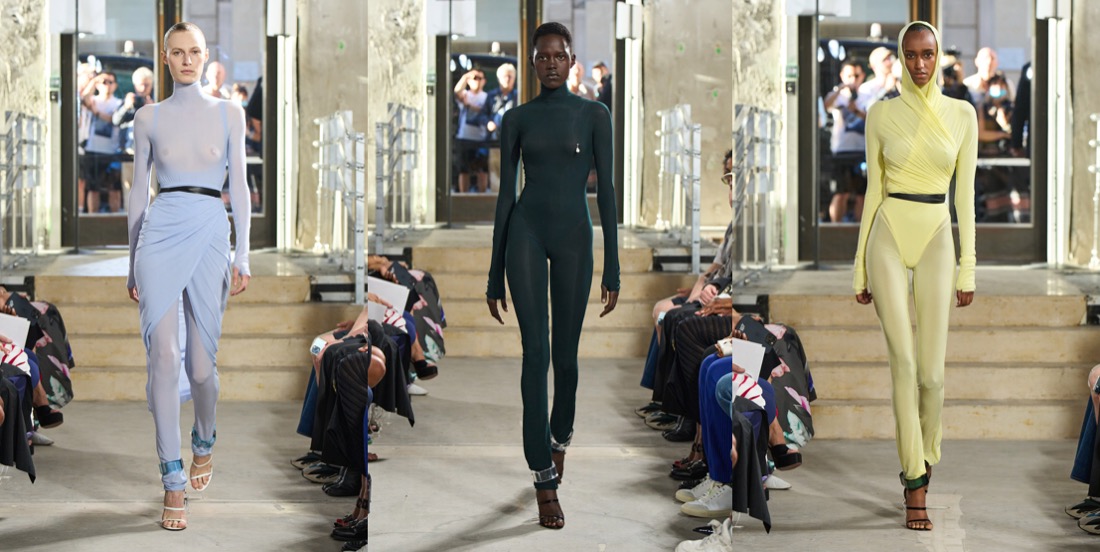
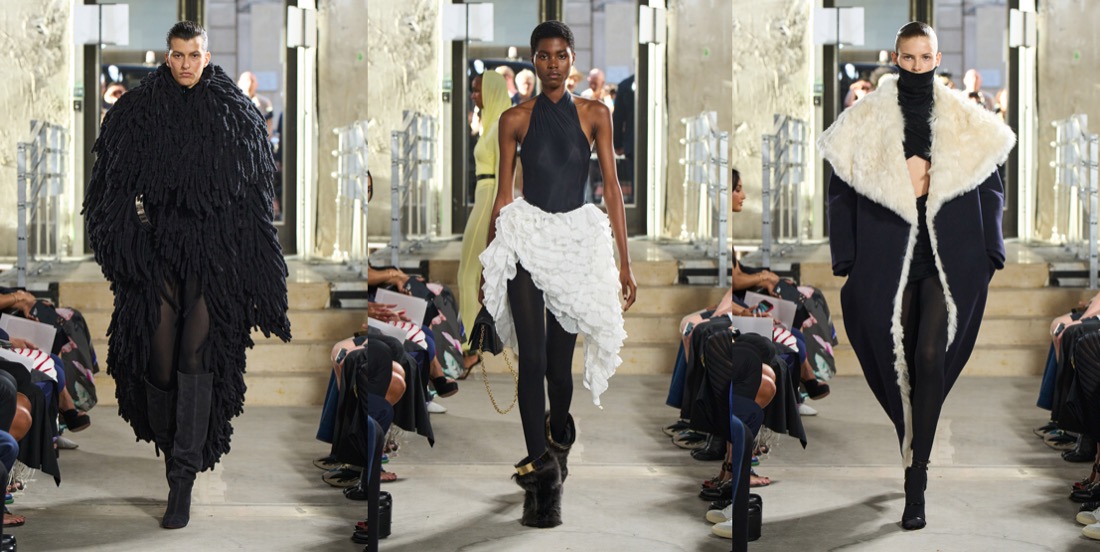
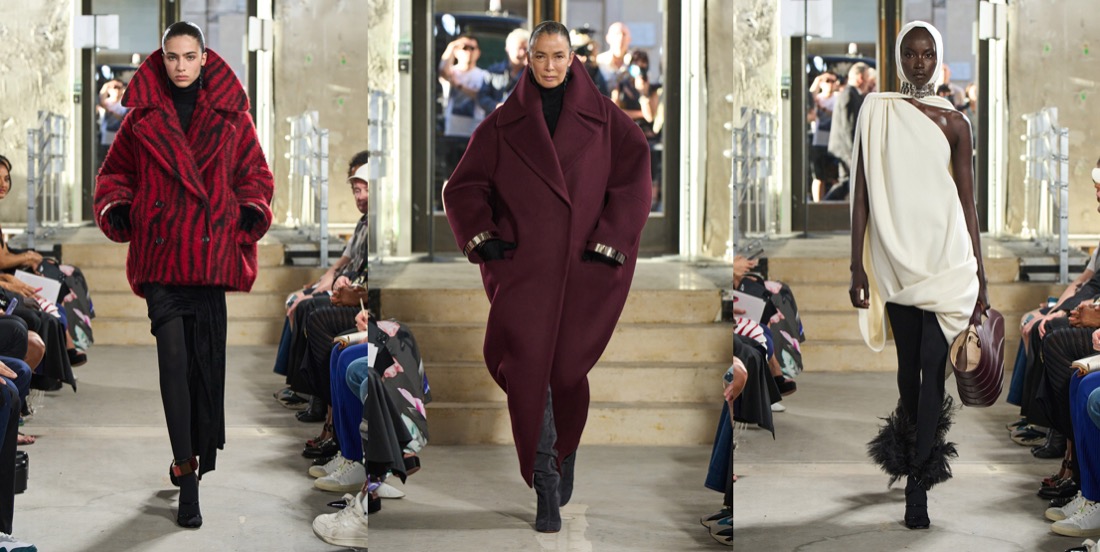
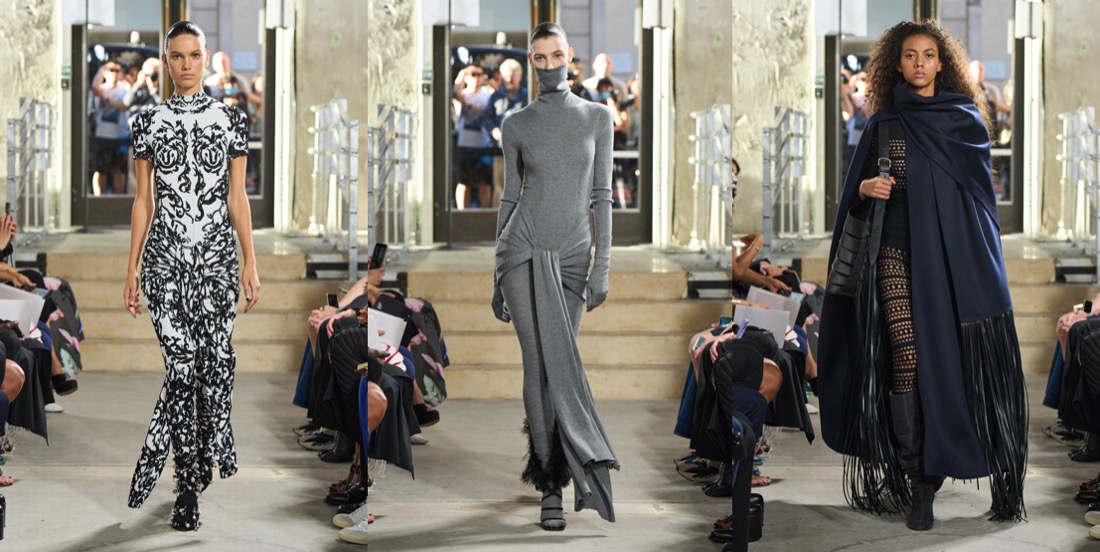
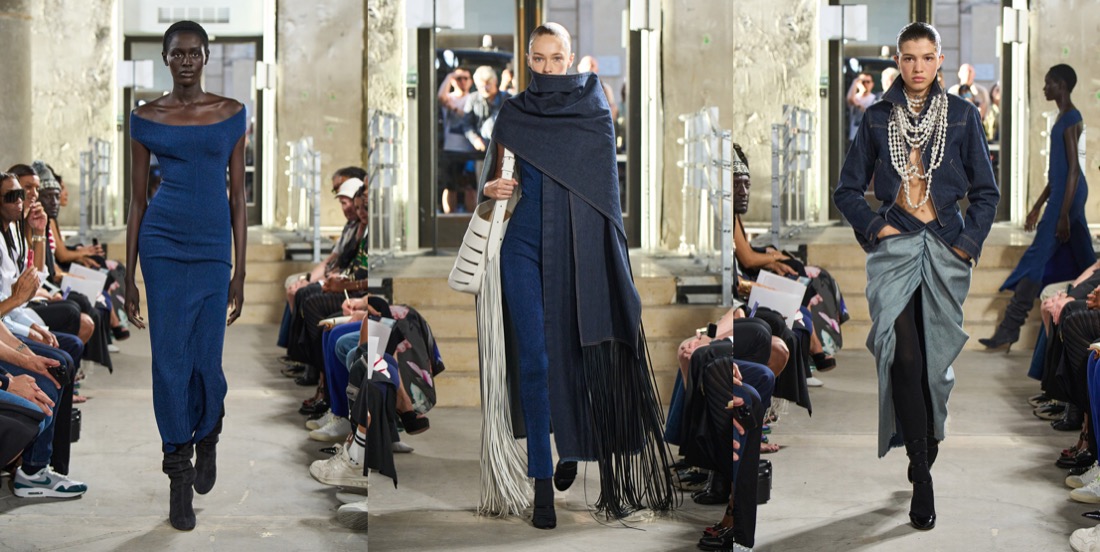
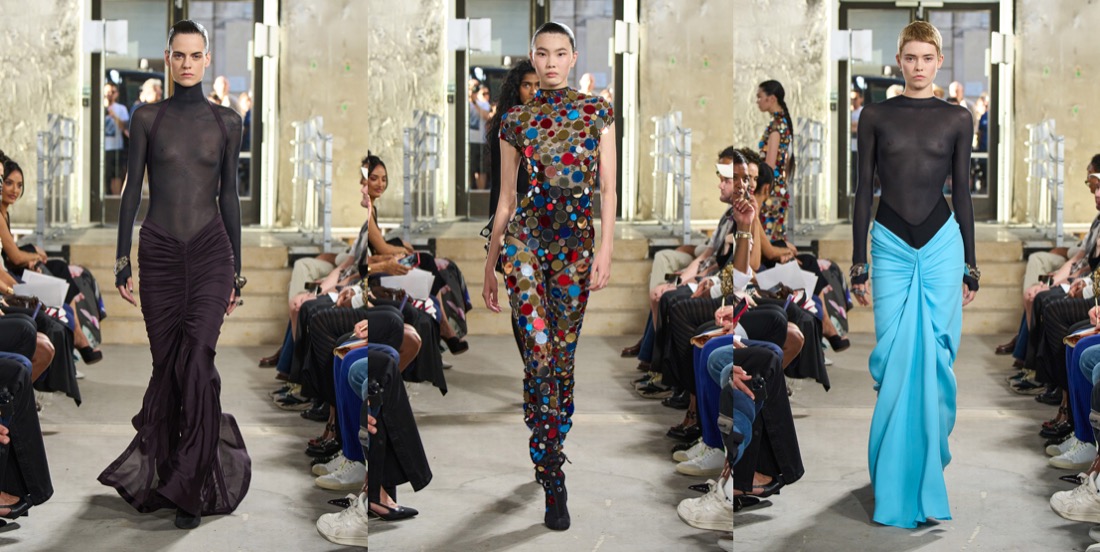
The latest Alaïa collection is about simplicity and purity. It’s about intimacy, about reducing to an essence, about finding a freedom and invention in that. At the same time, Pieter Mulier managed to keep it sensual and tactile, not brutally minimal. The entire autumn-winter 2024 collection was created using a single merino wool yarn, reinvented over and again with the maison’s textile and knitwear suppliers, who have worked with Azzedine Alaïa, the late designer and his brand, for decades. Mulier’s take on the part-ready-to-wear, part-haute–couture collection is predominantly based on the curve, on the circle – the curves of women, and circles of friends, of chosen family, an idea essential to the essence of Alaïa. “For this show, I wanted to bring us all together, to view everything up close – close together, close to the clothes“. Draped tops fell asymmetrically in supremely elegant folds; minimalist skirts and dresses were looped and wrapped, sarong-like, to show a leg. A black jumpsuit seemed to be made of one continuous piece, gathered into a halter in front, leaving the back bared. Knitted turtleneck tabard sweaters showed slivers of naked torsos in passing. “I love that you’re covered, you’re covered completely – but then you show something”, the designer mused. The two-storied show space integrated the collection with design objects that are signifiers of the Alaïa boutique on rue de Marignan: the Pelota lamps, created by Marc Newson, and the Mollo sofas by Philippe Malouin. It all made sense.
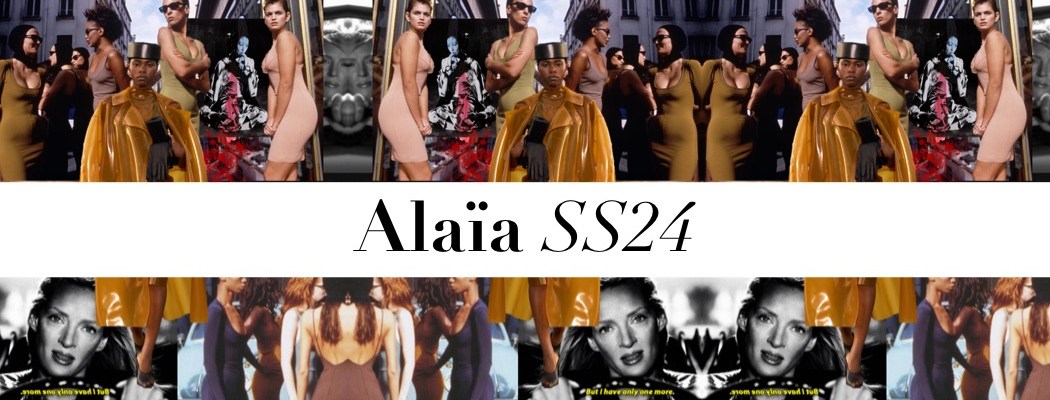
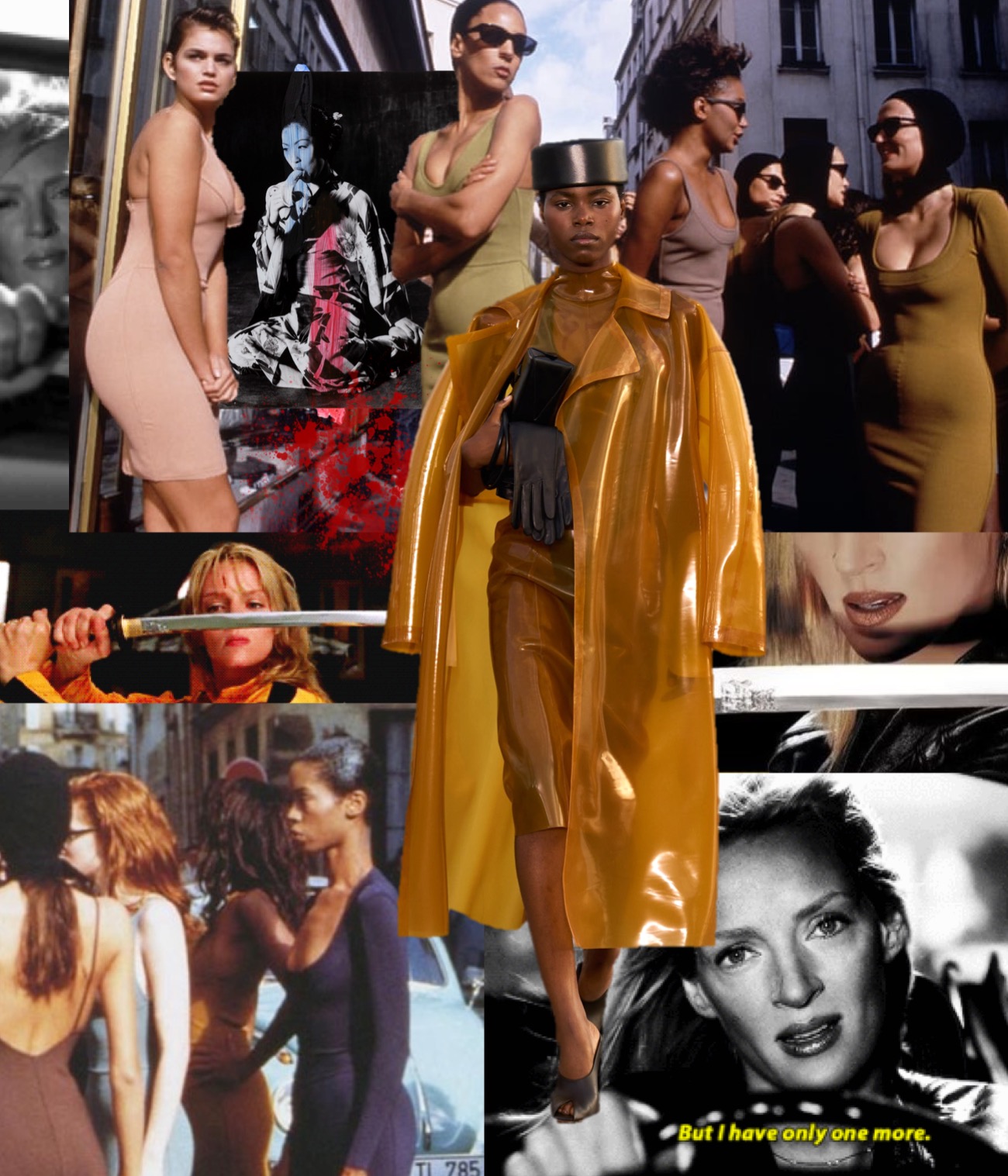
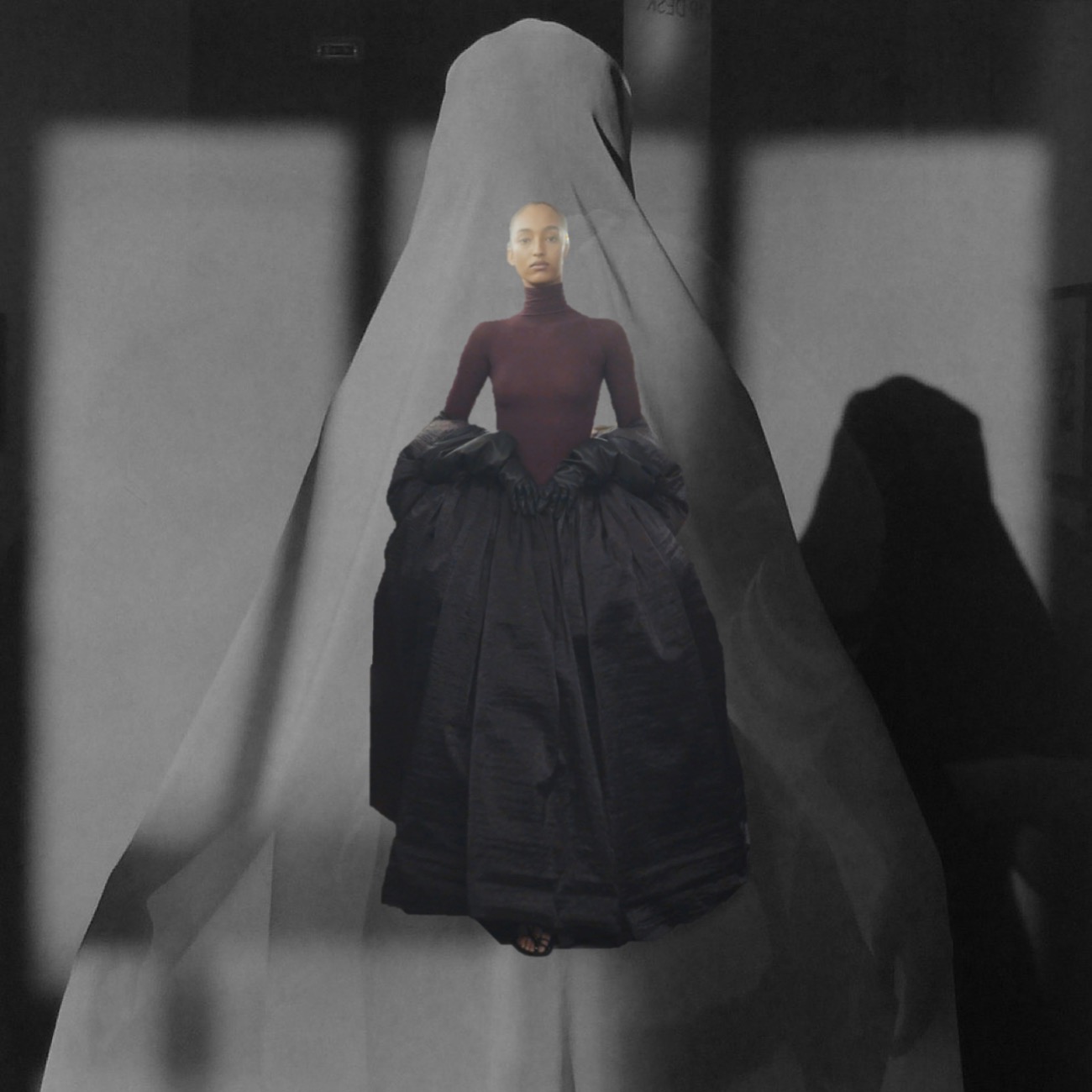
Collage by Edward Kanarecki. Don’t forget to follow Design & Culture by Ed on Instagram!
Hey, did you know about my newsletter – Ed’s Dispatch? Click here to subscribe!
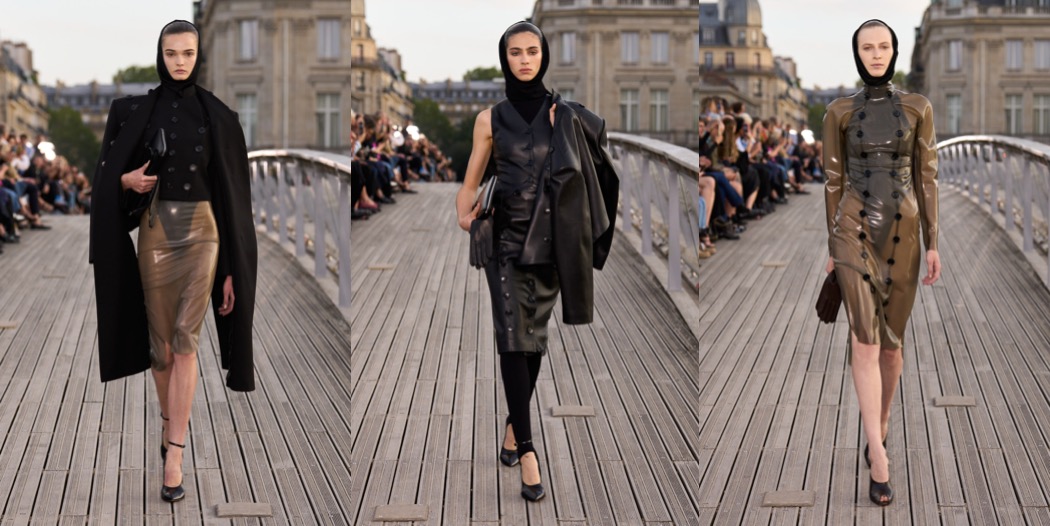
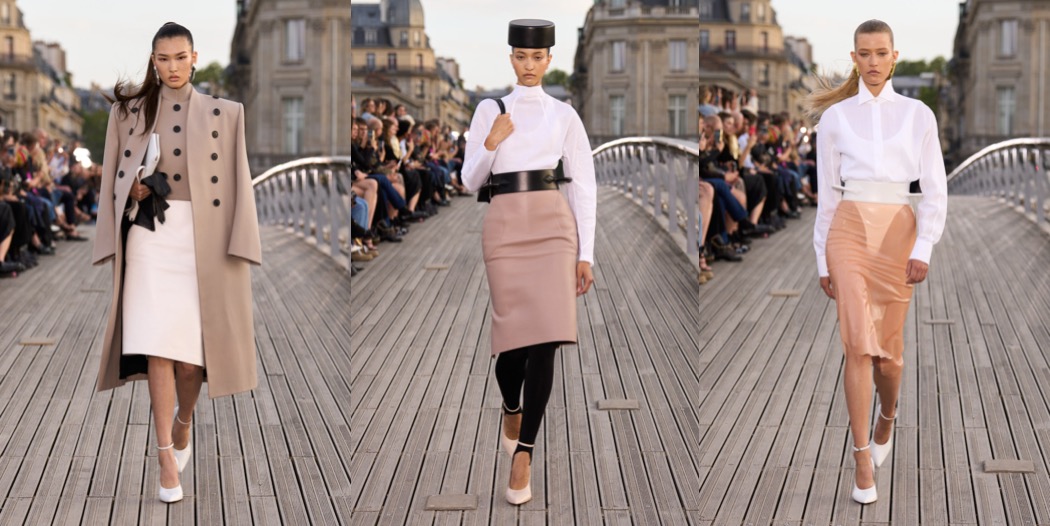
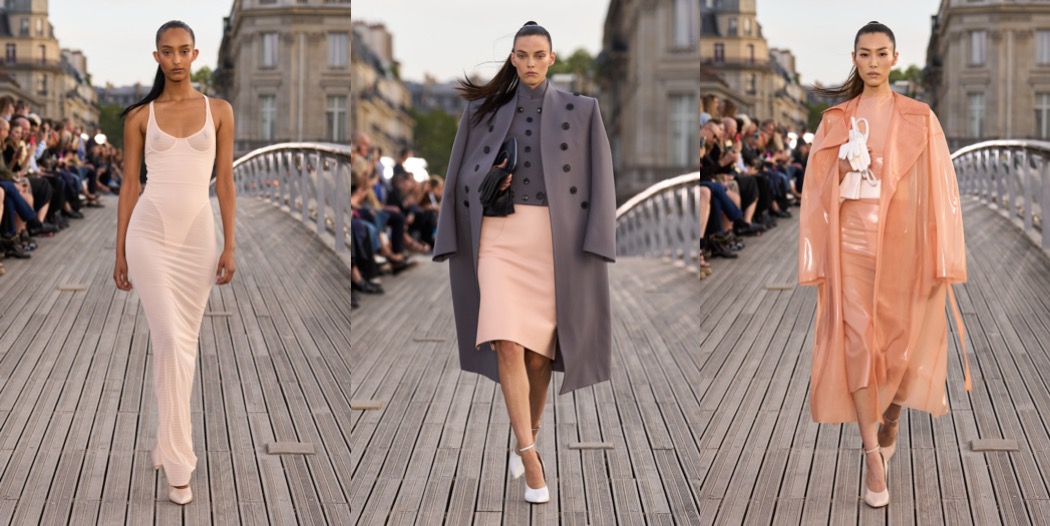
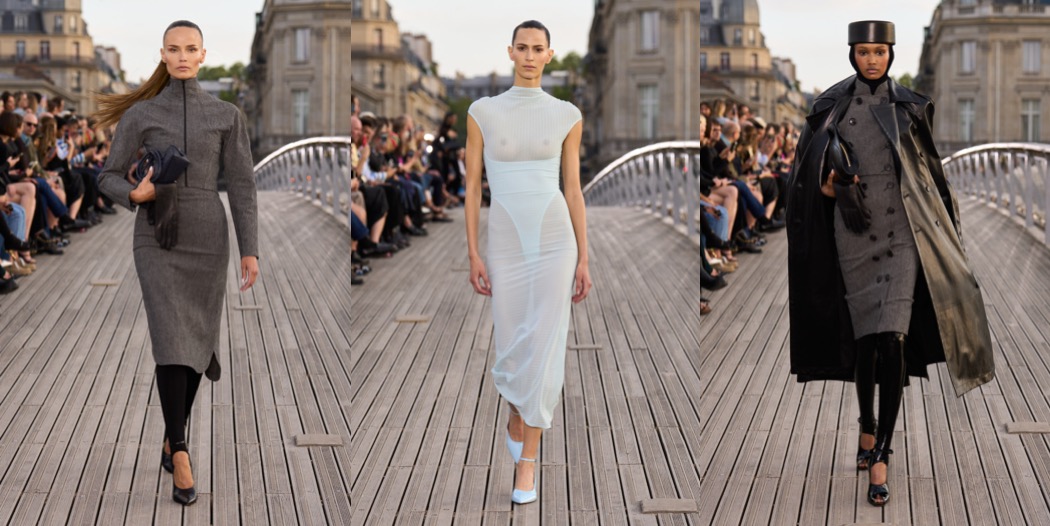
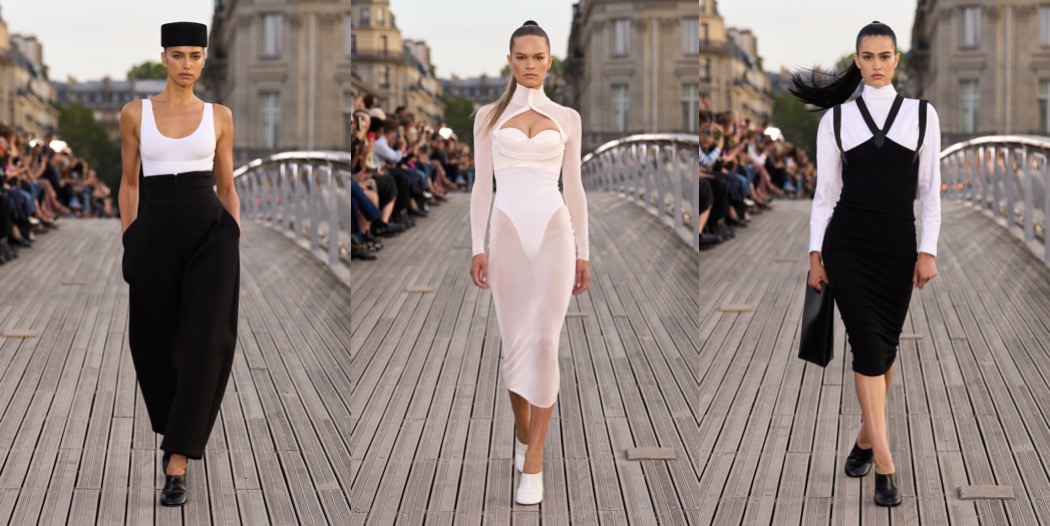
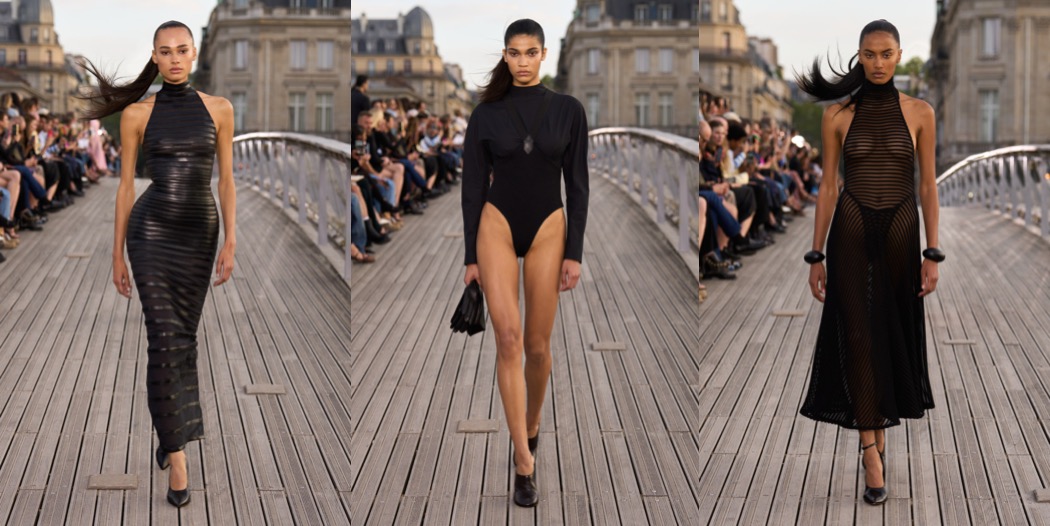
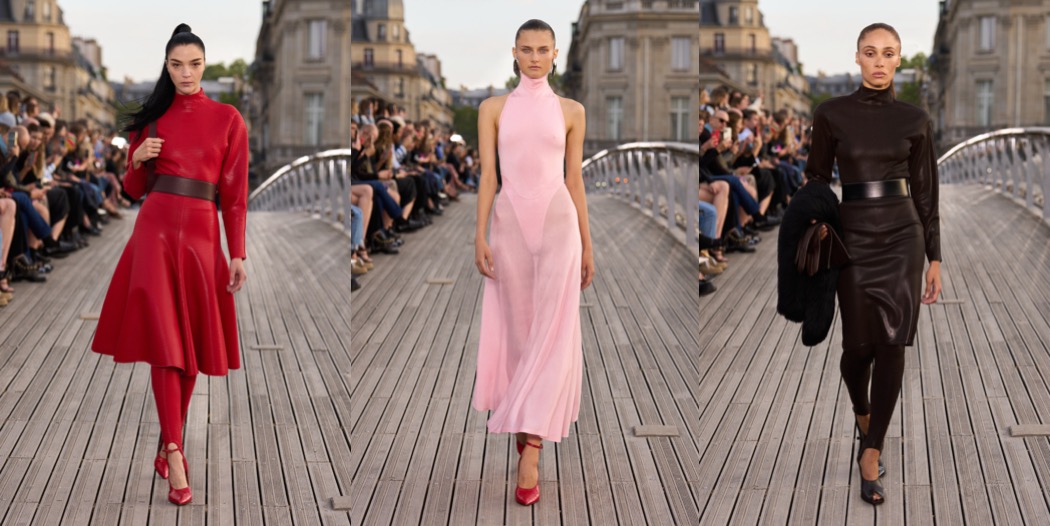
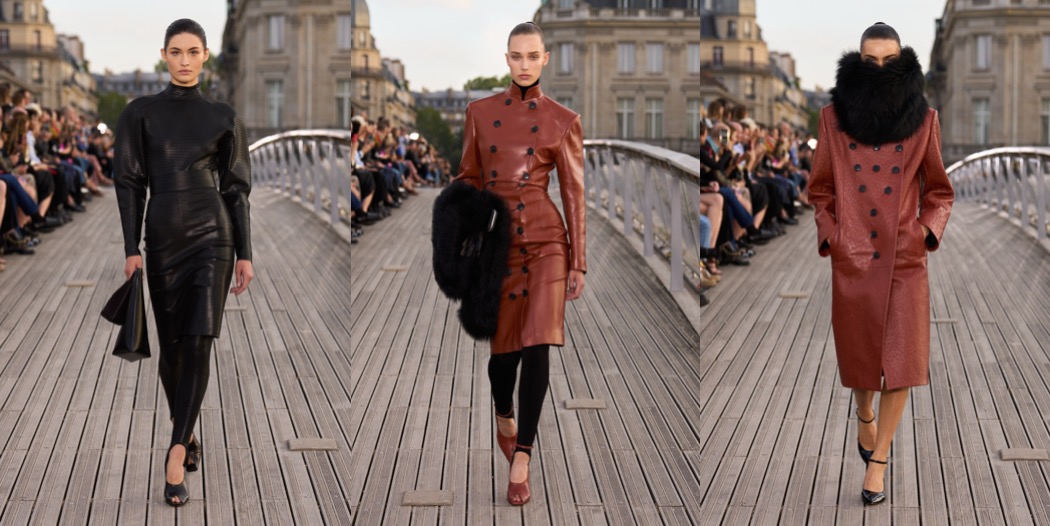
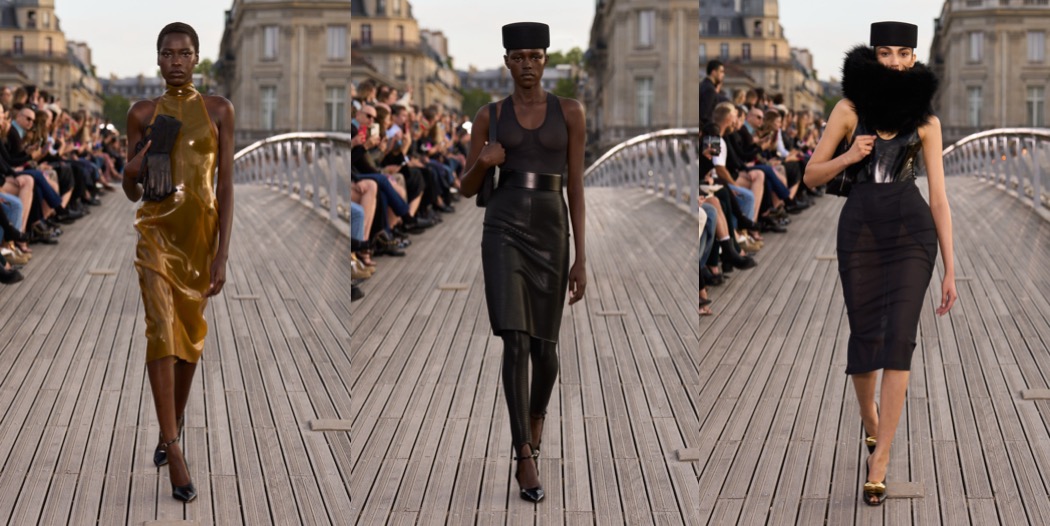
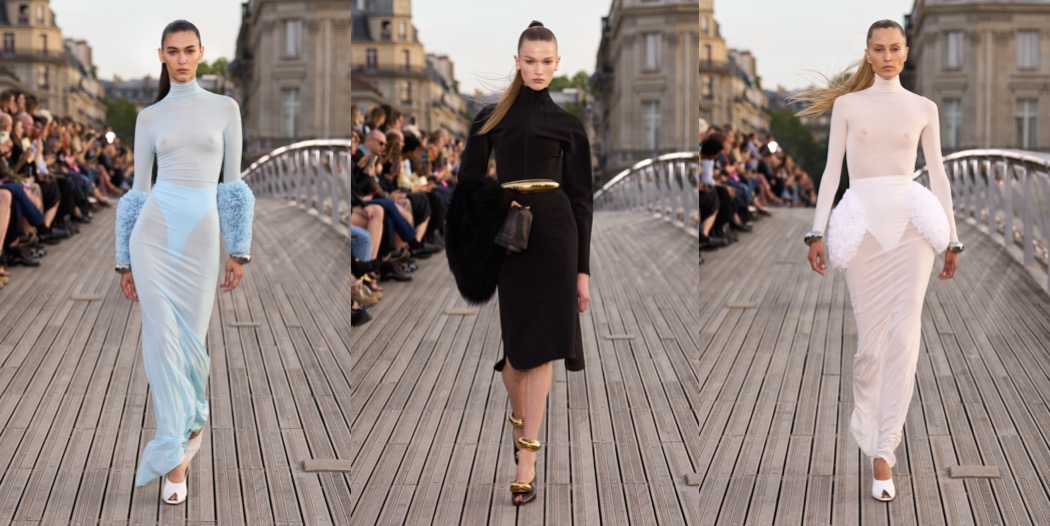
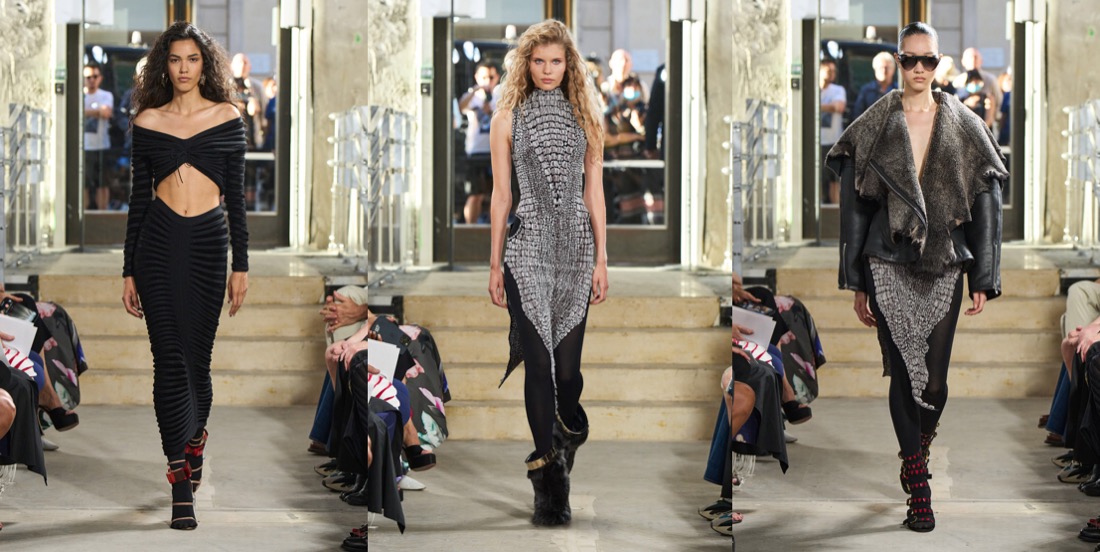
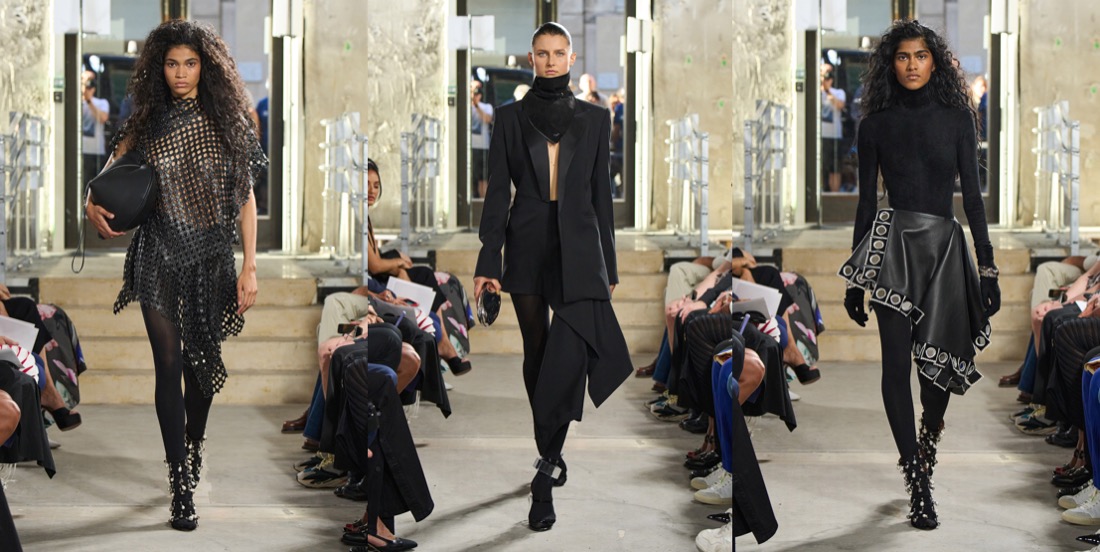
The latest Alaïa collection by Pieter Mulier is hot, sexy, F-A-S-H-I-O-N. In another words, a perfect start of haute couture week, which quite ironically happens in the midst of one of the most tumultuous moments in France’s contemporary history. Taking place over a footbridge across the Seine, the fashion show couldn’t have been more public – a strong contrast to the intimacy of Mulier’s last presentation, which he held in his own apartment in Antwerp. “For me, that’s what it is about,” he declared afterward. “It’s about extremes. You know Alaia is high heels or flats.” The bridge bristles with lovers’ padlocks bolted to its handrails. It seemed an apt environmental accessory to the unabashedly sexualized, latex and visible-thong clad vision of women Mulier was unleashing on the world. “It’s the next step in what I want to say about Alaïa,” he said. “Not fetish – that’s not a good word – but it’s personal obsessions that I wanted to do in a way that other people didn’t. Using latex, using leather in a different way. Creating a silhouette that’s very feminine, but yet quite different than what you see today.”
Kinky fashion has its own long Parisian tradition – there’s nothing new in seeing the proposal of chic bourgeois women in immaculate tailoring who also happen to be displaying underwear. These male-gaze luxury fashion tropes have a 50-year history that goes back as far as Yves Saint Laurent and Helmut Newton. The 21st-century set of questions for Mulier center more on how to handle the empathetic argument that Alaïa always made for glorifying the physicality of womanhood; how to claim it as his own, and make it relevant in his own time. Indeed ‘time’ was the overarching theme Mulier was talking about—in the sense of the time it had taken to mould and tailor the silhouettes and add obsessive details, “like 35 buttons on a coat.” You could see the time-consuming techniques lavished, say, on the opaque-sheer splicing of horizontal bands of strips of leather and gauzy fabric, winding in varying widths down a floor-length dress. The tailoring was nipped to the narrowest of pencil skirts; the taut knitwear engineered to expose the thonged bodysuits that are, of course, Alaïa-central. If you’re looking for a revenge wardrobe, Mulier has it sorted out for you.
Collage by Edward Kanarecki. Don’t forget to follow Design & Culture by Ed on Instagram! By the way, did you know that I’ve started a newsletter called Ed’s Dispatch? Click here to subscribe!
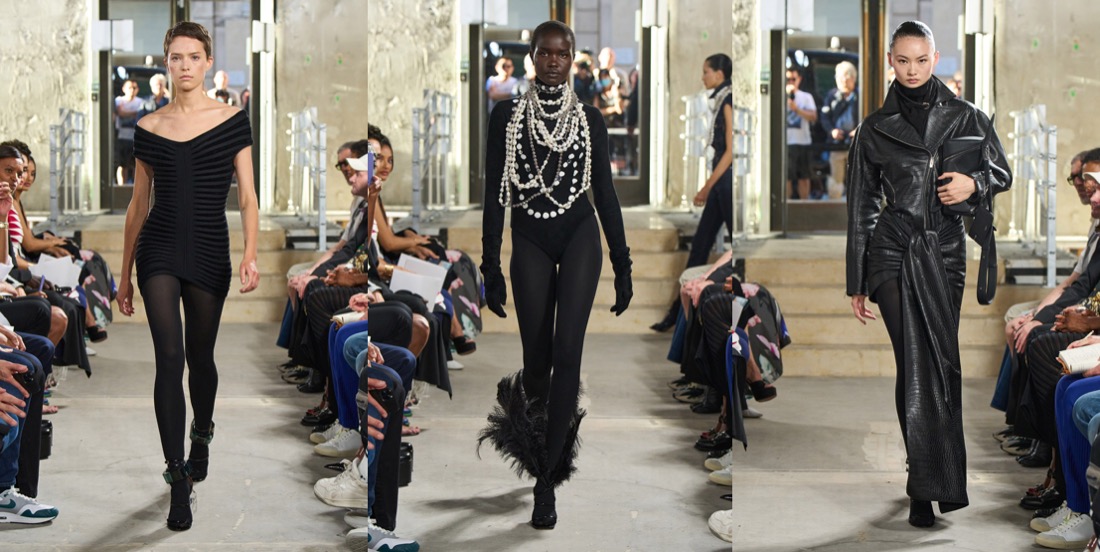
Azzedine Alaïa used to present his collections on 7 Rue de Moussy in Paris, the legendary address which wasn’t only the studio and flagship Alaïa store, but also his home. After the shows – or even on regular days – he invited his guests, from friends to models, to his kitchen, where he served his favorite dishes. This feeling of family-like community was fundamental for the designer and his independent brand. For autumn-winter 2023, Pieter Mulier took that notion to heart, and held his latest fashion show in his and his partner’s (Matthieu Blazy, Bottega Veneta’s creative director) apartment in Antwerp. The group of guests was small: a pack of fashion’s finest critics, the brand’s muses (like Tina Kunakey) and Mulier’s friends (think Raf Simons, Gaia Repossi and Dries Van Noten). The 1972 Brutalist landmark home was a fitting backdrop for the designer’s fourth collection for the brand: sophisticated, somber, very Antwerp. With that gesture, Mulier wanted “to share something of who I am” by pulling Alaïa’s culture onto his own territory. “It’s actually very simple. I didn’t want to do a big show – I didn’t want cold, distant glamour. I want to do something very intimate, small as Azzedine liked it,” he explained. His models had performed their long-leggedy Alaïa strides around his apartment in a collection that showed, in close-up, how the clothes fit to the body (rounded in the shoulder, wrapped, draped). The architecture, and the quality of the Flemish light has an effect on how Mulier sees and shapes his design, he said. “We work here on the beginning of every collection on the ground floor studio with the Alaïa team”, he revealed. “When I start, I always work in the kitchen. And when I’m in the kitchen, I look up to the cathedral, over there.” The conversation with his surroundings began a pursuit of a sculpted roundness, he said. “In our house, everything is geometric. In Alaia, everything is about the two extremes of masculine and feminine, and basically our house is very masculine. You put a feminine silhouette in it and it changes completely. Everything was sculpted on the body so everything is round; all the drapes are cut in circles.” Rounded shoulders, sculpted torso, narrowed hips, elongated silhouette: the beginning, in dense immaculately-fitted dark brown jersey, introduced it. There were bodysuits, jackets, bustiers, and flipped-out skating skirts. Eyes zoomed in to figure out the lines of glinting silver that were running down the backs of sleeves and undulating over hips. They were conceptual ‘pins’ – part homage to the dressmaking and fitting process, part perverse play on piercing; sharpness versus softness. Also a nod to a dress Alaïa once made.
But where was the Belgian identity of Mulier beginning to be apparent? “The tailoring is very minimal. I told the team, I want it to be as minimal as possible, with the maximum effect. But it needs to be sensual, where all the drapes are circles,” he said. “There’s a white dress where we just cut it, draped, attached it – and that was it. So on that level it’s very Antwerp.Very simple.” The white dress, with its scarf over the head, serendipitously evoked the drape of the North African hoods Alaïa often referenced. But there was surely the hint of other Belgian street vibes going on. There was another kind of bomber-hoodie and a distinct echo of an army-surplus parka; then, Mulier’s choice of faded denim rather than Alaïa’s classic rigid version. Moving toward evening, Mulier’s drapes in black cotton were whipped around the body in a dynamic caught between sophistication and romance. Back views mattered: one dress had a low-down half-moon cutout that reverbed sexily from the showstopper Mulier sent out last season. He is not one to rush, but nevertheless, in his logical, emotional Belgian manner of doing things, Mulier is gradually putting his own stamp on the brand. Maybe this collection wasn’t as ferocious and bold as his first line-ups for the brand, but it certainly was the most emotionally-charged.
Collage by Edward Kanarecki. Don’t forget to follow Design & Culture by Ed on Instagram!
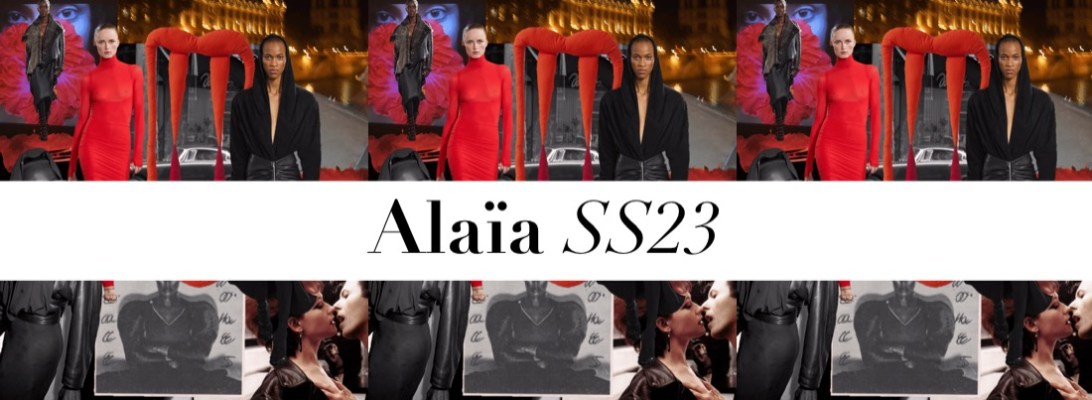
This is Pieter Mulier‘s third season for Alaïa. The Belgian designer has already proved that he understands the codes of Azzedine Alaïa, and is capable to convey them to a contemporary audience with grace, sophistication and refinement. The spring-summer 2023 fashion show, which opened the haute couture week in Paris, was, however, the designer’s most turbulent line-up. It seems that Mulier wanted to tackle far too many Alaïa themes and in the end, the collection read as overcharged and, well, messy. Of course, each garment put separate is a masterful work of artistry and tailoring – we are speaking of Monsieur Alaïa’s studio know-how – but the overall of the collection needed an edit. But let’s start from the beginning.
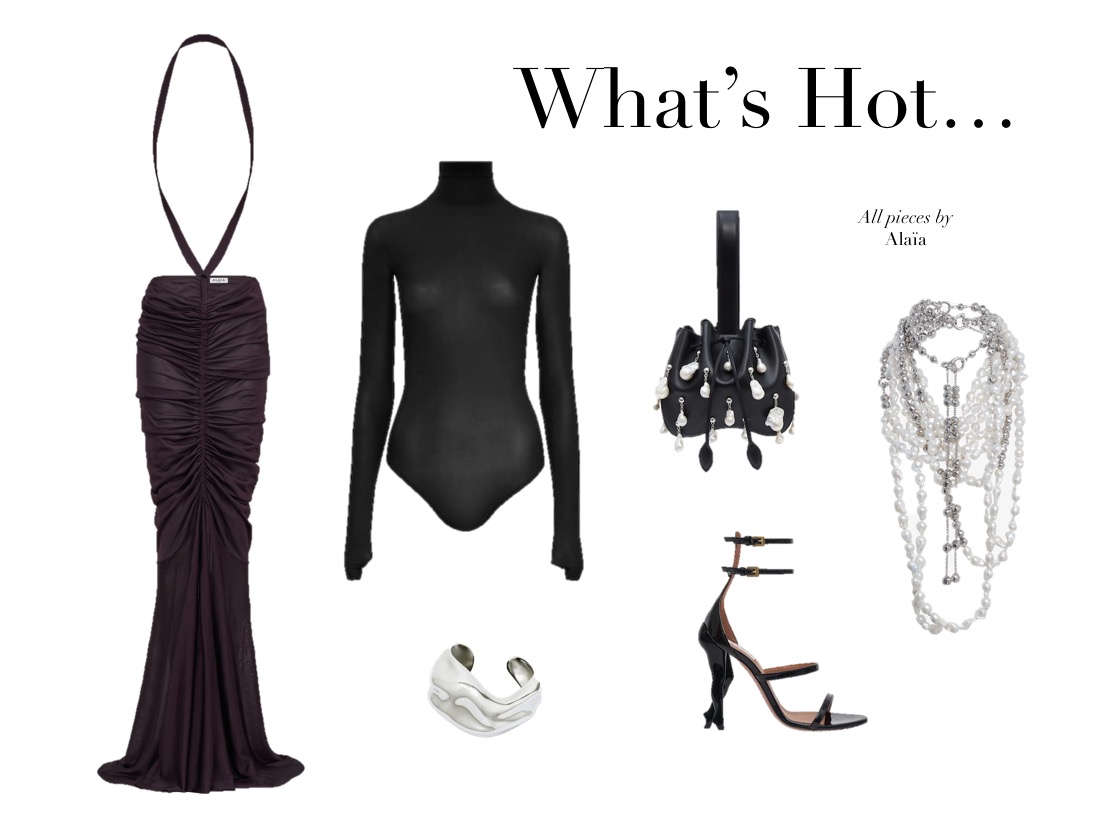
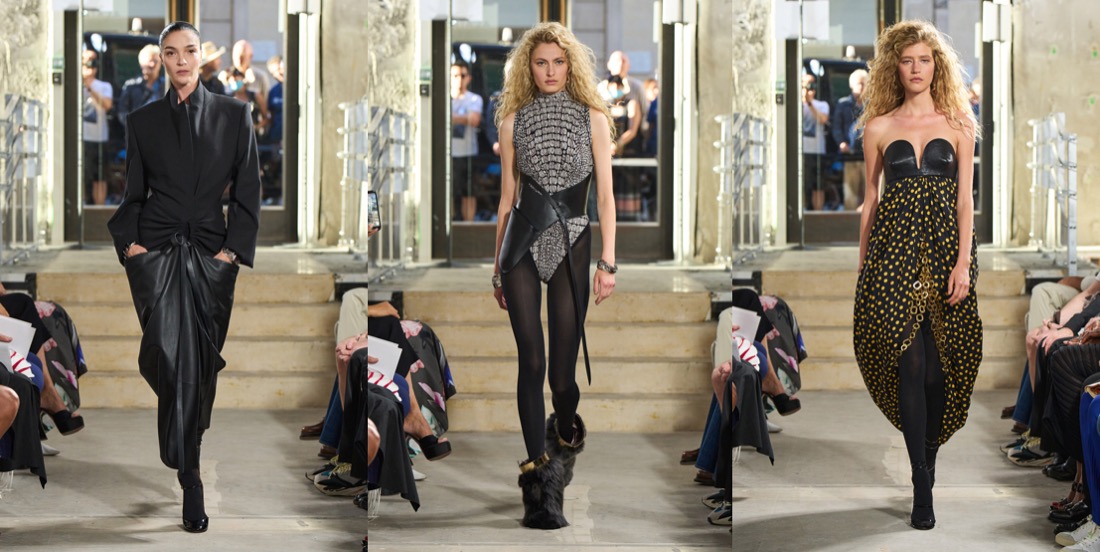
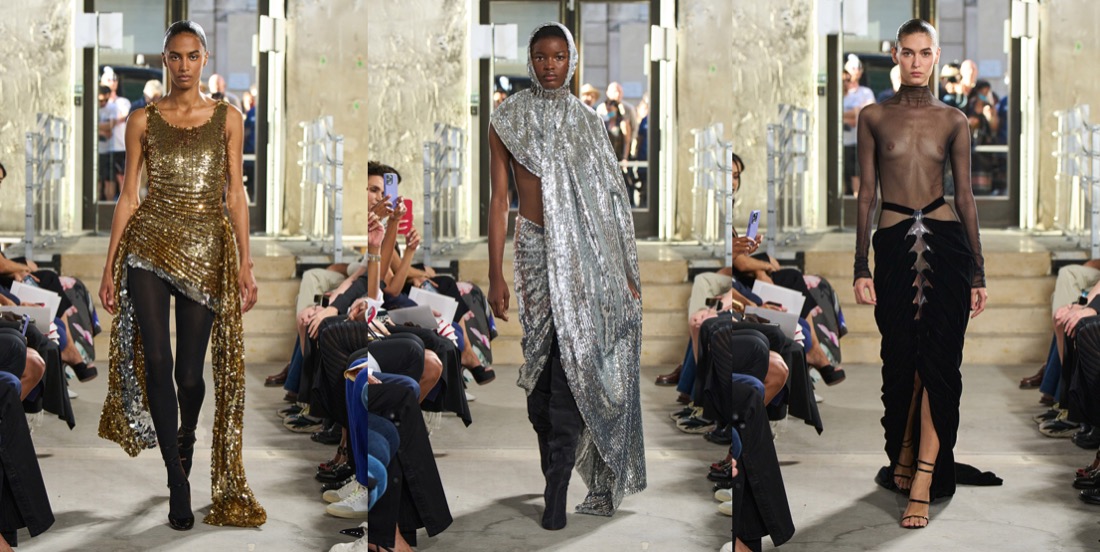
Mulier invited people to the unfinished space that will be the new Alaia store on the Faubourg St. Honoré – an architectural work-in-progress that he saw as the perfect foil for the feeling of his third collection: “something rough and something elegant at the same time.” It crackled with energy; the models collectively channeling a modern vision of the glamazonian power of female physicality that was born in this house in the ’80s. As if to emphasize that it’s dressing the body he’s talking about, Mulier opened with second-skin almost-sheer stretch silk layered bodysuits, the first with a single trompe l’oeil pearl-drop nipple “piercing.” What followed flowed into all kinds of sophisticated twists and turns of draping, wrapping, ruching, and knotting, interspersed with the kind of anatomical knitted body-dresses that are an Alaia wonder. Eyes fell to the footwear: long-haired boots cuffed with huge metallic bangles on cubic lucite heels; black lacquer stiletto heels in the shape of a naked woman’s legs. Mulier has an instinct for the extreme accessory which chimes with today’s hunger for the surreal. The chunky bangles, his own invention, are bound to trigger bounty-hunters, but the suggestive stilettos were reissued Azzedine originals from 1992. Mulier said he’d never had the chance to explore drape in his former jobs (at Christian Dior and Calvin Klein), but if that was ever an ambition, he’s come to the right place. Alaia is staffed with people who have a spectacular and nuanced repertoire of technical skills which enable Mulier to model ideas in 3-D; to make dresses that rely on asymmetry, hip-ruching, suspension, and the North African influences which Alaia used as a source of innovation.
Mulier said he’d been “obsessed with a 1984 show, which not many people know, because Azzedine was basically draping with viscose, and also draping with leather.” In emulating the latter – the leather and shearling – he left edges raw and invented a version of perforated black leather – almost like paillettes – to make a rough-edged t-shirt and tiny skirt that Tina Turner would have worked to the max. The knack of it was to make the complex look almost spontaneous. Again, the craftsmanship amazed, yet the the final result unfortunately felt heavy. There’s a sense that Mulier is learning on the job all the time, and finding the creative balance between respecting the brand’s codes and his own vision of contemporary relevance. It takes time for people to get to know and understand each other in any house where there’s an atelier. The spectacularly erotic finale dress – this one would make Azzedine proud. Somehow, it consisted of a black velvet skirt, suspended from a ribbon-belt, the central drape radiating, by some magic, from a line of vertical geometric transparent paillettes. And on the top, a sheer black long sleeve bodysuit. It looked astonishing enough, walking sinuously towards you, but the real impact of this genius construct was in the back. The draped swoop of the skirt dipped down just a fraction below the line of the bodysuit. Above it was the belt, tied nonchalantly in a bow. As I’ve mentioned earlier: the new Alaïa keeps the extremely high standards of garment-construction. I just wish Mulier would introduce some much-needed lightness to his work, so that these exquisite looks could truly speak, and not fight for space. That’s one of Monsieur Azzedine’s main ethoses: find the right balance.








 Design & Culture by Ed