
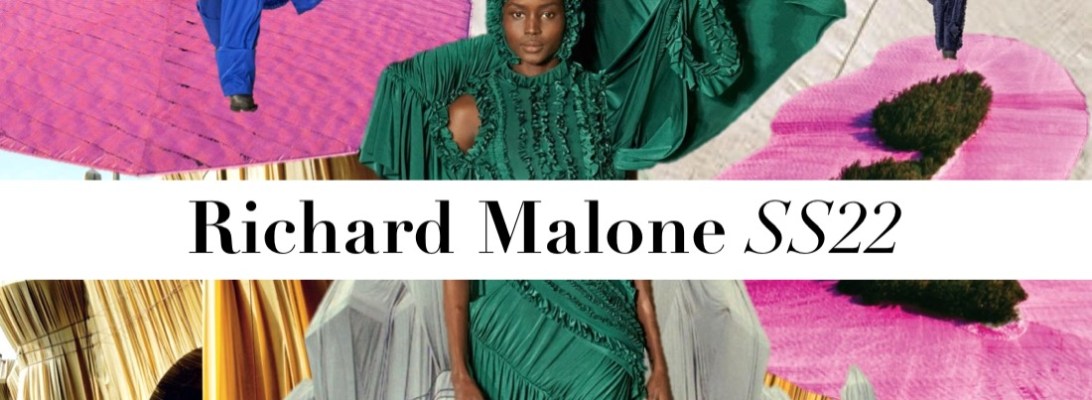
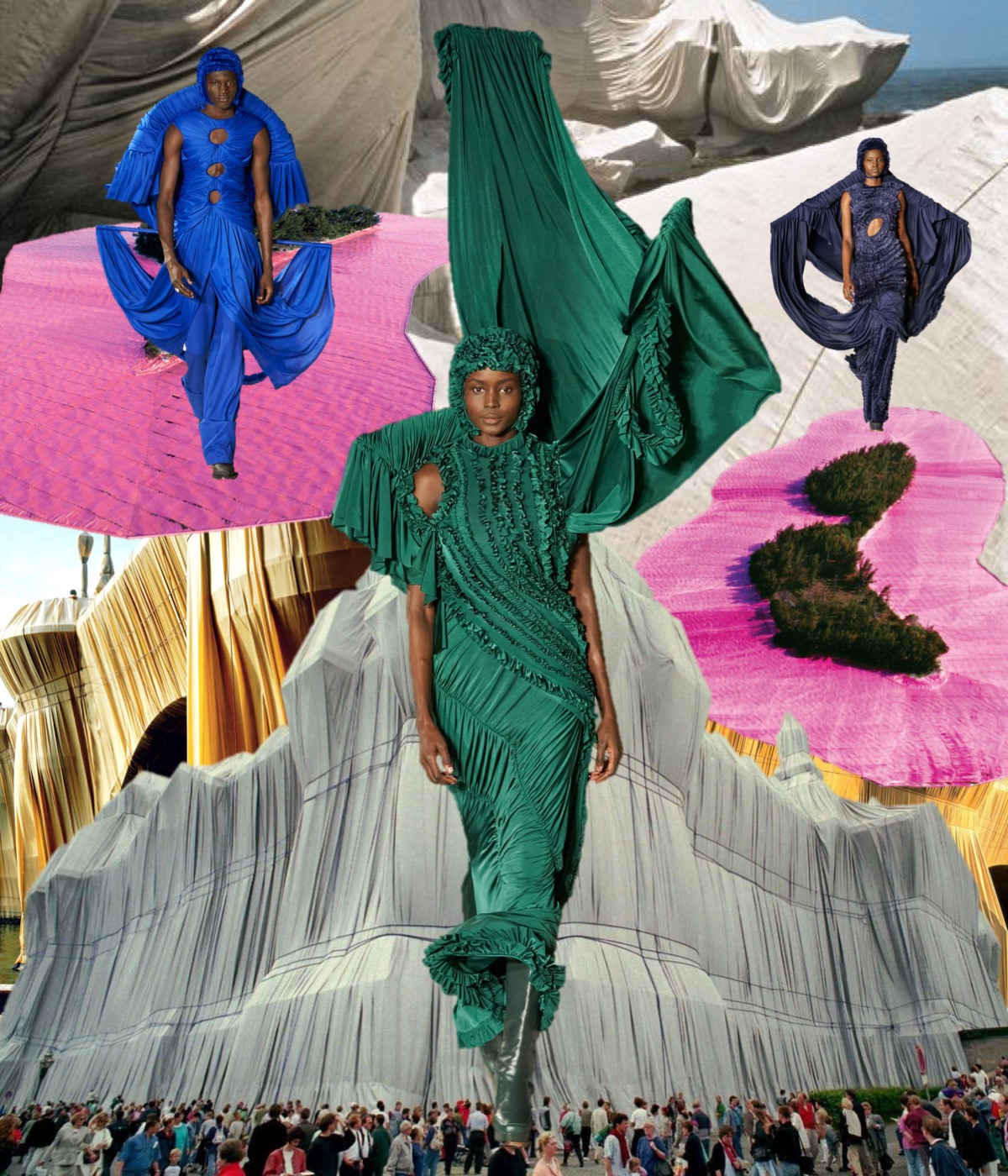
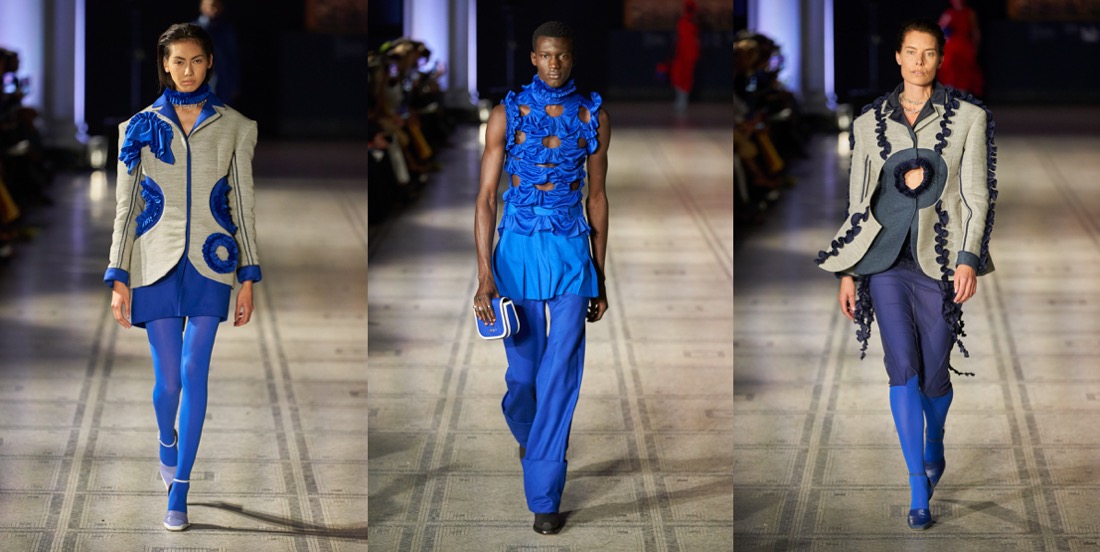
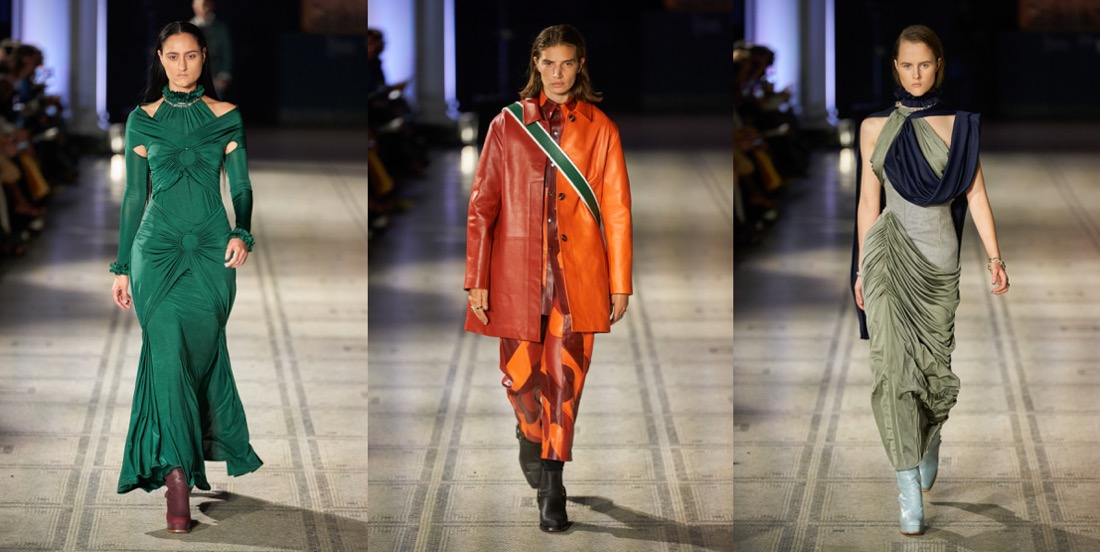
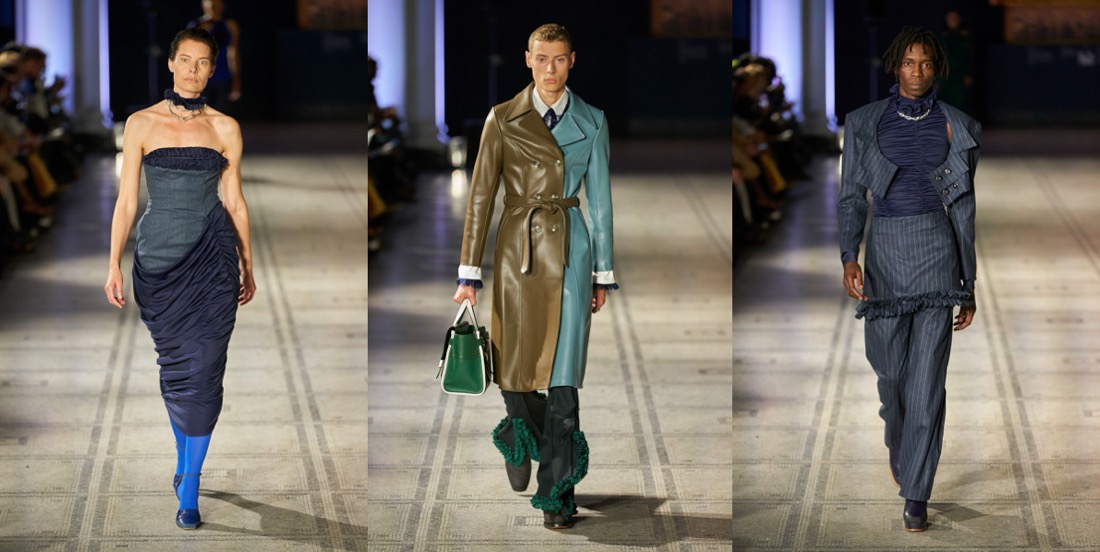
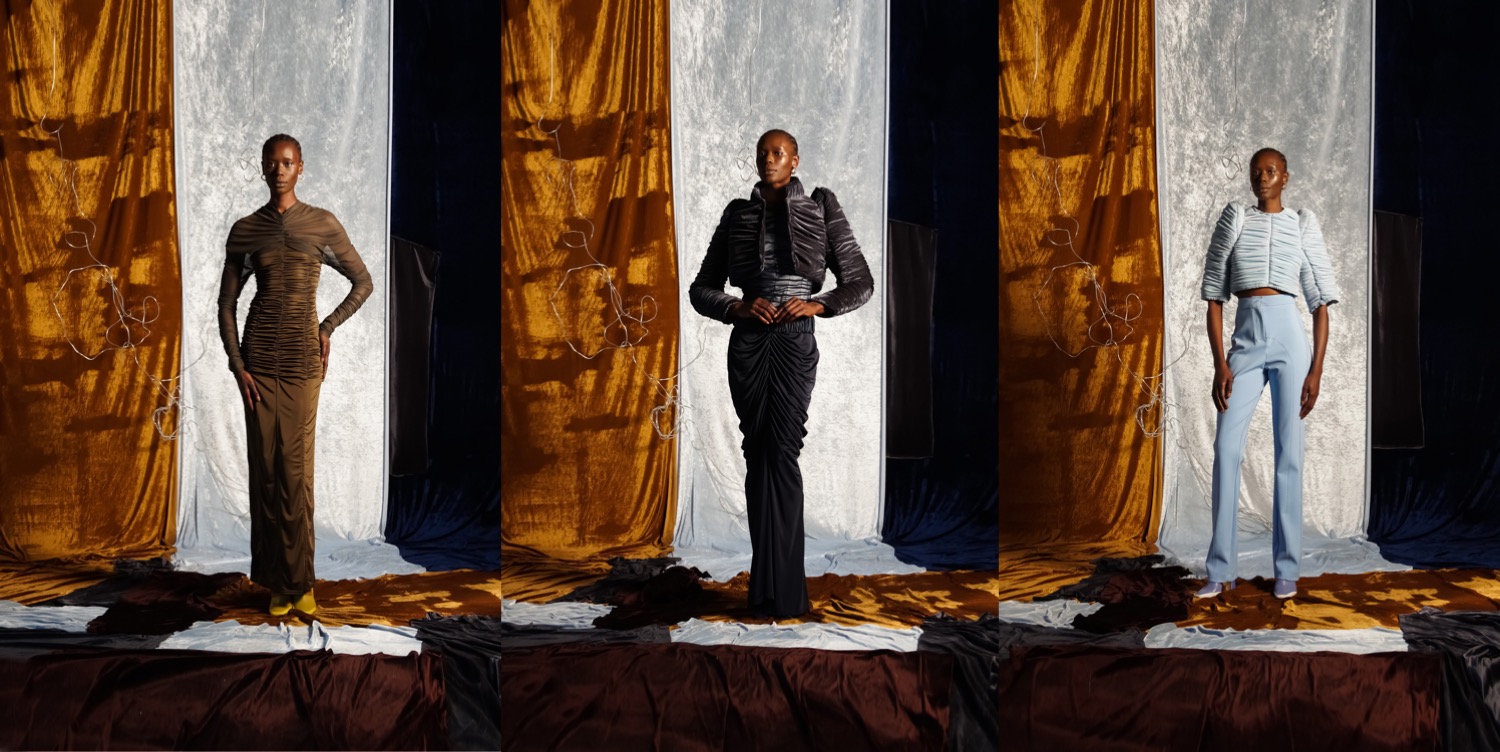
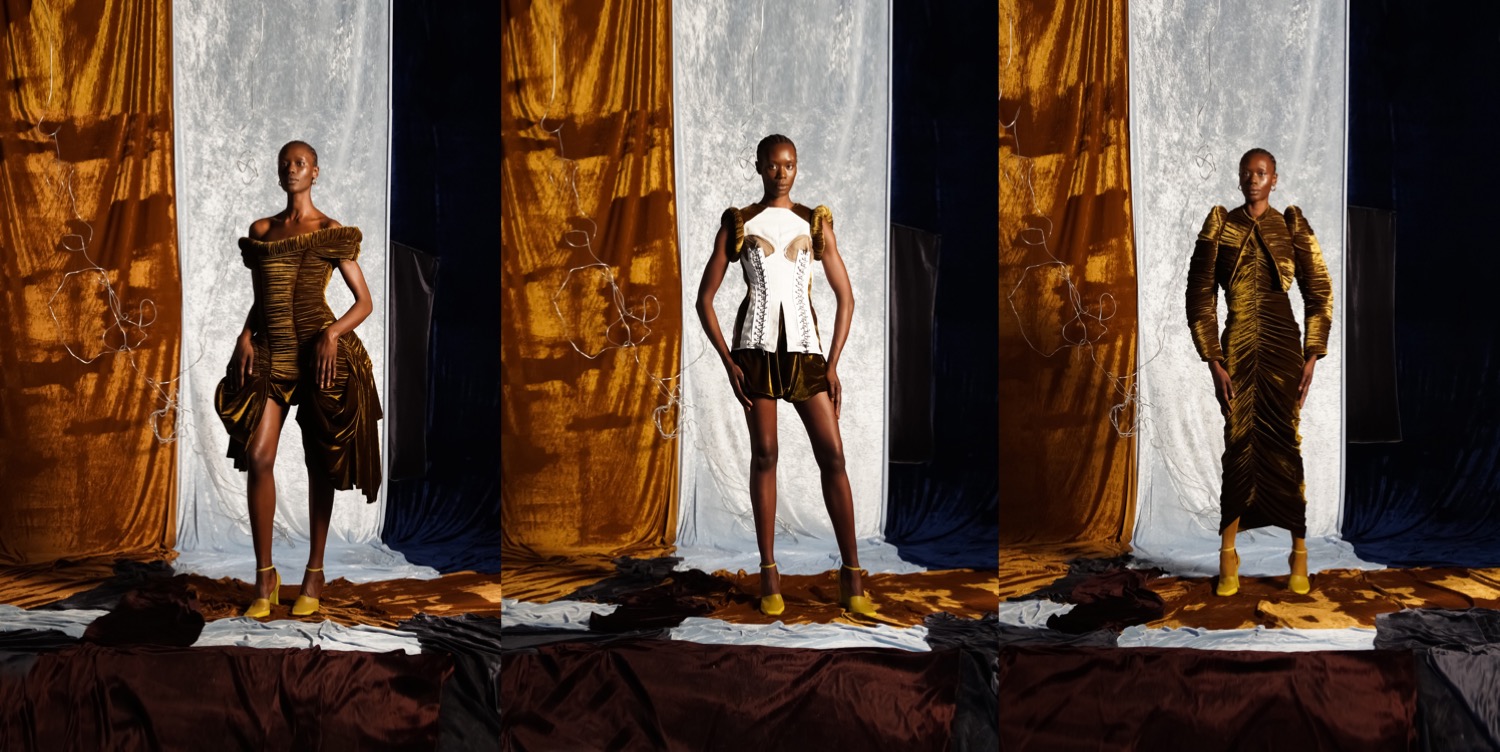
Richard Malone‘s spring-summer 2022 garments, made in part using fragments of materials, including scrap leather provided by Mulberry, were presented among Raphael cartoons at the Victoria & Albert Museum in London. These artworks, intended to hang in the Vatican, are Renaissance treasures; within the usual hierarchy of art, they are more highly valued than fashion design. Who and what “counts” and/or is represented in art and fashion is a subject that preoccupies Malone, who became increasingly interested in Irish craft heritage and its relationship to place and language during lockdown. “I’ve really been thinking about being an immigrant in this country, coming here on my own and building this business, and then what gets to be celebrated and what we get to talk about,” the designer said in a pre-show chat. Without the possibility to engage in person with his team, spring’s collection was not built on conversations or a moodboard but out of nostalgia. The circular forms that appear throughout the collection were specifically inspired by the celebratory, decorative rosettes (resembling scrunchies, observed Malone) and armbands that the designer’s grandmother would carefully assemble by hand to commemorate horse meets and wins by the Gaelic Athletic Association. Home crafted with care, these happy, colorful rounds commemorate quotidian, humble joys. As such they stood in contrast to the monumental and classical narratives of the Raphael cartoons, which, to Malone, represent “good taste,” and perhaps also social class. “It fascinates me that my starting point was that very simple thing,” he said. During lockdown “I really got to assess what the meaning of making those things is, and what putting them in a space like the V&A and trying to make them elevated and interesting could mean. I think sometimes when you go to museums or you go to fashion stores, you can feel quite ashamed of your upbringing not being very conversationally valuable. Now I’m like, ‘Oh no, that’s the most valuable thing that I have.’” As an outsider, Malone brings a sense of realness and proportion (in the sense that he is committed to keeping his production runs small) to the smoke and mirrors world of fashion. The setting of his show, the designer noted, “really heightened the fact that a lot of fashion is imitation, or it isn’t real life.” But that’s a dichotomy that also plays out in his own work: “There’s one side of what I do that’s quite theatrical and abstract, but then there’s also the real women that buy clothes from me, and men, and they’re such two different conversations,” he observed. “There is more than one truth in everything.” Malone delivered on the drama with his finale looks, which might be described as “window dressing” as they seemed to frame the models as curtains do a window. These seemed to pay homage to the drapery-heavy campaign the designer created for Mulberry, with whom he is collaborating this season as the company celebrates its 50th anniversary. In addition to putting his own spin on classic Mulberry bag silhouettes, Malone used traceable leather provided by the company in his collection, and much of the jersey was salvaged from the above-mentioned ad. Old and new, precious and humble, these dichotomies were present throughout the collection. Materials usually reserved for sampling, like horsehair, were retained for the finished garments. Malone introduced menswear for spring, with a focus on bolero jackets and apron pants. Rounds predominated, and Malone brought his designs full circle, as it were, via different paths. Some looks, like the cutout jackets, considered the circle as a negative space, for example; in contrast, draping built out and gave dimensionality to the shape. “I work like a builder in a corner of my studio,” said Malone. He finds joy in making; in the set of a sleeve, the importance of cut, the language of fabric. “All I’m trying to do,” he said, “is build something that is personal and real.”

Collage by Edward Kanarecki.



 Design & Culture by Ed