Berlinesque. Anonymous Club Resort 2024

Shayne Oliver keeps on teasing the fashion industry with his next, creative steps. Since announcing the relaunch of Hood by Air in 2020, the designer has been teasing a number of projects: first was “Prologue,” the HBA capsule modeled by Naomi Campbell; then came a preview of his eponymous ready-to-wear label at New York Fashion Week in February of last year, followed by Anonymous Club, the elusive talent incubator he formally introduced last year. Coming soon is an art exhibition in Berlin, where he recently moved. These projects don’t abide by industry schedules. They arrive when Oliver is ready.

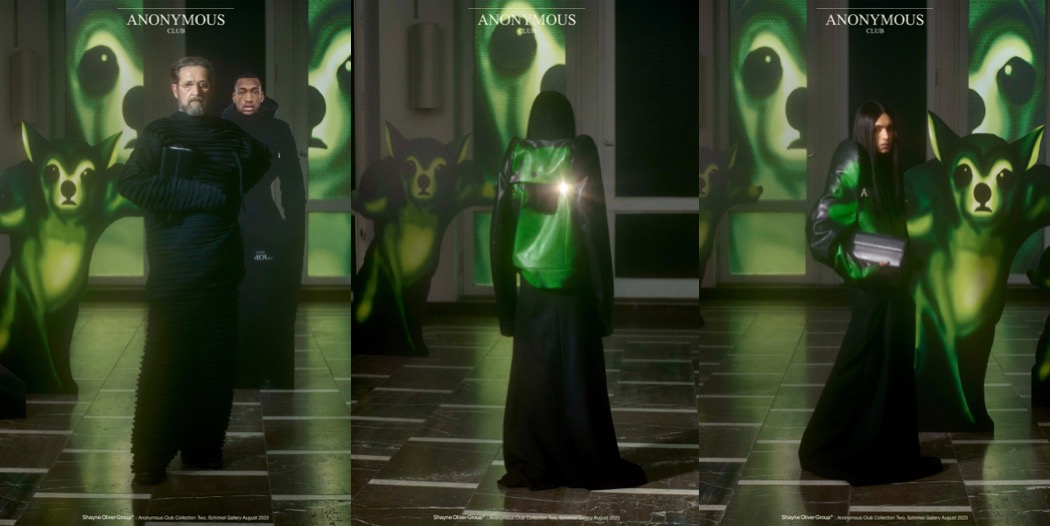
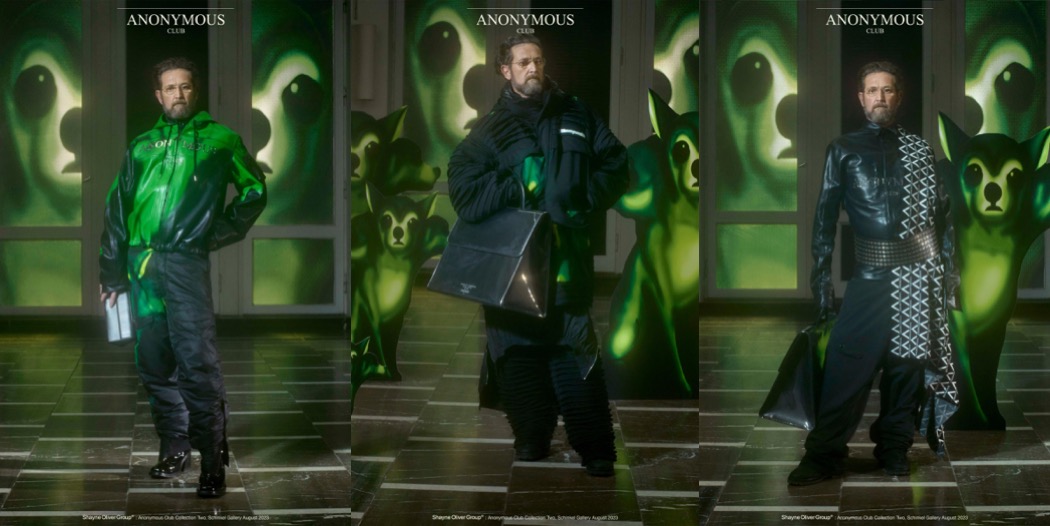
A year after its first drop, Oliver is back with the second installment of Anonymous Club, and with it some newfound structure. “I’m working to create more clarity, that’s part of what this campaign is about,” he said. He was referring both to this lookbook, shot at Schinkel Pavillon, which features the designer Stefano Pilati, a Berliner for the last couple of years, and to a campaign the label dropped last week on Instagram, which stars Telfar Clemens, Raul Lopez, and Patia Borja, who also appear in this slideshow as cutouts. “Anonymous Club is about friendship and camaraderie with people that share like-minded ideas,” Oliver said. The lineup itself is a tightly edited collection of staples with the Shayne Oliver twist in a limited color palette consisting of black, beige, and neon green. There’s the pagoda shoulders Oliver often presented at Hood by Air, his usual club-ready leather jackets and trousers, and a run of oversized utility jackets. More interesting are a t-shirt with its shoulders raised to hide the neck but sloped to the regular shoulder apex, and a flared skirt with two jacket sleeves as part of the front drape. To Oliver’s credit, as pervasive as the Hood by Air aesthetic he and Lopez introduced a decade ago is today, his clothes are imbued with a certain authenticity. The show-stealer in this lookbook is a three-headed chihuahua, a reference to Cerberus, the hound of Hades in Greek mythology that guards the gates of the Underworld. Oliver explains it came from a dark place: back in the HBA days, he felt in need of a watchdog to look over ideas and protect the “naive period in the creative process.” He feels similarly about Anonymous Club now. “Sometimes some aspects of things need to be protected for it to blossom into something,” he explained.

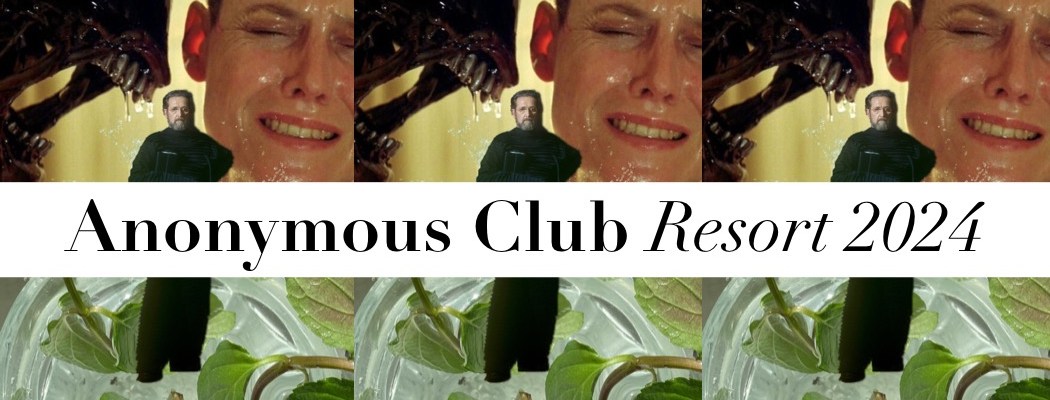
Collage by Edward Kanarecki.
Don’t forget to follow Design & Culture by Ed on Instagram! By the way, did you know that I’ve started a newsletter called Ed’s Dispatch? Click here to subscribe!

NET-A-PORTER Limited

“HUMAN IS” at Schinkel Pavillon

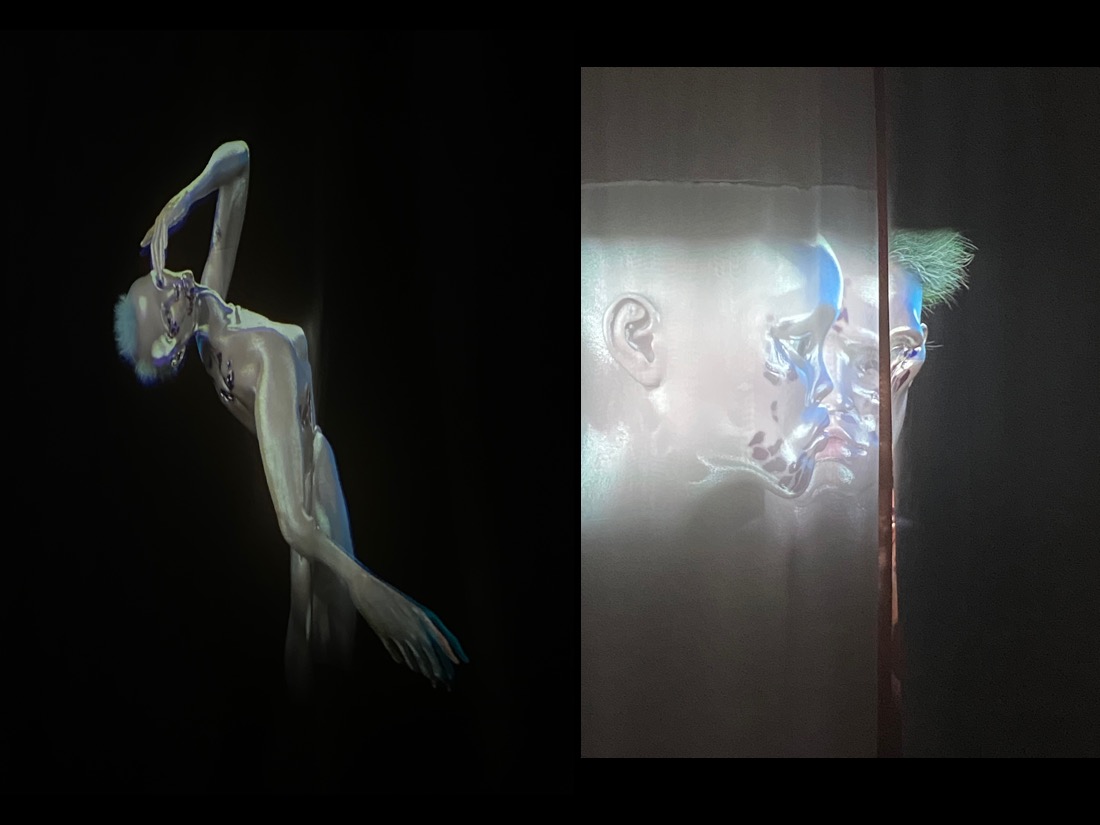
HUMAN IS” is the best exhibition I’ve been to in a while. Don’t walk, run to Schinkel Pavillon if you happen to be in Berlin this summer. Sci-fi spirituality meets post-human aesthetics. Bodies, fakeness, AI, reproduction, mutation, realness, primal instincts, fluidity… all that in the ultimate cocktail-party spot of the DDR Germany times. You feel as if you were abducted by the aliens in the solemn 1970s Berlin and were about to get high on out-of-this-world ~vibes~. Curated by Nina Pohl and Franziska Sophie Wildförster, the exhibition offers distinctions between dystopia and reality that are increasingly collapsing in the face of inexhorable technological and ecological upheavals. “HUMAN IS” borrows its name from the eponymous short story by Philip K. Dick (1955) and investigates the idea of being human as a contestable and reversible category.

Since the 19th century – and its notions of capitalist, scientific and technological progress – science fiction has held up a mirror to the changing contemporary conditio humana with its values, fears and limitations. The seemingly external threat of extraterrestrial, supernatural or artificial beings often reveals itself as self-made anxiety and part of our cultural condition. The monstrosity of the unknown arises to shake up limitations, in effect, decentering the human protagonist. “HUMAN IS” juxtaposes historical with newly produced artworks. The exhibition paints a polyphonic picture of the mutual penetration of body and technology: it addresses the often violent interdependence of humans on their technological surroundings and opposes any promises of salvation through trans-humanistic progress. Simultaneously, it opens up spaces of possibility in which dualistic taxonomies can be overcome in favor of a networked and interdependent existence. The art show engages science fiction to transcend the humanistically inscribed human, on the one hand, and the species of anthropos, on the other, through both material and perspectival liminality. For many, the collapse of the systems we have come to rely on is no longer a distant apocalyptic future. Visionary science fiction writer Ursula K. le Guin sees fiction as a container for reinventing the possibilities of human experience and knowledge beyond any linear narrative of progress. And it is through these stories that the destruction and alienation of contemporary existence can trigger creative processes and a new ethics of relationality, which may no longer be truly human.

Oberwallstraße 32 / Berlin

Photos by Edward Kanarecki.
Don’t forget to follow Design & Culture by Ed on Instagram! By the way, did you know that I’ve started a newsletter called Ed’s Dispatch? Click here to subscribe!

NET-A-PORTER Limited