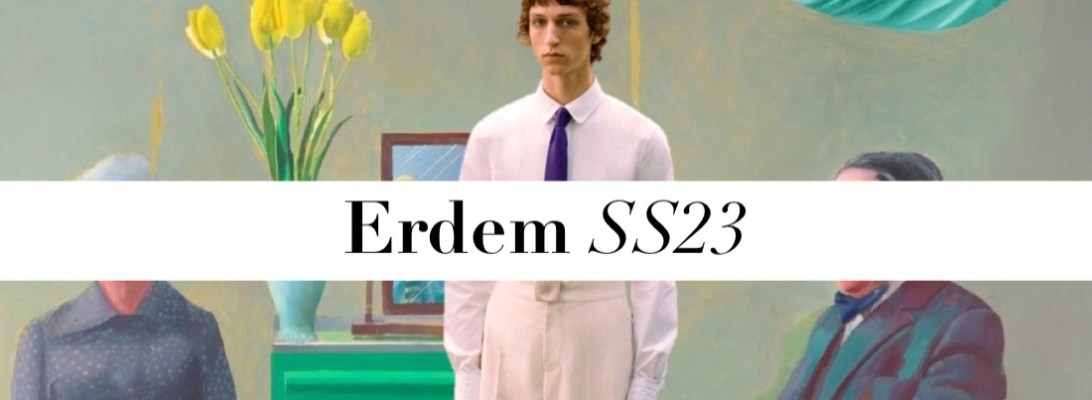
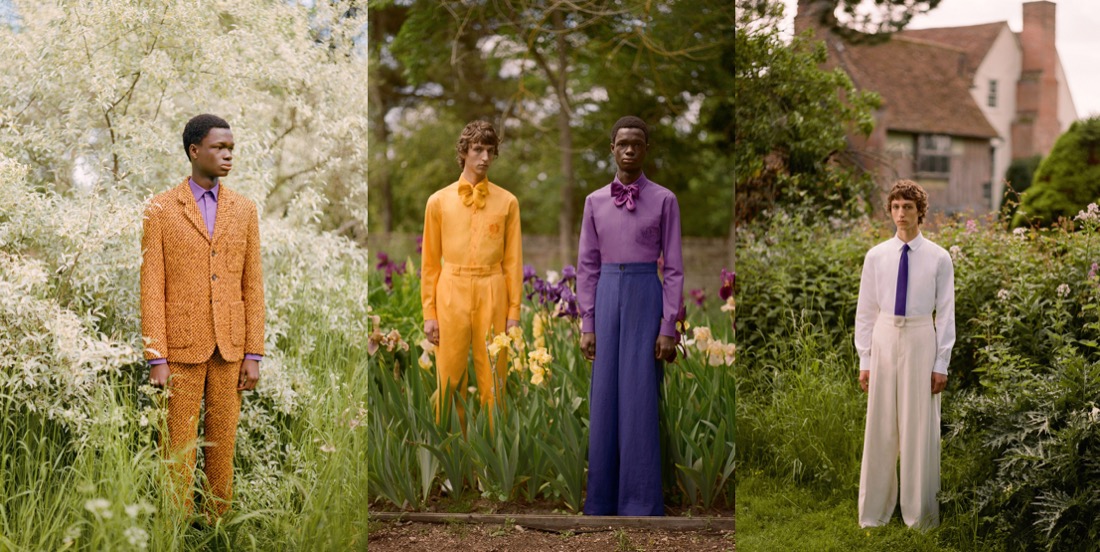
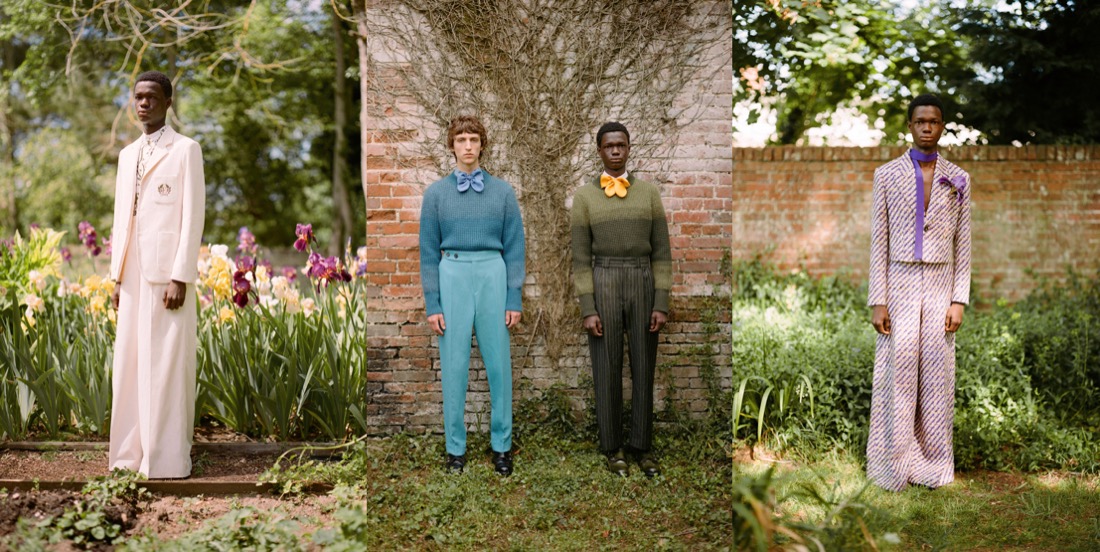
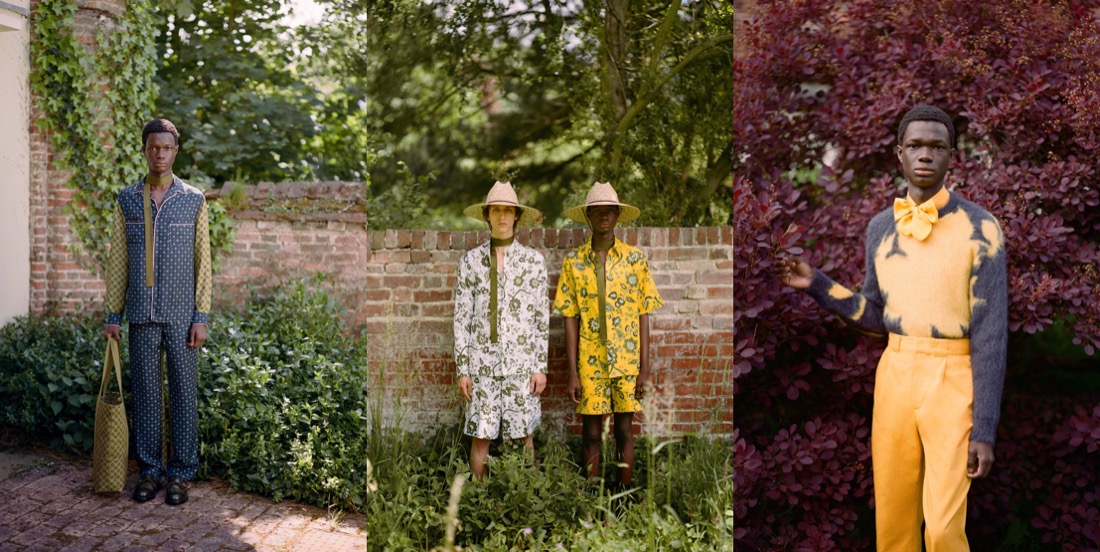
This is Erdem Moralioglu‘s second menswear season, and his vision of the Erdem man becomes more refined and clear. Handsome, young men standing in an English country garden, against beds of succulent purple and yellow flag irises. With his cinematic eye for glancingly historical biographical references, Moralioglu almost conjured a reincarnation of an everyday scene from the country life of the painter and plantsman Cedric Morris. It was shot at Benton End in rural Suffolk, Morris’s home from 1939, where he created a microcosm of an artistic avant-garde bohemian life with his lover Arthur Lett-Haines, as well as founding an art school. Lucian Freud was an early pupil. Cedric Morris, it turns out, was a friend and supplier of the society florist Constance Spry, who designed the Queen’s Coronation and who had her highly successful shop a few doors down from where the Erdem flagship is now. Connie Spry and her aristocratic clientele are all over his collection. There’s nothing like a romantic coincidence to get Moralioglu going. This one was a pure gift in terms of the colors he loves, inspiration for his boyishly foppish sense of style all the way through to the floppy, blowsy bow ties which seem almost like blooming corsages picked from Morris’s iris beds. The idea for digging into this aristocratic alternative history had actually hit him a little while ago at a Cedric Morris exhibition at the Garden Museum. Even without knowing a thing about this artist, though, you can sense the spirit of the 1940s that Erdem picked up in photos and paintings: Englishmen in hand-knitted sweaters, tweeds, shorts, and silk dressing gowns.
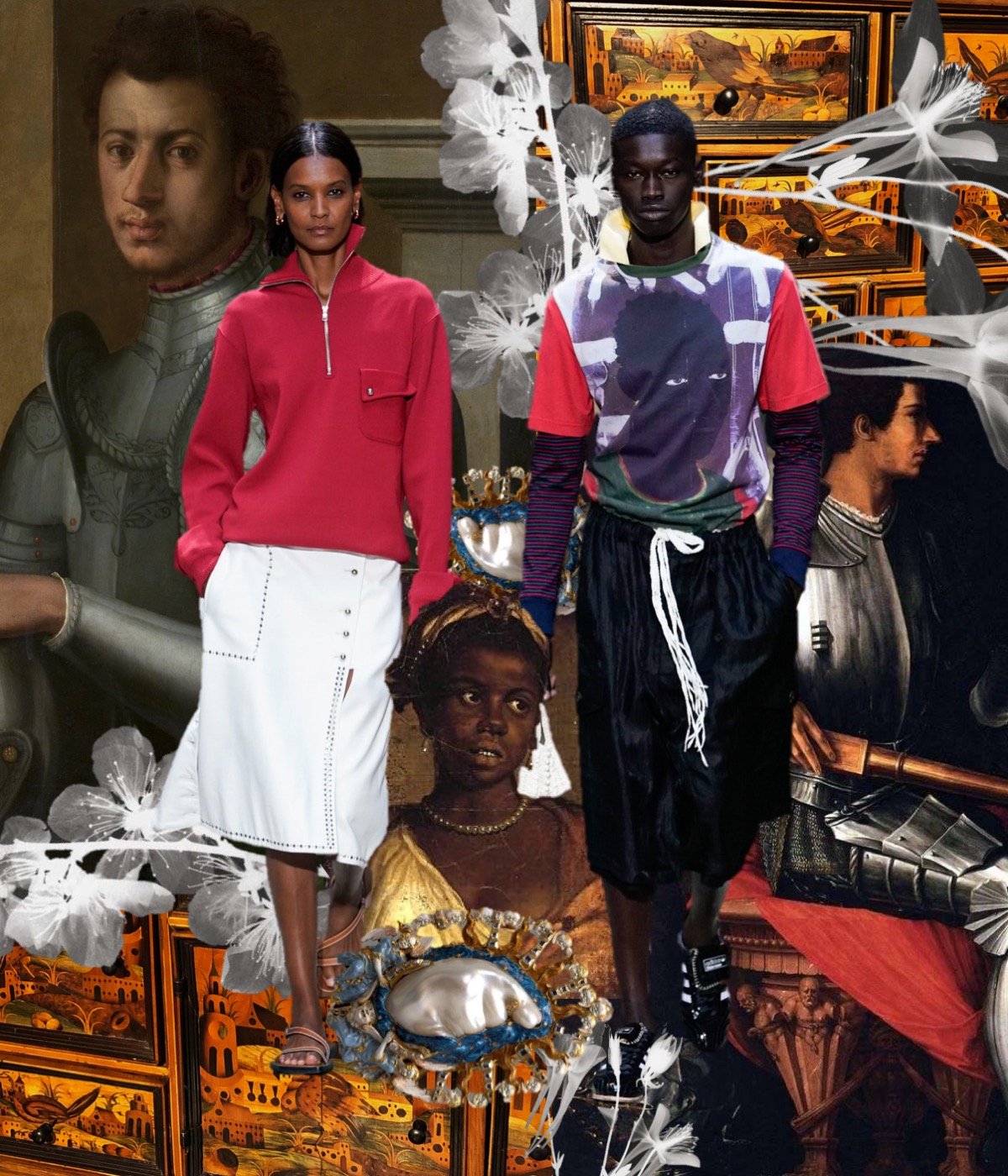
Towards the end of the press preview of this sumptuously progressive show, Grace Wales Bonner mentioned Sankofa. This bird-looking-backwards symbol of Ghana’s Akan people, she said: “means’ ‘going back to go forward.’ It is not about being nostalgic or historical. It’s about taking something from the past in order to pass it forward and make it useful for the future. And that’s the spirit of this collection.” Wales Bonner was speaking in the central courtyard of Florence’s Palazzo Medici Riccardi, a space where one Pitti Uomo executive mentioned in passing that there had never before been a live fashion show. It was as if the Palazzo had been waiting 485 years – the time since it was once home to the first Black head of state in modern Europe – to become the outbound runway for this evening’s Sankofa flightpath. Its starting cipher was Alessandro de Medici, who until his assassination in 1537 at the hand of a cousin ruled here as the first hereditary monarch of the Florentine Republic. His mother was named Simonetta da Collevecchio – aka “Soenara” – and was Black. She, history a little shakily relates, was a house servant who became mother to Alessandro after an encounter with either Duke Lorenzo (the official father) or Pope Clement VII. “I wanted to acknowledge that presence but also think about the idea of arrival,” said Wales Bonner. The building also held an additional layer of resonance relevant to her practice of excavating multifaceted manifestations of cultural intersection through garments. The palazzo was commissioned by Alessandro’s ancestor Cosimo in 1444, around the same time that he hosted the 17th ecumenical council, a global gathering of Christendom which according to historian Paul Strathern included: “Armenians and Ethiopians… other entourages included Moorish, Berber, and black African attendants.”
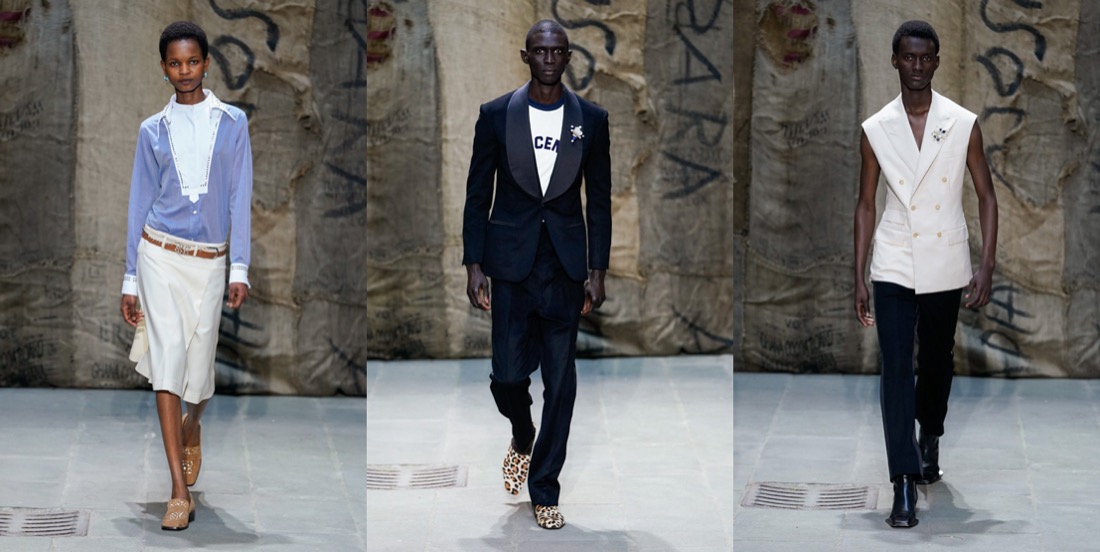
All of this context served as evidence that the building around us has played a role in the history of Black agency and participation in Renaissance Italy. It was leveled by the intervention in the Palladian architecture by the artist Ibrahim Mahama, who clad the space in a huge patchwork of hand stitched jute sacks originally used to export cocoa from his home country of Ghana – where Wales Bonner met him several months ago – into the global markets. “It was important to have an equal representation within the space,” said Wales Bonner. The opening look featured the reproduction of an artwork by Kerry James Marshall. This was another pointer towards Wales Bonner’s intention to rehang the display of menswear in Florence just as one would rehang a gallery – in order to shift the visitors’ experience. Just as effective was the slow coalescence of menswear forms – some sourced from the previously mentioned binary of contemporary European tropes of formality and informality, and others from a broader array of traditions whose boundaries were broken down by adjacency. Paris’s Charvet provided handsome robes and day-pajamas in jacquards whose patterns were drawn from Wales Bonner’s research into West African tradition. The macramé womenswear dresses were set with hand-made glass beads by Ghanaian artisans, and the heat-dryed hand-dyed jersey had been fashioned in Burkina Faso (Wales Bonner was building new trade routes between Africa and Italy, and Savile Row too). In menswear there was genre-busting back and forth between futuristic sportswear (which included a hand-made adidas shoe whose trefoil looked lacily artisanal) and Wales Bonner-directed, Anderson & Sheppard-cut tailoring in cashmere and camel hair that was de-conventionalized through emphasised shoulders and small sly acts of sartorial ‘wrongness’ that looked incontrovertibly right. So back to Sankofa. What was the backward-looking-bird returning to, in order to pass forward for the future? Said Wales Bonner: “It’s about bringing an Afro-Atlantic spirit to European luxury by honoring these traditions wherever they are. And making something hybrid or integrated through working with different people.”






 Design & Culture by Ed