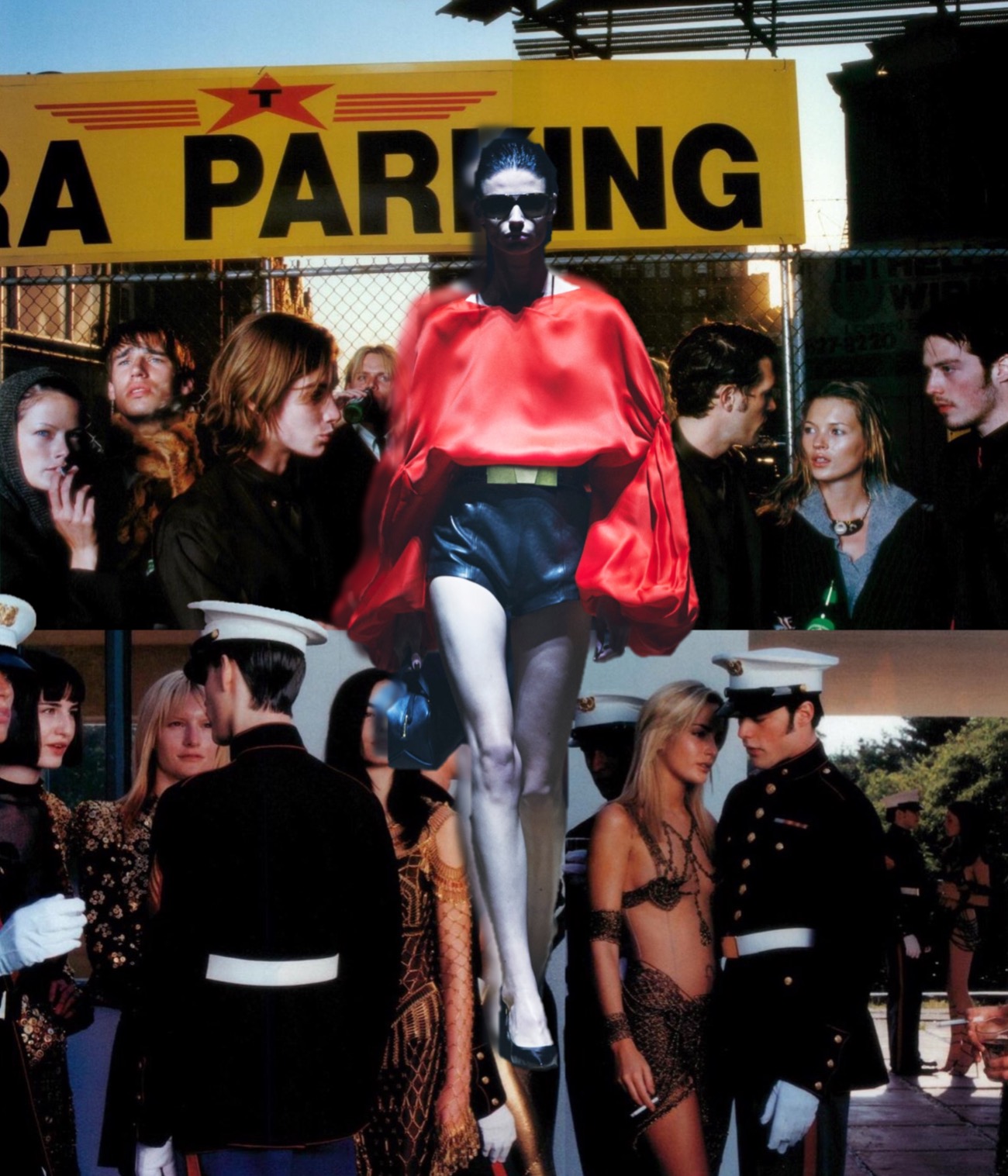
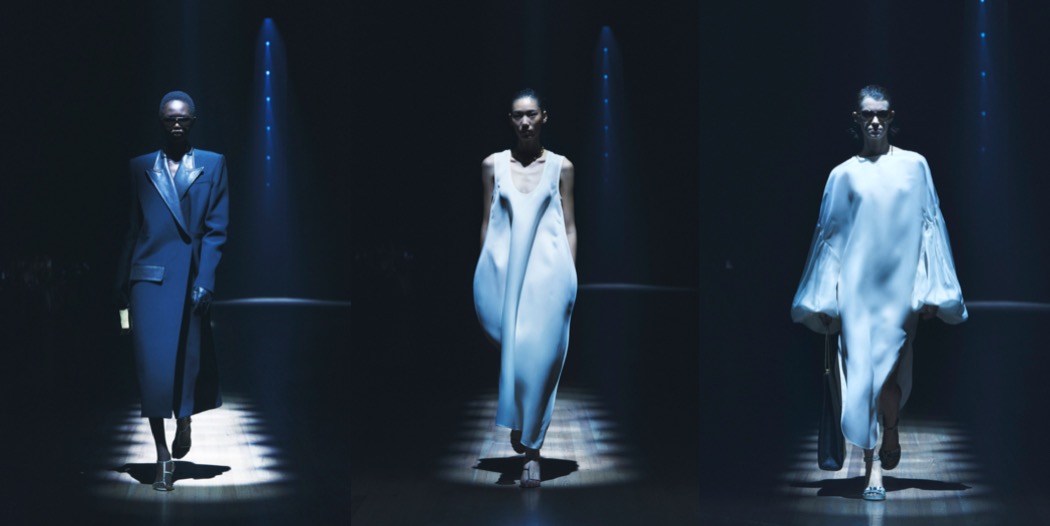
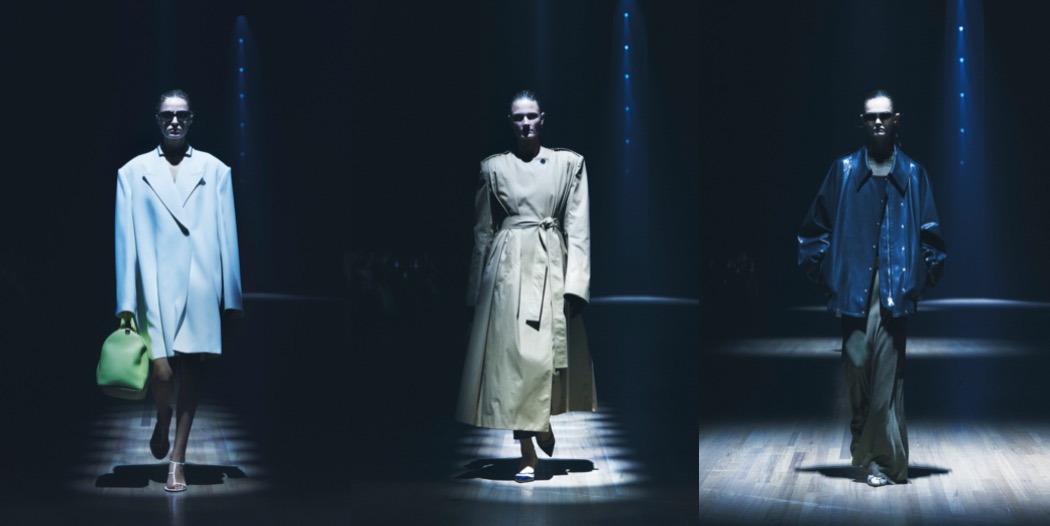
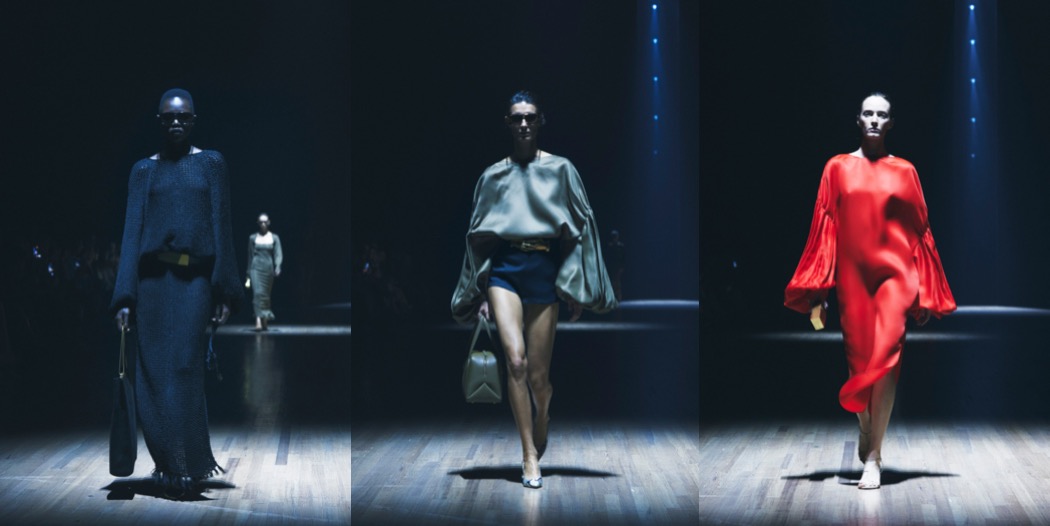
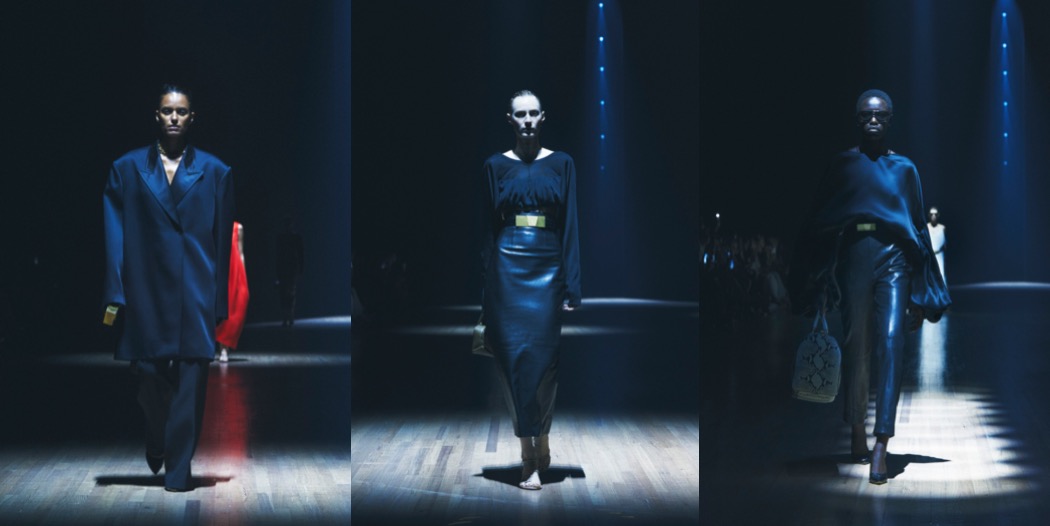
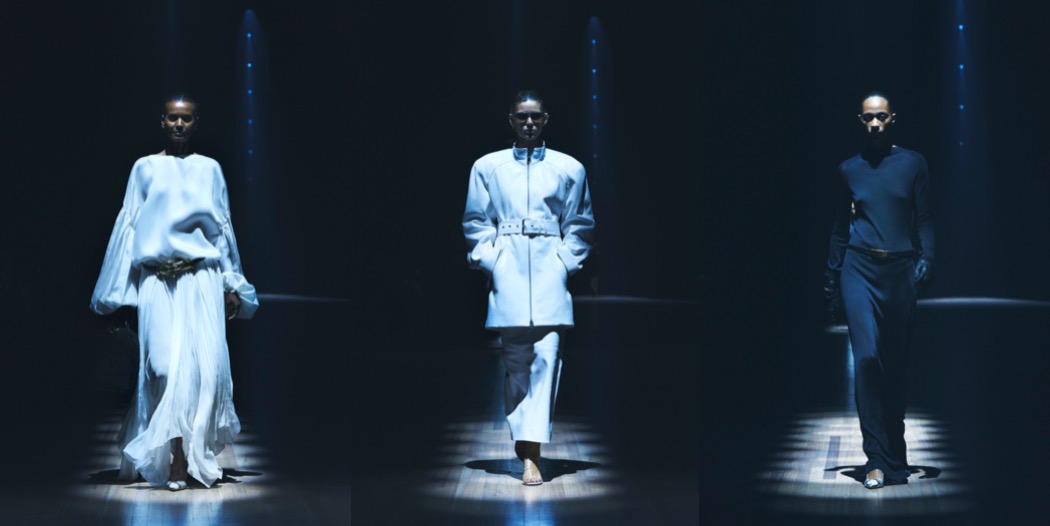
At Khaite, yet again you could barely see the clothes, but could definitely get the vibes of a coherent vision of a contemporary New York woman. The lighting theatrics on the very darkened runway emphasized the sharp silhouettes Catherine Holstein has in offer for spring. She called them “ferocious“. “I think every woman in New York has to handle herself with a real fearlessness,” said Holstein, indicating that that’s what she had to do while operating as her label’s top creative and, until recently, CEO. “And that’s always something that I bring forth in the brand.” At this brand you won’t find novelty, but rather elevated wardrobe staples that never get out of style: exaggerated masculine coats, big-shouldered blazers, sensual silks, investment bags. The semisheer body-con knits were an understated answer to all the straightforward sexiness we see on the other runways. Holstein might be the contemporary Donna Karan of New York Fashion Week.
Collage by Edward Kanarecki. Don’t forget to follow Design & Culture by Ed on Instagram! By the way, did you know that I’ve started a newsletter called Ed’s Dispatch? Click here to subscribe!
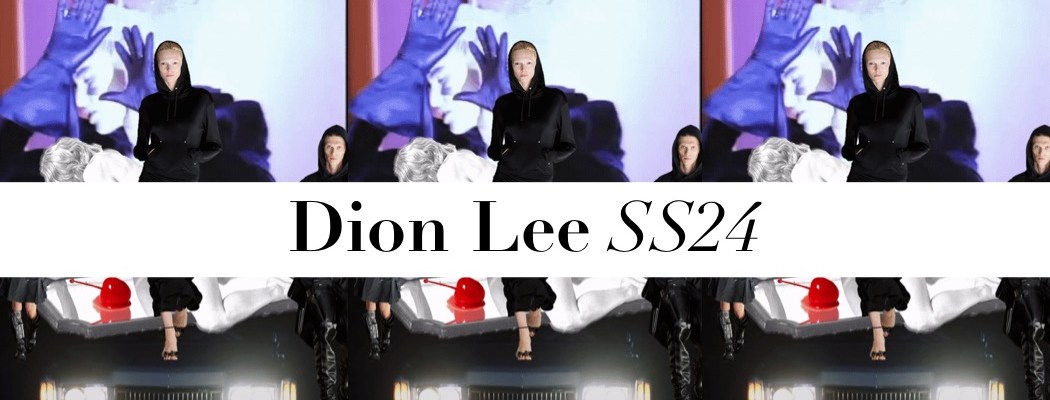
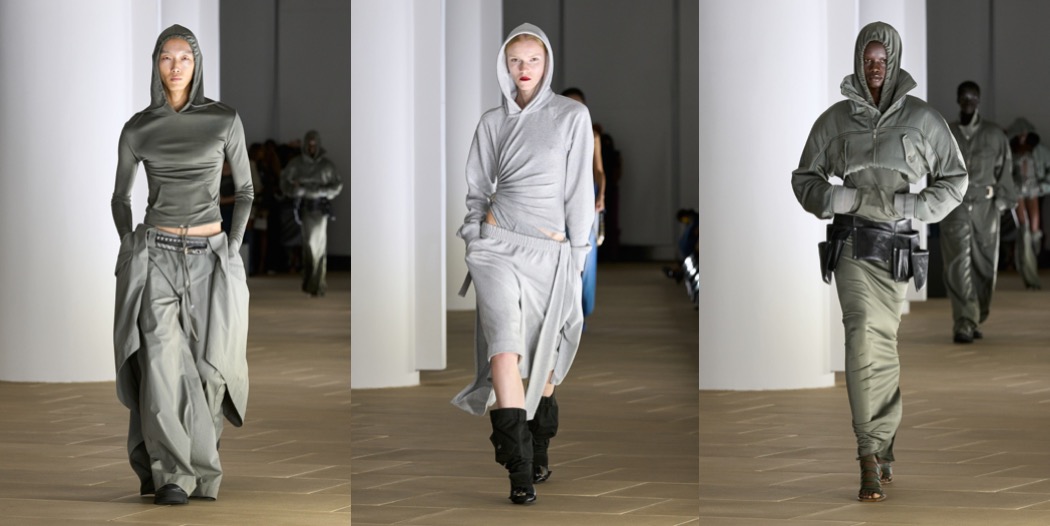
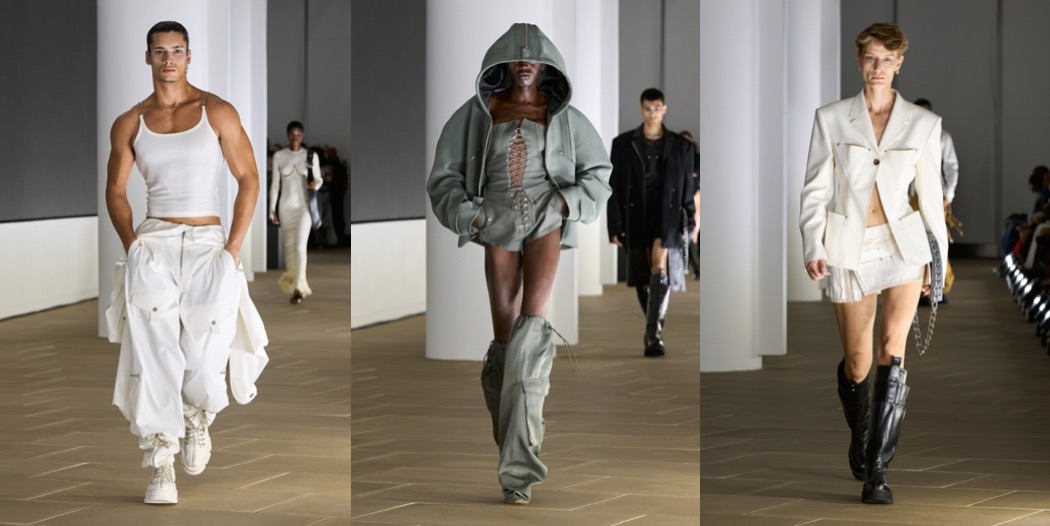
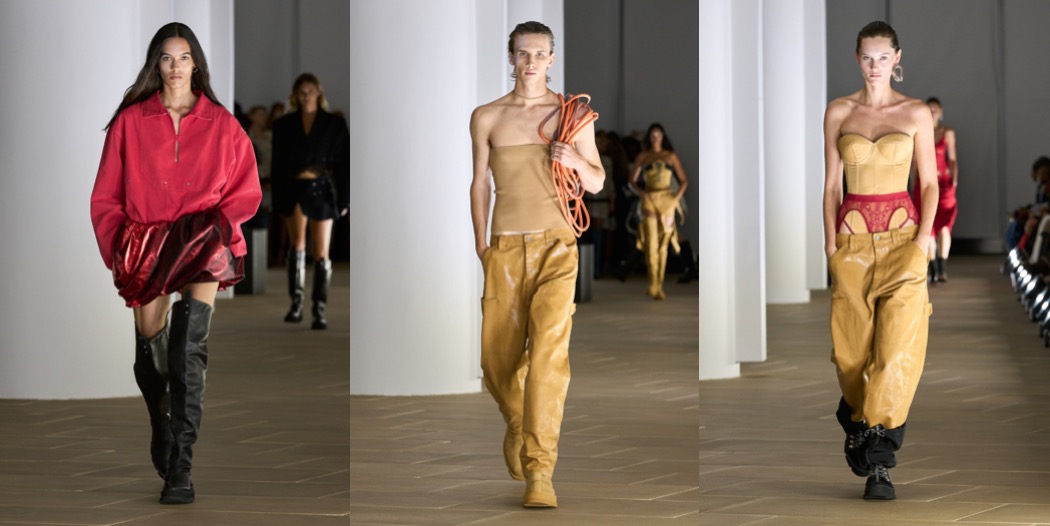
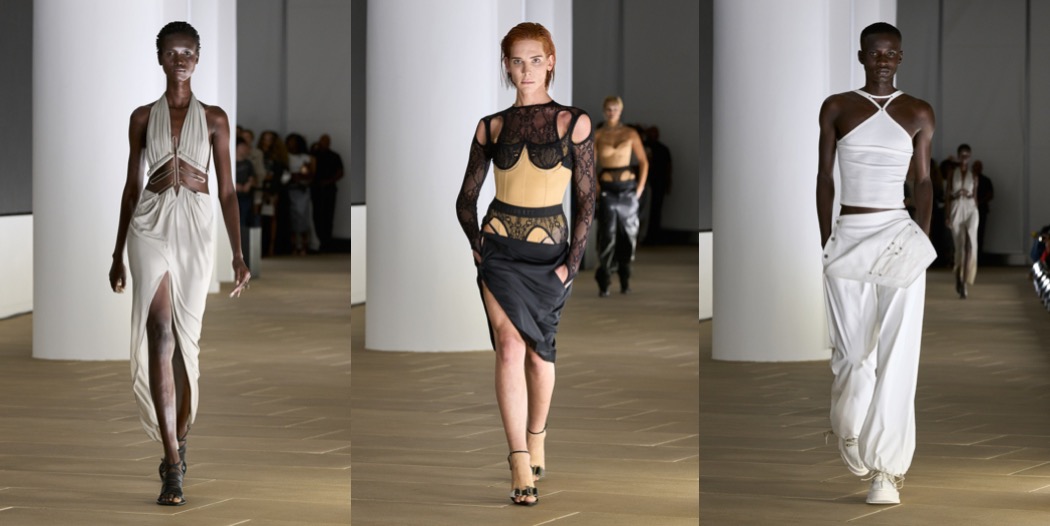
What I appreciate about Dion Lee‘s work is his consistency – a word that so many other New York Fashion Week designers should learn. His spring-summer 2024 is sexy and bold, and with wit. “This season was primarily about evolving the utility and construction language I’ve been playing with until now,” the designer said. What’s compelling about Lee as a designer is his ability to both fixate and expand on a specific theme while managing to keep his clothes distinctly true to his style. The Australian creative mentioned he started playing with power cords as a way to drape for his autumn offering, which carried over into this collection in the shape of shirring details by way of bungee cords. Particularly fun was a pair of trousers that had its back label replaced with an outlet; the model walked down the runway plugged in, carrying his coiled orange cord as a shoulder bag. Elsewhere, Lee laminated denim and introduced foiled leather for a sleek hint of texture. The latter was used in bubble-hem skirts and dresses, which added a welcome variation of shape. Also cool were his lace lingerie-like explorations; they felt freshest where they fell weightless around the body rather than constrict it.
Collage by Edward Kanarecki. Don’t forget to follow Design & Culture by Ed on Instagram! By the way, did you know that I’ve started a newsletter called Ed’s Dispatch? Click here to subscribe!
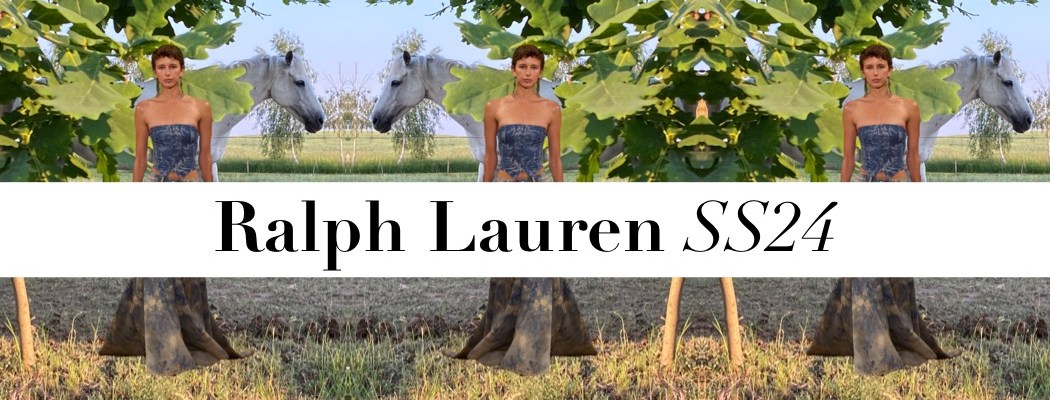
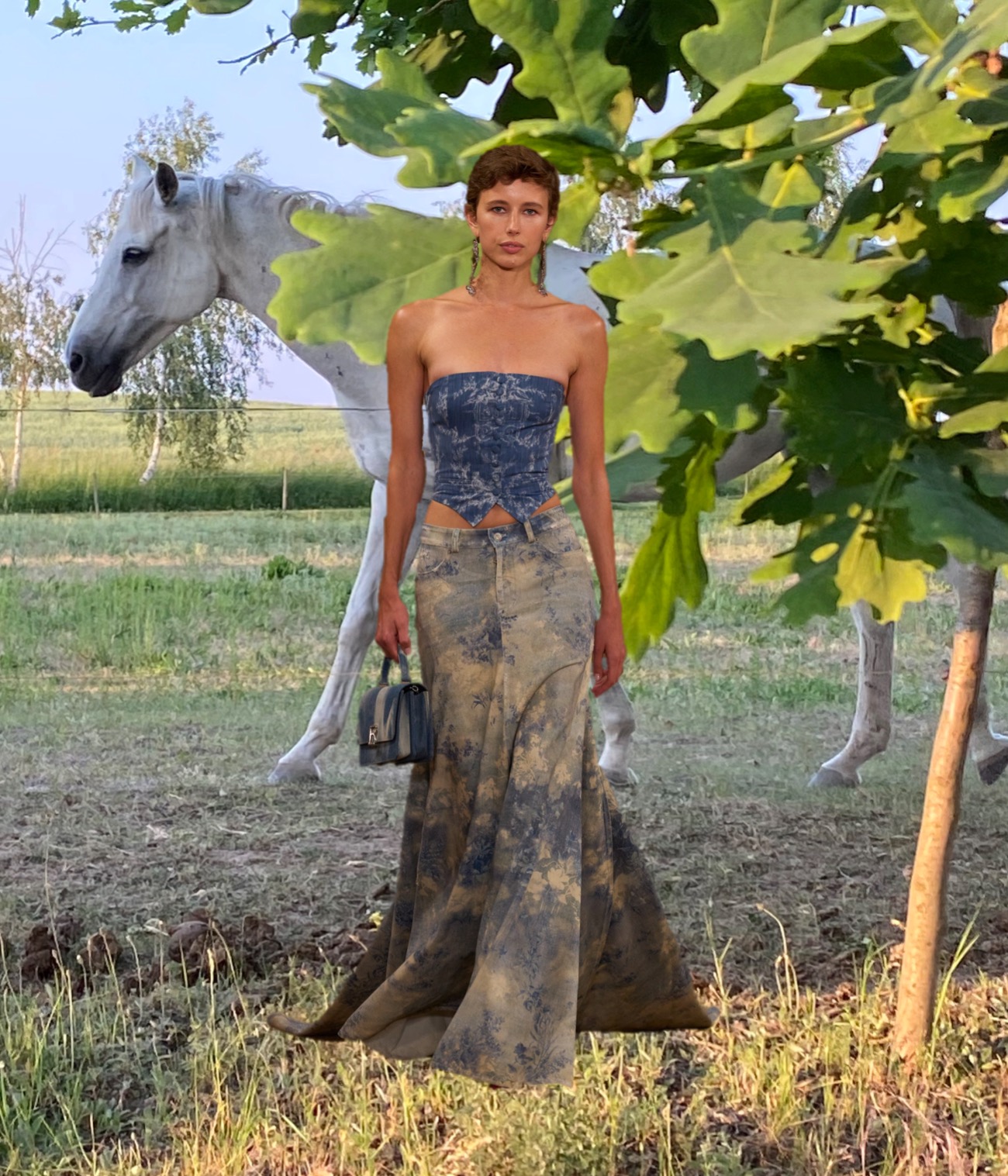
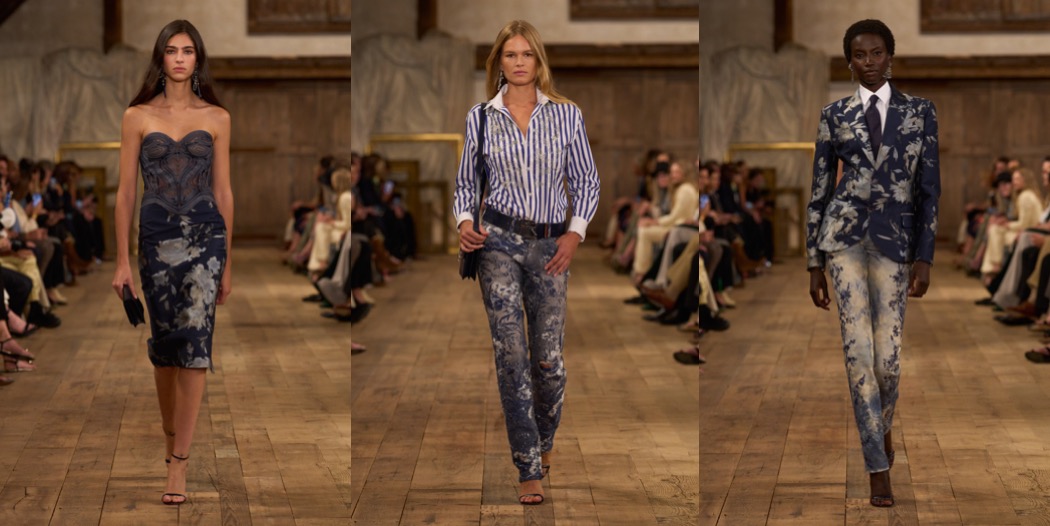
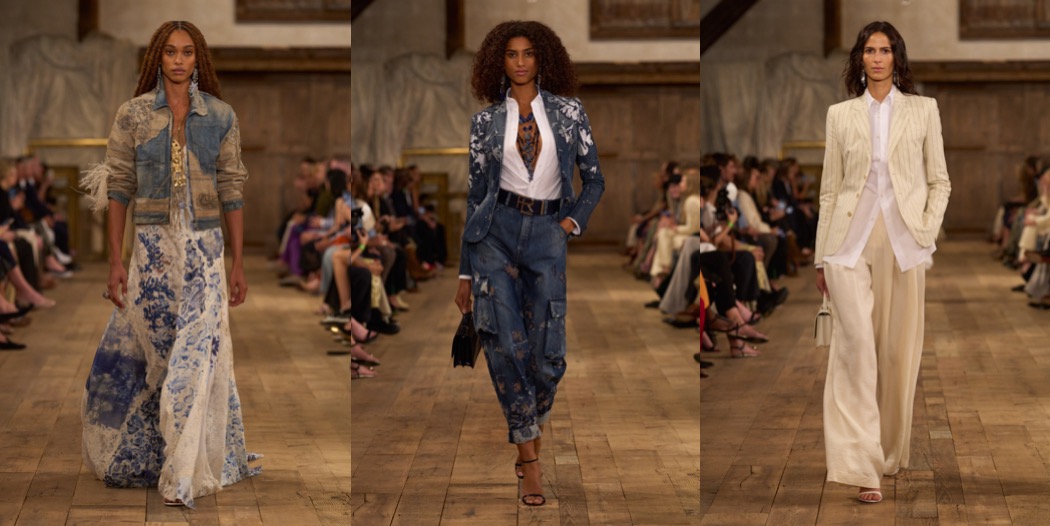
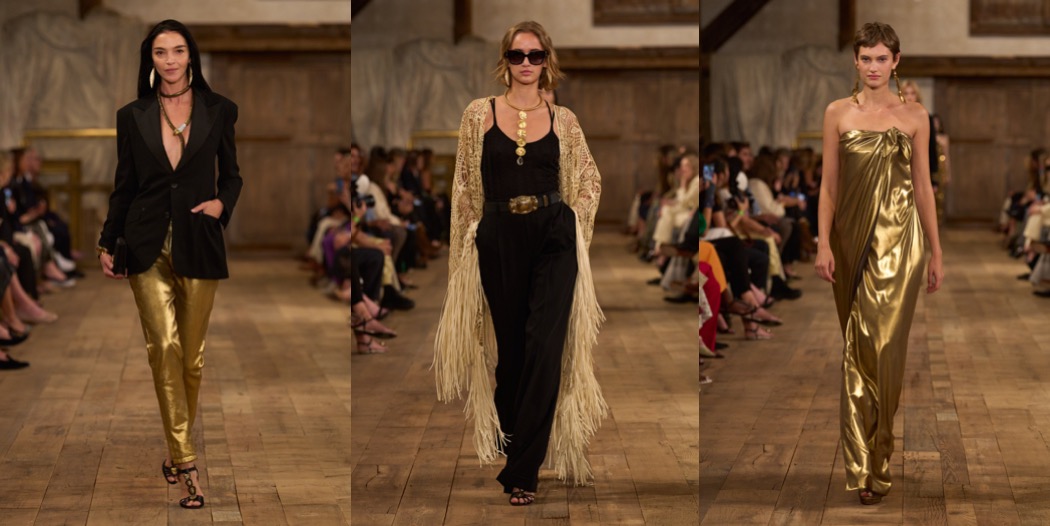
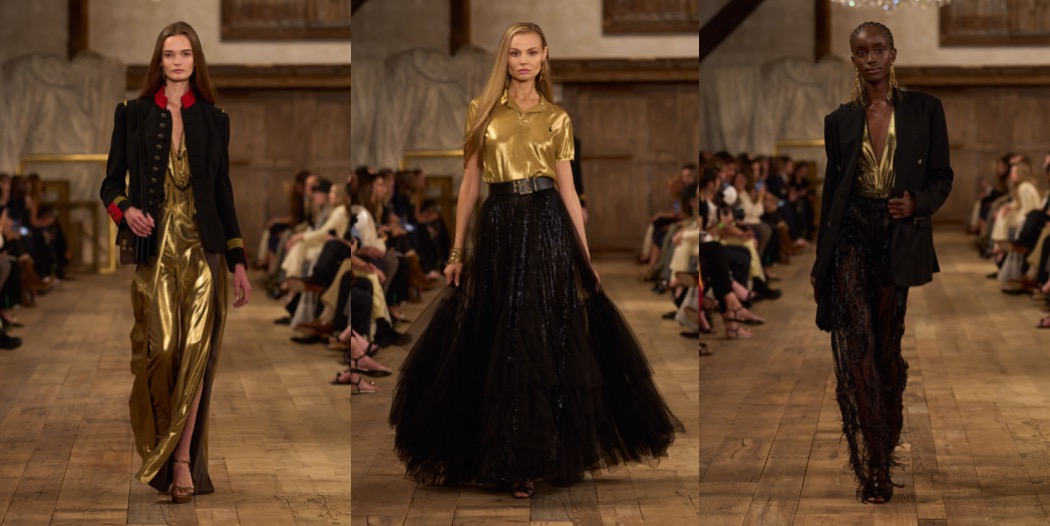
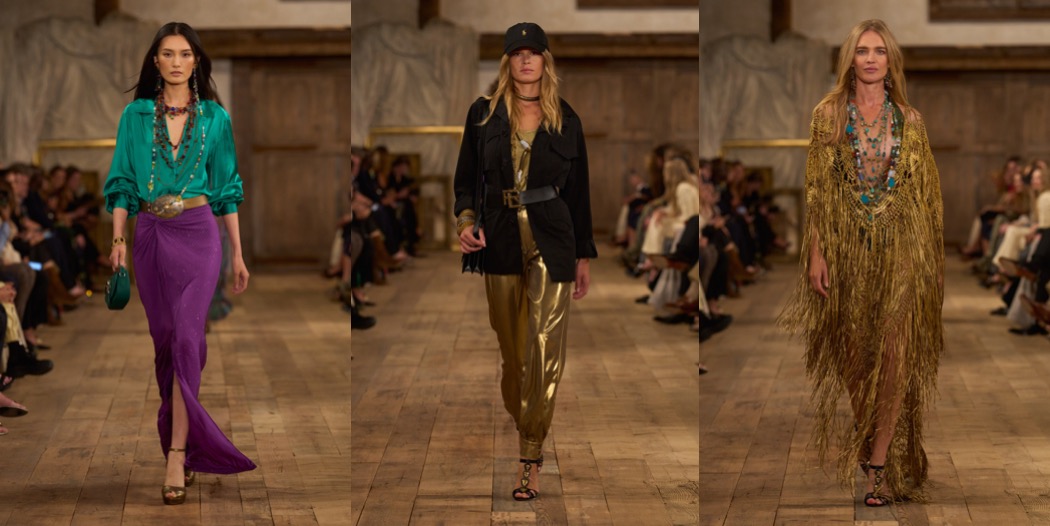
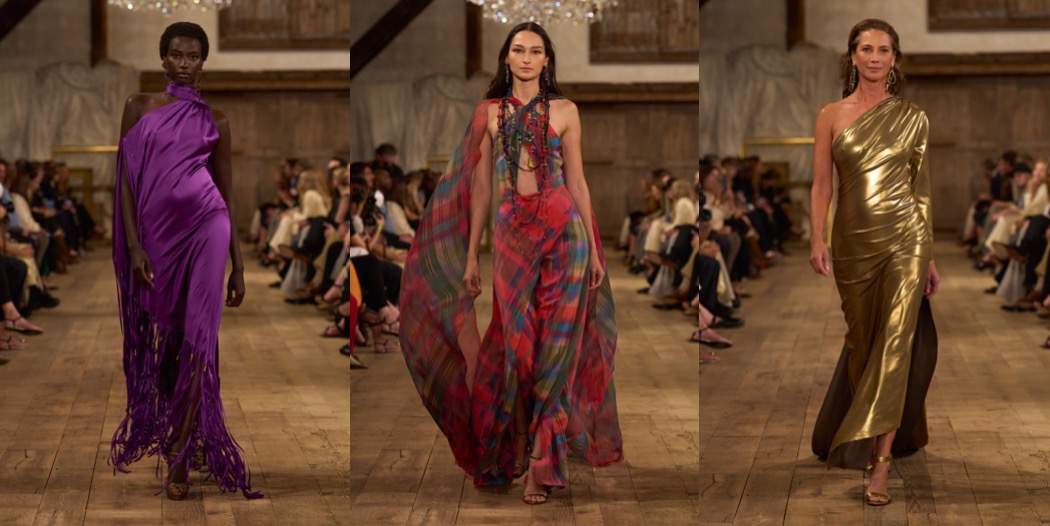
There’s something so reassuring about a Ralph Lauren collection. It’s really good to see the designer back on the New York Fashion Week schedule, as he brings much-needed substance to the table. For spring-summer 2024, the all-time American designer looks back at his 2000s aesthetic (especially the gorgeous spring-summer 2003 collection which resonates so well with fashion in 2023) and delivers a line-up of what I call future vintage, clothes that will become heirlooms. The offering started with that most American of fabrics, denim, only Lauren treated it in the most elevated of ways; lined with chiffon and tulle and burnt out into devorés, it was then over-embroidered with sequins and beads. It doesn’t feel like an exaggeration to liken these pieces to couture, even if the silhouettes he was working with were straightforward jackets and cargo pants. From there, the show moved onto a series of black and gold looks and a chance to play with house codes like the RL logo, which was picked out on the torso of a clingy beaded black dress, and the military jacket, which got belted over silky pants and strappy heels. Christy Turlington’s show-closing gold lamé one-shoulder gown was a knockout. A glamorous, NYFW moment.
Collage by Edward Kanarecki. Don’t forget to follow Design & Culture by Ed on Instagram! By the way, did you know that I’ve started a newsletter called Ed’s Dispatch? Click here to subscribe!
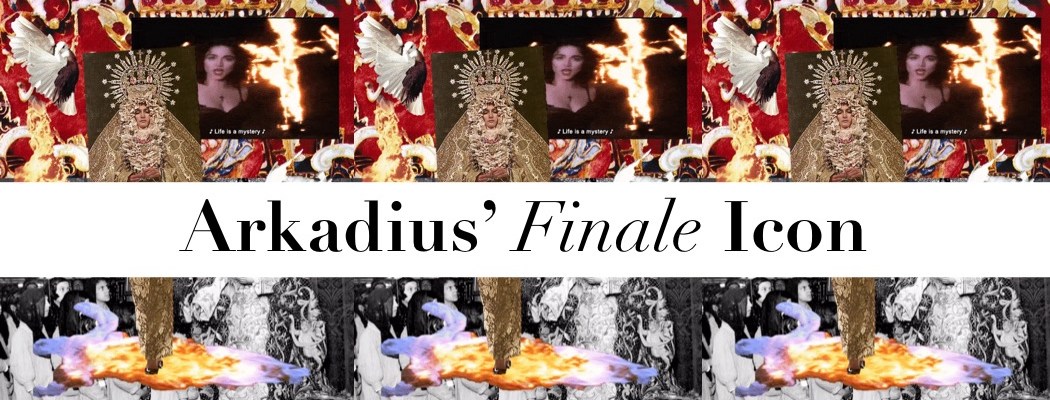
Back in July, I defended my MA Thesis in Art History titled “Selected Phenomena of Haute Couture Fashion as a Reception of Early Modern Catholic Pictorial Traditions”. In the thesis, I’ve analyzed one of the most intriguing examples of dialogues between fashion and Catholic imagery in history: Arkadius’ Finale Icon which closed his revelatory spring-summer 2002 collection. For the sake of research and a better understanding of the designer’s intentions, I’ve interviewed Arkadius himself at the beginning of the year. Yes, the legendary designer, the ultimate icon of Polish fashion, the creative who enamored London in the late 1990s and early 2000s.
First, here’s an excerpt from my thesis, where I discuss the designer’s take on Catholic imagination through Finale Icon, an incredible piece of fashion history:
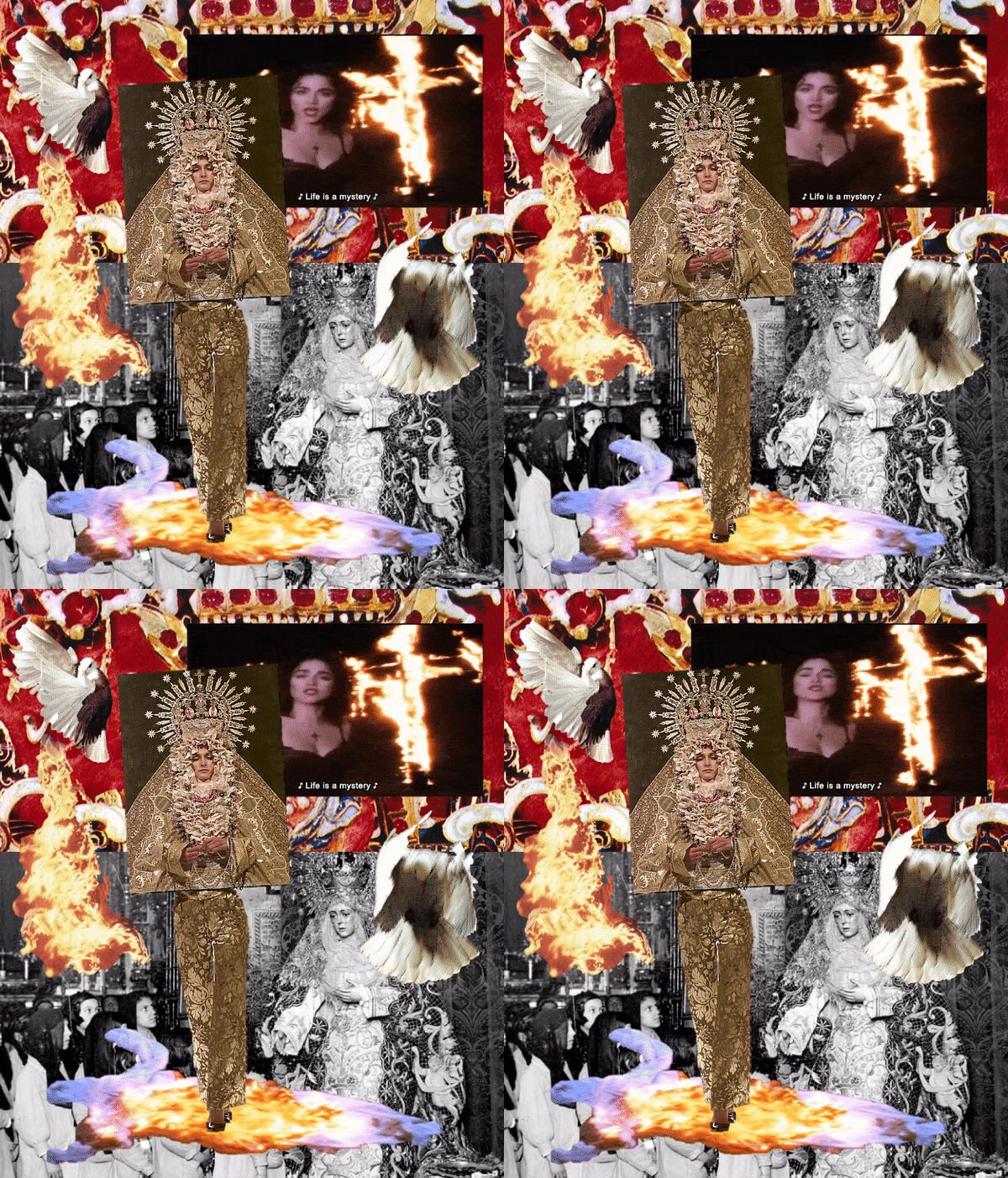
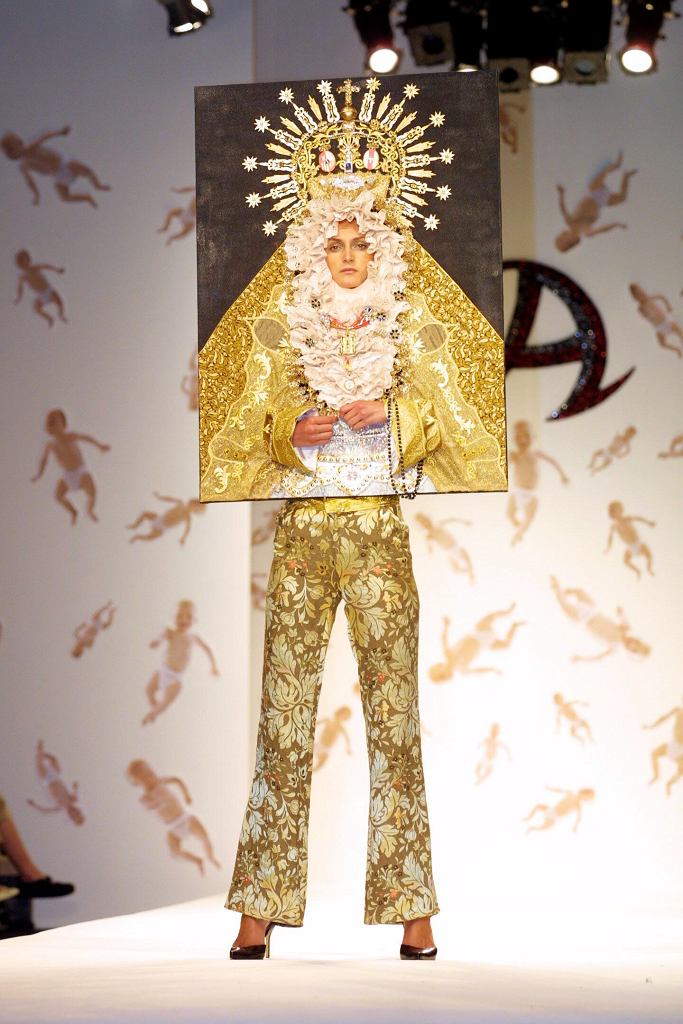
Arkadius’ design, which comes from the Virgin Mary Wears The Trousers collection, was inspired by two different artistic representations of Mary: the statue of the Blessed Virgin of Macarena from the Basilica De La Macarena in Seville and the painting of Our Lady of Czestochowa.
In his work, Arkadius drew inspiration from the world around him, from political events and social phenomena to art and literature. As with Cristóbal Balenciaga [another designer whose Catholicism-inspired work I’ve analyzed in my thesis], images of visual culture related to homeland were an important reference for him. An example of this is the spring-summer 2001 Paulinacollection, where Polish folklore and rural lifestyle proved to be the key references. Polishness as understood by Arkadius, consisting of a cultural landscape built from folk traditions (including Łowicki and Podlasie cut-outs and wicker decorations), was never seen before in such a bold way in the work of any contemporary fashion designer, let alone at London Fashion Week. It seems that the Paulina collection became a starting point for the further deconstruction of Polishness, and the creation of a collection related so intensely to a significant image of native visual culture that is Catholic tradition. In the designer’s own words, “the environment in which we grow up, the society in which we function and the religion we follow shape us in a certain way.” The Virgin Mary Wears The Trousers collection appeared to be a thorough reflection on the phenomenon of religion, which can unite as well as differentiate people.
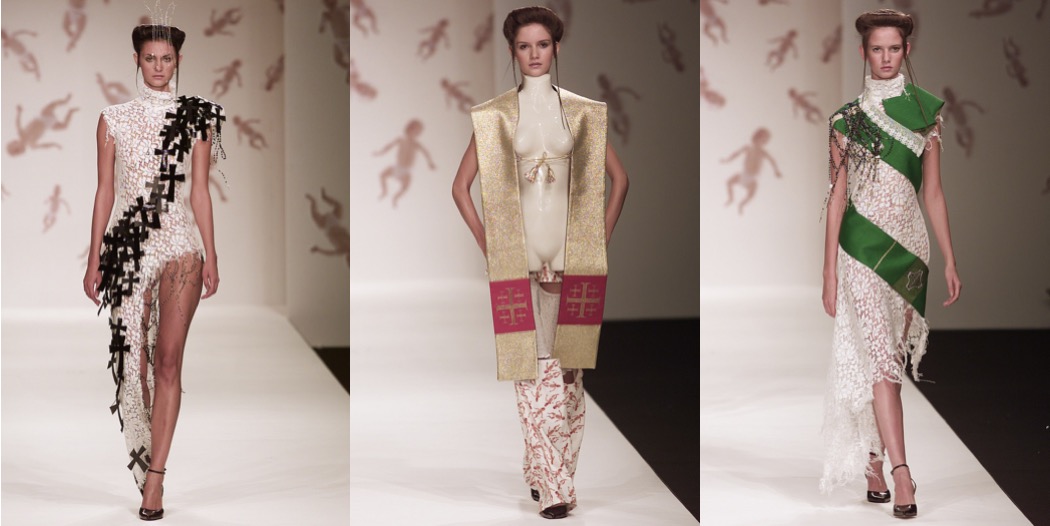
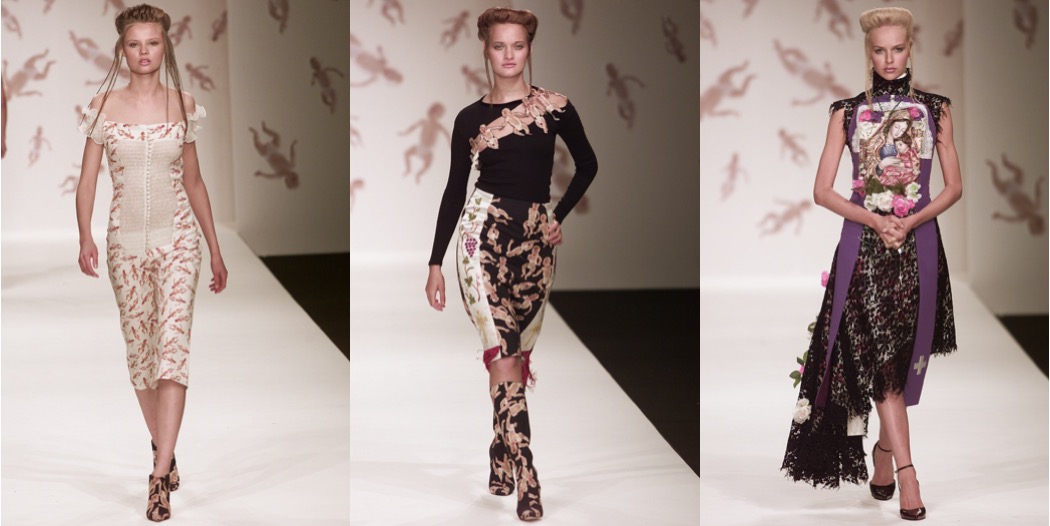
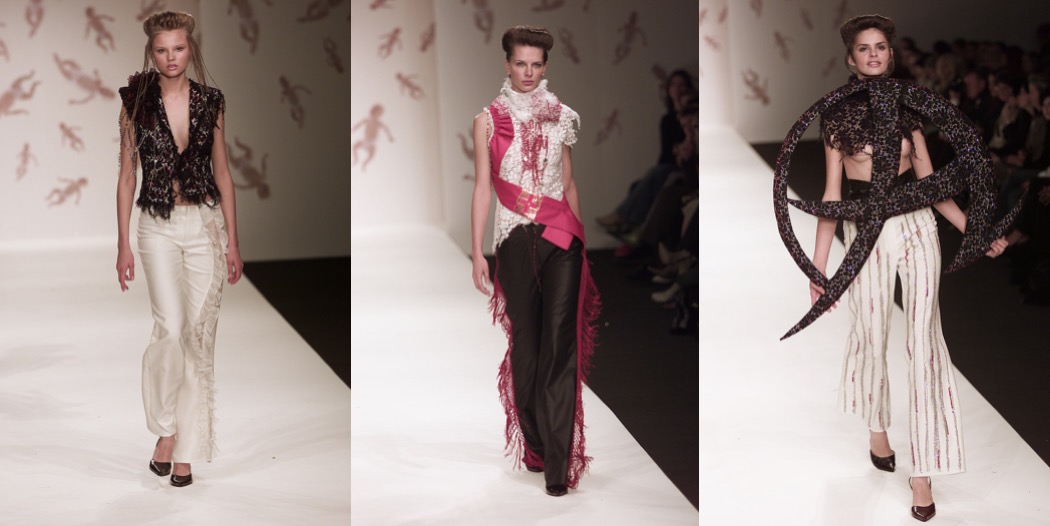
The Polish designer presented looks inspired by liturgical vestments (such as a stole), treated rosaries as decorative trims on dresses, and used ecclesiastical motifs like the Latin cross, the heart-shaped ex-voto and the representation of the white dove in the form of ornate embroidery on jackets and tops. Arkadius “desacralized Catholic images and church ceremonial and transported and exploited their aesthetic qualities for the sake of fashion spectacle”, Dominik Zieliński stated in the designer’s monograph. What interests me most, however, is the final creation in the collection, which Vogue fashion critic Sarah Mower compared to an experience of “religious climax”.
The Finale Icon look largely escapes conventional identifications of garments. Presented on the catwalk by model Kasia Pysiak, the outfit consisted of two essential pieces of “clothing”. The upper part of the ensemble, worn over a black shirt, was a rectangular black canvas stretched over a frame with specially cut holes revealing the model’s face and her protruding hands. The lower part of the outfit was a pair of pants of classic cut covered in opulent, floral pattern. The runway styling was completed with black stilettos created in collaboration with Jimmy Choo Couture. The most important element of the look is the aforementioned canvas, which was modeled on the image of the Virgin Mary as well as on the tradition of decorative dresses placed on representations of Madonnas [a historical Byzantine-Ruthenian tradition]. This part of the ensemble, with its form resembling an icon and depicting on its surface the figure of the Madonna wearing a crown, was hand-finished with gold jacquard fabric, various lace and costume jewelry in the form of cabochons. It was a “controversial combination of the traditional sacred with the modern profane”, Zieliński concluded.
And now here’s the interview regarding Finale Icon – published for the first time here on Design & Culture by Ed!
Ed: Regarding the final look from the Virgin Mary Wears The Trousers show, what influences and inspirations from sacral art played a significant role for you? The book “Arkadius. Fashion That Became Art” mentions the inspiration coming from the Virgin Macarena of Seville. Why was this particular representation of the Virgin important to you? Did you treat that image of her in a “formal” way when creating this garment, or was it more of an initial impetus for the creative process?
Arkadius: The main reason for using the image of the Virgin Macarena of Seville was her global recognition as an iconic religious imagery. This particular image is an actual 3D sculpture and is very well known and a striking work of art, with a very deep sorrow look, tears, which capture the morbid spirit to represent the philosophy of this particular collection. The strength of the image and the entire mood of the collection was also beautifully captured by the model wearing it as the finale of this show.
Ed: Looking at the ensemble, I instantly associate it with “Our Lady of Czestochowa”, and especially with the “ritual” that is so characteristic of this artwork – that is, adorning it with the encrusted dresses. Did such inspiration take place in your creative process? Do you see any dialogue between the runway look, and this very work of art and the Byzantine-Ruthenian tradition associated with it?
Arkadius: Being Polish myself, my original idea was indeed to use the imagine of Matka Boska Częstochowska and not the Virgin Macarena of Seville, but I also knew that our Polish Matka Boska did not have the same global recognition as Macarena. The Finale Icon outfit was directly inspired by the opulence of Macarena figure, with all its intricate details of embroidery, gold and Byzantine richness. This richness is a metaphor of holiness in the Catholic religion, which very often puts more attention to the imagery rather than the spiritual connection as its religious representation.
Ed: The final look is literally related to the title of the collection. The model portrays the Virgin Mary “wearing the trousers” – that is, in a sense, occupying a stereotypically male stance/position. In my thesis, I am interested in the gender stereotypes, so deeply encoded in the Catholic imagination. Designers, through the medium of fashion, subvert them – for example, they create outfits inspired by the vestments of cardinals or bishops, strictly reserved for the male church hierarchy, and use them in women’s collections. Was criticism of the patriarchy one of the more important aspects regarding the creation of this look?
Arkadius: It is a very good question, thank you for this. I don’t think that anybody has ever asked me what was behind the title. This was actually nothing more and nothing less as a tongue-in- cheek or a whimsical exaggeration of our made-up story of who actually wore the trousers in the family. But this comparison also brought attention to a very fast changing family and gender structure and how many women are now actually running families and not men as it used to be in the past. Hence the idea of the title and the recognition of woman’s strength and her actual position in the society in the 21st century.
Ed: The entire ensemble, from the “icon” part to the trousers, is extremely tactile, rich in texture, opulent, like a real sculpture or painting depicting the Virgin Mary. Do the materials used in the creation of the outfit have an ecclesiastical origin or were they upcycled?
Arkadius: All the materials used in this outfit were recycled from already previously owned pieces of fabric. Only the frame of the icon was purchased new. The trousers fabric was bought by me in Grand Bazar in Istanbul, so it had a Byzantine origin. I bought it at the time because I liked it very much and it didn’t have a specific purpose at the time of my purchase. It became useful later on while creating this particular outfit. All the intricate details from the icon part, were used as cut outs from all sorts of other items we already had or had to find in charity shops.
I’m endlessly grateful to Arkadius for providing me with such valuable answers to my questions, and to our mutual friend Julia Strużycka for connecting us!
FYI: If you want to read my full MA Thesis (it’s in Polish) or are willing to publish it in an academic journal, please feel free to contact me at designadculturebyed@gmail.com!
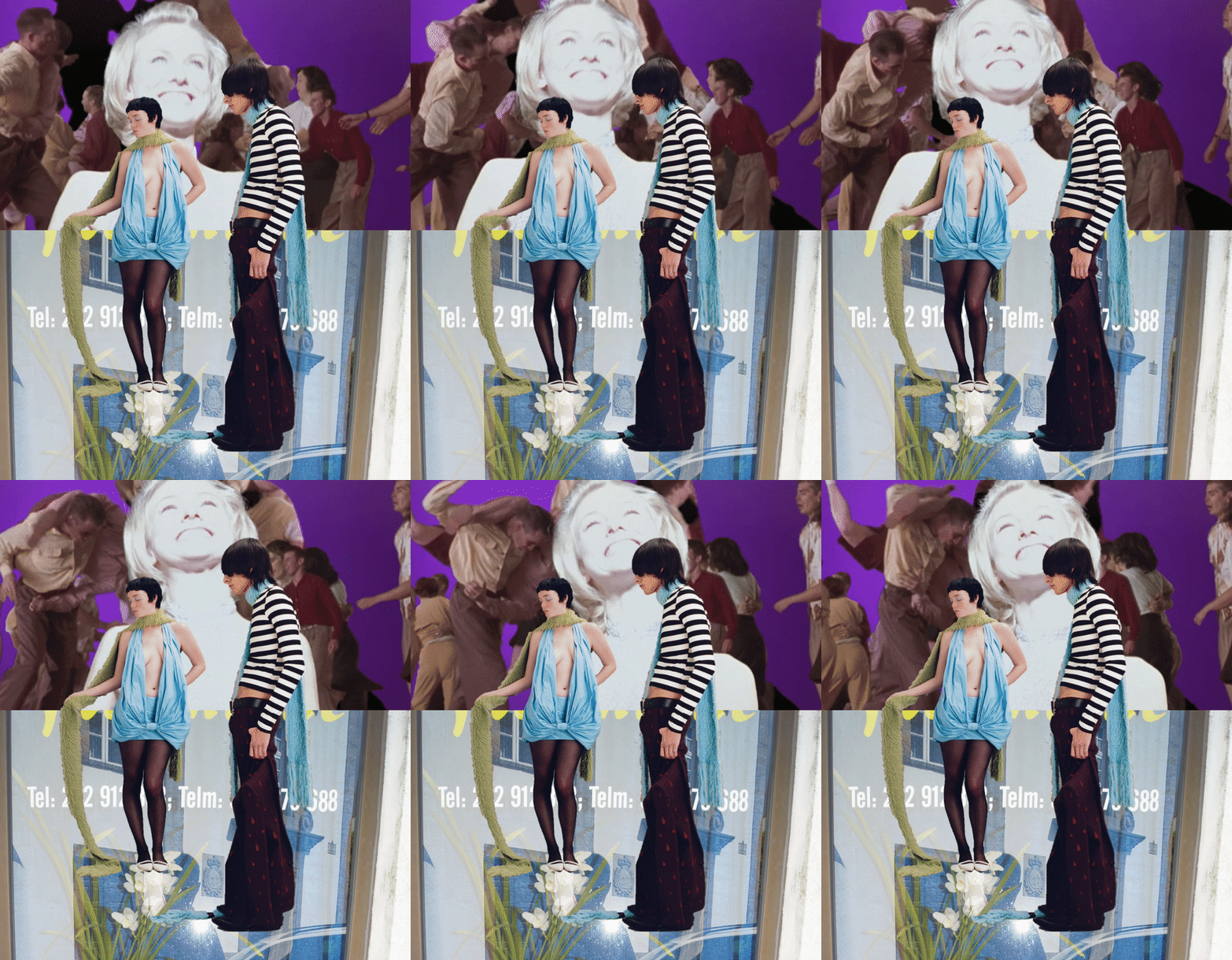
Collage by Edward Kanarecki. Don’t forget to follow Design & Culture by Ed on Instagram! By the way, did you know that I’ve started a newsletter called Ed’s Dispatch? Click here to subscribe!
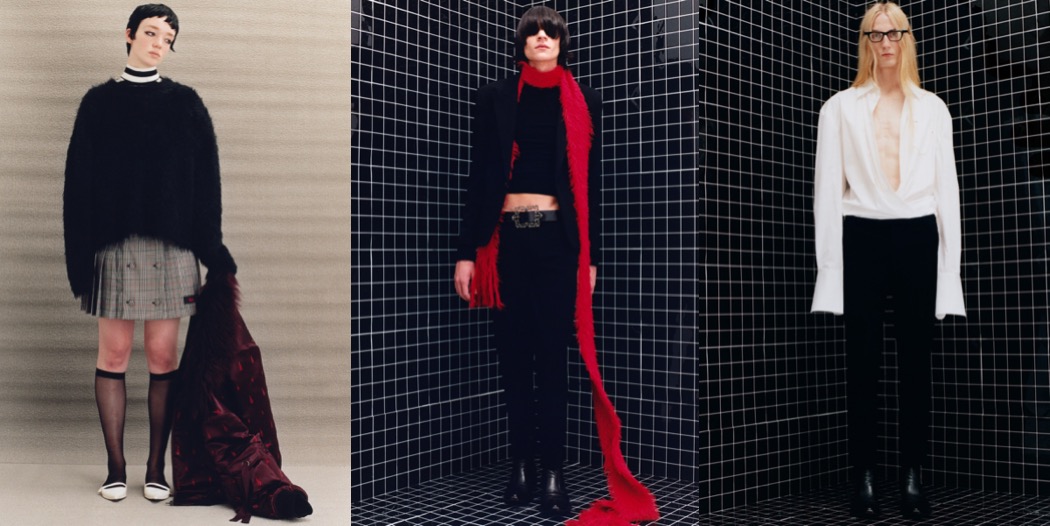
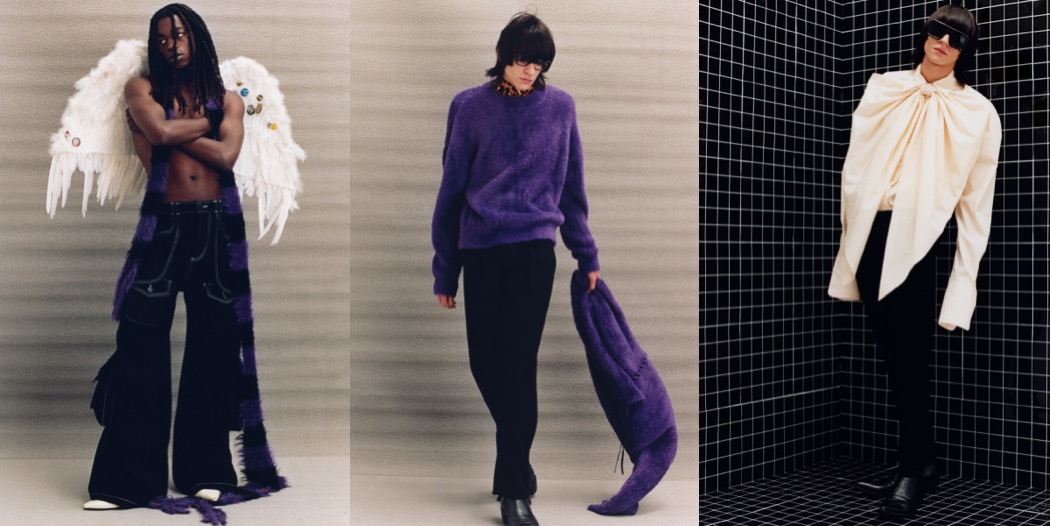
At the age of 18, Raul Solis packed his bags and moved from the West Coast to New York. His coming of age coincided with the rise of the Strokes, Yeah Yeah Yeahs, and the Rapture, who played at small venues to beer-fueled crowds at the time. For LRS‘s spring-summer 2024, Solis indulged in what he called “twisted nostalgia” by referencing the early 2000s and its early ’60s teddy-boy roots in a collection that was indie – without the sleaze – both in aesthetics and origin. It’s no small feat to keep a self-owned business afloat. Elements of the collection – the melted Mickey Mouse figures, a pair of pants made from old American flags – speak to the world we’re living in today, one where the dream coexists with nightmares. The crystal blood drops on slim-cut pants and jackets reference the struggle but not in a macabre way. But LRS also offers more relatable, day-to-day pieces. The designer cut a striped turtleneck to expose just the right slice of midriff and accessorized a pair of low-cut rocker pants with an extra-big belt buckle and a trailing skinny scarf. A mini kilt looked anything but uniform, and wide-cut jeans were made to rave. All of these pieces conveyed a narrative without being tricky.
Collage by Edward Kanarecki. Don’t forget to follow Design & Culture by Ed on Instagram! By the way, did you know that I’ve started a newsletter called Ed’s Dispatch? Click here to subscribe!












 Design & Culture by Ed