Paris, baby. Saint Laurent SS22

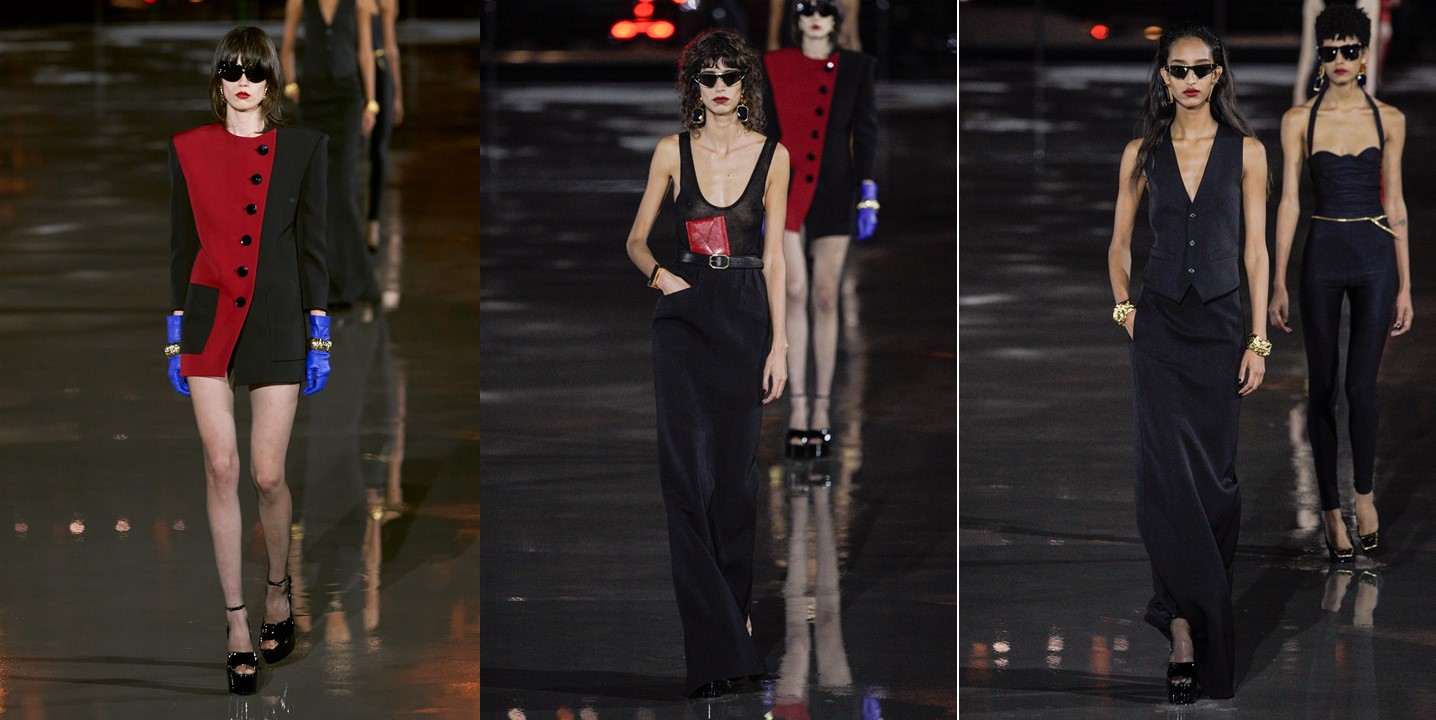
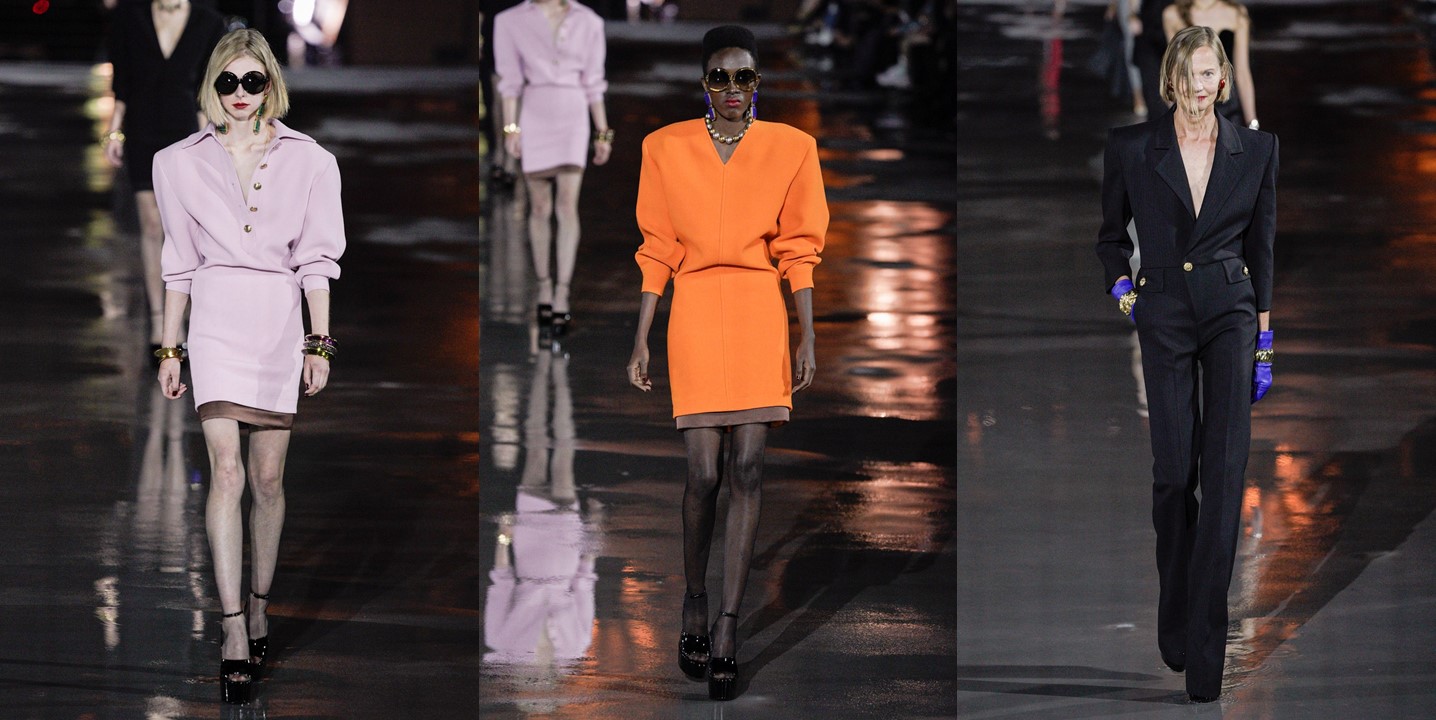
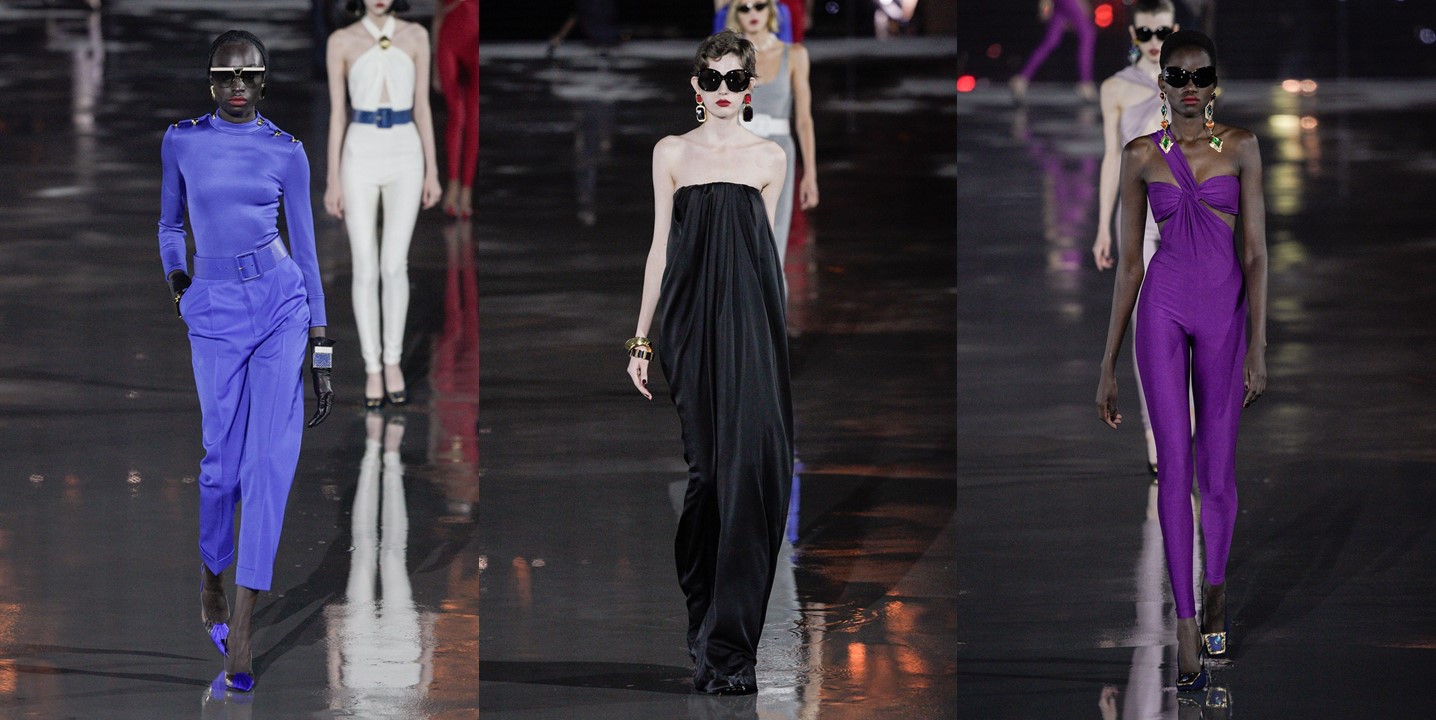
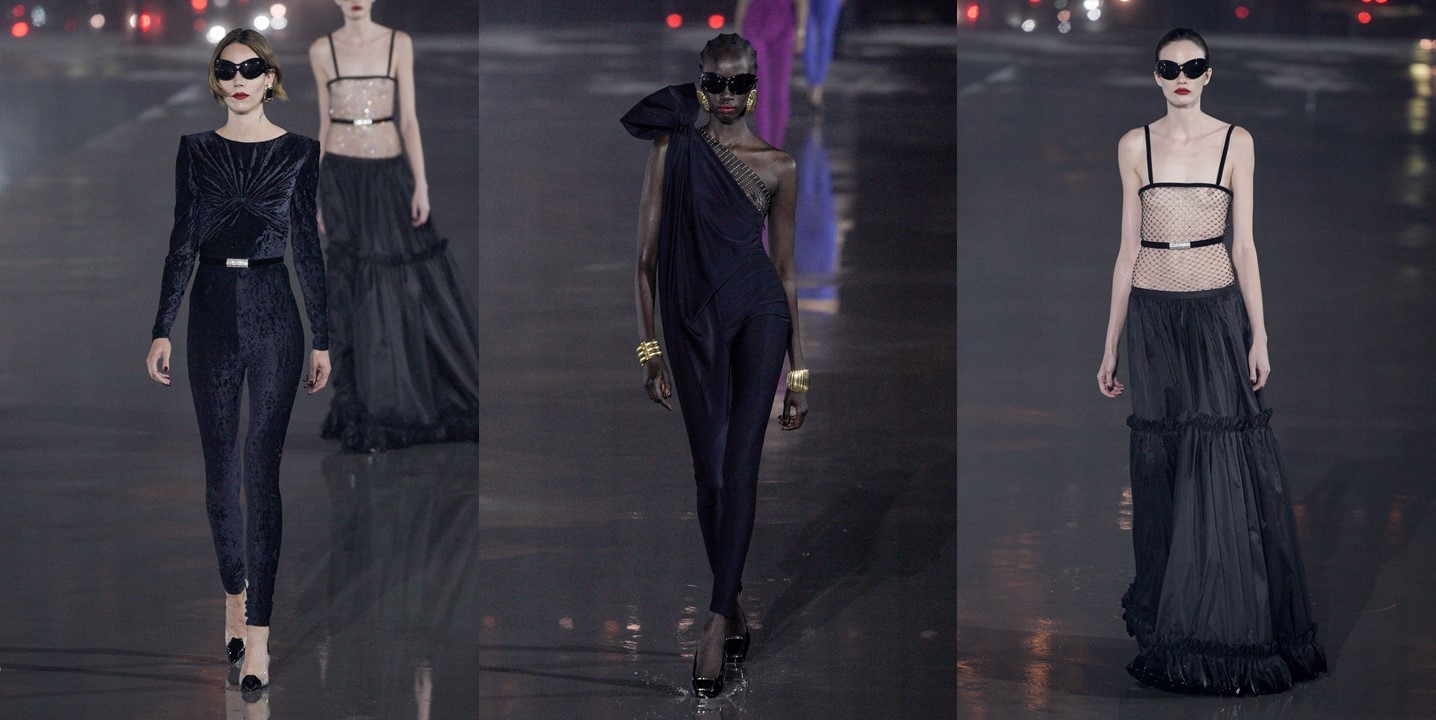
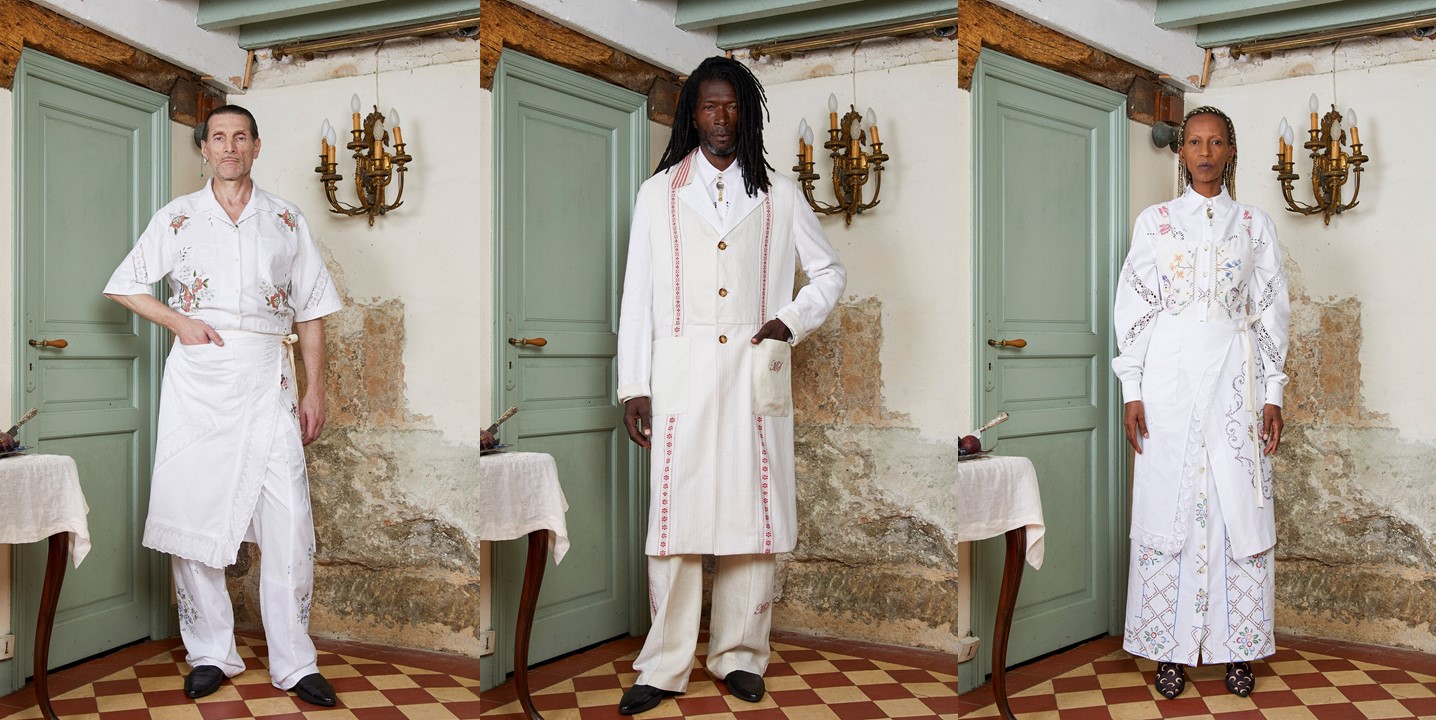
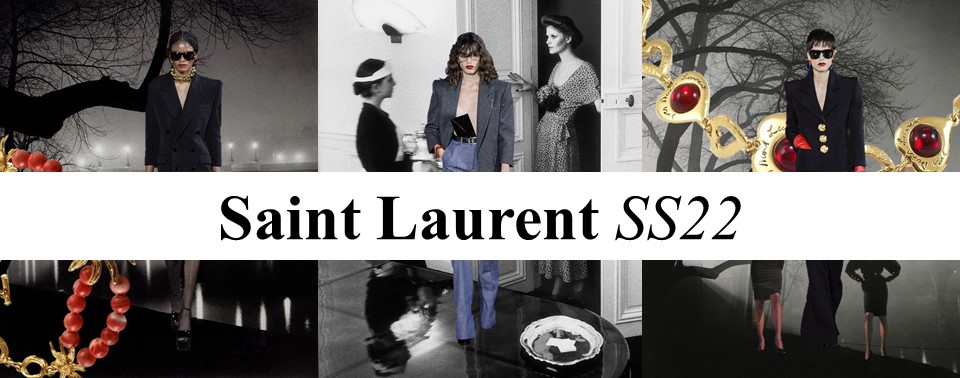
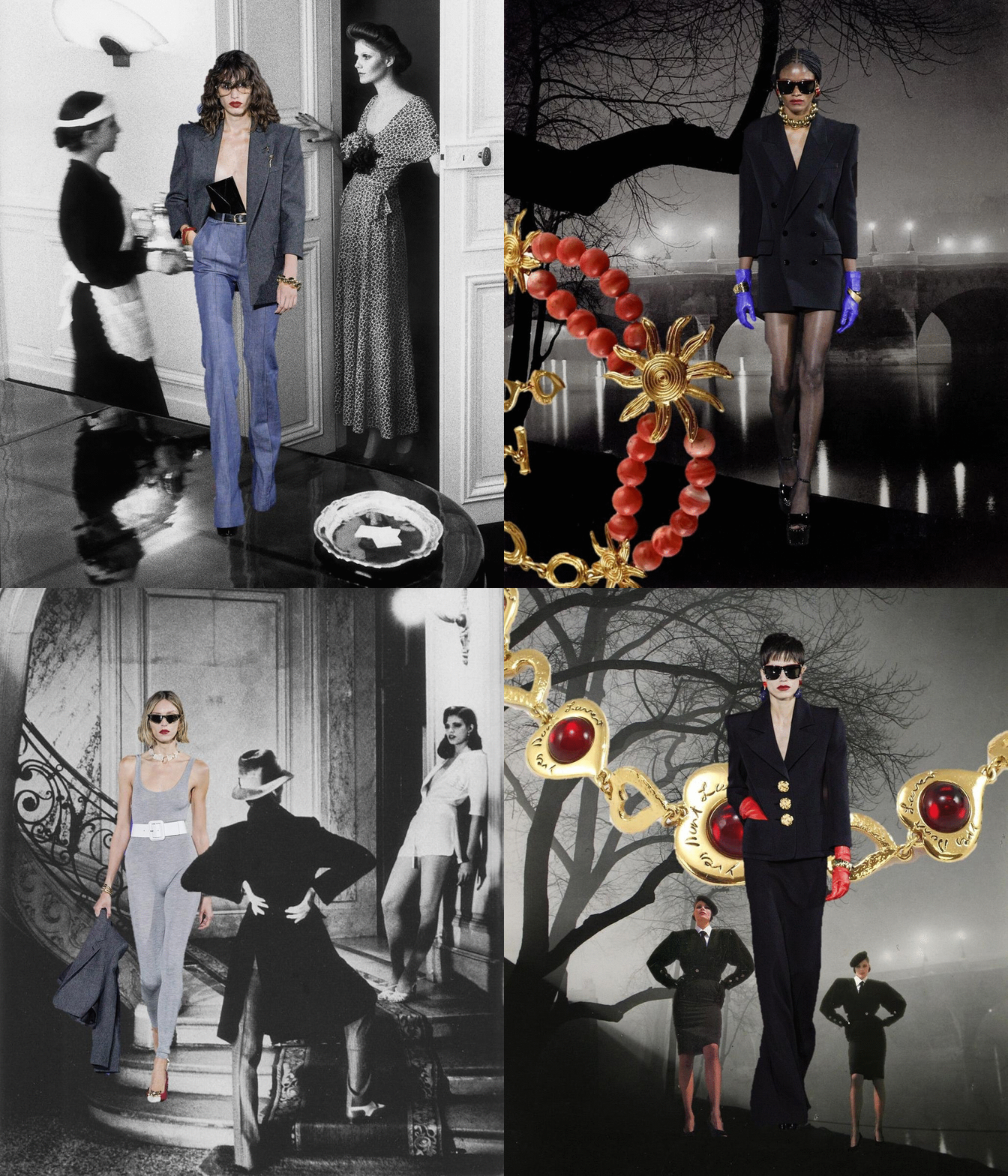
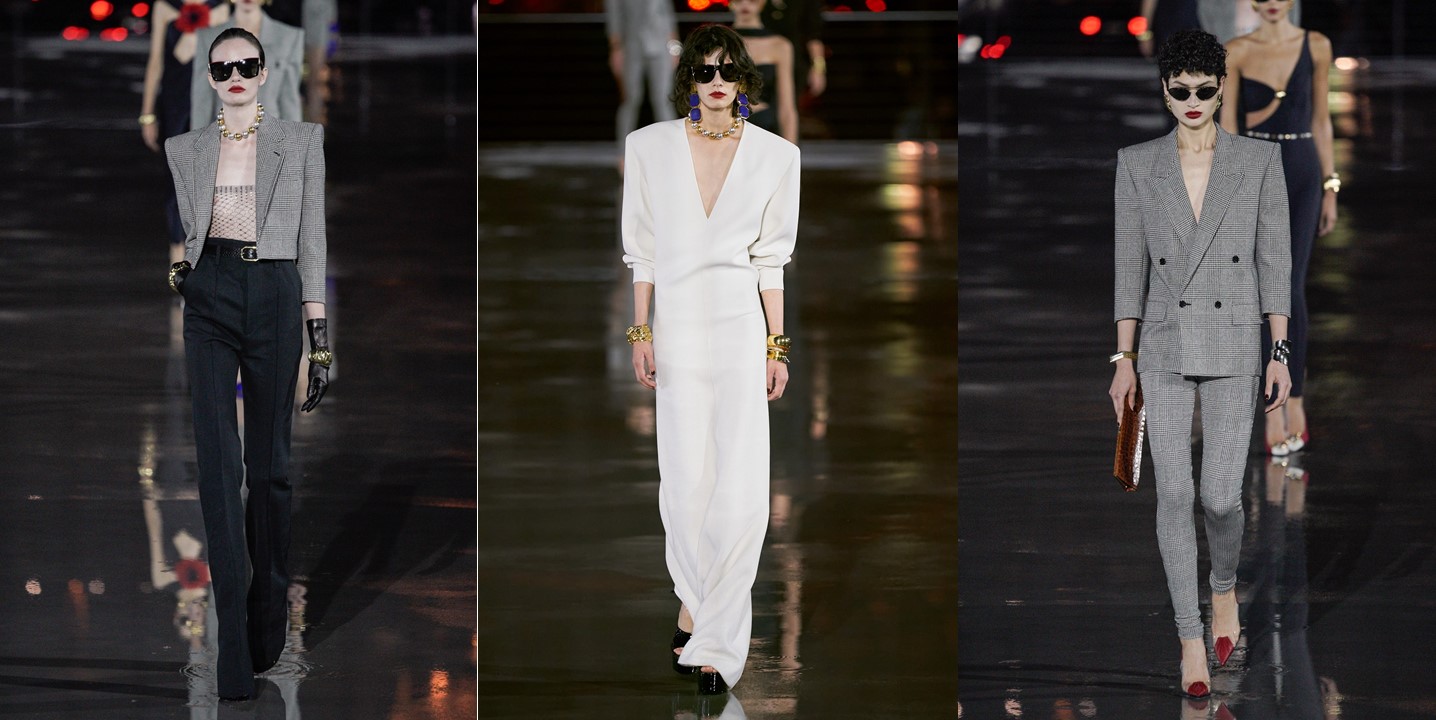
We are in Paris, baby! Paris Fashion Week started with a bang, all thanks to Saint Laurent which returned to the usual schedule. There was a magical moment towards the end of the spring-summer 2022 show when Anthony Vaccarello’s towering waterfall structure rained softly on his guests’ faces as the last models made their way off the runway to Zimmz’s entrancing “Eclipse”, the Eiffel Tower twinkling in the distance. “I was kind of sick of listening to all those people talking about the future of fashion. For me, we just had to switch off. That was it,” Vaccarello said before the show, recalling his early lockdown decision to leave the Paris schedule. “I knew that once the pandemic would become a little bit better, it would be impossible to totally change this way of showing. It’s part of fashion.” Picking up where he left off – the autumn-winter 2020 latex collection that hardly needs a recap – Vaccarello put his softer, more pragmatic collections of the lockdown period behind him, and forged ahead with the look he believes in for a 2020s wardrobe. “For me, this collection is the continuation of the latex collection: it’s a style that I want to establish,” he told Vogue. “The latex collection was a liberating collection for me. I was feeling free. I didn’t have anything to prove to anyone else about what I was able to do for Saint Laurent. I relate that collection to the Scandal collection of Paloma.” The collection in question was Yves Saint Laurent’s 1971 tribute to Paloma Picasso, who wasn’t one of his most famous muses but one of the most influential ones, nonetheless. “Pierre Bergé told me that Paloma Picasso was the only woman who inspired a collection for Yves Saint Laurent,” Vaccarello said. We tend to always talk about Betty Catroux and Catherine Deneuve, but Paloma was the only one who really changed Yves Saint Laurent’s perception of fashion, Vaccarello explained. “Before, he was really into couture – really into this cute, very perfect silhouette – and when he met her, with her huge red lips, dressed in vintage, she was really new for him. It changed his own style. In my mind, I want to have the same change after the pandemic.” His instinct made for a spirited collection that amplified the signatures of Picasso’s look. The shoulders of jackets broadened into rigorous silhouettes, the necklines and slits of dresses grew closer together, and leggings and jumpsuits – some wrapped glamorously around the contours of the body – proposed a new take on eveningwear for the post-pandemic decade. Curiously, in a scantily clad season that’s coined the “new sexy”, Vaccarello’s collection was decidedly covered-up for a Vaccarello collection – something the skin-tightness of it all balanced back into sensual territory. What does a designer known for legs and miniskirts make of this “new sexy”? “I hate the sexy I see. It looks like the sexy I did 10 years ago,” he quipped. “Everyone can do sexy, but for me it’s about assuming what you are, not trying to seduce others. It’s being confident in what you are. Paloma is very sexual but not the kind of woman you want to mess with. You wouldn’t bother her in the street, for example.” Perhaps that was Vaccarello’s 1990s sensibility talking: the mindset of a boy raised on the sophistication of supermodels, immaculate music videos, and an approach to sex that felt a lot more intelligent than that of the 2000s, a decade many designers are referencing this season.
Collage by Edward Kanarecki.
Fichu Pour Fichu. Marine Serre SS22

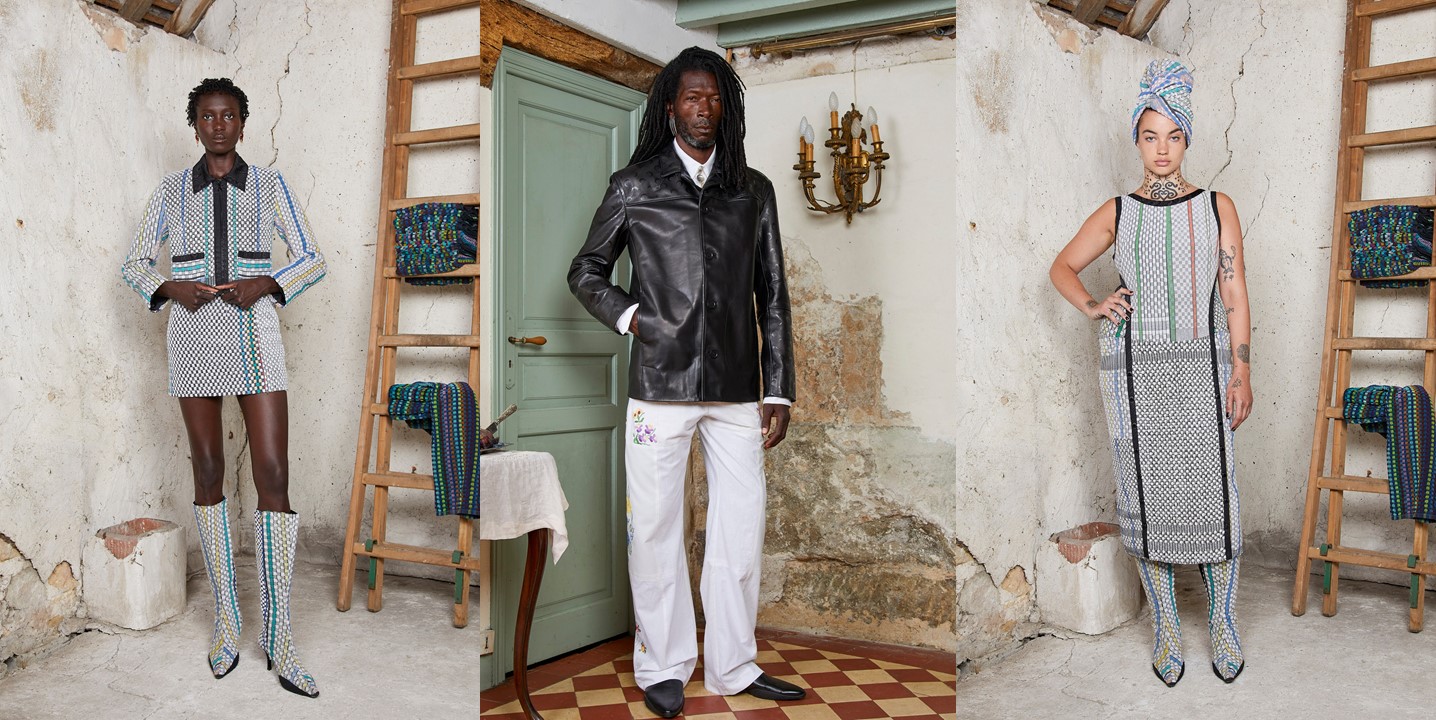
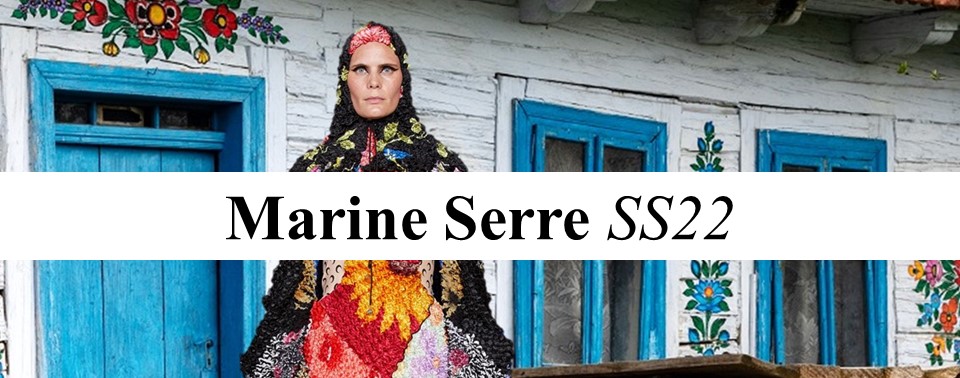
For the spring-summer 2022 collection entitled Fichu pour Fichu (“We are doomed”), Marine Serre pushes further her eco-conscious approach to fashion. Inspired by the ongoing state of flux the world is experiencing, the line-up focuses on reconnecting with others and our surroundings, and leading a life without the feeling of loneliness that comes with isolation. Accompanying the sustainable pieces, this season Serre delved even deeper into the power of film with Ostal24, a 13-minute short that transports us through interior and exterior worlds that could be situated somewhere in the past, present, or future. The title Ostal24, which means “house” in Occitan – a historical language spoken in Serre’s native region – grew from her belief that through sincere engagement with our primal instincts, we can create a sense of home wherever life takes us. “The most important thing for me is what people feel when they see Ostal24 rather than what they think,” Serre says. “I want people to feel the beauty and the simplicity of being together and finding joy in cooking, eating, dancing, yoga. And at the same time recognize that everyday we make choices that have an impact, so how can we be more responsible in the decisions we make? Fashion is about more than draping fabric and making a profit, it can be a place where we are free to take meaningful action.” And yes – those looks are made of upcycled towels and discloth!

Collage by Edward Kanarecki.

Men’s – Full Throttle. Celine SS22

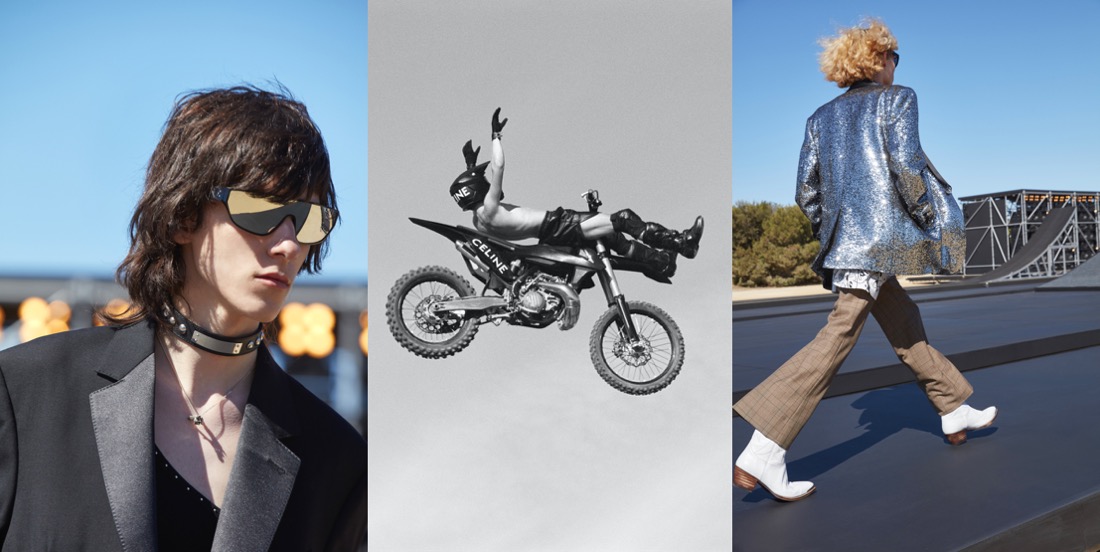
As Phoebe Philo is coming back to fashion, the Celine wound seems to heal. Which doesn’t mean I suddenly love Hedi Slimane‘s vision – but at least I can tolerate it. Still, his men’s spring-summer 2022 collection left me with some mixed feelings. This season, we’ve got an action-and-item packed Celine show recorded by drones somewhere on the Archipel des Embiez in the south of France. On a black runway set up with freestyle motocross ramps and jumps, teams of shirtless Honda-riding boys leapt and arced against the Mediterranean sky. The location is apparently not far from where Slimane lives outside St.Tropez, and this was Slimane on home territory in more ways than one: capturing his endless obsession with male teen energy, studding the collection with multiple art collabs, and wrapping it all up to the beat of a mesmeric looped soundtrack. The FMX bikers belong to a community that invented its renegade free-riding sport in the hills of California in the early ’90s – Slimane has been documenting them since 2011, when he came across them while he was living in L.A. This time, he commissioned and co-produced the music with Izzy Camina, intersecting the long, slouching march of a black-leather and silver-sparkled collection with souvenir slogan T-shirts and prints made by 14 of the emerging artists he collects and promotes. Since the pandemic hit, Slimane has shifted his Celine productions into the open air and into spectacular French locations. Wherever he lands, though, be it a Formula One racetrack, a chateau in the Loire valley, or this time, on a rocky coastline, there’s always the same, recognizable atmosphere, the romantic-erotic stamp Slimane puts on a world inhabited by young men. His meeting of motocross daredevilry and neo-rave frippery nailed the current summer of spring-summer 2021 teen spirit – a full-ranging breakdown of XXL elephant jeans, mirrored bug sunglasses, scaled-up bombers, tour jackets, and draped tuxes. Black capes flew over black leathers; sequins, crystals, and silver western boots glinted. Slimane targets Gen Z, and he confidently thinks he knows what they want. But I’m not sure if his take on youth is actually that relevant today. To me, it feels like an over-done costume. And Gen Z look forward to the unforced sense of authencity.

Collage by Edward Kanarecki.

Higher Forces. Maison Margiela AW21 Couture

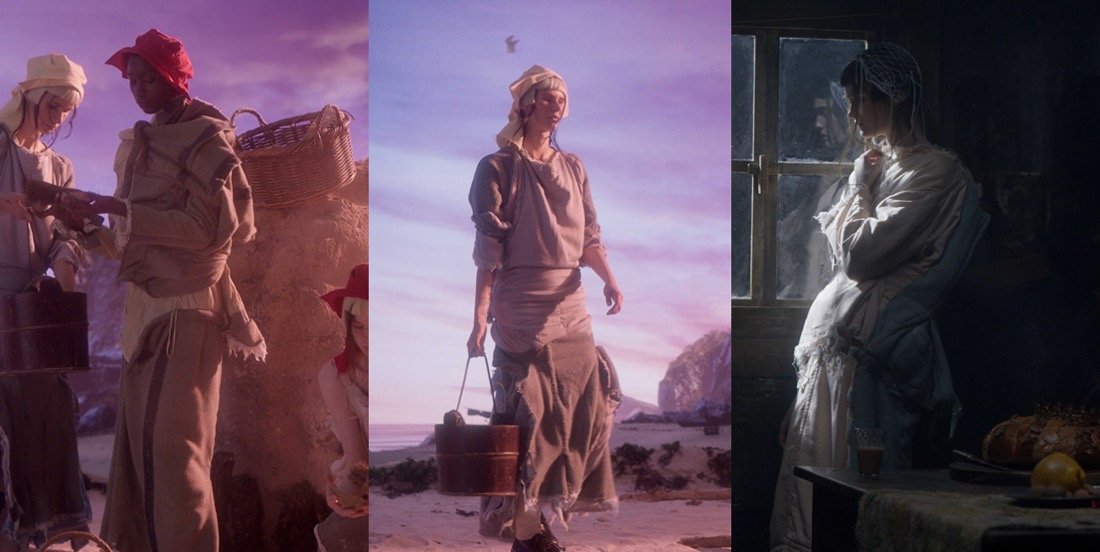
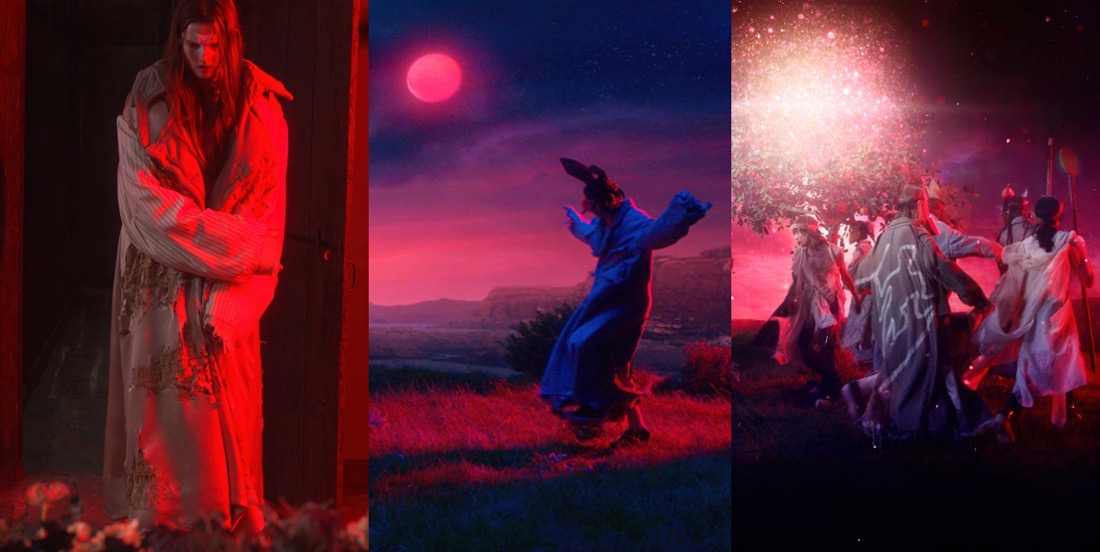
The idea of how we all felt through this pandemic, and being brought to our knees by the power of mother nature.” That’s a succinct clip from a long conversation with John Galliano about the making of his Maison Margiela Arstisanal collection, which he scripted into the epic film, A Folk Horror Tale, that had its premiere in a Paris cinema this week. The comment seemed emblematic. A romantic, mysteriously troubling struggle with the elements was on Galliano’s mind as he designed and crafted clothes and moving pictures with the French Oscar-winning director-producer Olivier Dahan. “The effect of the weather, the sea, the moon, the elements, started to play on my psychology.” Galliano has been a story-teller, a stream-of-consciousness creator since his very beginnings as a student who made his first historically-inspired French Revolution collection, Les Incroyables, in 1984. Images and self-imagined characters who connect the past with the present have stimulated and preoccupied him for his entire career. In 2021, finally, he’s seized the opportunity to bring those ideas alive through a medium that reaches far beyond the limitations of the catwalk formula. Even the lookbook of his collection breaks with standard conventions. In what is probably the most personal of all the collections he has done for the hand-made Artisanal line – the house equivalent of haute couture – it’s a triumph of emotionally-driven material experimentation. He said it “came out of hours and hours of dialogue” in his studio, giving form to the conversations with the young group of house models – his ‘Muses’ – who take part in his process of making clothes on their bodies; and who eventually act out their meaning.

That’s how he reached into a gothic, time-traveling manifestation of weather-beaten, tattered, ancient-looking clothes set around the idea of an isolated community of fisher-people battling for survival against the sea. His first historical reference-point was early photographs of Dutch fishermen – the specific traditional lines of their tiny jackets, voluminous trousers, Guernsey sweaters, and wooden clogs. Another, the legend of King Canute, whose people forced him to command the tide to retreat, and who surrendered them his crown when he failed; saying that only God is in charge. A smashed-mirror crown played a recurring part, found and refound in scenes conjuring a sinister medieval ritual playing over centuries. The idea of people living at the mercy of uncontrollable forces tuned into the conversations he’d been having with the young people in his studio: “Talking about mental health issues, trans issues around the table with my muses, listening to some of them describe how they were feeling and acting,” during the troubles of lockdown. He has empathy for them. “I don’t profess to be a therapist, but I’ve done some hardcore rehab myself, and I recognize myself and a lot of what they’re saying or doing. And all I was saying was, you know, the best thing is to talk about it.” As an older and wiser person, he said, “there was a privilege and a joy in sharing.” As he put it in his introduction to the film, “it’s about the fast-wash of anxiety, the power of nature – and when faced with that, how helpless we are.” That idea took literal form in the way he processed his fabrics, treating them with enzyme washes and stone-washing to remove color; shrinking and wringing them out in a technique he calls “Essorage.” In many ways, his methodology appears to be the complete opposite of the traditional formalities of haute couture, but represents his break away into an equally intense study of how clothing can be transformed from vintage and found materials in the modern world. He described how garments were graded up six or 12 times, and then shrunk to fit. How linings of skirts and suits were turned inside out and converted into dresses. How he attacked denim jackets and loden coats and a 19th century woman’s corset jacket, unpicking and revealing their original colors in the seams when the washing and wringing was done. There was a beautiful sweeping blue-and-white patchworked coat made from chopped-up charity-shop finds. Delft tile-patterns were crocheted together in a sweater. The artist Celia Pym darned a blue Guernsey with newspaper reports of the death of King George V.

Galliano is always pushing for progress, experimentation. Nevetherless, with their little cotton Netherlandish hats and kerchiefs, their tabi-clog waders, and their romantic, shredded piratical looks, the Margiela Muses looked more purely Galliano than they have done for many a year. “The narrative of the story is make- believe,” he said, “which is always what I want with a collection, anyway.” With so much at his fingertips it’s almost as if John Galliano has gone back to rediscover the primal power of who he always was from the beginning.

Collage by Edward Kanarecki.

Be The Queen. Viktor & Rolf AW21 Couture

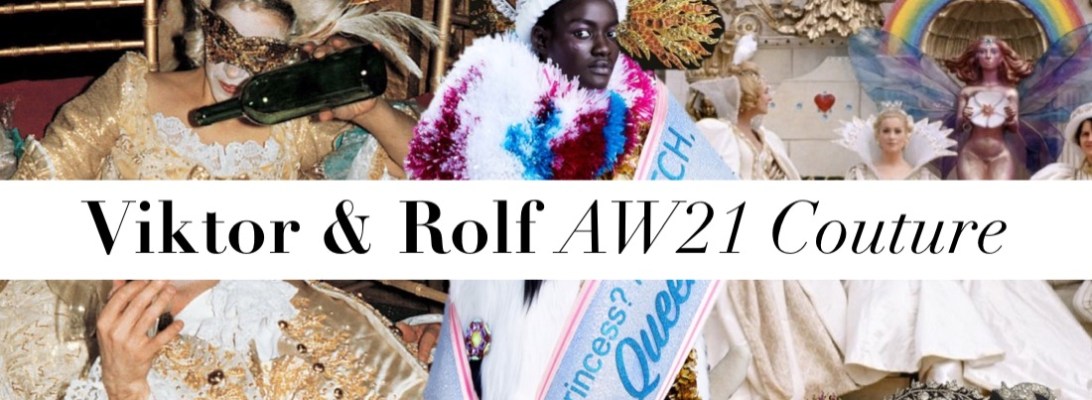
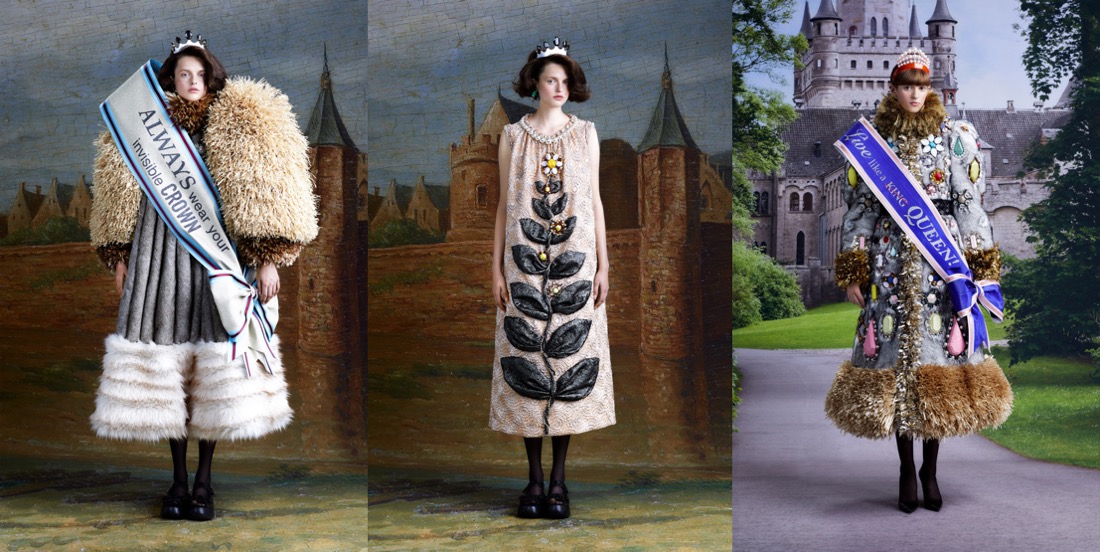
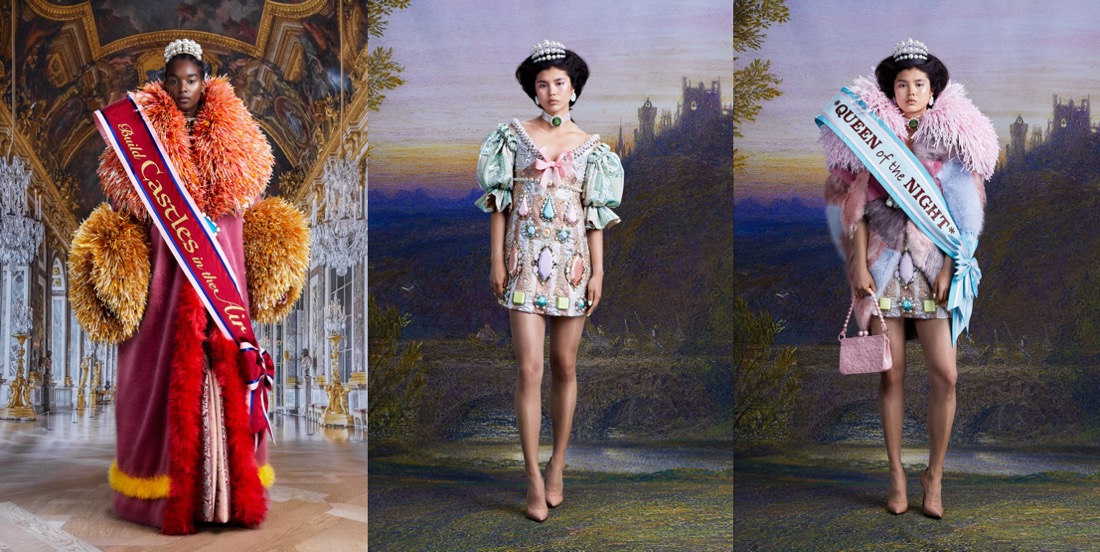
Viktor Horsting and Rolf Snoeren do couture that instantly becomes viral. That is certainly the case with their latest Viktor & Rolf collection, which at first glance, might seem to tread familiar ground, with coat shapes resembling those from their Russian doll collection for autumn 1999, and slogan sashes from spring 2019. The pair carried over their interest in jeweled embellishments here, though in different dimensions and styles; and in keeping with their dedication to reducing waste, many of the pieces are patchworked—as are the concepts behind the garments. As Snoeren put it, “there’s all kinds of elements from all different worlds.” The first theme that comes across is a royal one, and, with continuing buzz around The Crown and the Oprah interview, it’s quite topical. What the designers couldn’t have known is that Young Royals mania would start to heat up at almost the exact time they presented their collection. Many tropes are referenced in the lineup, ranging from fairy tales to cartoons. There are medieval-style brocades and an “ermine” cape. A raffia “fur” is a fantastic take on high/low. Tiaras and crowns of plastic are a clue that everything is not what it seems, which is confirmed, without subtlety, with the queen-themed sashes. “We wanted everything to be bigger than life,” noted Horsting. “It’s like a play on queens or royals. We wanted to be uplifting and joyful and – fun is not the right word – but colorful, sparkling, positive. You are your own creation.”

Collage by Edward Kanarecki.