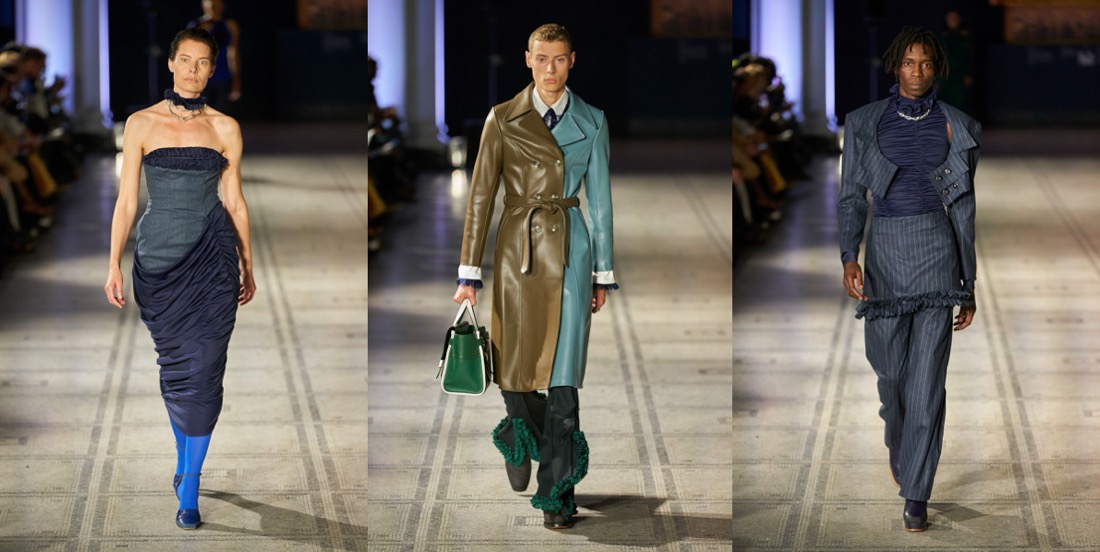
Precious & Humble. Richard Malone SS22

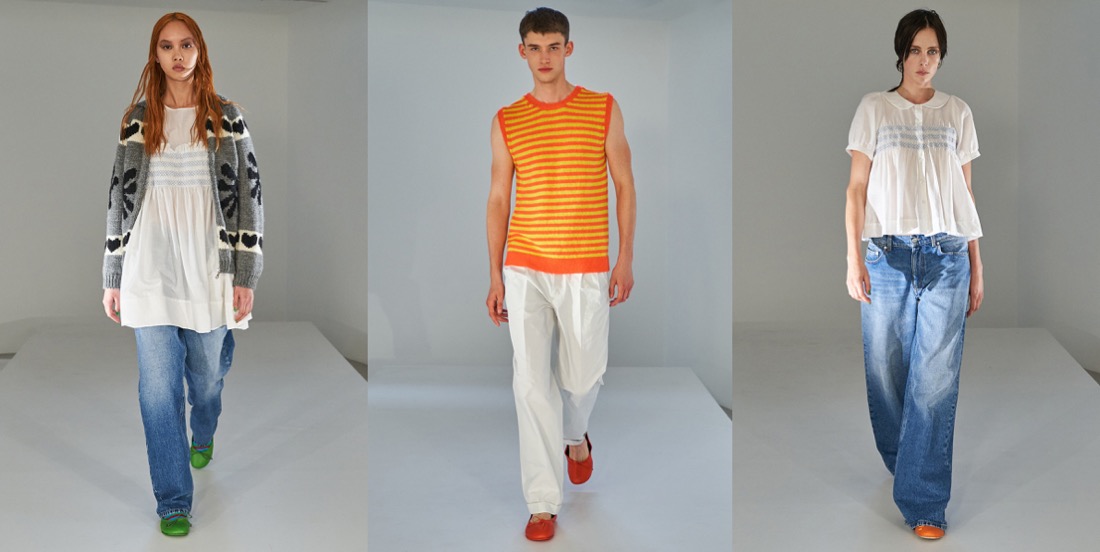
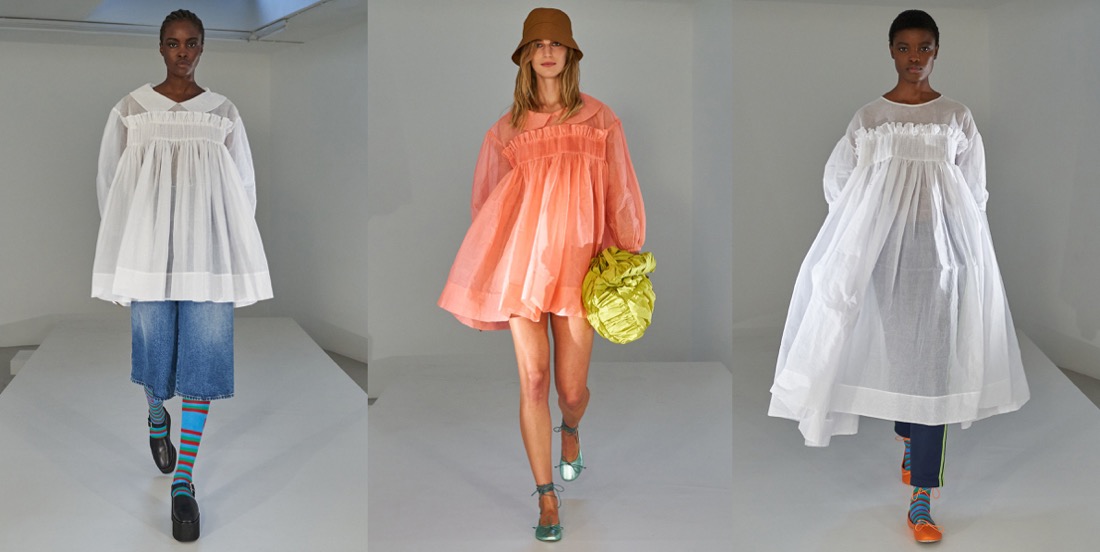
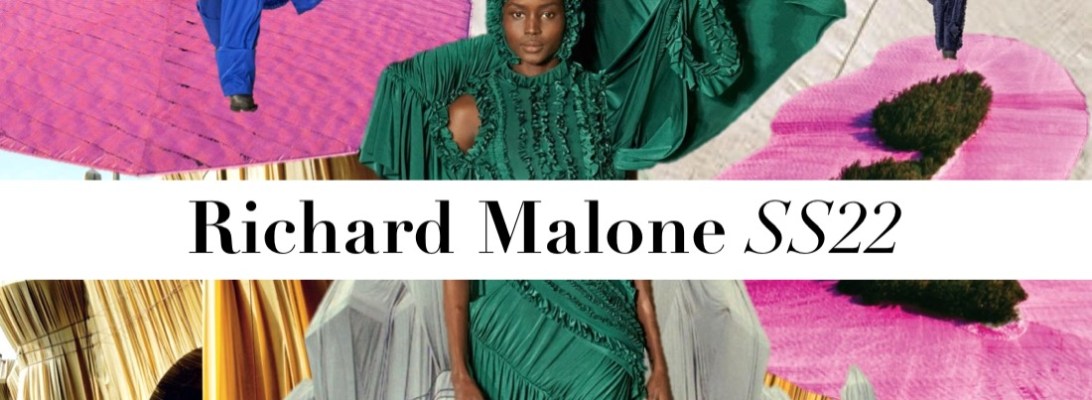
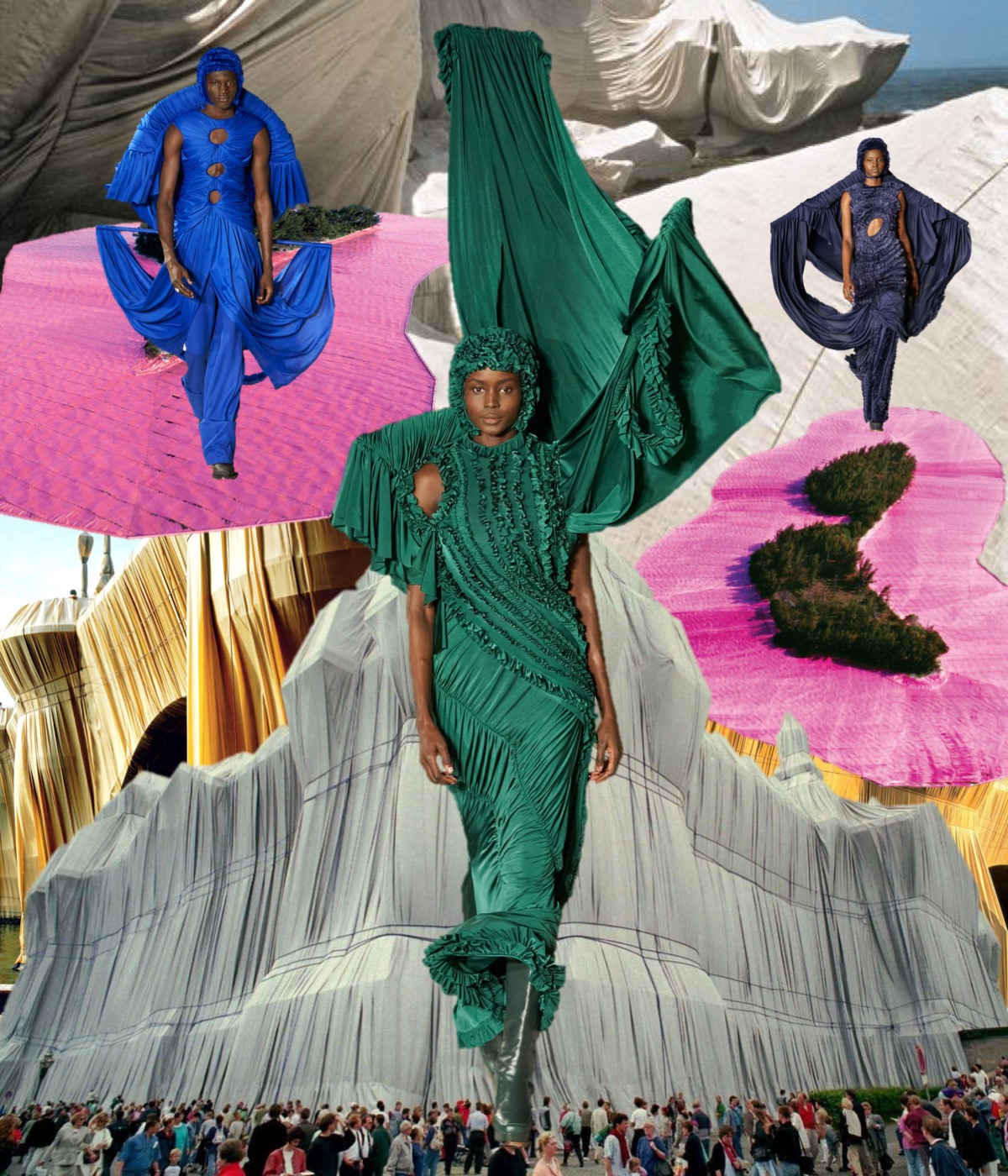
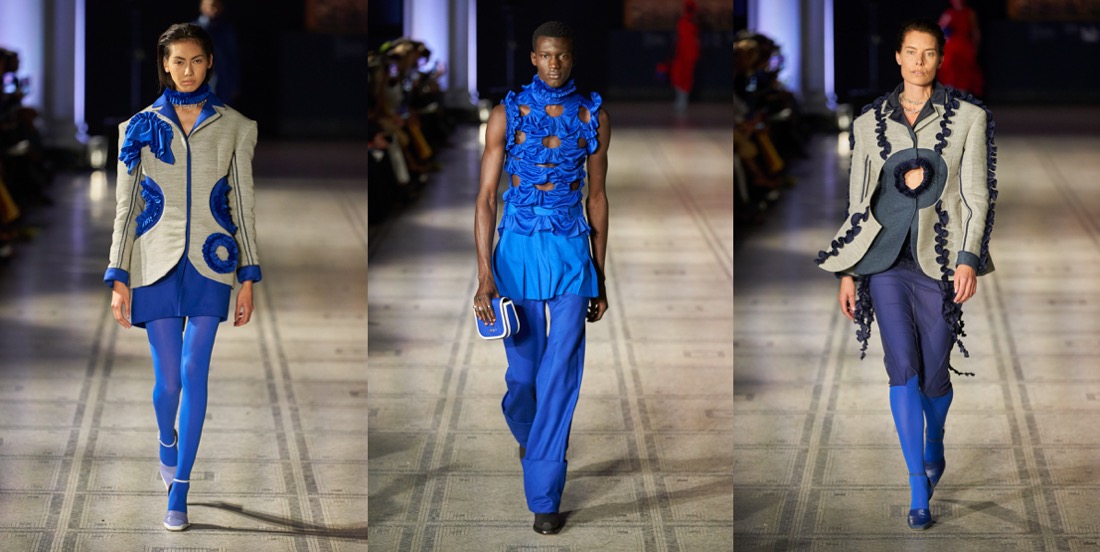
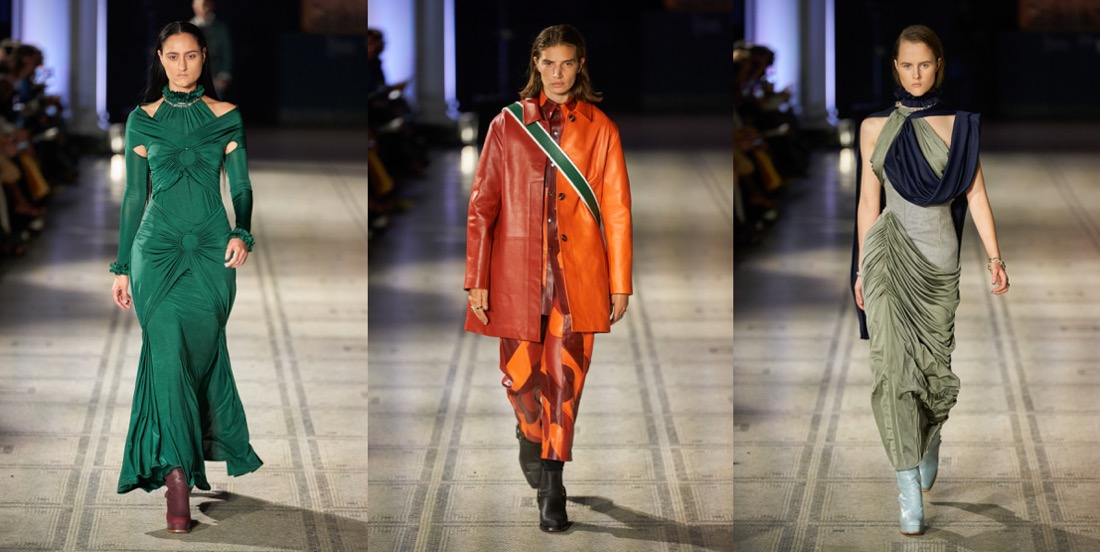
Richard Malone‘s spring-summer 2022 garments, made in part using fragments of materials, including scrap leather provided by Mulberry, were presented among Raphael cartoons at the Victoria & Albert Museum in London. These artworks, intended to hang in the Vatican, are Renaissance treasures; within the usual hierarchy of art, they are more highly valued than fashion design. Who and what “counts” and/or is represented in art and fashion is a subject that preoccupies Malone, who became increasingly interested in Irish craft heritage and its relationship to place and language during lockdown. “I’ve really been thinking about being an immigrant in this country, coming here on my own and building this business, and then what gets to be celebrated and what we get to talk about,” the designer said in a pre-show chat. Without the possibility to engage in person with his team, spring’s collection was not built on conversations or a moodboard but out of nostalgia. The circular forms that appear throughout the collection were specifically inspired by the celebratory, decorative rosettes (resembling scrunchies, observed Malone) and armbands that the designer’s grandmother would carefully assemble by hand to commemorate horse meets and wins by the Gaelic Athletic Association. Home crafted with care, these happy, colorful rounds commemorate quotidian, humble joys. As such they stood in contrast to the monumental and classical narratives of the Raphael cartoons, which, to Malone, represent “good taste,” and perhaps also social class. “It fascinates me that my starting point was that very simple thing,” he said. During lockdown “I really got to assess what the meaning of making those things is, and what putting them in a space like the V&A and trying to make them elevated and interesting could mean. I think sometimes when you go to museums or you go to fashion stores, you can feel quite ashamed of your upbringing not being very conversationally valuable. Now I’m like, ‘Oh no, that’s the most valuable thing that I have.’” As an outsider, Malone brings a sense of realness and proportion (in the sense that he is committed to keeping his production runs small) to the smoke and mirrors world of fashion. The setting of his show, the designer noted, “really heightened the fact that a lot of fashion is imitation, or it isn’t real life.” But that’s a dichotomy that also plays out in his own work: “There’s one side of what I do that’s quite theatrical and abstract, but then there’s also the real women that buy clothes from me, and men, and they’re such two different conversations,” he observed. “There is more than one truth in everything.” Malone delivered on the drama with his finale looks, which might be described as “window dressing” as they seemed to frame the models as curtains do a window. These seemed to pay homage to the drapery-heavy campaign the designer created for Mulberry, with whom he is collaborating this season as the company celebrates its 50th anniversary. In addition to putting his own spin on classic Mulberry bag silhouettes, Malone used traceable leather provided by the company in his collection, and much of the jersey was salvaged from the above-mentioned ad. Old and new, precious and humble, these dichotomies were present throughout the collection. Materials usually reserved for sampling, like horsehair, were retained for the finished garments. Malone introduced menswear for spring, with a focus on bolero jackets and apron pants. Rounds predominated, and Malone brought his designs full circle, as it were, via different paths. Some looks, like the cutout jackets, considered the circle as a negative space, for example; in contrast, draping built out and gave dimensionality to the shape. “I work like a builder in a corner of my studio,” said Malone. He finds joy in making; in the set of a sleeve, the importance of cut, the language of fabric. “All I’m trying to do,” he said, “is build something that is personal and real.”
Collage by Edward Kanarecki.
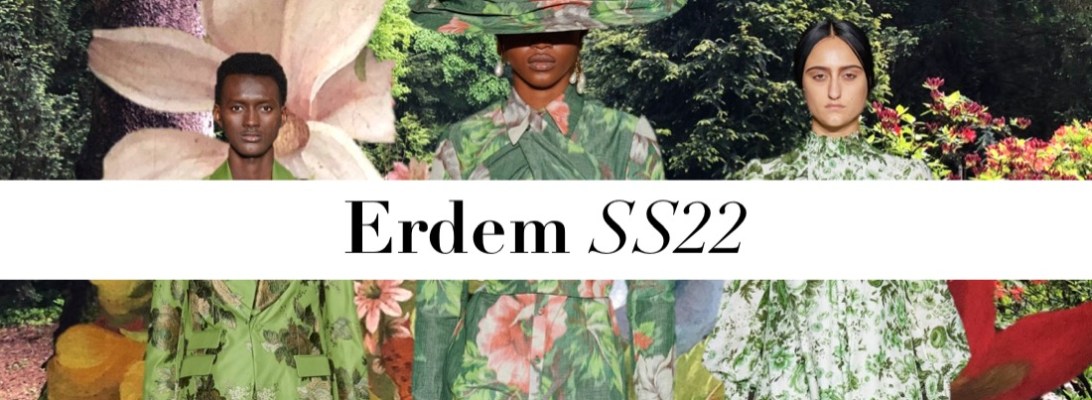
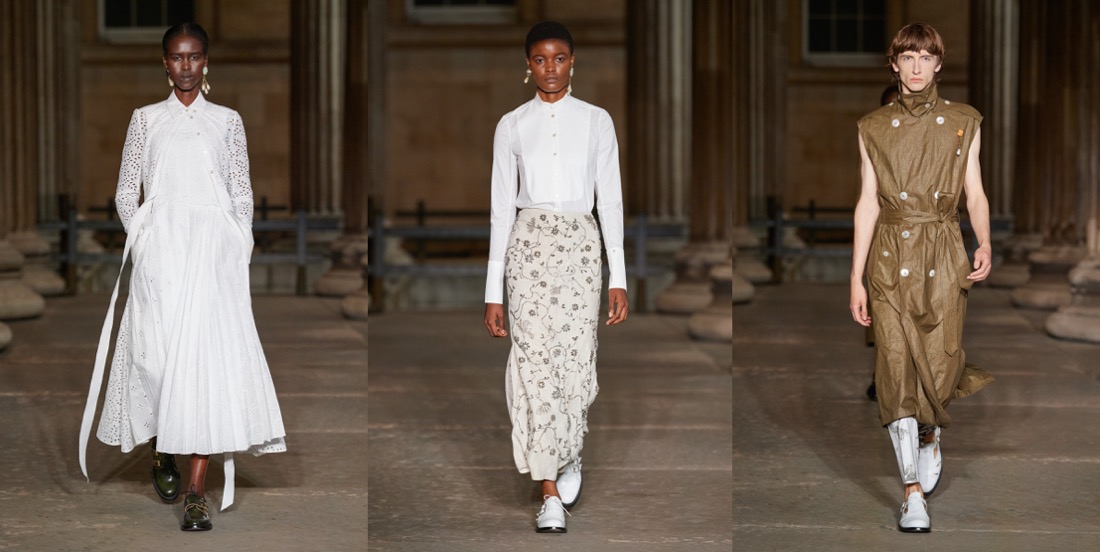
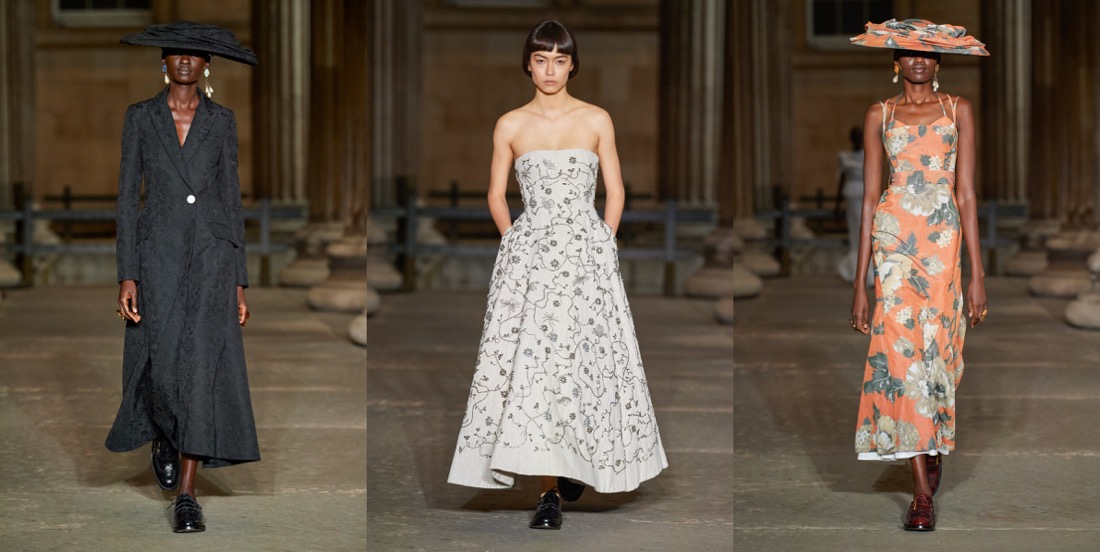
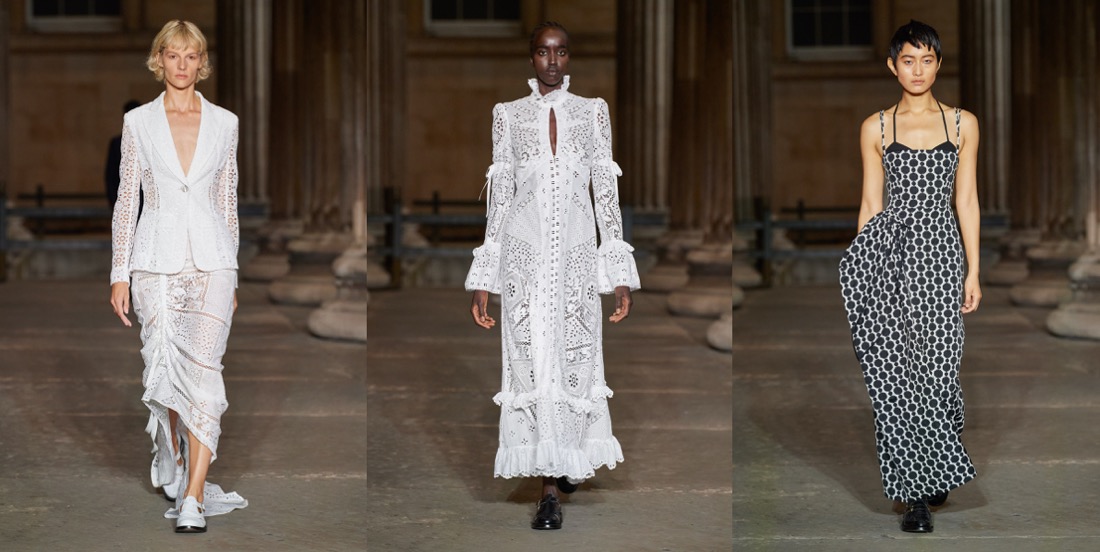
Blooming Garden. Erdem SS22

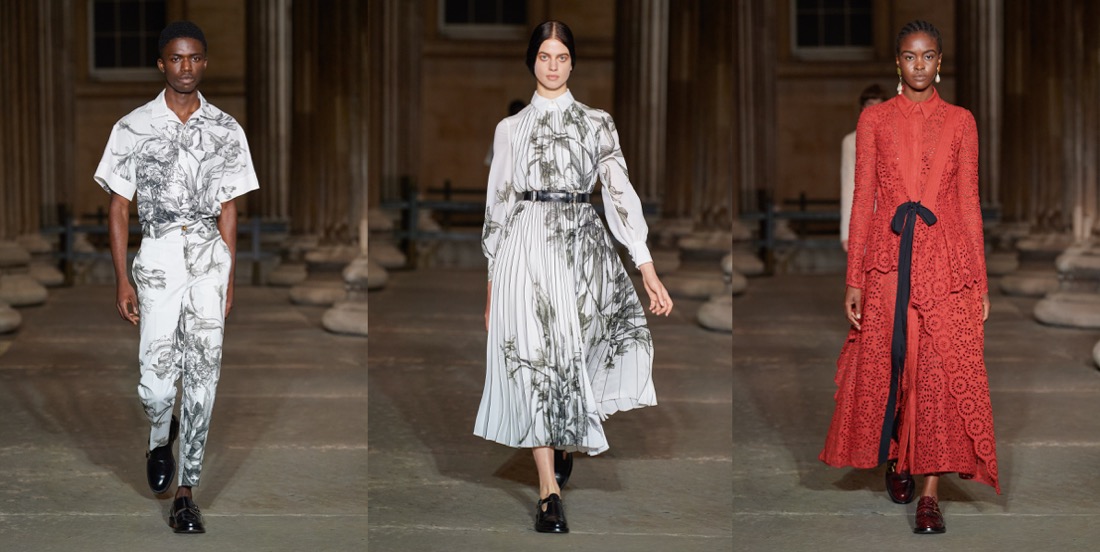
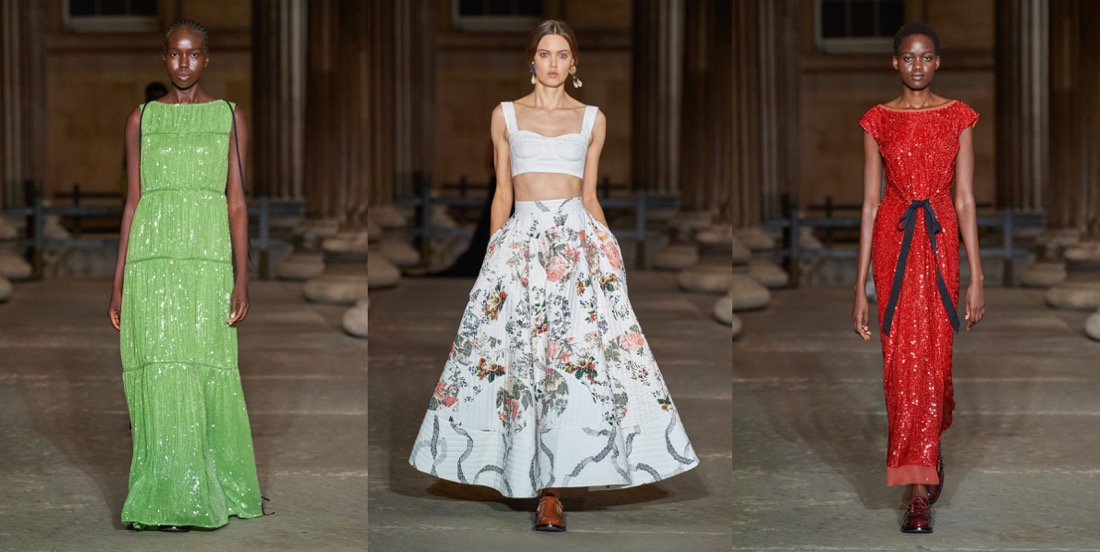
Ever since Erdem Moralioglu moved into his new house in Bloomsbury during the pandemic, his work has taken on a more demure and sober character. Somehow, the fusion between that sensibility and the old-world glamour that underpins his oeuvre feels appropriate for now. Dramatic, but with balance. Erdem’s 15th-anniversary collection – and first runway show since the pandemic – captured that dichotomy in a purified and clarified ode to his own body of work. Presented in the colonnade of the British Museum (in Bloomsbury), he envisioned it through the wardrobes of Bloomsbury’s best: Edith Sitwell and Ottoline Morrell, whose spirits he could easily have come across on one of his evening strolls across Bedford Square. “I was really fascinated with these two women – both six foot – who knew each other, and donated to the British Museum,” Moralioglu said backstage, highlighting their independent and formidable approaches to life in the early- and mid-20th century. “Both women lived outside of the time that they actually lived in: Ottoline Morrell dressed in kind of Edwardian dress in the 1930s, and Edith Sitwell would wear something kind of medieval. They were displaced and disjointed in terms of time and pace,” he observed, with words that could have described the last 15 years of Erdem collections just as well. Throughout his own history, he has freely and defiantly traveled the annals of fashion history at large, spinning fantastical narratives around characters and events drawing on fact and fiction, and brought those looks into contemporary contexts. This collection was no different. While its silhouettes were carved from the first half of the previous century, Moralioglu twisted them out of their prim lines and switched opulent fabrics for “poor” ones, using instead embellishment as his richness factor. A delicate floral embroidery curled around dresses looked almost like an industrial chain print, quilted floral skirts were kind of wrong but cool, and lace dresses transformed into knitwear de-prettified that girly trope. Styled consistently with unfussy brogues – and showed alongside the terrific sturdy-romantic menswear he launched this summer – those tactics created a sense and sensibility that spoke to that post-pandemic appetite for the gentle grand gesture.

Collage by Edward Kanarecki.
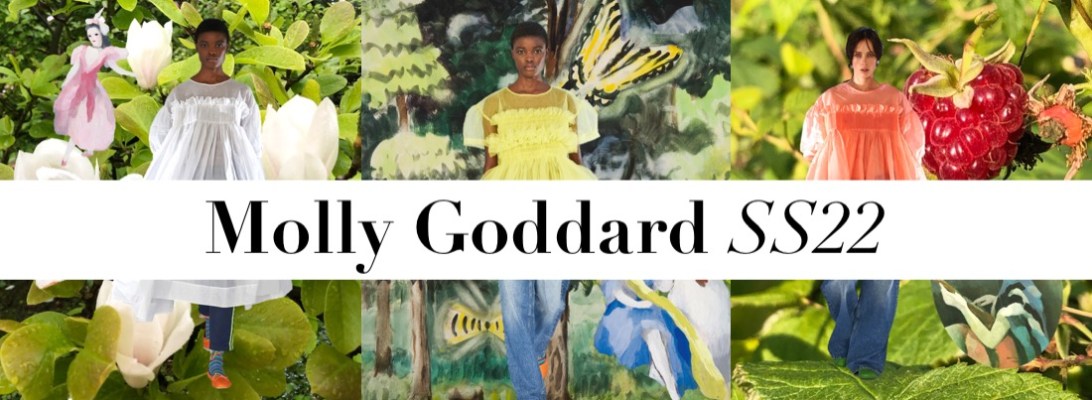
Be My Baby. Molly Goddard SS22

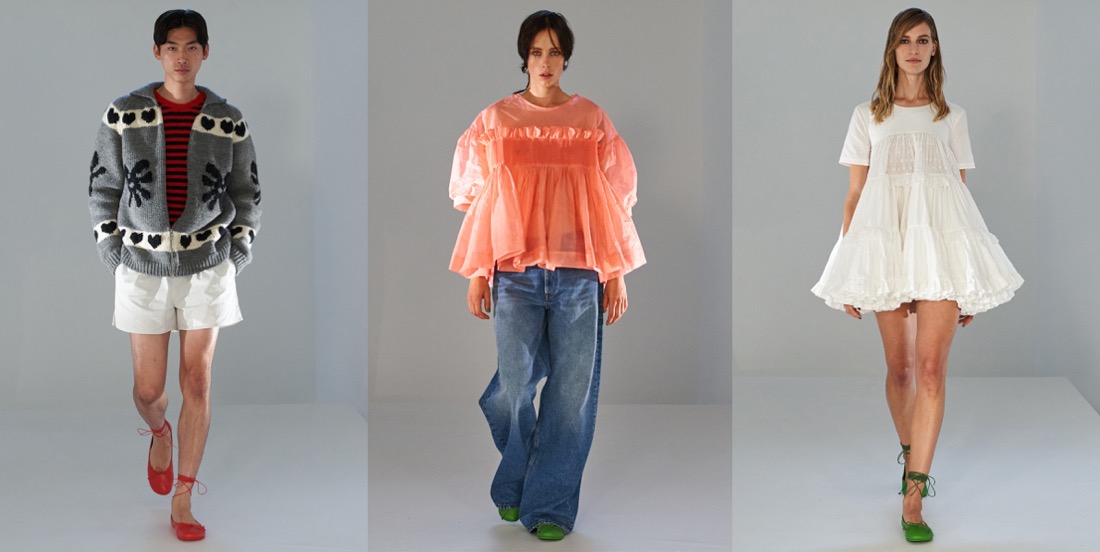
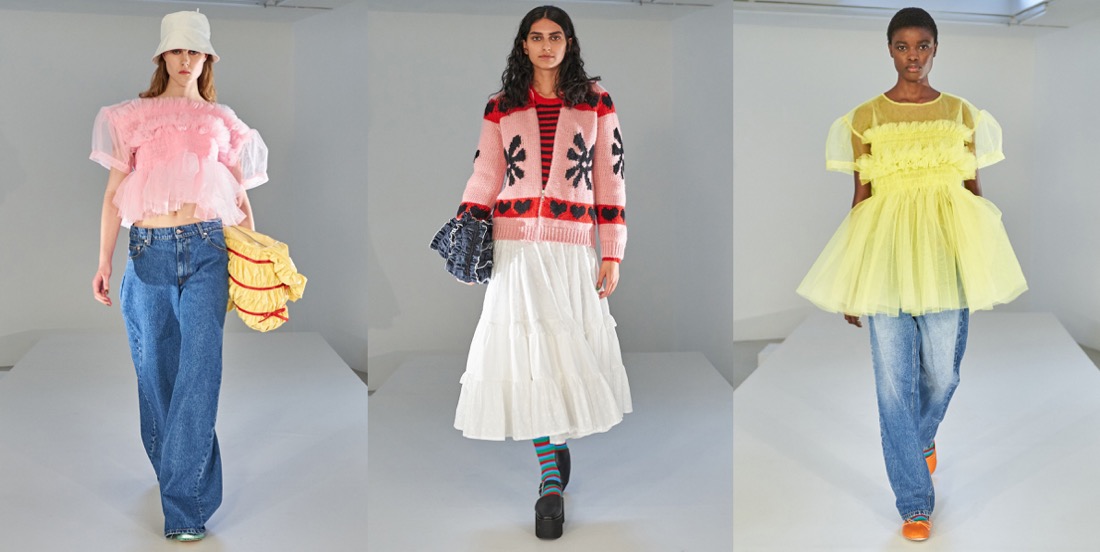
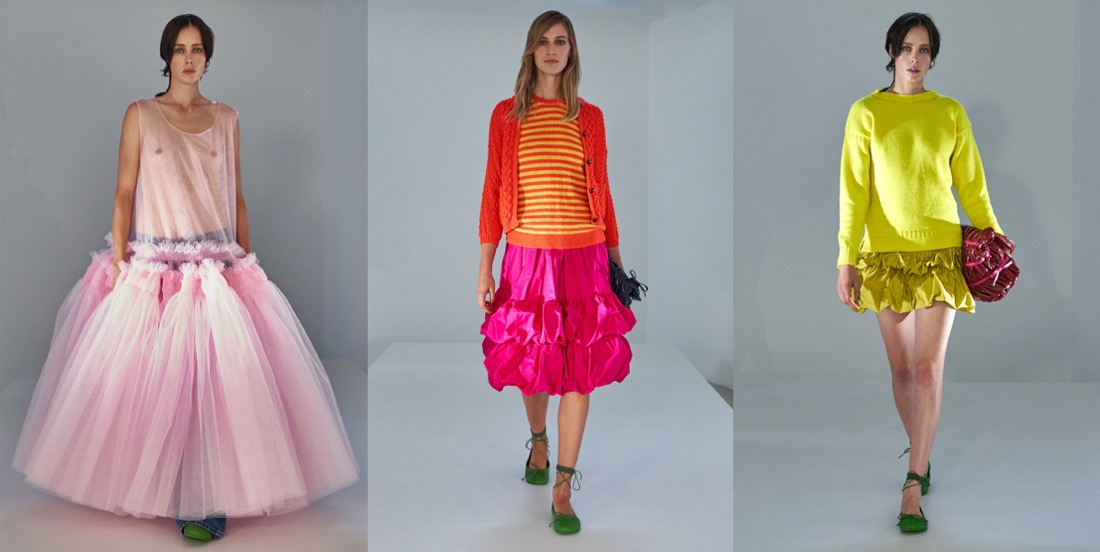
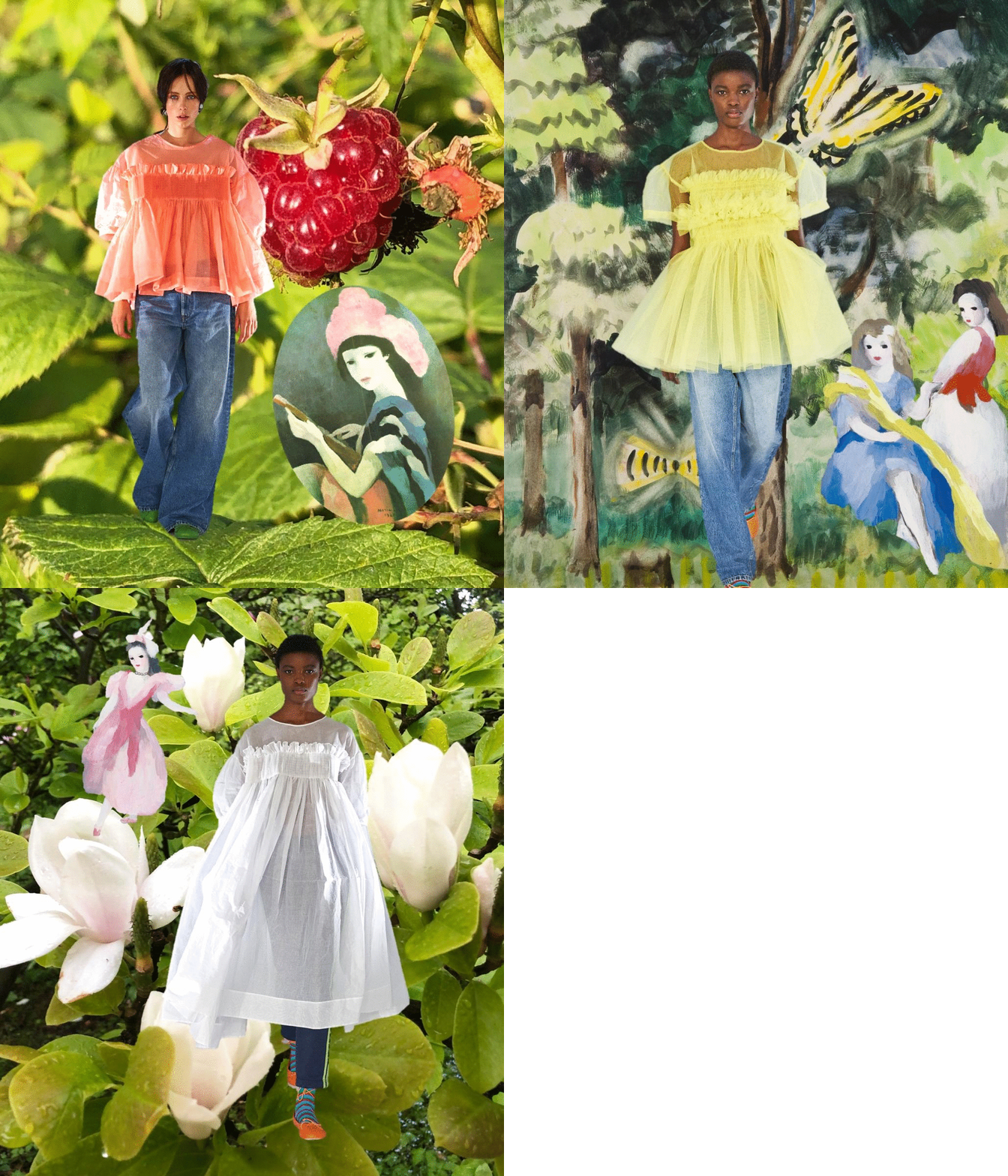
It’s a baby-boom among fashion designers in London! Both Molly Goddard and Simone Rocha have returned to the new season with infants. Molly’s Frank was charming visitors with appointments at her studio this morning, while his mother was explaining how being pregnant made her “think about baby clothes” for the spring-summer 2022 season. In fact, it’s intrinsic to her origin-story as a Central Saint Martins fashion student: “My graduation collection was all based on blowing up the dresses I had when I was a child,” she said. That’s where her obsession with smocking grew. This was a woman-centric staring down, laughing at and toying with whatever toxicity might be meant by “Lolita.” The multiple meters of pink net which typically explode from this designer’s little baby-smocked bodices are definitely not for women who simper. There’s one of those dresses in her spring collection: a classic Molly Goddard party frock. More noticeable, though, is her diversification from full-on going-out clothes. Instead of a show, she shot a video in her studio which demonstrates what Molly Goddard people can wear all of the time. Excellent wide-leg jeans. Neon-bright Guernsey sweaters and Aran knit cardigans. Smocks to layer over track pants. Menswear – including flared trench coats, stripy sweaters and ballet flats. Next season, Goddard is aiming for a full runway show again. In the meantime, her baby-time has generated as much joy as ever, and possibly even more clothes that a lot of people will want to have in their lives.

Collage by Edward Kanarecki.
That’s Hot. Nensi Dojaka SS22

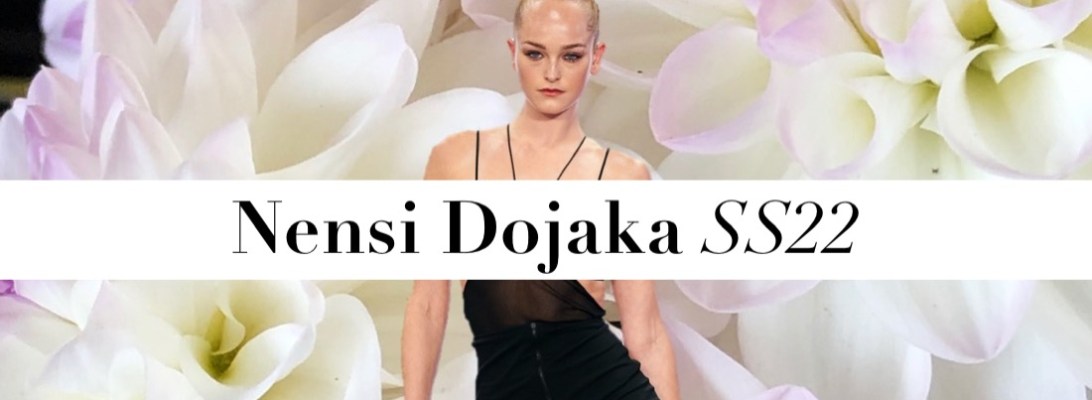
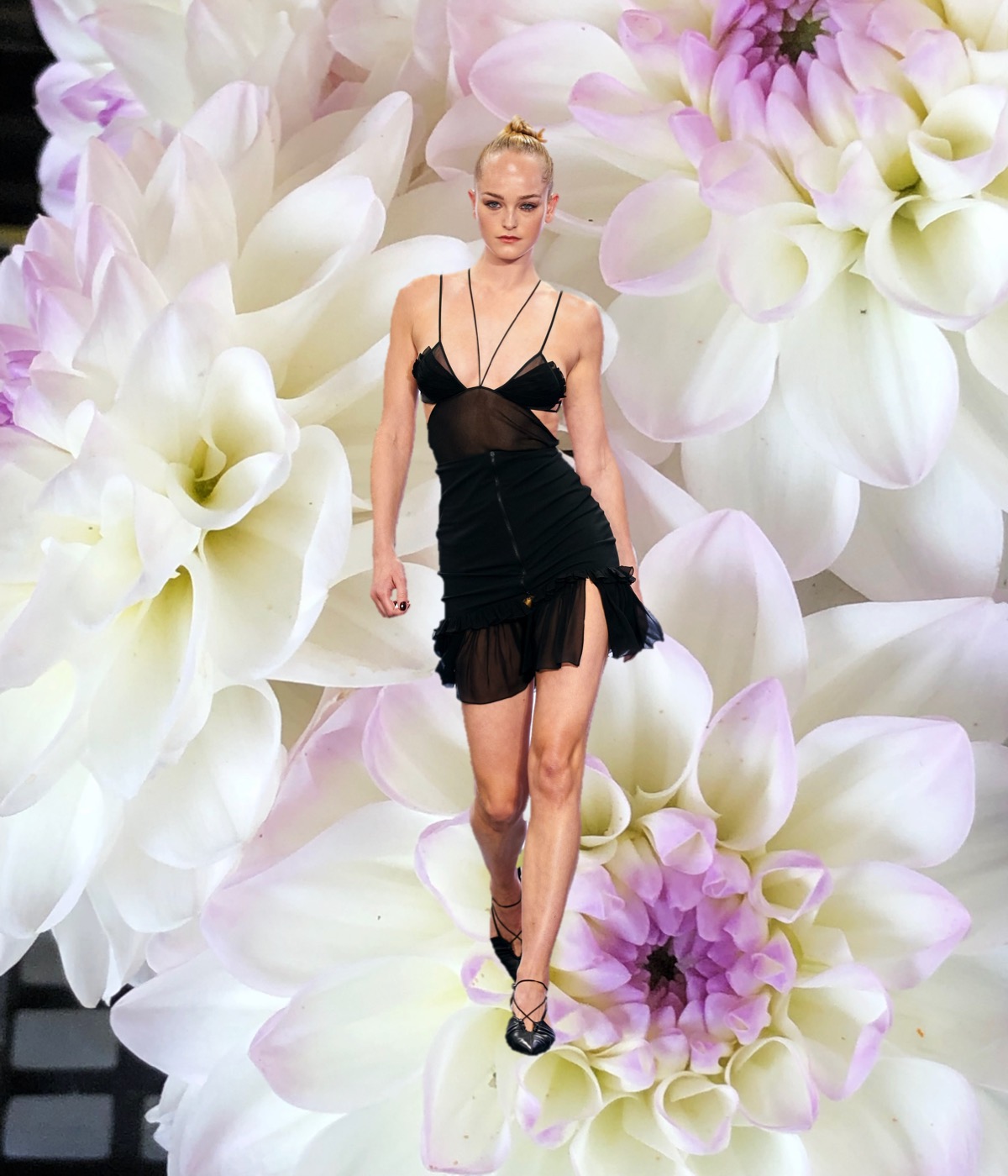
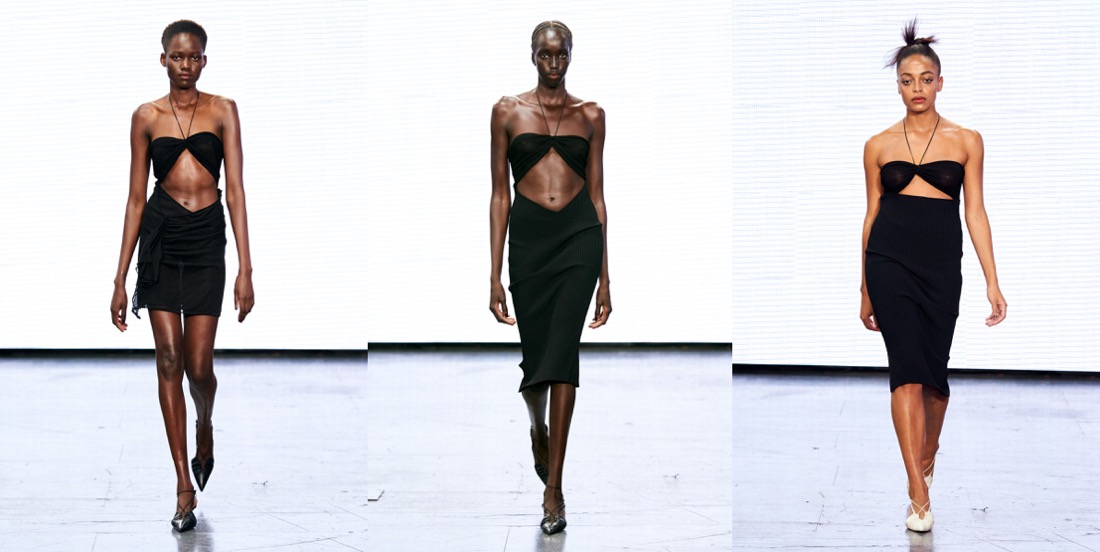
Hot Girl Summer all year long – that’s the key message from the first day of London Fashion Week. Nensi Dojaka is one of the freshest forces in womenswear for a long time to emerge from London. The creative directors of LVMH judged her to be that the other day, when they awarded her the 2021 winner of the LVMH Prize from an impressive field of global contenders. Dojaka has a lot of fans. Dua Lipa and Rita Ora are among them; like her, both have Albanian roots and have grown up in London. Dojaka has lived and studied in the city since she was 17 years old. First she learned the exacting art of lingerie technology at London College of Fashion, hence her fanatically perfectionist expertise in the minute calibrations of fitting bras and multiple, adjustable straps. She then progressed through the Central St Martins MA course, then to her first group outings with Fashion East. She had her first solo show yesterday – a collection which showed all the finesse she’s managed to evolve in dressing the female body in classily engineered nuances of reveal and conceal. Dojaka’s is a total look that’s arrived just in time to greet the pent-up longings of women who’ve spent too long in confinement and are looking for an exit from all-concealing smocks and whatever homewear descended to during lockdown. Here was her antidote: dresses topped with petal-like bras held on with minute rouleau straps to reveal plunging backs; high-waisted, super-fitted, tapered trousers and draped, twisted georgette tops. Tailored jackets, some of them detailed with separate sleeves, were tied on with slim black ribbons. Then the tights: who’s ever seen leg-wear like Dojaka’s hosiery, with a cut-out zone containing a tulle flower on one thigh, and seams running up the front? Her repertoire runs through pointy, strappy, kitten-heeled shoes, rib knit dresses, draped swimwear and bras. The fact that her business was essentially formed during the worst of the pandemic is testament to the down-to-earth realism of this hard-working young woman. She makes sophisticated, desirable, complex product that’s centered on the complex desires of her sophisticated female peers.

Collage by Edward Kanarecki.
New York. Khaite SS22

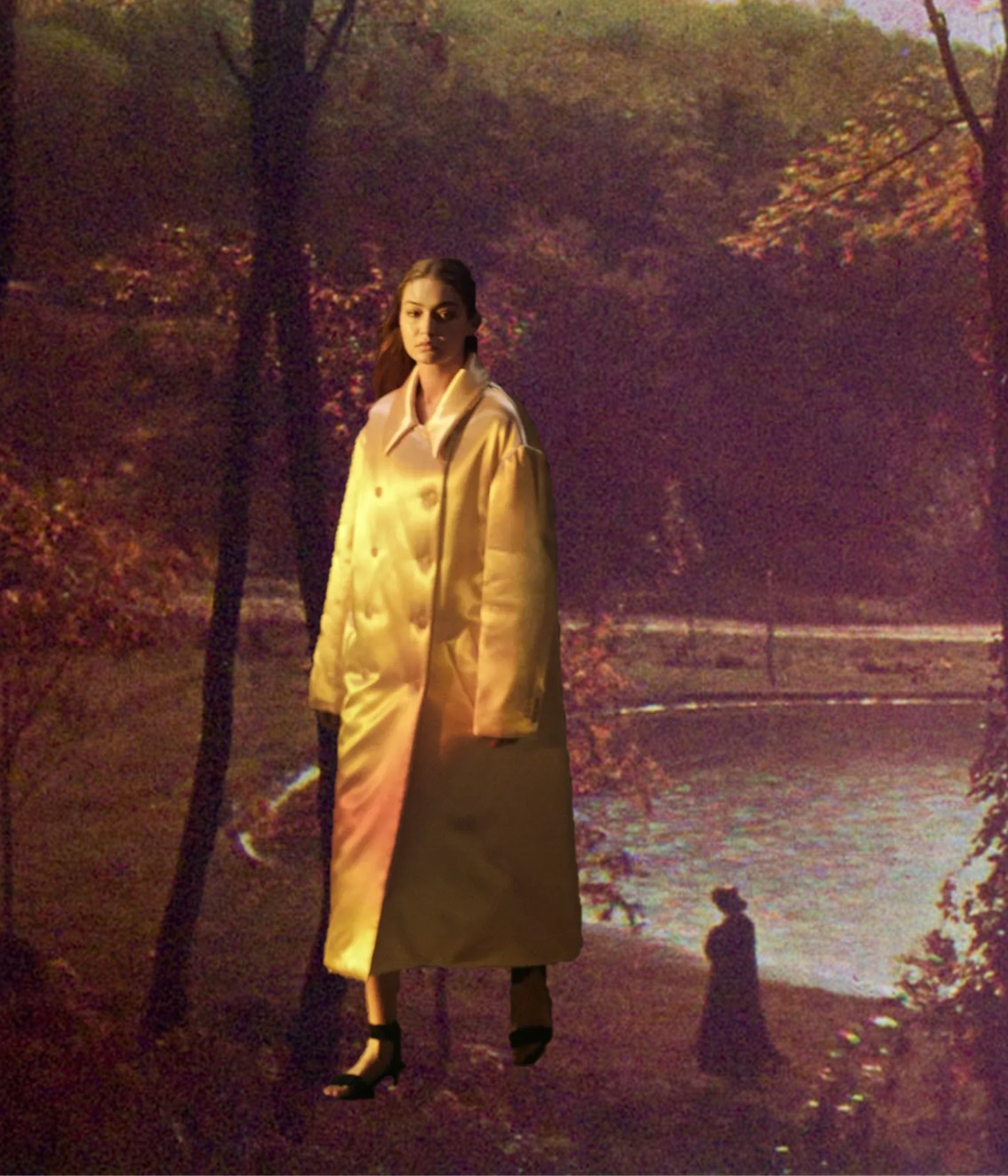
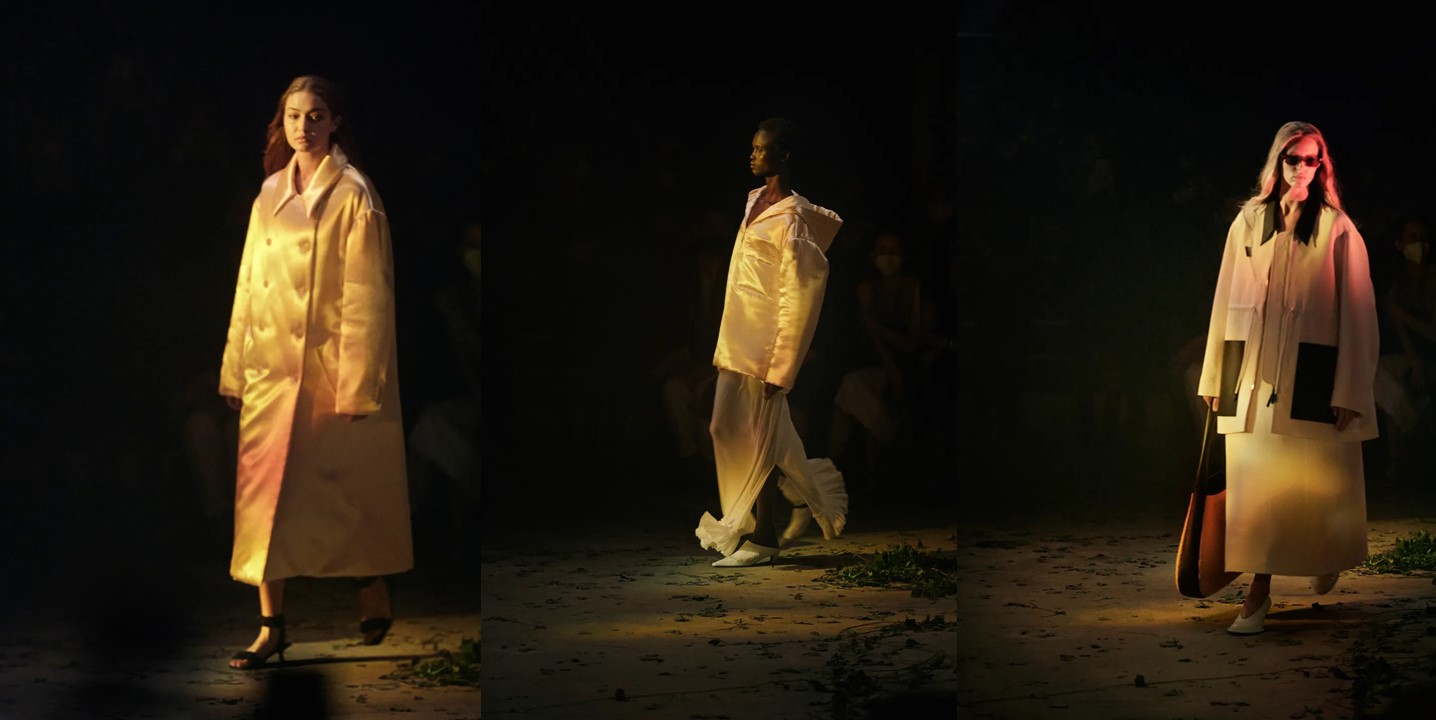
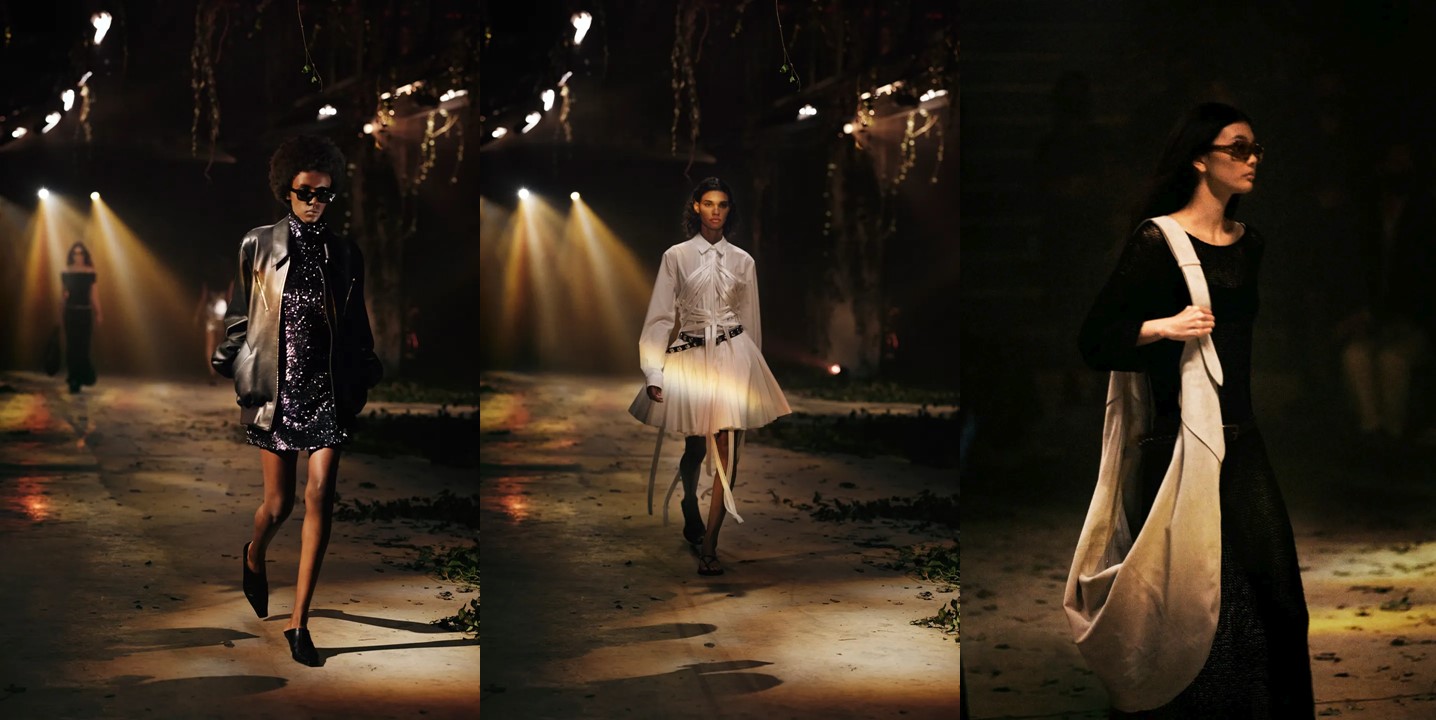
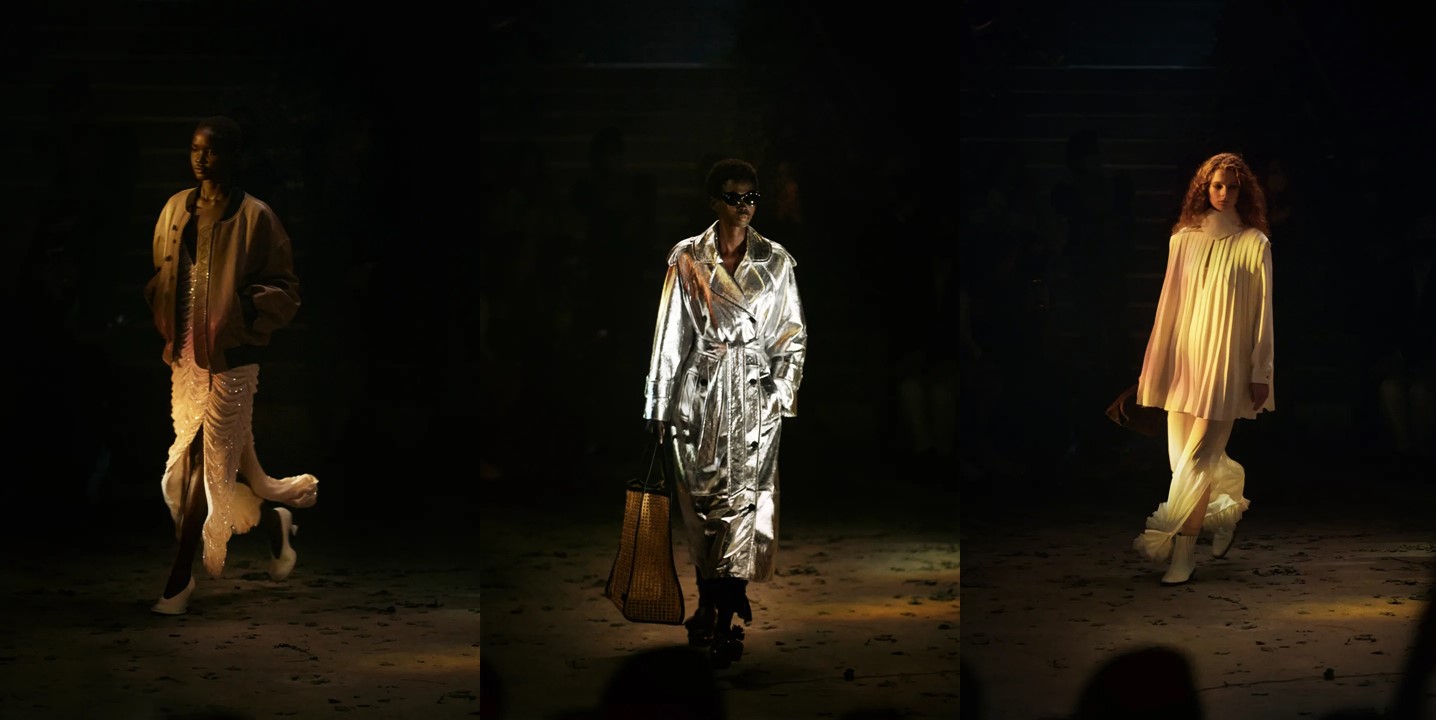
Khaite’s spring-summer 2022 show was incompatible with Instagram, from the intentional lack of photographers to the (also intentional) dim, hazy lighting. This was Cate Holstein‘s intention. Set in the bowels of a Lower East Side apartment building, there were wild green vines climbing up the walls, tumbling from the rafters, and snaking across the floor, as if we’d descended into an overgrown, long-forgotten basement. It was something of a metaphor for New York’s resilience and regeneration, and echoed a collection designed for the equally resilient New York woman. Much of Holstein’s focus this season was on the touch and feel of the clothes – and not just in the materials but how a garment might alternately embrace or liberate the wearer. Gigi Hadid’s opening look was a luminous ivory satin coat lightly filled with down, “like your duvet cover, but more elevated,” said Holstein at a preview. “I think it’s still important to be gentle to ourselves,” she added. A crinkled organza bubble dress would be almost weightless on the body, while a new hand-stitched satin harness might feel satisfyingly snug over a T-shirt. A chrome sequined mini was deliberately heavy, she noted, “to ground you.” These are details that can’t be captured in two dimensions, but make all the difference IRL. “I think we’ve really established the brand’s character, so now it’s about pushing our materials and construction techniques,” said the designer. Holstein pointed out a ruched sequined dress in glittering pale gold, styled here with an oversized chocolate bomber. The effect was of a woman heading to a glitzy party – maybe her first since lockdown – and on her way out the door, she throws on her everyday jacket, not a fancy evening coat. Why fuss when you can be comfortable? Now more than ever, she’s less inclined toward prescriptive full looks and deeply curious to see how each customer puts their own unique spin on a Khaite piece.

Collage by Edward Kanarecki.