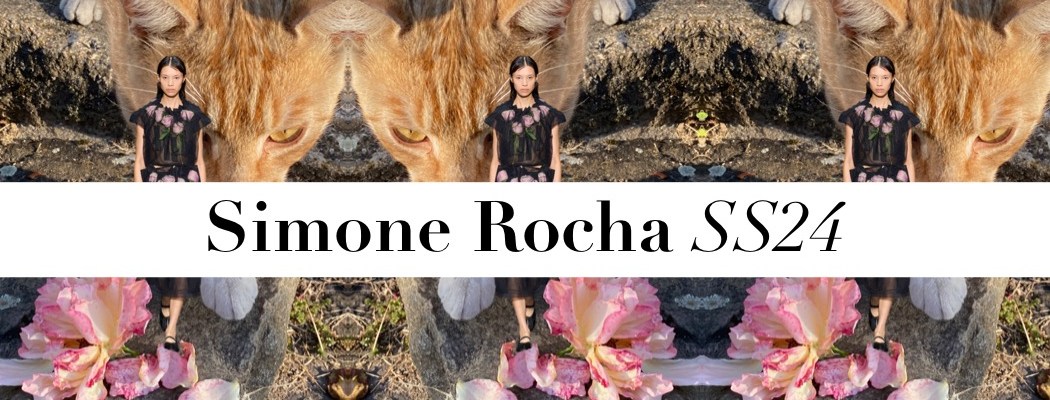
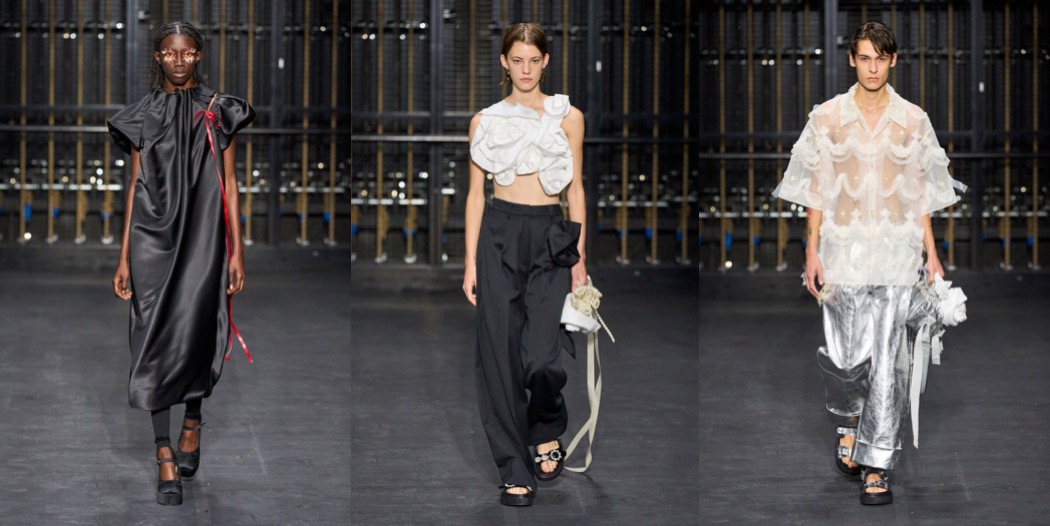
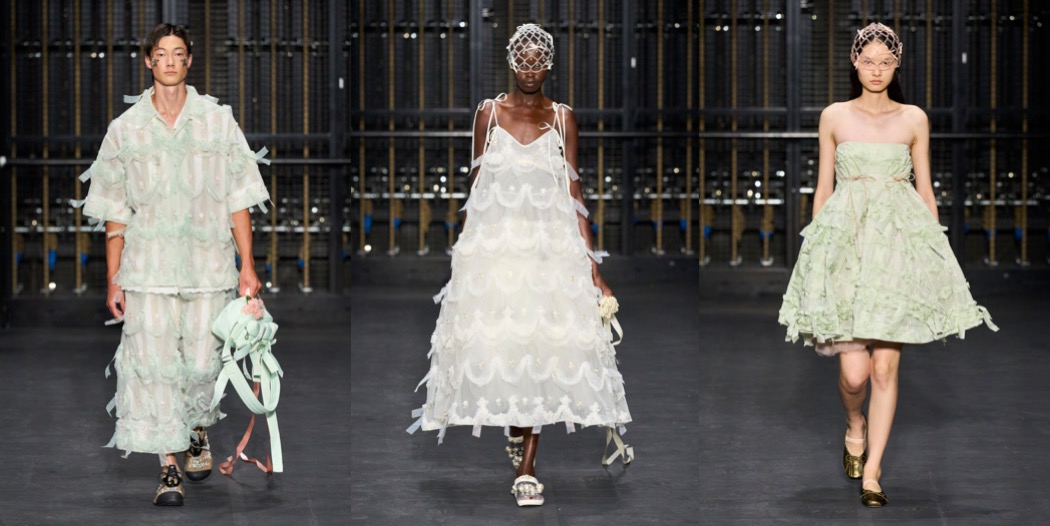
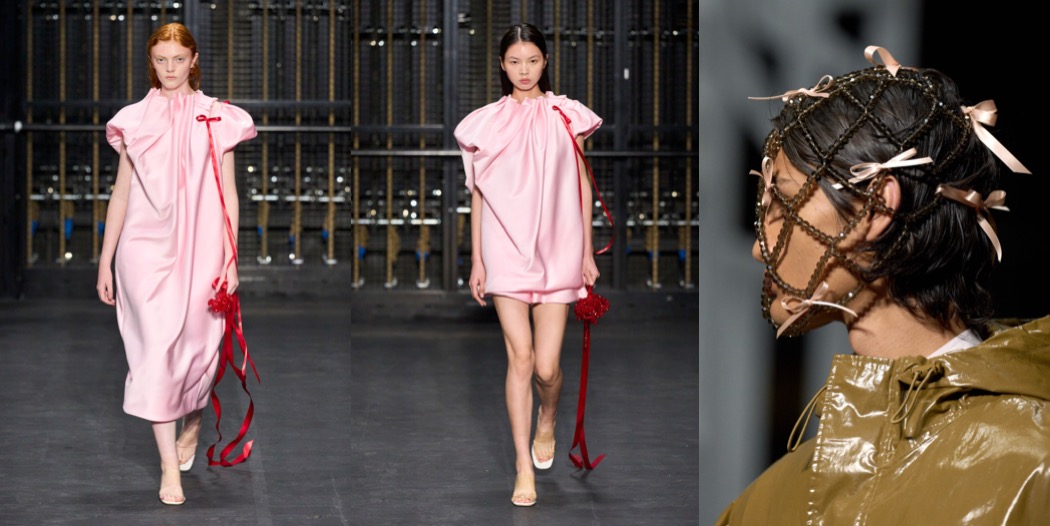
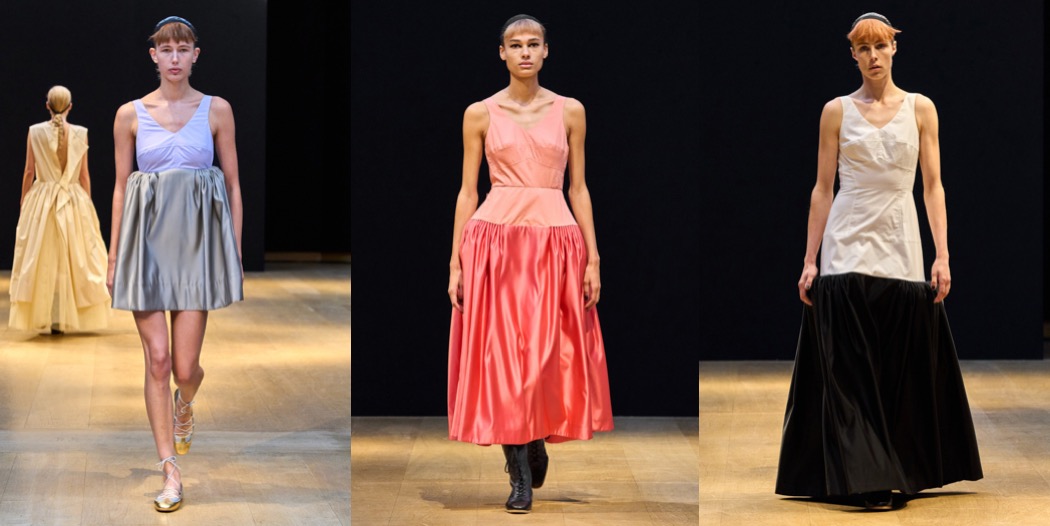
Simone Rocha staged her spring-summer 2024 show in the rehearsal space at the English National Ballet. “I love the rise and fall of doing a show,” she said. “Sometimes it’s a big spectacle, sometimes it really brings people in.” By shows, she also had wedding ceremonies on her mind. The cake-inspired tiers of appliqué on white tulle dresses and the sound of silver “wedding” bells tinkling on slippers, sleeves and bags. “It’s almost fragmented,” the designer said of Frederic Sanchez’s music for the show. “It’s that disturbed feeling, all the emotions of a rehearsal… the nerves!” Despite the sense of tension Rocha set out to create, there’s little chance of a bride wearing one of these dresses getting cold feet the night before. The show’s highlight: instead of a bride holding a bouquet, fresh roses were bunched between layers of sheer tulle, and fabric versions were manipulated into dresses and jackets. Models carried single stems fashioned from cotton or pearls, and bare legs were decorated with red rose tattoos. As a motif, it was equal parts enchanting and fragrant.
Collage by Edward Kanarecki. Don’t forget to follow Design & Culture by Ed on Instagram! By the way, did you know that I’ve started a newsletter called Ed’s Dispatch? Click here to subscribe!
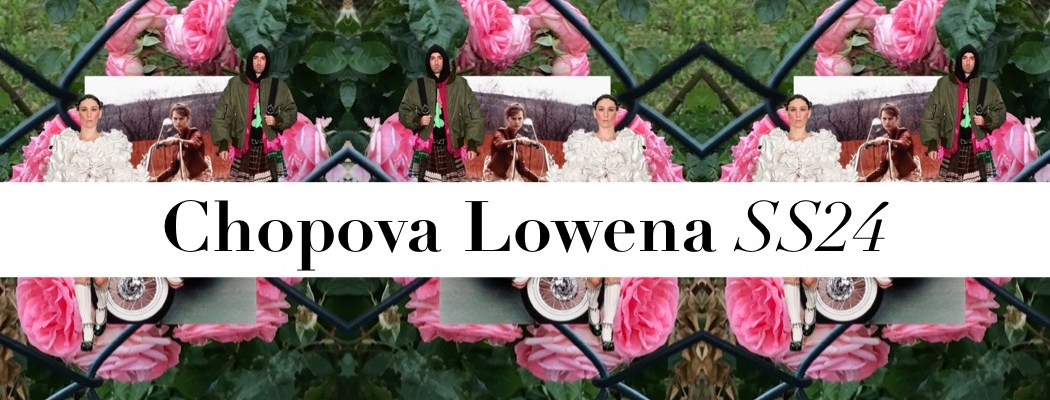
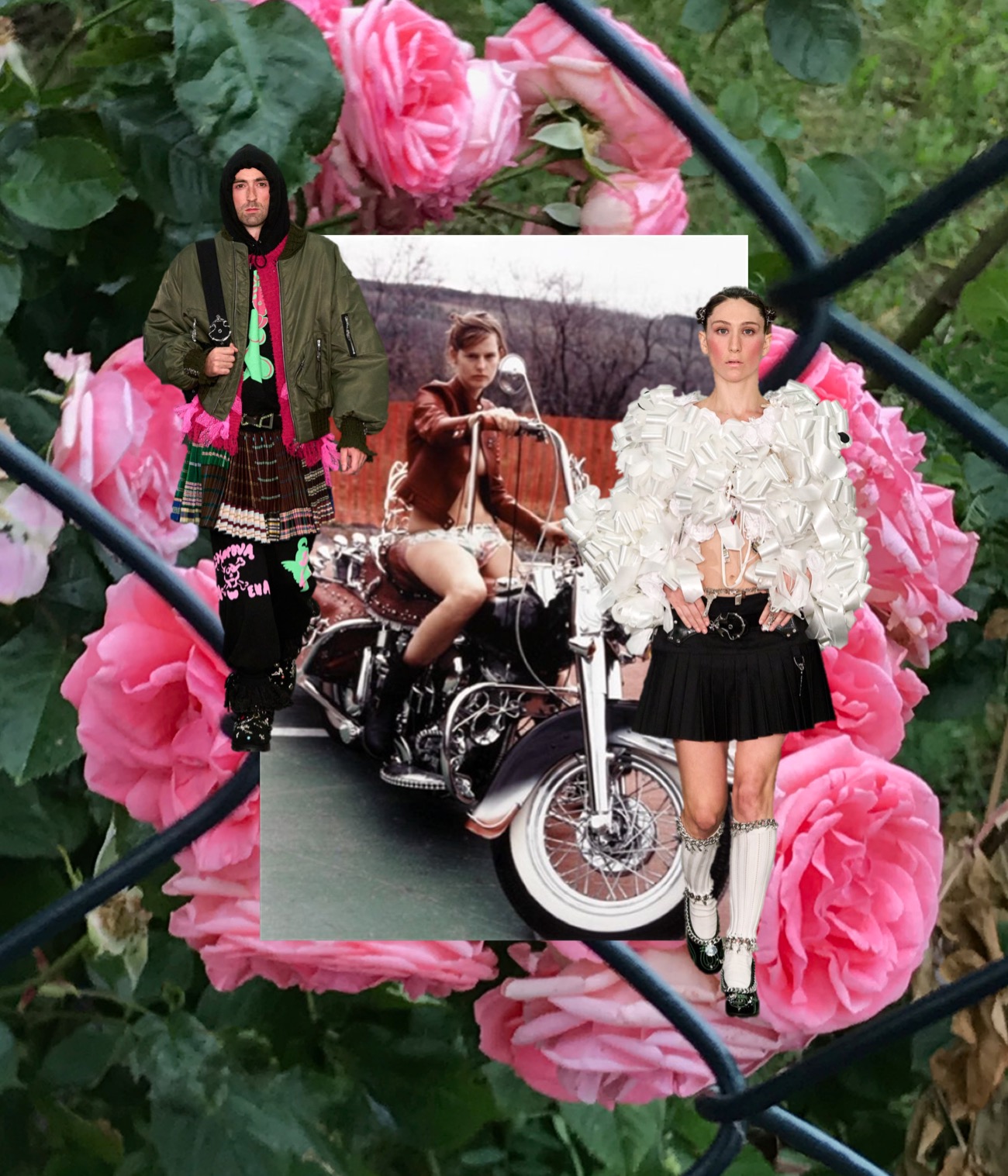
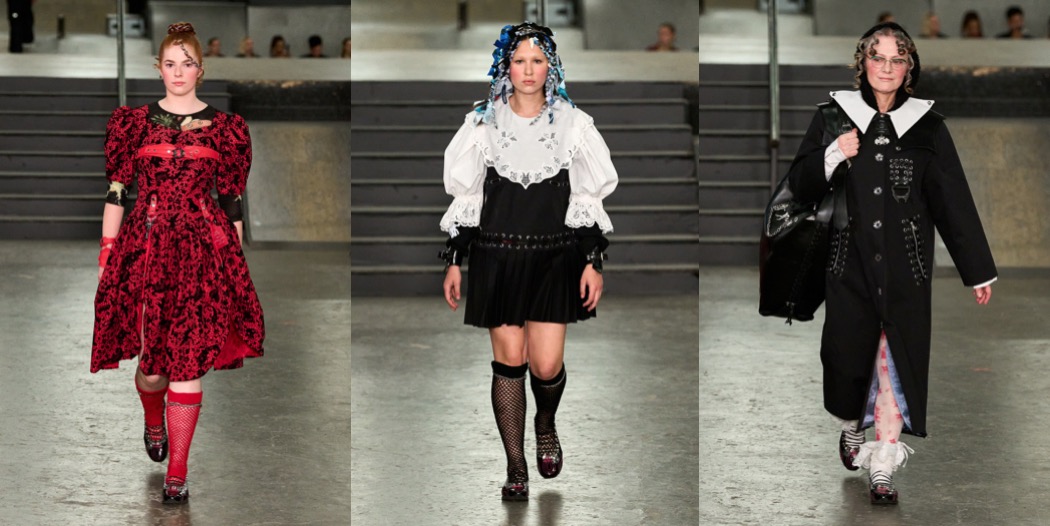
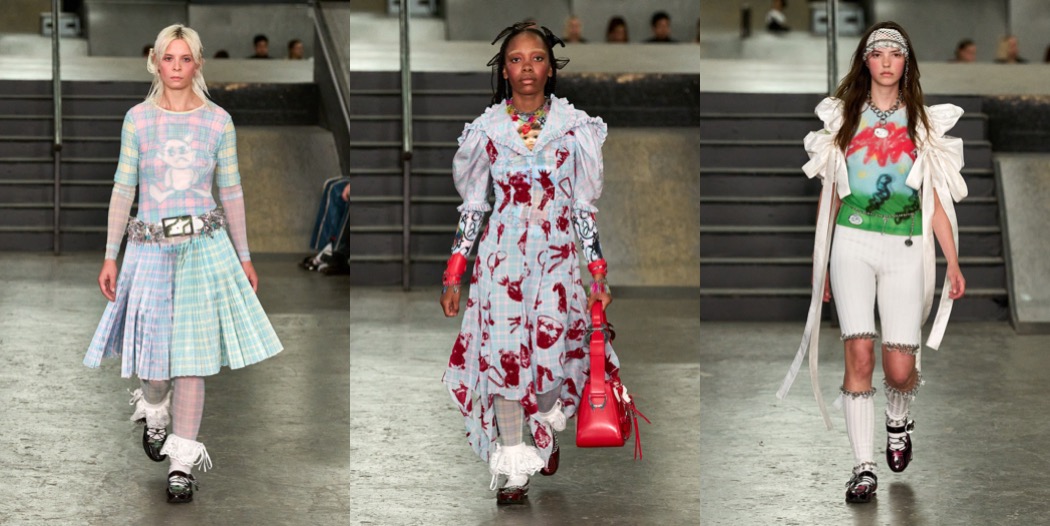
Chopova Lowena, a relatively young brand, is stomping its way through a period of economic gloom, in a country severely hamstrung by the after-effects of Brexit and the pandemic, with good humor, common sense, and clever ideas. Emma Chopova and Laura Lowena’s weakness for folkloric whimsy with a streetwise swagger speaks for itself and keeps on enchanting the clients. Extra spice came courtesy of the casting, which took in friends, colleagues, acquaintances, plus mothers and brothers and boyfriends, resulting in a compelling line-up of characters you simply couldn’t take your eyes off. For their spring-summer 2024, the designers had chosen the skatepark as an homage to the “skater boy you love” (that’s Bulgaria-born, New Jersey-raised Chopova) “or the boy you want to be” (Somerset-raised tomboy Lowena-Irons). Tony Hawk made his presence felt in plaid pajama pants, graphic zip-up hoodies, board shorts and studded Ugg boots, part of a collaboration with the brand. The rest referenced the ancient Flora Day festival, held every May in the village of Helston in Cornwall, on England’s wild south-west coast. Comprising numerous processions and dances, including mermaids and maidens, angels and devils, it manifested in hand-embroidered broderie anglaise dresses, thick leather belts and a pair of knickers adorned with hundreds of beads and charms, and a particularly fabulous jacket made of white crispy ribbons like those you’d see on draped across a wedding car.
Collage by Edward Kanarecki. Don’t forget to follow Design & Culture by Ed on Instagram! By the way, did you know that I’ve started a newsletter called Ed’s Dispatch? Click here to subscribe!
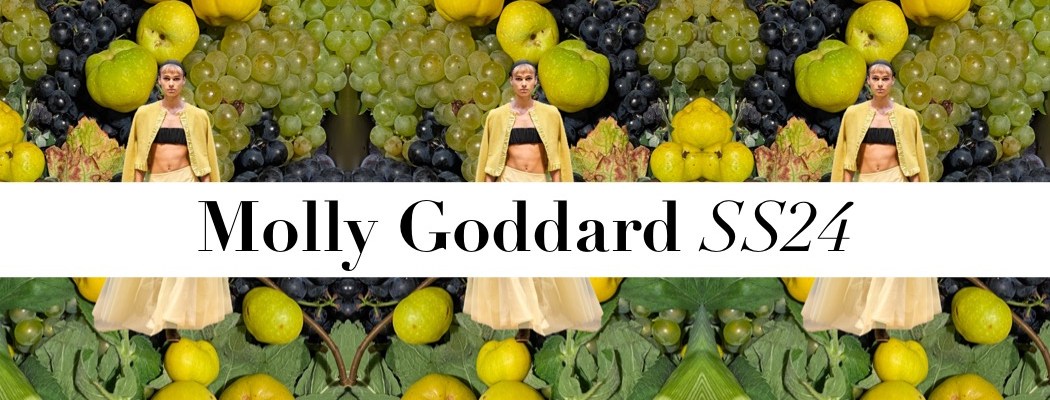
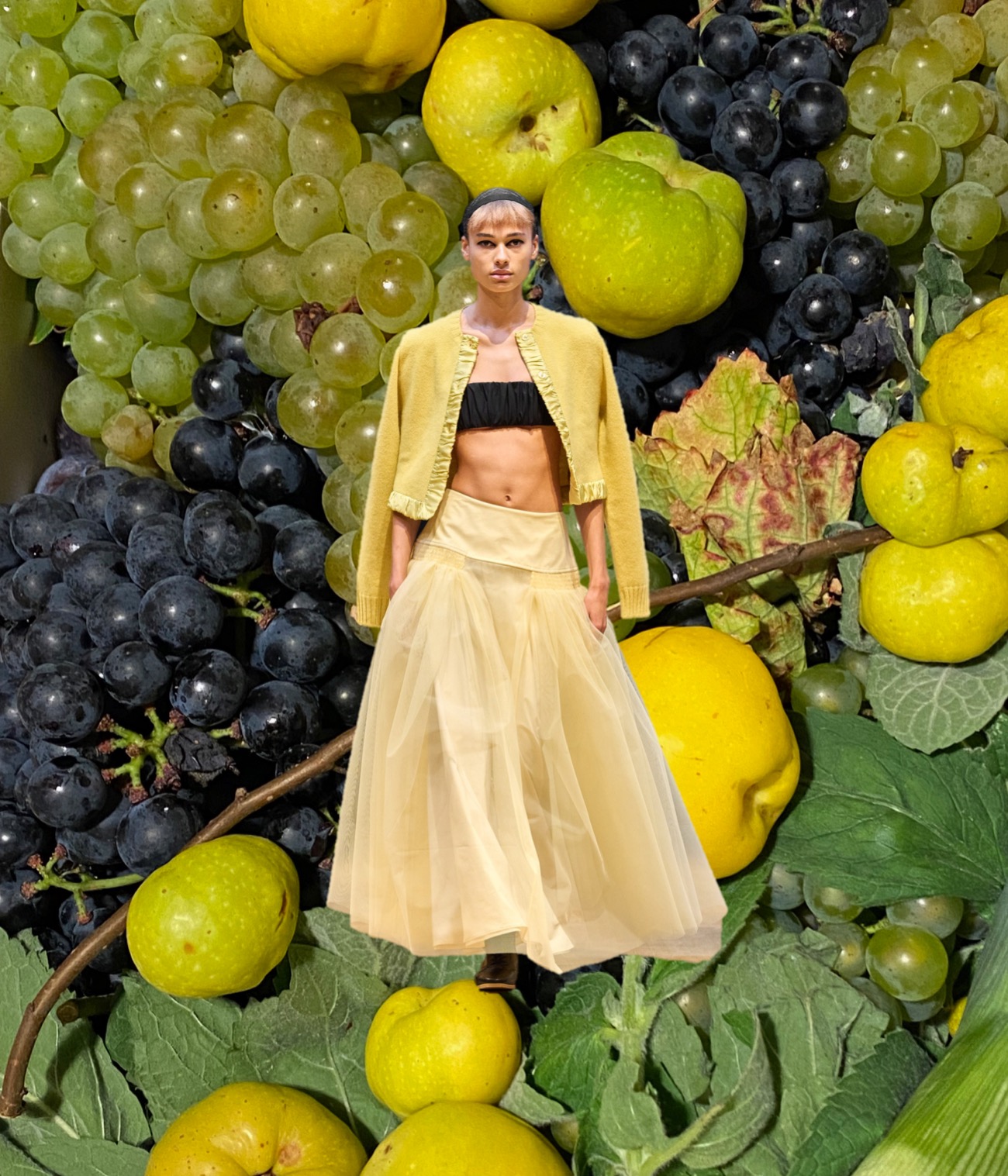
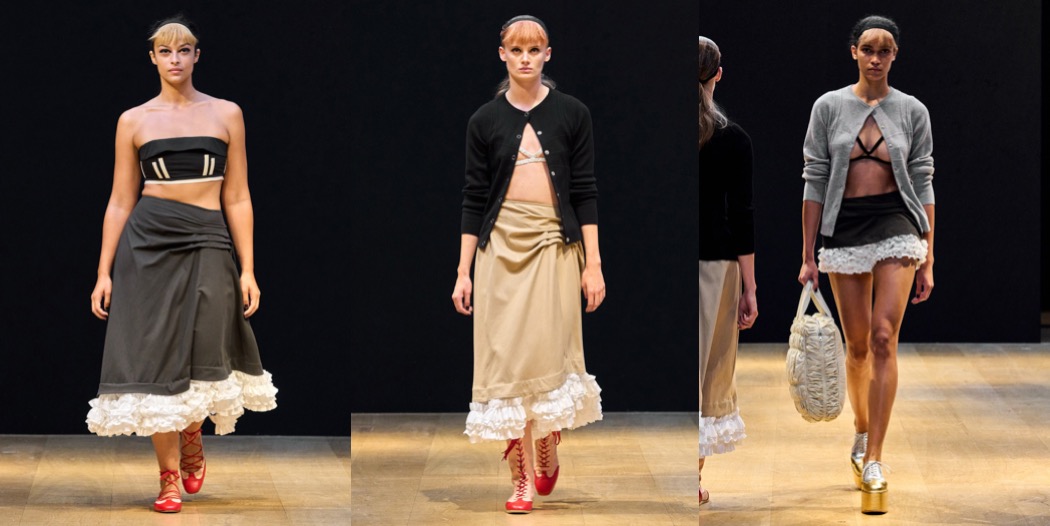
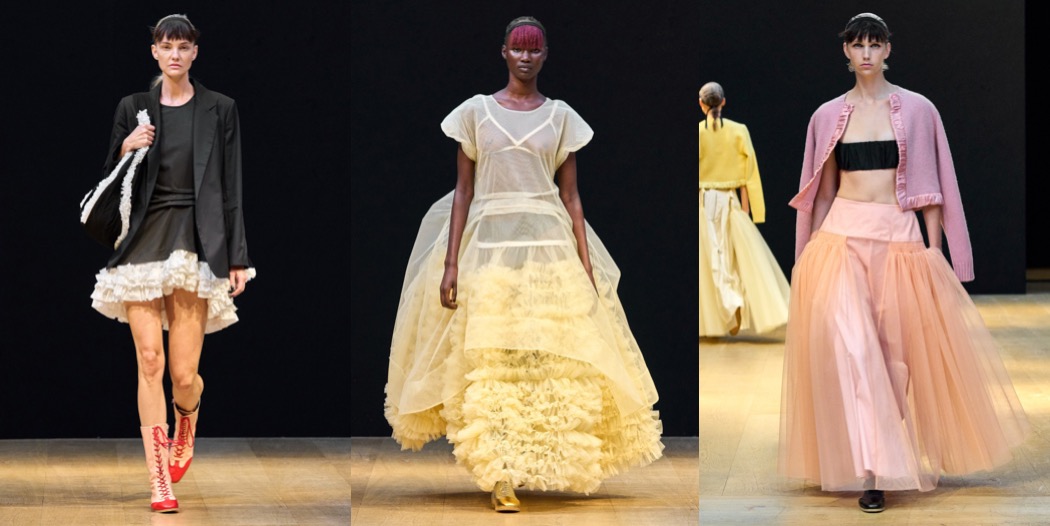
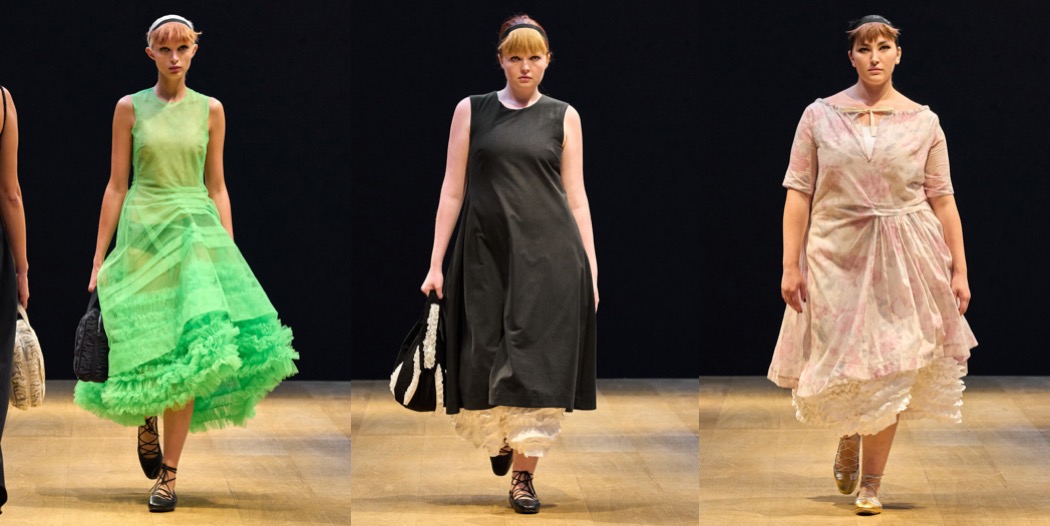
This season, Molly Goddard played with the notion of a “behind the scenes” moment: what’s happening behind the surface, or closed doors or… the clothes. The spring-summer 2024 show took place at Christie’s auction house on King Street, the other occasions upon which the designer would tend to visit were during the set up of displays. She elaborated: “When there are these masterpieces just lying on the floor: it’s kind of amazing to see and very exciting, which I guess in some way is connected to the collection.” Goddard fashioned a fair few masterpieces of her own in a lineup that focused on nudging the mechanics of garments to the surface, turning them inside out in order to create a patina of production. She said she’d done her research in the National Theatre Costume Hire, examining the stitched clockwork of garments ranging in style from Regency to contemporary. Long skirts were shirred at the hip to create drape down to edged froths of pale ruffled petticoat. The trademark tulle skirts were teamed with loosely corseted tops whose sheerness exposed the geography of boning and corsetry that defined their gentle geography. A dusty pink woolen cardigan was edged with a two-inch strip of satin, like some old granny blanket left bundled in the cupboard of a spare room. Washed out red rose prints used on more skirts and knitted into another cardigan – magenta paneled at the shoulder – added to the sense of comfortable, domestic nostalgia. A precise excavation of the deeply familiar but also overlooked, this was a quietly masterful collection. Said Goddard: “What I enjoy most is when I get really stuck in to how to make clothes; the techniques and the fabrics and the fit.” That pleasure in Goddard’s process was evident in its result.
Collage by Edward Kanarecki. Don’t forget to follow Design & Culture by Ed on Instagram! By the way, did you know that I’ve started a newsletter called Ed’s Dispatch? Click here to subscribe!
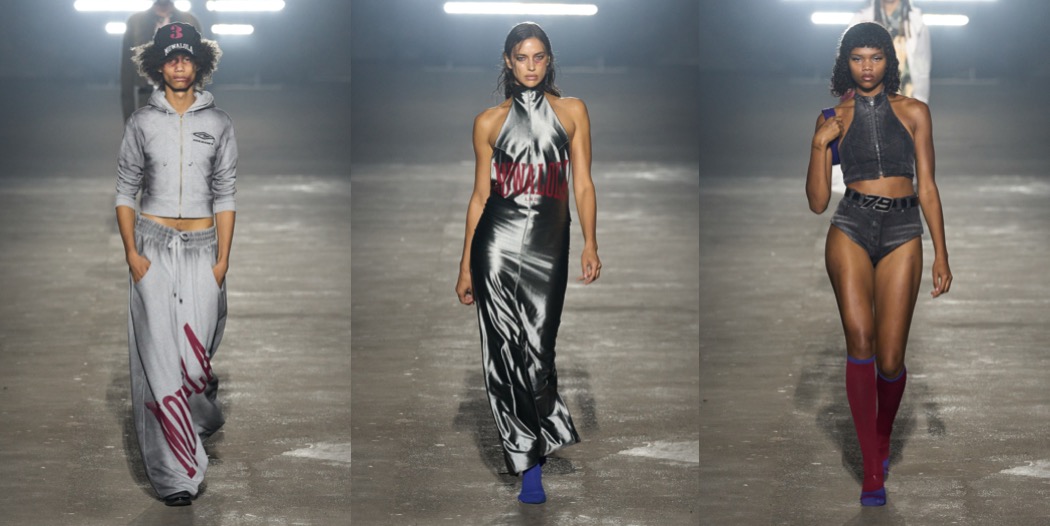
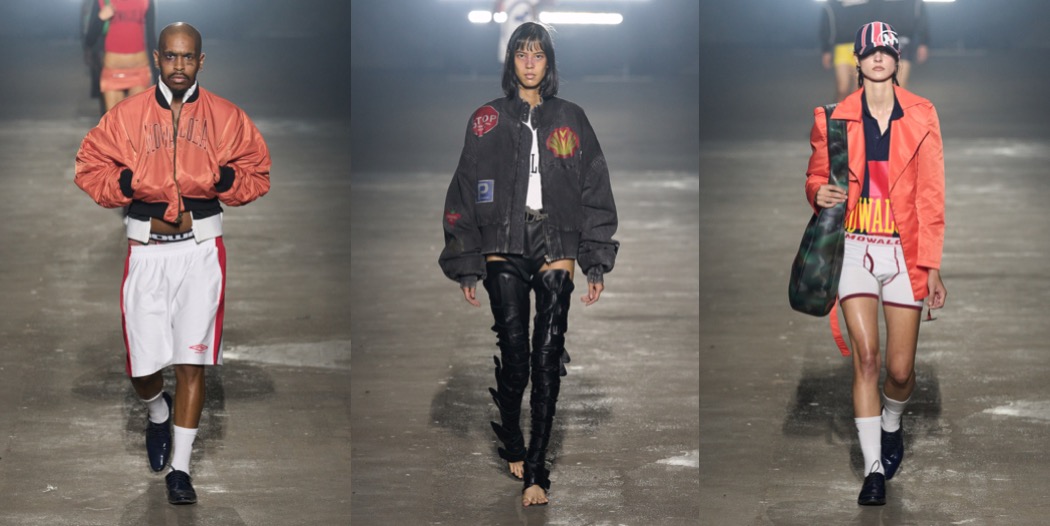
Mowalola Ogunlesi delivered a sharp start of London Fashion Week. Mowalola, the brand, is fast, furious, and at times obscene, but in a creatively vital way. Backstage of her spring-summer 2024 show, the designer, said the collection had been sparked by her first-ever viewing of David Cronenberg’s Crash. “I was really excited by the fetishization of pain through crashing,” she said. It prompted her to imagine “a whole universe that resides on the street,” filtered through a prism of ecstatic jeopardy. But Mowalola doesn’t stick to one reference. Masturbating anime girl prints; off-the-shoulder bombers with faux Highway Patrol patches; thigh-highs and micro skirts inspired by street walkers. A lot of stuff that Ogulensi’s customers will love. All that, like the excellent dirty denims, seemed to emanate a conceptual solar system adjacent to some of Glenn Martens’s work at Diesel. The pants that flashed cracks at the back and crotch hairlines were maybe subject to the influence of Alexander McQueen’s gravity. This was good company to keep: however the gartered, bisected pants and skirts, now a Mowalola signature, were all Ogunlesi’s own. The flags-of-the world theme was another highlight. This also ran into a poignant EU skirt meets Union Jack cap look. The extreme contrast of volumes in some sportswear looks made the generic appear particular.
Collage by Edward Kanarecki. Don’t forget to follow Design & Culture by Ed on Instagram! By the way, did you know that I’ve started a newsletter called Ed’s Dispatch? Click here to subscribe!
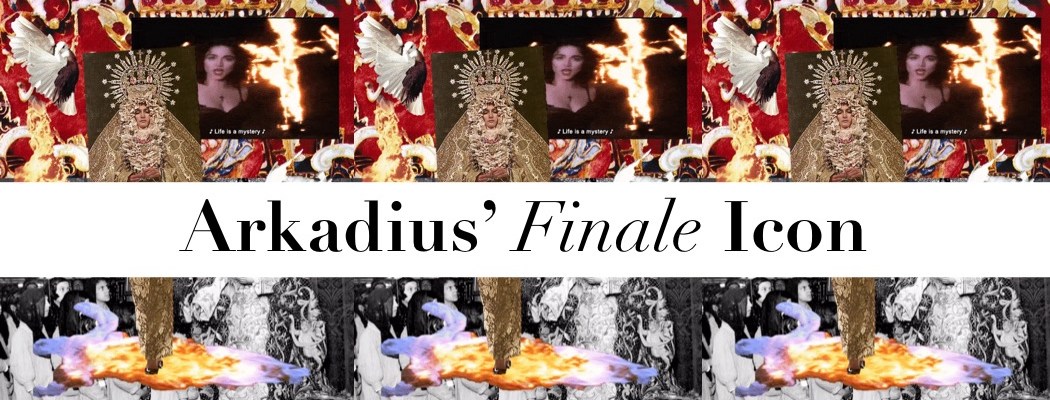
Back in July, I defended my MA Thesis in Art History titled “Selected Phenomena of Haute Couture Fashion as a Reception of Early Modern Catholic Pictorial Traditions”. In the thesis, I’ve analyzed one of the most intriguing examples of dialogues between fashion and Catholic imagery in history: Arkadius’ Finale Icon which closed his revelatory spring-summer 2002 collection. For the sake of research and a better understanding of the designer’s intentions, I’ve interviewed Arkadius himself at the beginning of the year. Yes, the legendary designer, the ultimate icon of Polish fashion, the creative who enamored London in the late 1990s and early 2000s.
First, here’s an excerpt from my thesis, where I discuss the designer’s take on Catholic imagination through Finale Icon, an incredible piece of fashion history:
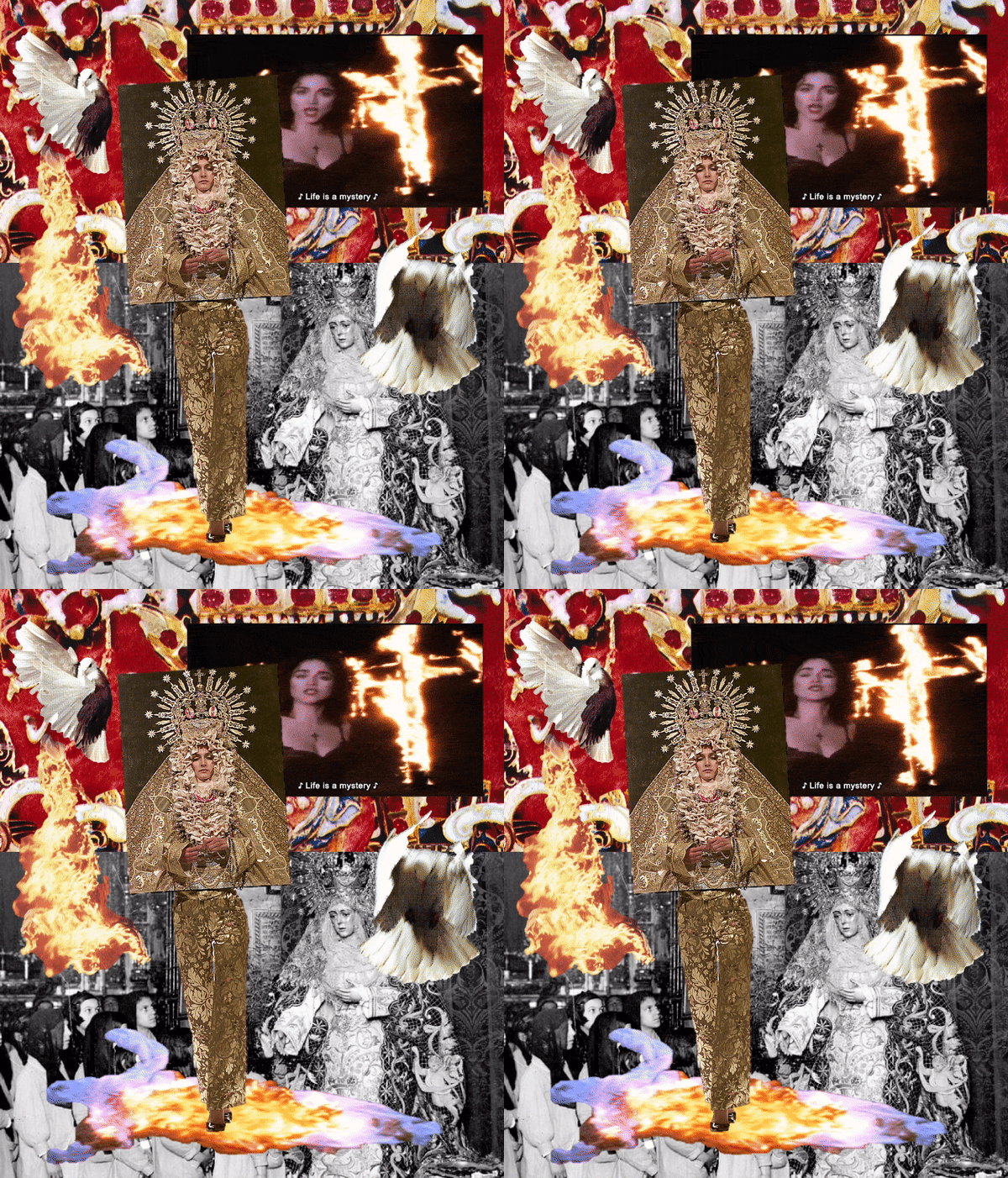
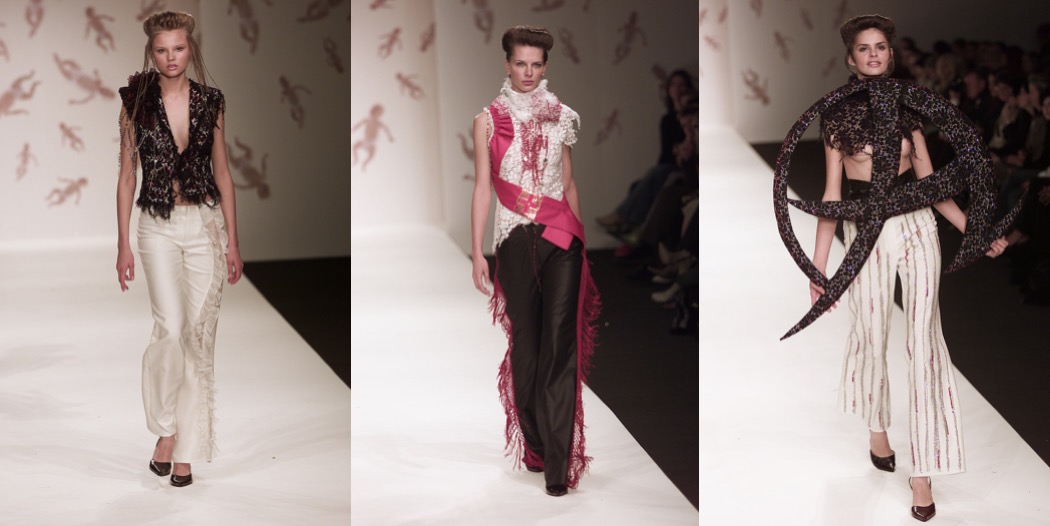
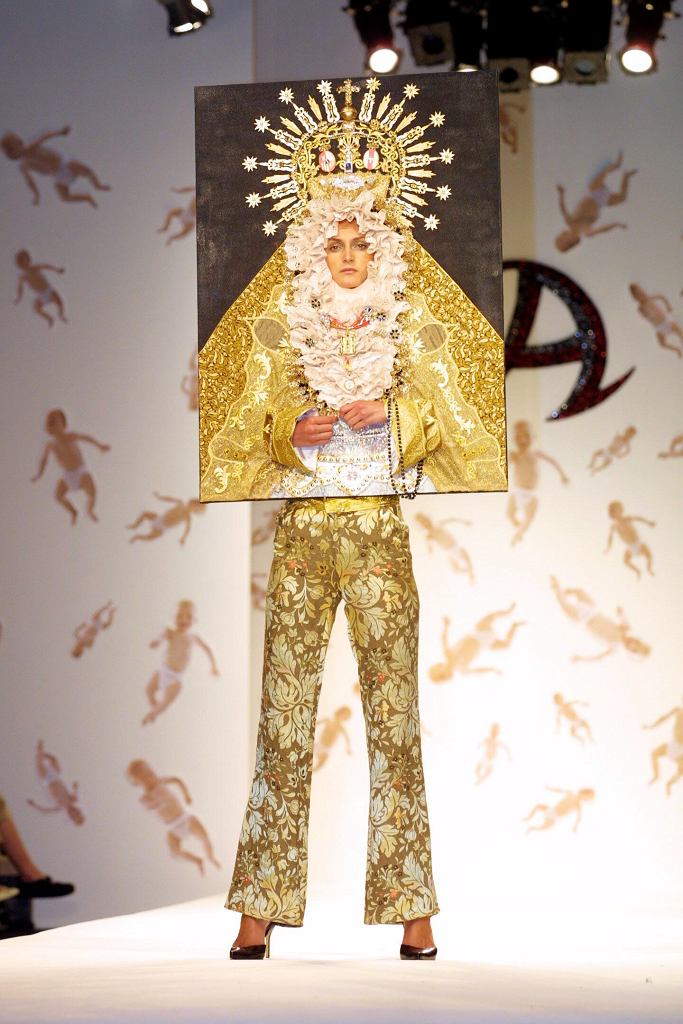
Arkadius’ design, which comes from the Virgin Mary Wears The Trousers collection, was inspired by two different artistic representations of Mary: the statue of the Blessed Virgin of Macarena from the Basilica De La Macarena in Seville and the painting of Our Lady of Czestochowa.
In his work, Arkadius drew inspiration from the world around him, from political events and social phenomena to art and literature. As with Cristóbal Balenciaga [another designer whose Catholicism-inspired work I’ve analyzed in my thesis], images of visual culture related to homeland were an important reference for him. An example of this is the spring-summer 2001 Paulinacollection, where Polish folklore and rural lifestyle proved to be the key references. Polishness as understood by Arkadius, consisting of a cultural landscape built from folk traditions (including Łowicki and Podlasie cut-outs and wicker decorations), was never seen before in such a bold way in the work of any contemporary fashion designer, let alone at London Fashion Week. It seems that the Paulina collection became a starting point for the further deconstruction of Polishness, and the creation of a collection related so intensely to a significant image of native visual culture that is Catholic tradition. In the designer’s own words, “the environment in which we grow up, the society in which we function and the religion we follow shape us in a certain way.” The Virgin Mary Wears The Trousers collection appeared to be a thorough reflection on the phenomenon of religion, which can unite as well as differentiate people.
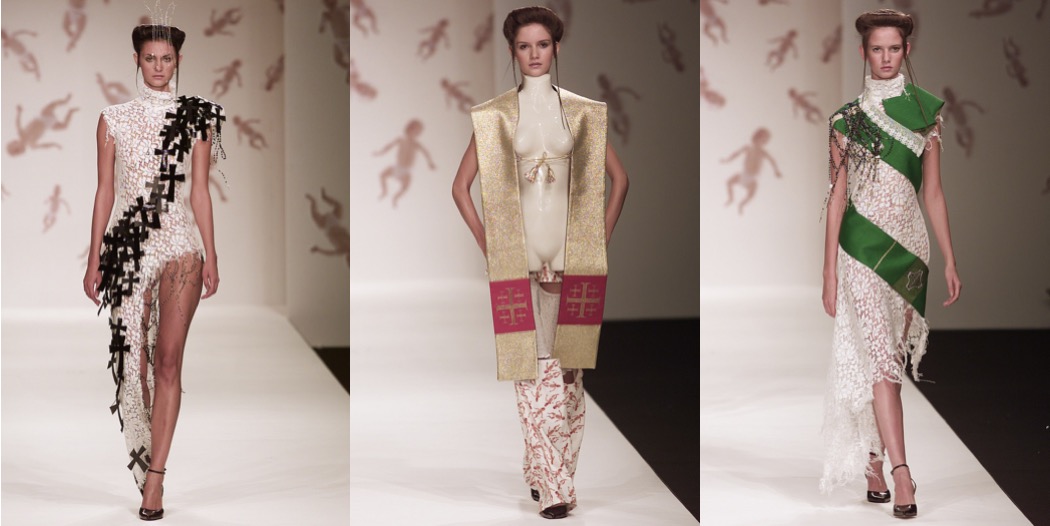
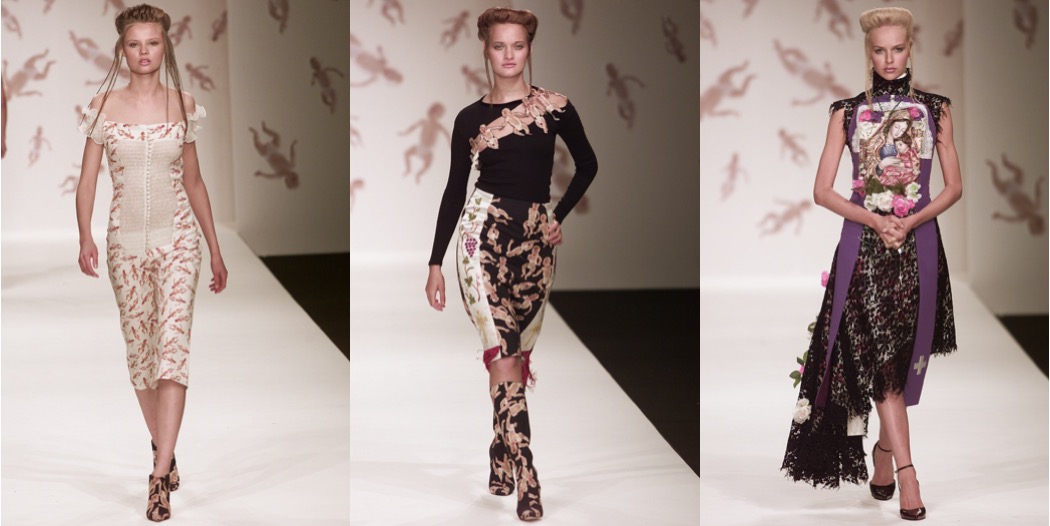
The Polish designer presented looks inspired by liturgical vestments (such as a stole), treated rosaries as decorative trims on dresses, and used ecclesiastical motifs like the Latin cross, the heart-shaped ex-voto and the representation of the white dove in the form of ornate embroidery on jackets and tops. Arkadius “desacralized Catholic images and church ceremonial and transported and exploited their aesthetic qualities for the sake of fashion spectacle”, Dominik Zieliński stated in the designer’s monograph. What interests me most, however, is the final creation in the collection, which Vogue fashion critic Sarah Mower compared to an experience of “religious climax”.
The Finale Icon look largely escapes conventional identifications of garments. Presented on the catwalk by model Kasia Pysiak, the outfit consisted of two essential pieces of “clothing”. The upper part of the ensemble, worn over a black shirt, was a rectangular black canvas stretched over a frame with specially cut holes revealing the model’s face and her protruding hands. The lower part of the outfit was a pair of pants of classic cut covered in opulent, floral pattern. The runway styling was completed with black stilettos created in collaboration with Jimmy Choo Couture. The most important element of the look is the aforementioned canvas, which was modeled on the image of the Virgin Mary as well as on the tradition of decorative dresses placed on representations of Madonnas [a historical Byzantine-Ruthenian tradition]. This part of the ensemble, with its form resembling an icon and depicting on its surface the figure of the Madonna wearing a crown, was hand-finished with gold jacquard fabric, various lace and costume jewelry in the form of cabochons. It was a “controversial combination of the traditional sacred with the modern profane”, Zieliński concluded.
And now here’s the interview regarding Finale Icon – published for the first time here on Design & Culture by Ed!
Ed: Regarding the final look from the Virgin Mary Wears The Trousers show, what influences and inspirations from sacral art played a significant role for you? The book “Arkadius. Fashion That Became Art” mentions the inspiration coming from the Virgin Macarena of Seville. Why was this particular representation of the Virgin important to you? Did you treat that image of her in a “formal” way when creating this garment, or was it more of an initial impetus for the creative process?
Arkadius: The main reason for using the image of the Virgin Macarena of Seville was her global recognition as an iconic religious imagery. This particular image is an actual 3D sculpture and is very well known and a striking work of art, with a very deep sorrow look, tears, which capture the morbid spirit to represent the philosophy of this particular collection. The strength of the image and the entire mood of the collection was also beautifully captured by the model wearing it as the finale of this show.
Ed: Looking at the ensemble, I instantly associate it with “Our Lady of Czestochowa”, and especially with the “ritual” that is so characteristic of this artwork – that is, adorning it with the encrusted dresses. Did such inspiration take place in your creative process? Do you see any dialogue between the runway look, and this very work of art and the Byzantine-Ruthenian tradition associated with it?
Arkadius: Being Polish myself, my original idea was indeed to use the imagine of Matka Boska Częstochowska and not the Virgin Macarena of Seville, but I also knew that our Polish Matka Boska did not have the same global recognition as Macarena. The Finale Icon outfit was directly inspired by the opulence of Macarena figure, with all its intricate details of embroidery, gold and Byzantine richness. This richness is a metaphor of holiness in the Catholic religion, which very often puts more attention to the imagery rather than the spiritual connection as its religious representation.
Ed: The final look is literally related to the title of the collection. The model portrays the Virgin Mary “wearing the trousers” – that is, in a sense, occupying a stereotypically male stance/position. In my thesis, I am interested in the gender stereotypes, so deeply encoded in the Catholic imagination. Designers, through the medium of fashion, subvert them – for example, they create outfits inspired by the vestments of cardinals or bishops, strictly reserved for the male church hierarchy, and use them in women’s collections. Was criticism of the patriarchy one of the more important aspects regarding the creation of this look?
Arkadius: It is a very good question, thank you for this. I don’t think that anybody has ever asked me what was behind the title. This was actually nothing more and nothing less as a tongue-in- cheek or a whimsical exaggeration of our made-up story of who actually wore the trousers in the family. But this comparison also brought attention to a very fast changing family and gender structure and how many women are now actually running families and not men as it used to be in the past. Hence the idea of the title and the recognition of woman’s strength and her actual position in the society in the 21st century.
Ed: The entire ensemble, from the “icon” part to the trousers, is extremely tactile, rich in texture, opulent, like a real sculpture or painting depicting the Virgin Mary. Do the materials used in the creation of the outfit have an ecclesiastical origin or were they upcycled?
Arkadius: All the materials used in this outfit were recycled from already previously owned pieces of fabric. Only the frame of the icon was purchased new. The trousers fabric was bought by me in Grand Bazar in Istanbul, so it had a Byzantine origin. I bought it at the time because I liked it very much and it didn’t have a specific purpose at the time of my purchase. It became useful later on while creating this particular outfit. All the intricate details from the icon part, were used as cut outs from all sorts of other items we already had or had to find in charity shops.
I’m endlessly grateful to Arkadius for providing me with such valuable answers to my questions, and to our mutual friend Julia Strużycka for connecting us!
FYI: If you want to read my full MA Thesis (it’s in Polish) or are willing to publish it in an academic journal, please feel free to contact me at designadculturebyed@gmail.com!
Collage by Edward Kanarecki. Don’t forget to follow Design & Culture by Ed on Instagram! By the way, did you know that I’ve started a newsletter called Ed’s Dispatch? Click here to subscribe!



















 Design & Culture by Ed