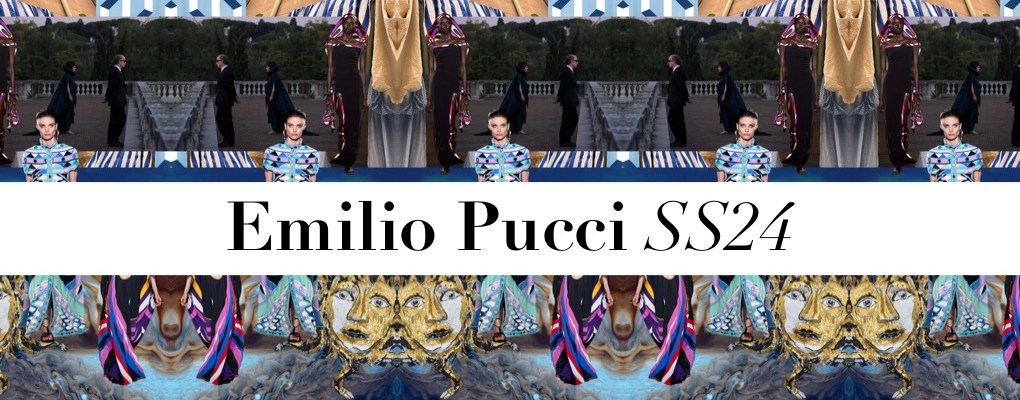
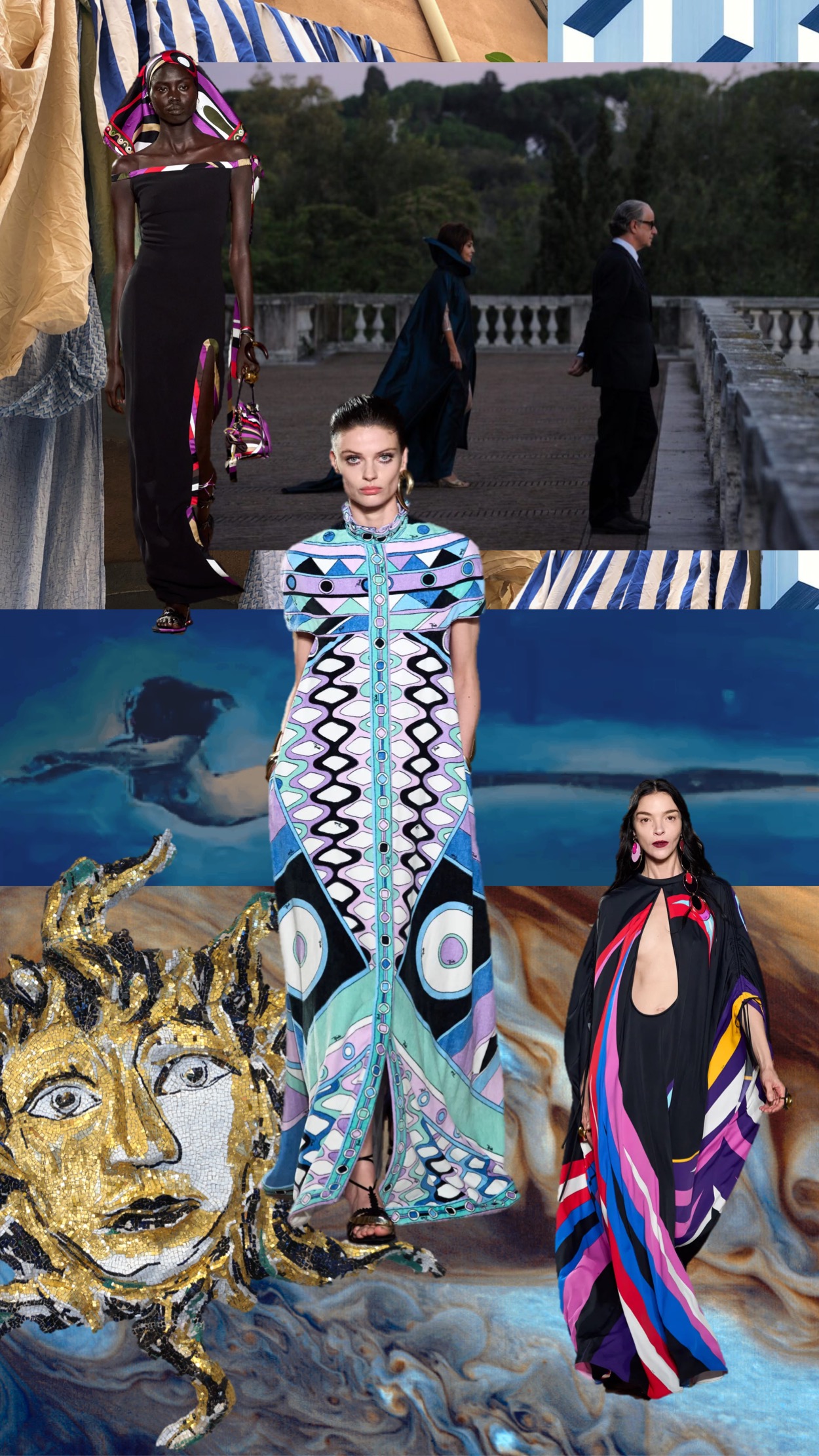
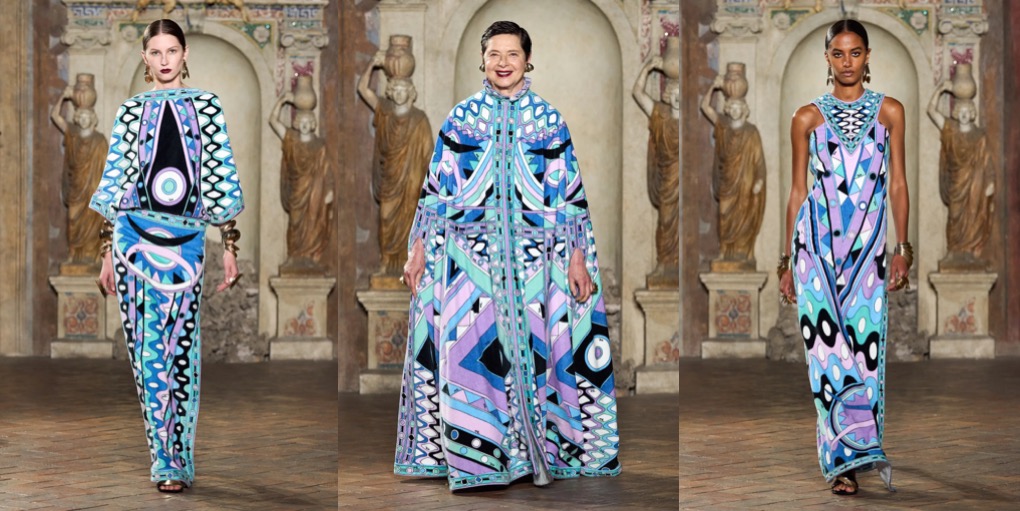
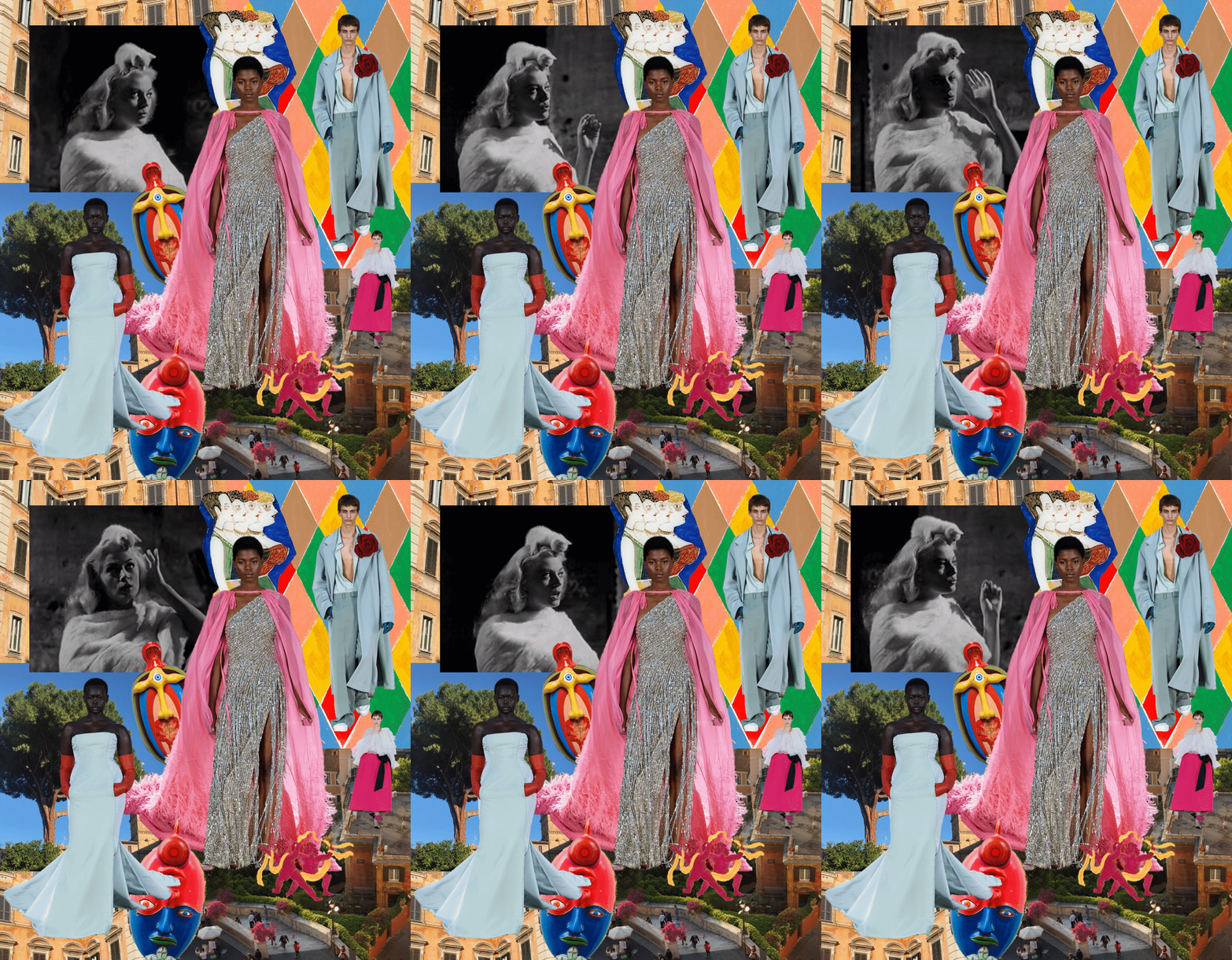
Camille Miceli delivered a bold and joyful Emilio Pucci moment: high-energy runway presentation held at Palazzo Altemps in Rome, opened with a stunning appearance by Christy Turlington and closed with the iconic Italian actress and model Isabella Rossellini. To the tune of Roisin Murphy’s covers of all-time Italian classics, the charismatic designer sent down a contemporary take on the psychedelic Pucci motif. No wonder why the collection was titled “Very Vivara” – after the iconic pattern which was created way back in 1965 and has the same vibrant resonance in 2024. Intertwining the characteristic sumptuousness and the emblematic lightness of the fashion house, shifting between organic and geometric shapes, Miceli offers a certain heartfelt glamour that doesn’t feel forced. Wearing a breezy Pucci caftan-dress, you’re a jet-set goddess, but one cherishing ease and comfort.
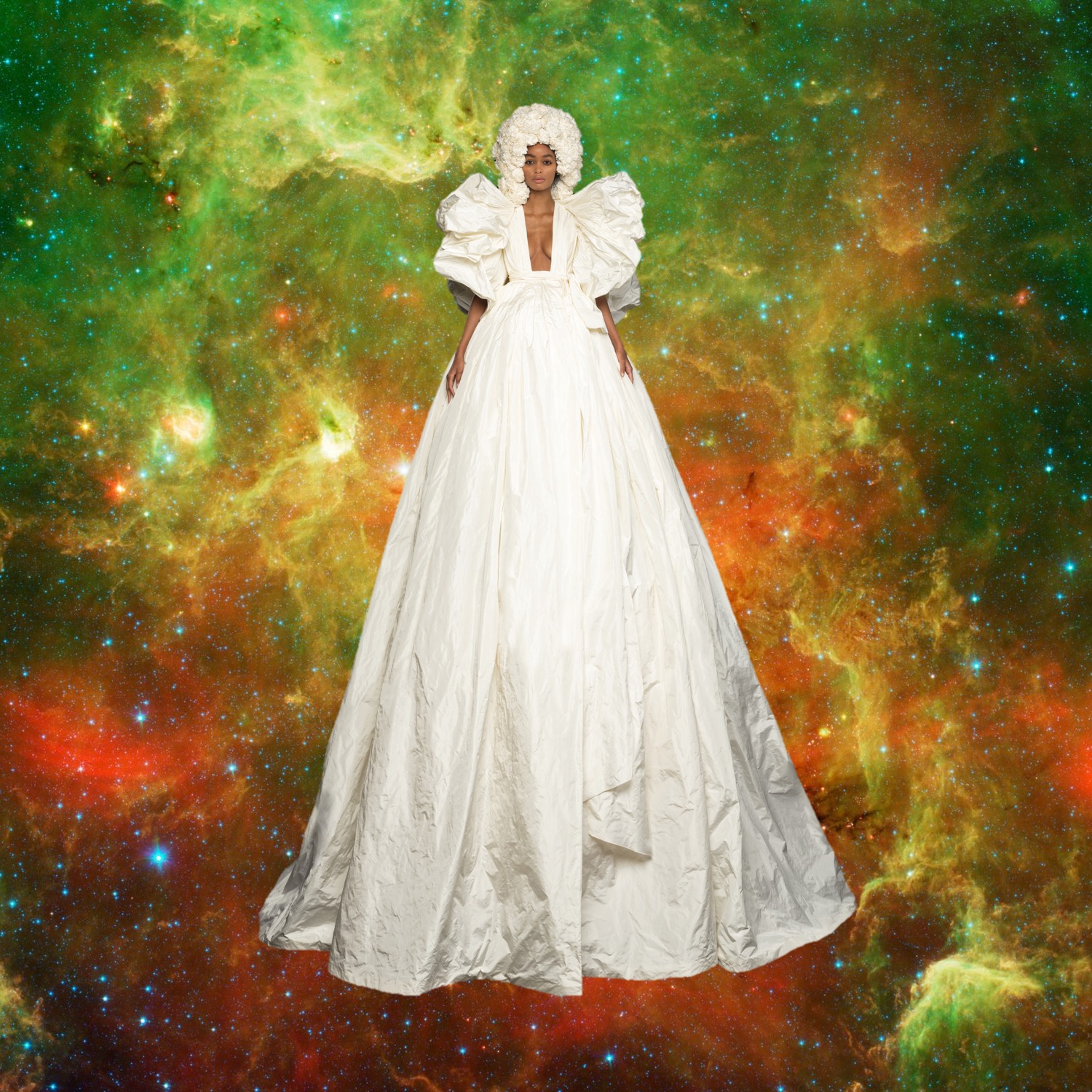
Collage by Edward Kanarecki. Don’t forget to follow Design & Culture by Ed on Instagram!
Hey, did you know about my newsletter – Ed’s Dispatch? Click here to subscribe!
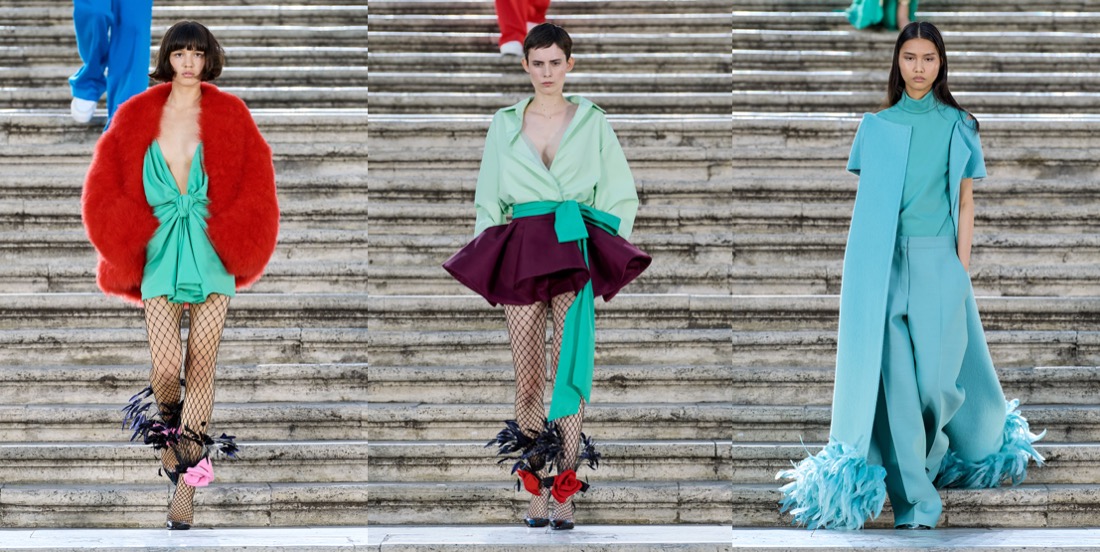
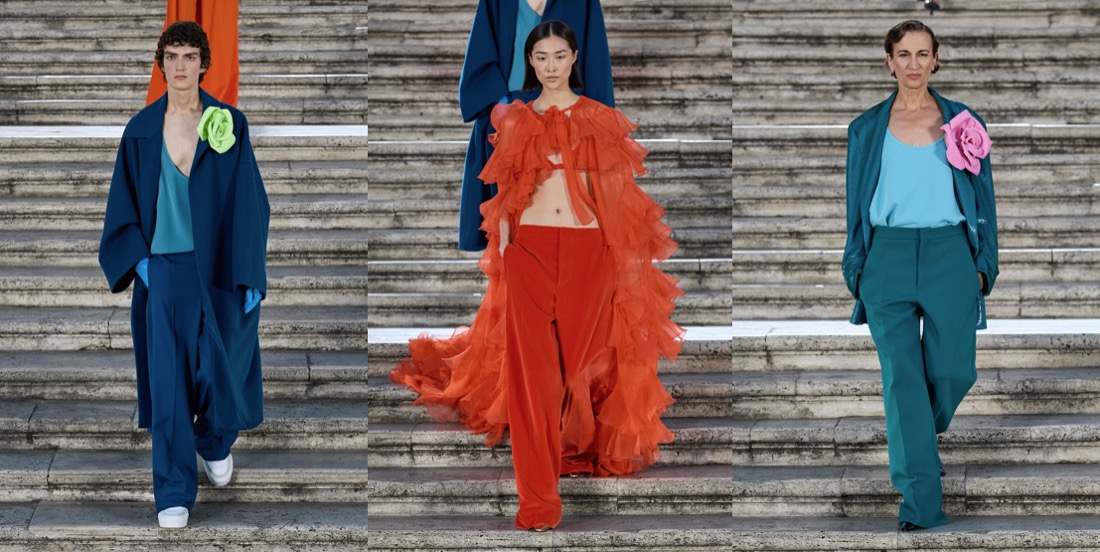
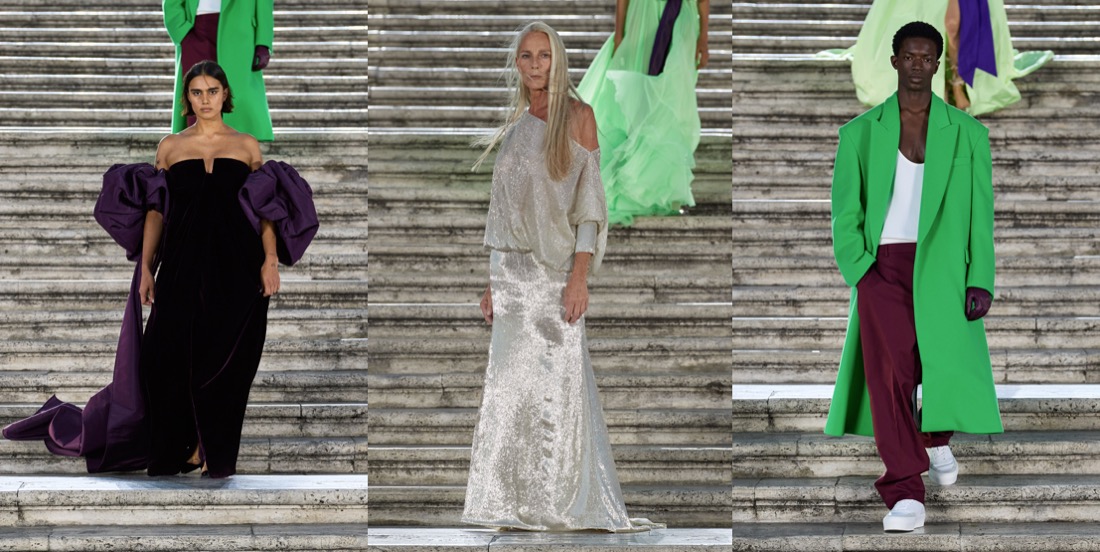
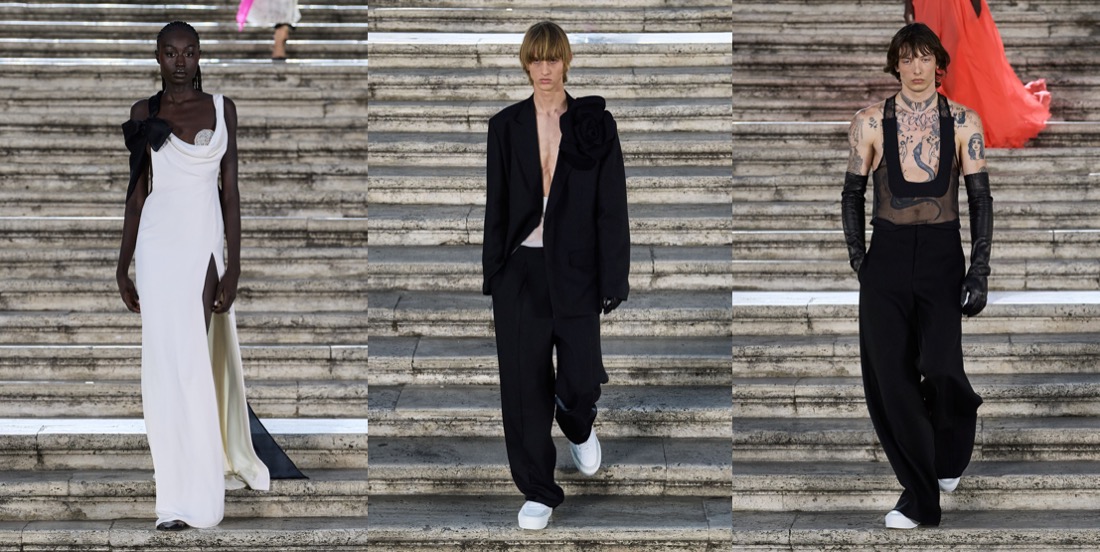
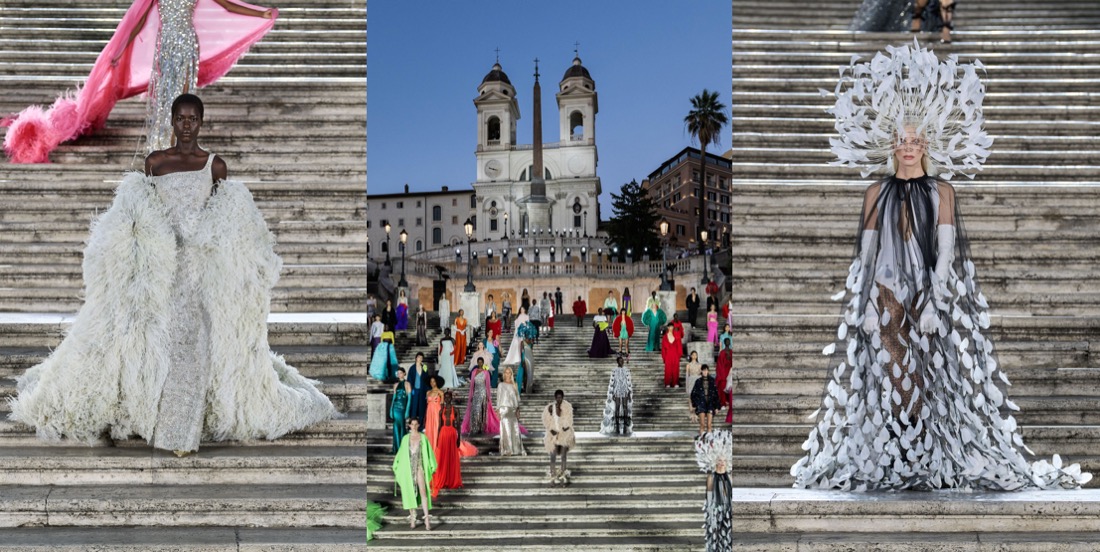
For Valentino’s spectacular autumn/winter 2022 haute couture show, creative director Pierpaolo Piccioli returned to Rome, where Valentino Garavani founded the storied maison back in 1959. Otherworldly bodies descending from the Spanish Steps in the golden evening sun, the romantic voice of Labrinth echoing from beneath the Trinità dei Monti… well, that was a scene. “I start from the finale, always,” Pierpaolo Piccioli said during a preview in Paris days before the show. “What I have in mind is these liquid, colourful drops coming down from the Steps, the volumes light and in movement.” He titled his show The Beginning: a return to the city where Valentino Garavani founded his maison, a place that has moved with the winds of change since the dawn of time. Like Piccioli’s Valentino, Rome’s codes may remain the same but its values are in eternal evolution. That was the sentiment behind a show he envisioned as “a conversation with Valentino” across the past, the present and the future. Piccioli had been dreaming of doing a show on the 18th-century steps. “It’s very personal. The last time Valentino did a show on the Spanish Steps was in the 1990s. It was a different moment in fashion. It was about lifestyle and the perfection of beauty, the glamour, the supermodels,” he reflected. “I wanted to get the spirit of Valentino – the joie de vivre – because I think it’s the only way of making beauty resilient to the time. On the other hand, there’s a picture I want to deliver, which is different from what it was 45 years ago. It’s the picture of what we live in. The Spanish Steps are the same, the atelier is the same, and in the end, clothes are clothes. I like to keep the rituals of haute couture. But the real difference is in the casting – in the humans – that can tell stories and witness a different moment in this world. I want to empower them and give them a voice and the opportunity to tell their own stories.”
Piccioli’s approach to the show manifested in a collection that didn’t just poeticise the decades-long legacy of Valentino Garavani, but his own contributions to the house. Rather than pursuing newness, he reflected on what Valentino stands for after 14 years under his own artistic directorship (and 23 years as an employee). Unless you’d spent those years under a rock, you’d immediately recognise the resplendent volumes of his dresses, suits and coats, the hypnotising hues of his gem colours, and the drama of his plumed headpieces bouncing like jellyfish in the stream of the Roman evening breeze. “I wanted to do a reflection about how much of myself is in Valentino, and how much of Valentino is in my identity,” he said. “It’s everything I’ve already done but in a different place.” Piccioli’s era at Valentino has followed a time of political divide when the progressive values he fights for – the diversity, inclusivity and self-expression represented in his casting – are contrasted by a rise of reactionary ideas that has only become terrifyingly evident with recent American Supreme Court rulings. In that sense, moments like the Spanish Steps show – these grand gestures of beauty – are a kind of activism on his part. It may be wrapped in majestically coloured taffeta, three-dimensional geometric plumage painstakingly made to evoke Roman mosaics, or voluminous hand-sequined suits, but at the core of Piccioli’s haute couture is a dream that cuts deeper than mind-blowing craftsmanship. “I believe that it’s my responsibility as a fashion designer to bear witness to the times we’re living in,” he said. “I think that beauty has the power to break through, touch people and their conscience. Taking a radical posture through a strong narration and through images of a world that’s changing has an impact, and gives visibility to values that have to be protected. I believe fashion can be political.” With the likes of Naomi Campbell and Anne Hathaway on the front row the show was testament to the global impact of the new age of haute couture that Piccioli has spearheaded in recent years. But as illustrated by the people who joined them – Valentino’s co-founder Giancarlo Giammetti, Piccioli’s family, and their dog Miranda – it’s a success achieved through a grounded approach to the industry, to the mainstream fame he has gained, and everything that comes with it. At the heart of Piccioli’s progression-driven age of Valentino are a realness, friendliness and ease that remain his greatest assets.
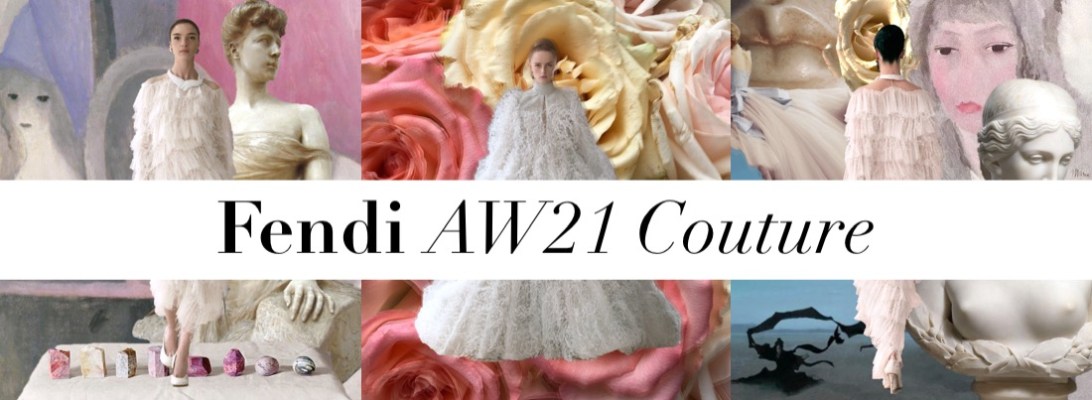
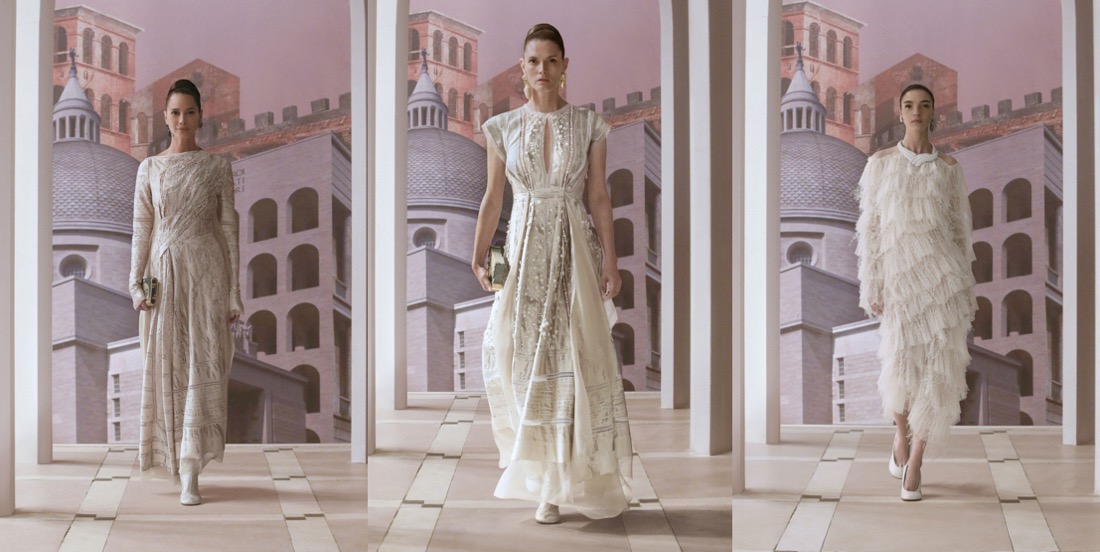
Kim Jones‘ second haute couture collection for Fendi was captured in an emotive film, which saw the likes of Kate Moss, Christy Turlington, Malgosia Bela and Amber Valletta gaze enigmatically into the camera as they wafted around a Roman theater set in dresses evocative of the stone and statues of the Eternal City. It was shot by Luca Guadagnino and scored by Max Richter. In the age of social media when big, beautiful dresses go viral, the direction Jones is setting for Fendi epitomizes a popular understanding of haute couture as something the eye can easily identify: bold ballroom silhouettes, sumptuous surface decoration and (very) famous faces. “It’s being optimistic about being able to socialize properly. I thought it was a nice moment to say that,” he said. Couture clients, Jones pointed out, “go to Fendi for something extravagant.” Two seasons into his tenure, his couture expression is manifesting itself in decoration and fabrication above all. His glamorous evening dresses serve as canvases for this finery, like the mother-of-pearl embellishment and recycled fur mosaic work that graced this collection. Watching it unfold, it feels like a formative process, as if all that intarsia and all those embroideries have been locked inside him for so long, waiting for the day when they could burst out into bona fide couture. Comparing to his heavy, over-worked January show, this one radiates with lightness and elegance that isn’t forced. To me, it felt like the mesmerising ambience of Rome. The film was inspired by Pasolini’s neorealistic Roman cinema, every architectural era of the city visible on its mock horizon. The fabrics and textures were informed by the buildings and pavements of Rome, some employed in statuesque lines that underscored the theme. Jones’s evolving exercise in the decorative aspects of haute couture made for eye-catching effects like the allover petal work of Moss’s oversized dress, or the marbling of Valletta’s swathing gown. Most compelling were the silhouettes that really took form, like the hypnotizing construction of a mosaic bolero jacket that resculpted the body through the volume-specific grammar of haute couture, or the dress worn by Mica Argañaraz, which demonstrated a similar idea in flou. “We had a lot more time to work on this one. We’ve actually had a full season. So, it’s a lot more worked into, and I think people will see a lot of difference in it. The people here, when they see what we’ve been doing, they can’t believe it’s the second one I’ve done. They say it’s a lifetime’s worth of understanding,” Jones concluded.
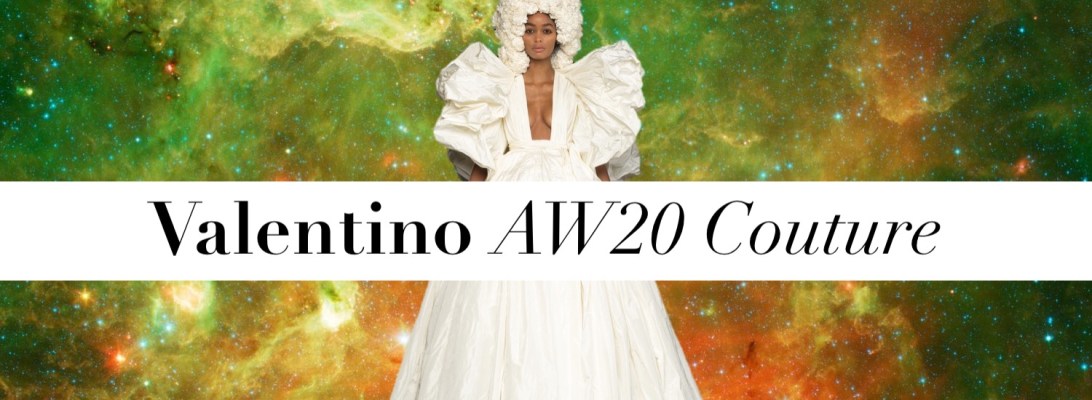
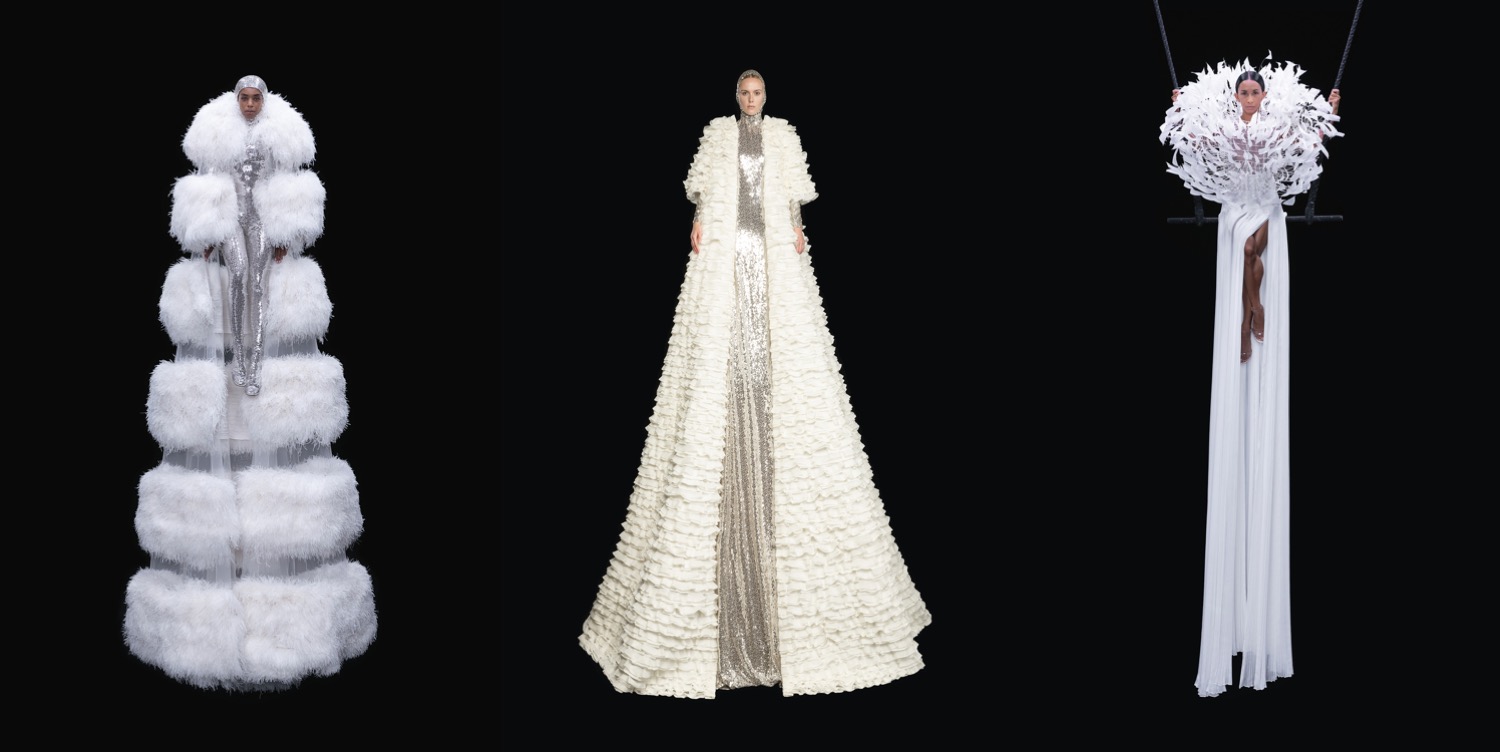
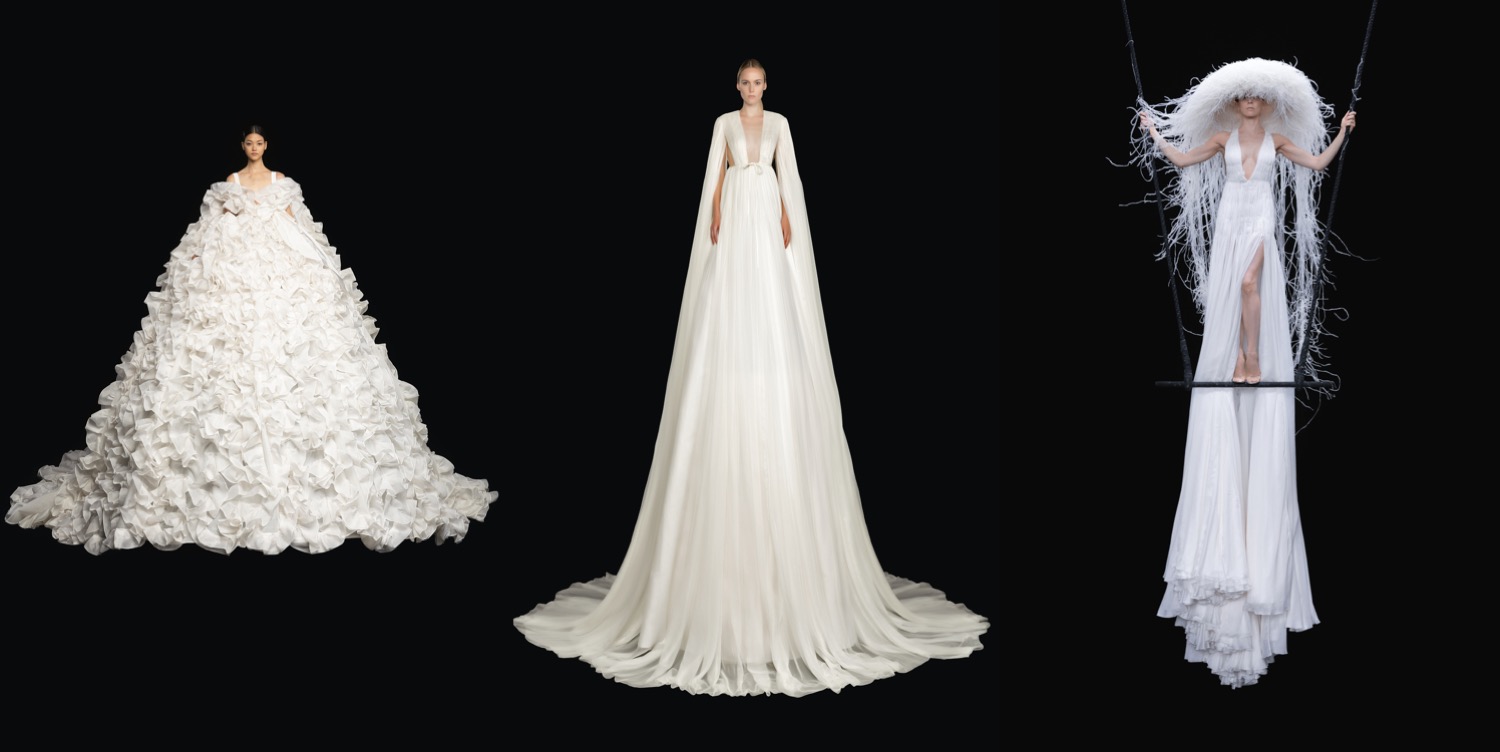
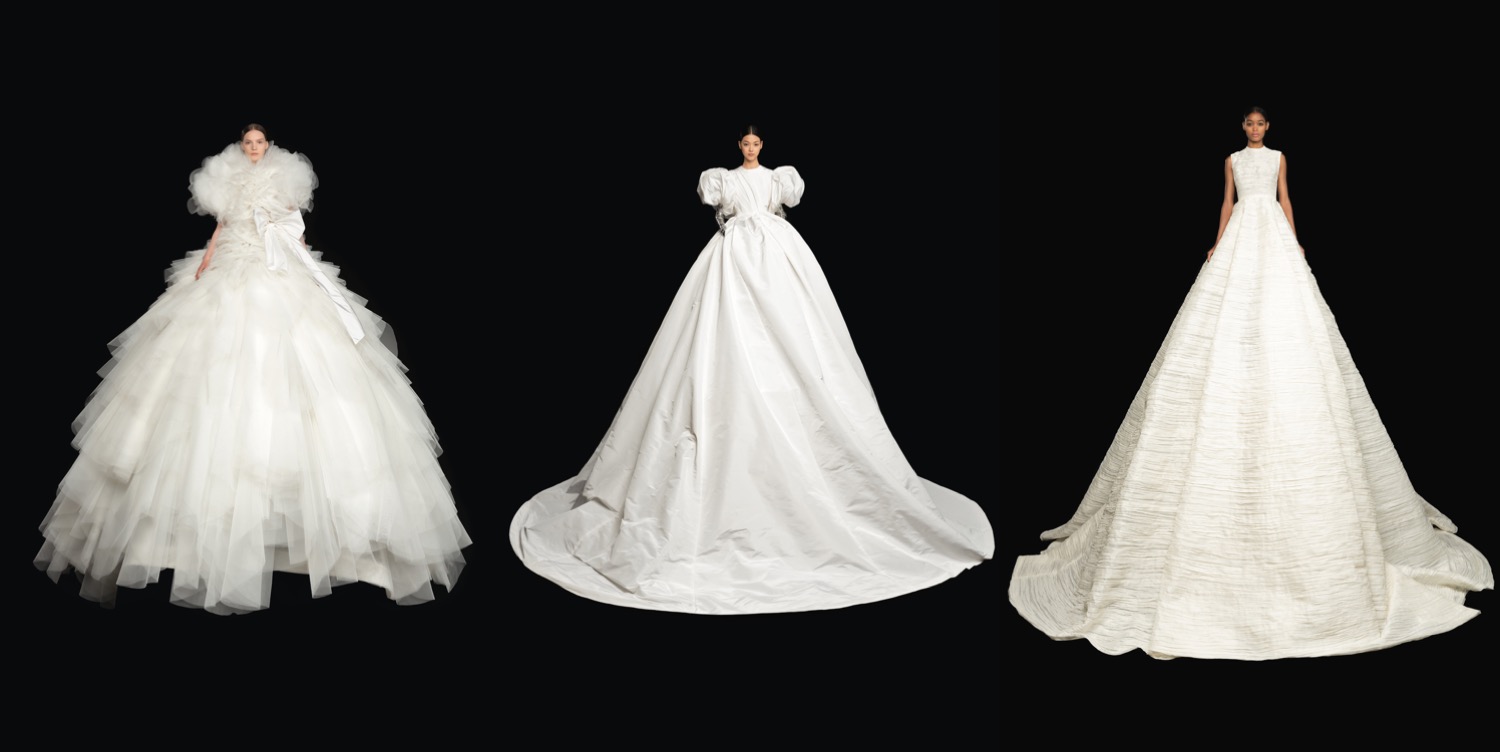
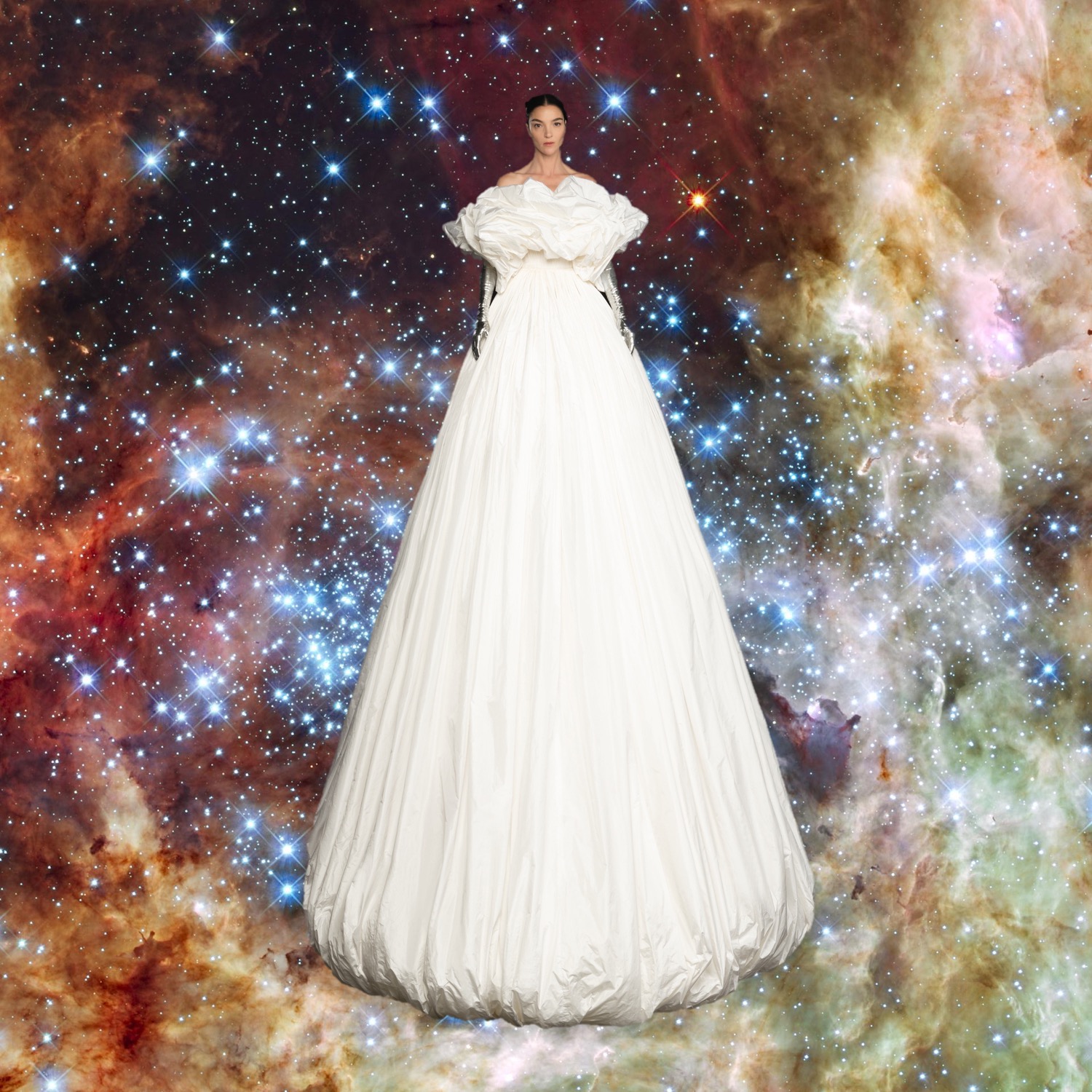
And again, Valentino‘s Pierpaolo Piccioli is the king of haute couture, even after months of confinement that could basically cancel the entire season. Entitled “The Performance: of Grace and Light, a dialogue between Pierpaolo Piccioli and Nick Knight,” the presentation played as a hybrid digital / physical event staged in a darkened void on the famed Cinecitta movie lot in Rome for local press and friends of the house. In a Zoom press conference, Piccioli explained he’d conceptualized the 16-look collection as “an extreme response” to the tough circumstances of lockdown; a determination to overcome the technical problems of socially-distanced working in the Valentino atelier and the impossibility of creating prints and lavish embroideries. “I didn’t want to feel the limitations. Couture is made for emotions, dreams,” he said. “It was super-emotional for us all to be here together to win this challenge. A moment I will never forget.” First came a pre-recorded screening of an artily glitchy video by Knight, in which projections of flowers and feathers played over meters-long dresses worn by women who appeared to hover in an aerial circus scenario. Cut to real time: curtains drew back to reveal the models, standing perched on ladders in a static tableau, their dresses – some of Pierpaolo’s biggest couture hits, elongated to the extremes, and revealed to be all-white – cascading to the floor, videoed live. INCREDIBLE. The idea of taking the show to Cinecitta, Rome’s “factory of dreams,” led the designer to add the concept of “the magic of early cinema,” evoking the silent movie imagery of with silver sequins and waterfalls of glittering fringe. To make it even more ethereal, Piccioli commissioned recordings from FKA twigs – her extraordinary voice soared poignantly as the models swung from trapezes and floated through Knight’s digital performance. Fashion communication on multi-platform formats has taken surreal twists and turns as designers have tried to conquer the dreadful problems of the pandemic. In Piccioli’s case, the surrealism was right there, embodied in the theatrical form of some of the most gorgeous dresses the world has ever seen.
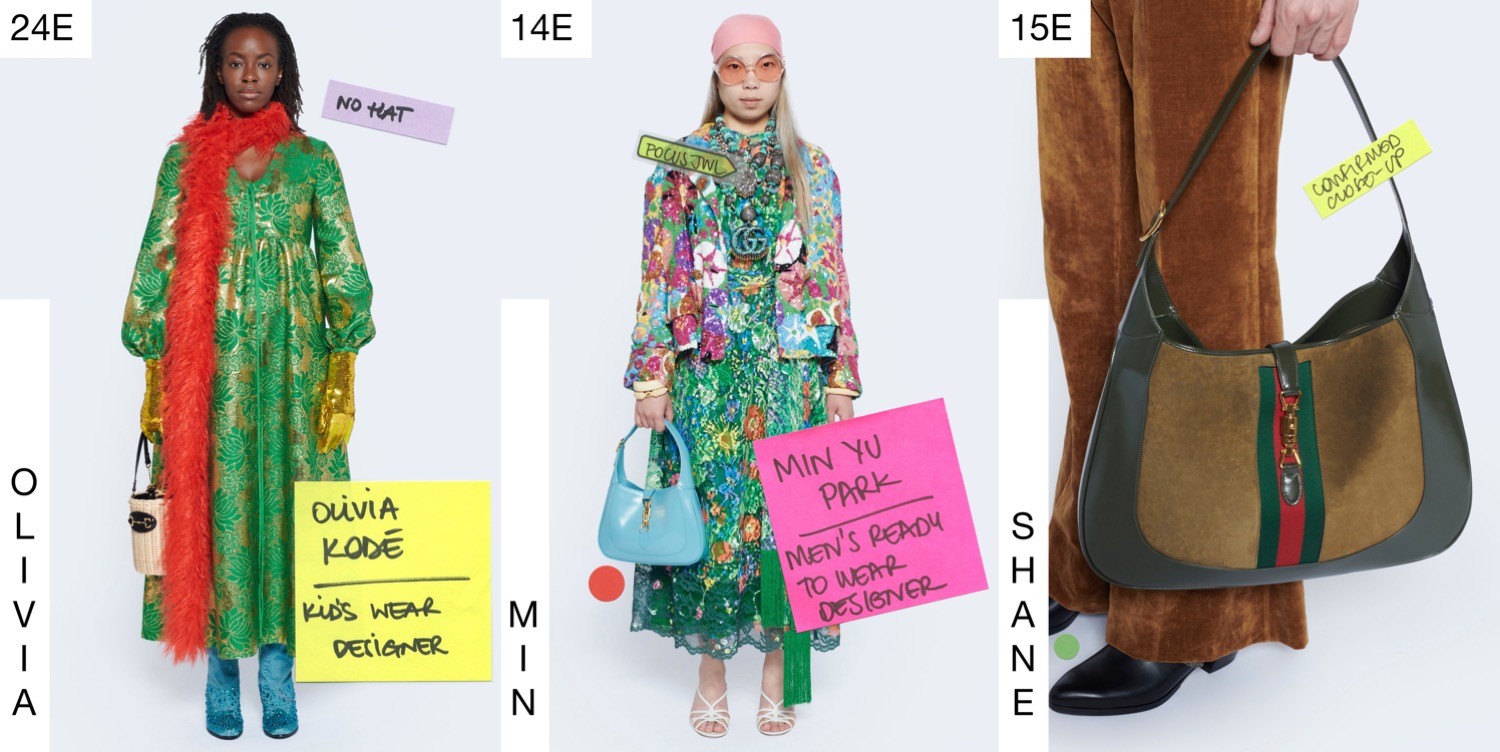
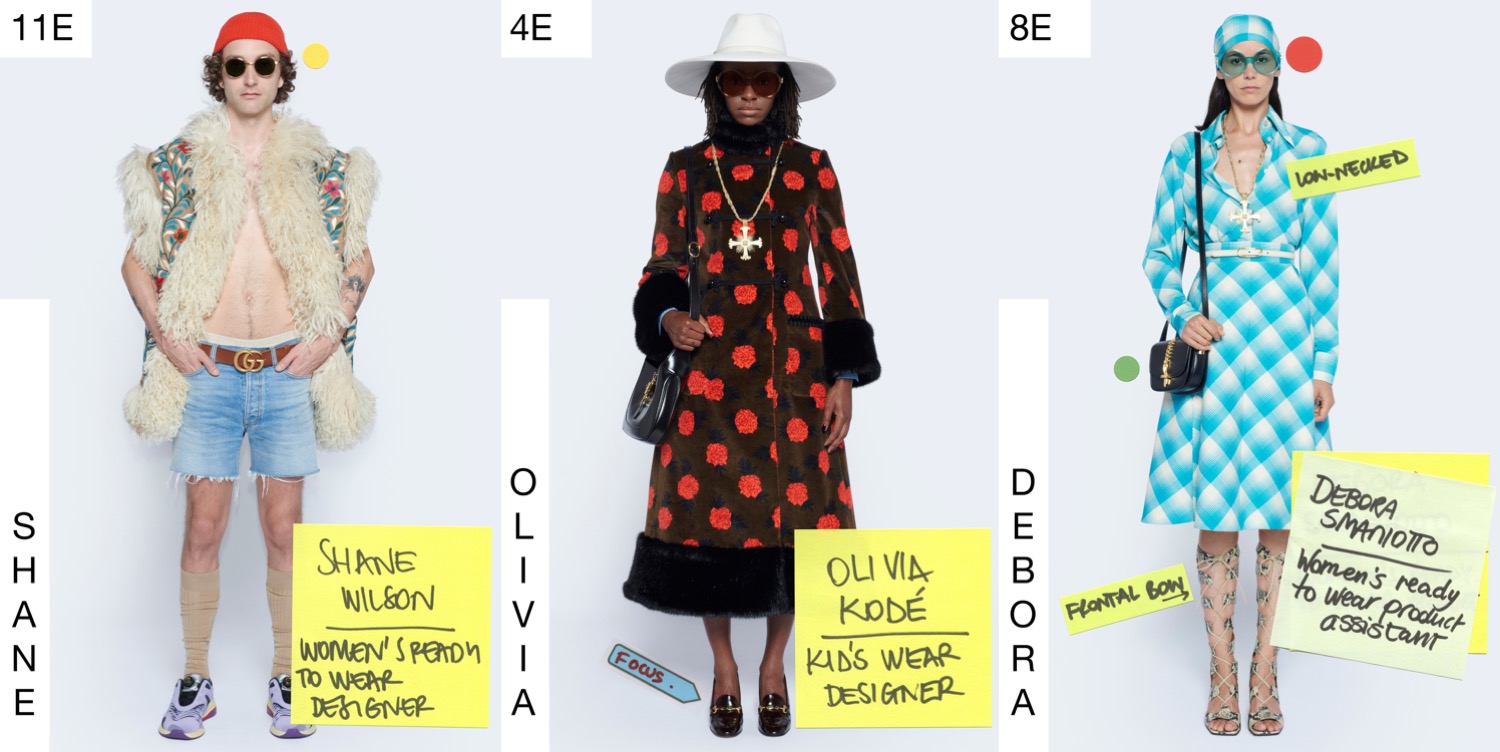
Last February, days before the coronavirus crisis broke out near Milan, Alessandro Michele staged a Guccishow in the round that was spectacular and intimate at once. In retrospect, it looks rather prescient: in inviting the audience behind the scenes and exposing the backstage goings-on of the hair and makeup crews and model dressers Michele was celebrating the very things that we’re all missing so badly in COVID-19-time: human interaction, collaboration, being part of a receptive audience. “Fashion is not just what we decide to show,” Michele said on a WhatsApp video call earlier this week. “The idea that a campaign is just a piece of paper? No, there is another show in the show.” The concept for the 12-hour livestream the brand produced for resort 2021, which the designer named “Epilogue,” and staged at the glorious Renaissance-era Palazzo Sacchetti in Rome with a natural soundtrack of cicadas, is to document the advertising campaign, to capture that “show within the show.” Only this time, Michele explained, “it’s less theater. This one will be more dirty. It’s a few cameras in a very Andy Warhol way, maybe they’re looking at nothing interesting. The experiment doesn’t work if I plan too much.” The Gucci designers working in his studio modelled the resort looks they worked on. On the WhatsApp call, he remembered a time as a young designer when a piece he was making was pulled for a show or a shoot and he didn’t see it again. “It was like someone tried to take from you your son.” Spotlighting his colleagues was “something beautiful,” he said, “they were so happy.” As for the clothes themselves, Michele called them “a celebration of my point of view, things that I did in the past, pieces that belong to my aesthetic.” That aesthetic is as singular and idiosyncratic as ever. Min Yu Park, a men’s ready-to-wear designer wears a beaded floral jacket, a floral lace dress, and a turquoise necklace that matches her Jackie bag. Alexandra Muller, an embroidery designer, models a long filmy floral-print ruffled dress with clear sequins that pick up the light. David Ring, a celebrities designer, sports an embroidered velvet blazer, a striped tee, logo flares, and sneakers. Just taking a glace at the clothes tells you right away: Gucci. Back in May Michele announced Gucci’s reduced show schedule. This may be the brand’s last resort collection, but the name “Epilogue” might be a misnomer. The learnings of lockdown – the importance of his team, the value of feeling – will stick with him, he thinks. “It’s not just a way to close, but to say what we’ve done and put seeds of what will be in the next chapter. Yes, it could also be a beginning.”





















 Design & Culture by Ed