Characters. JW Anderson AW22

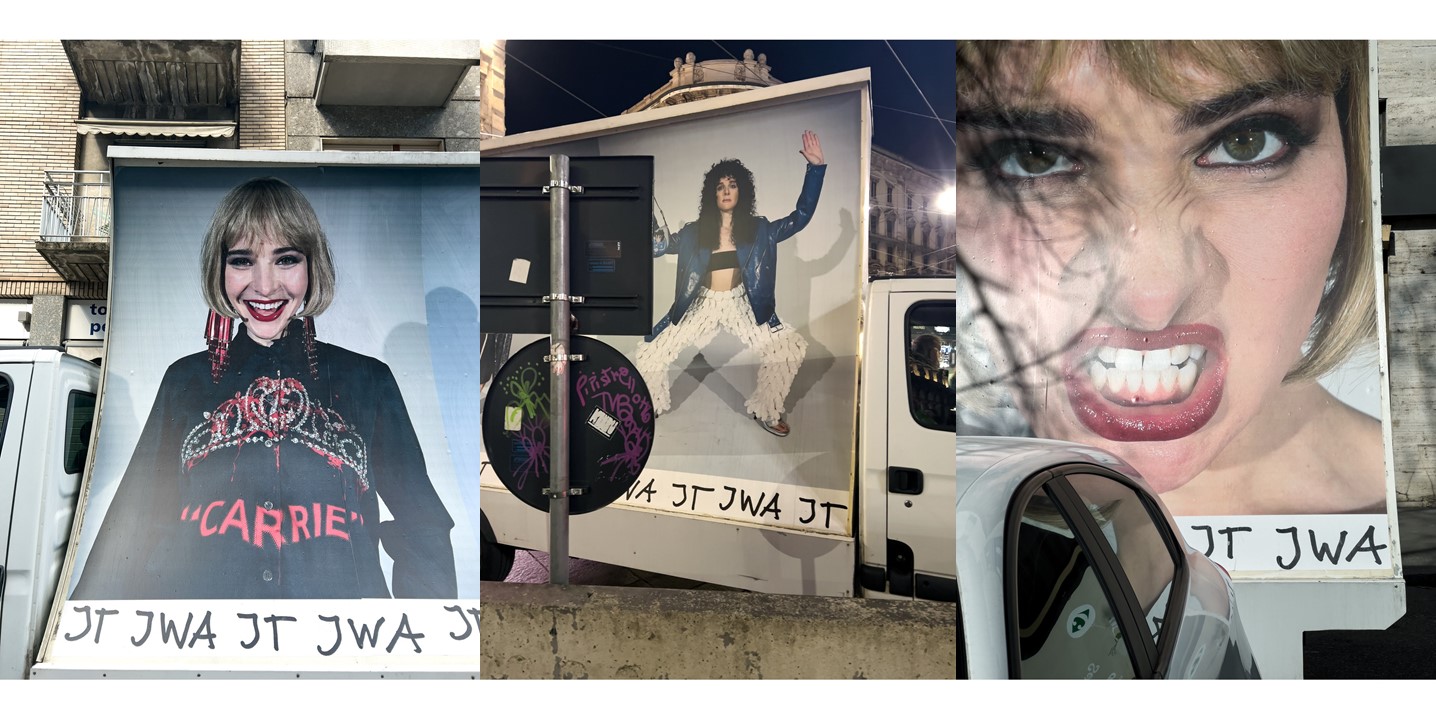
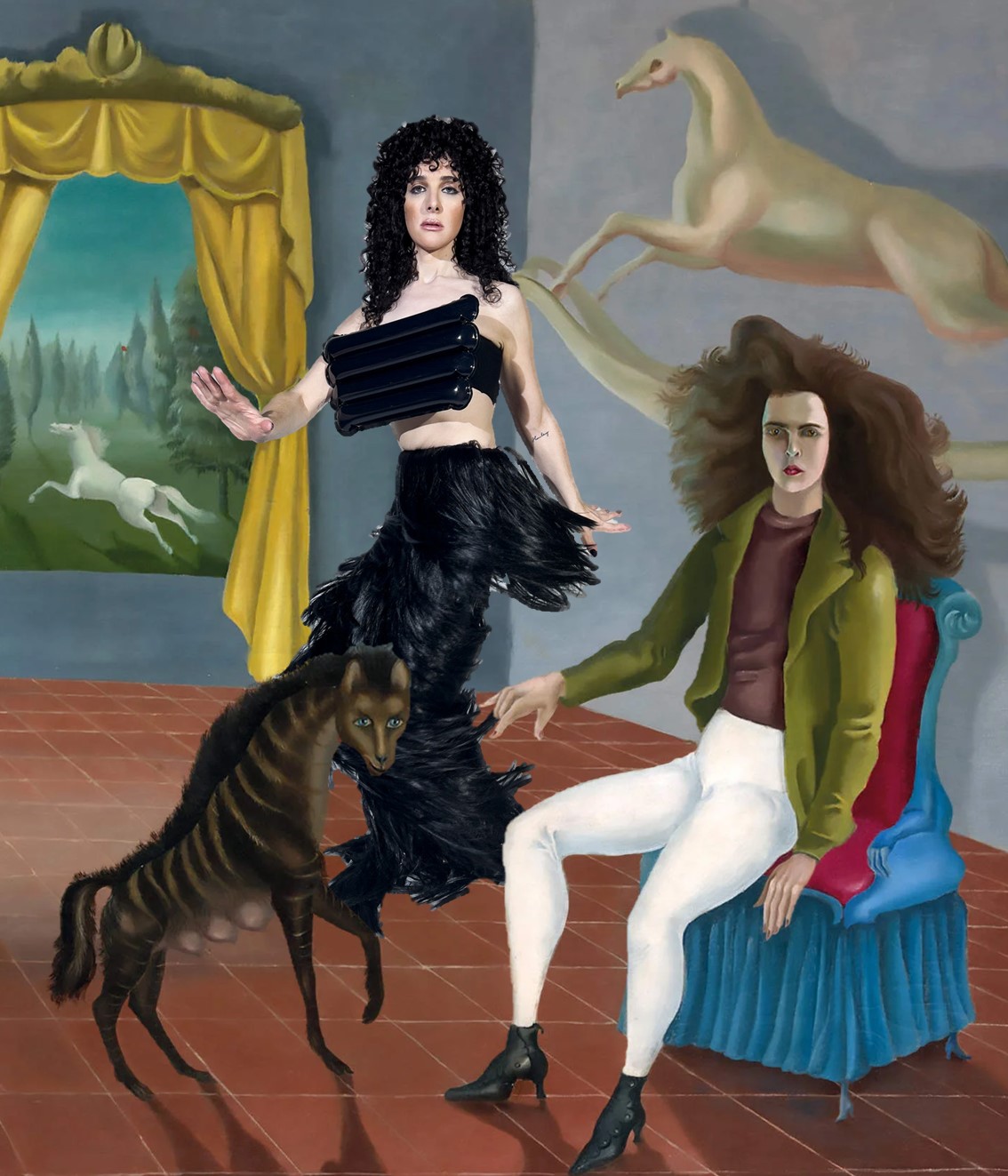
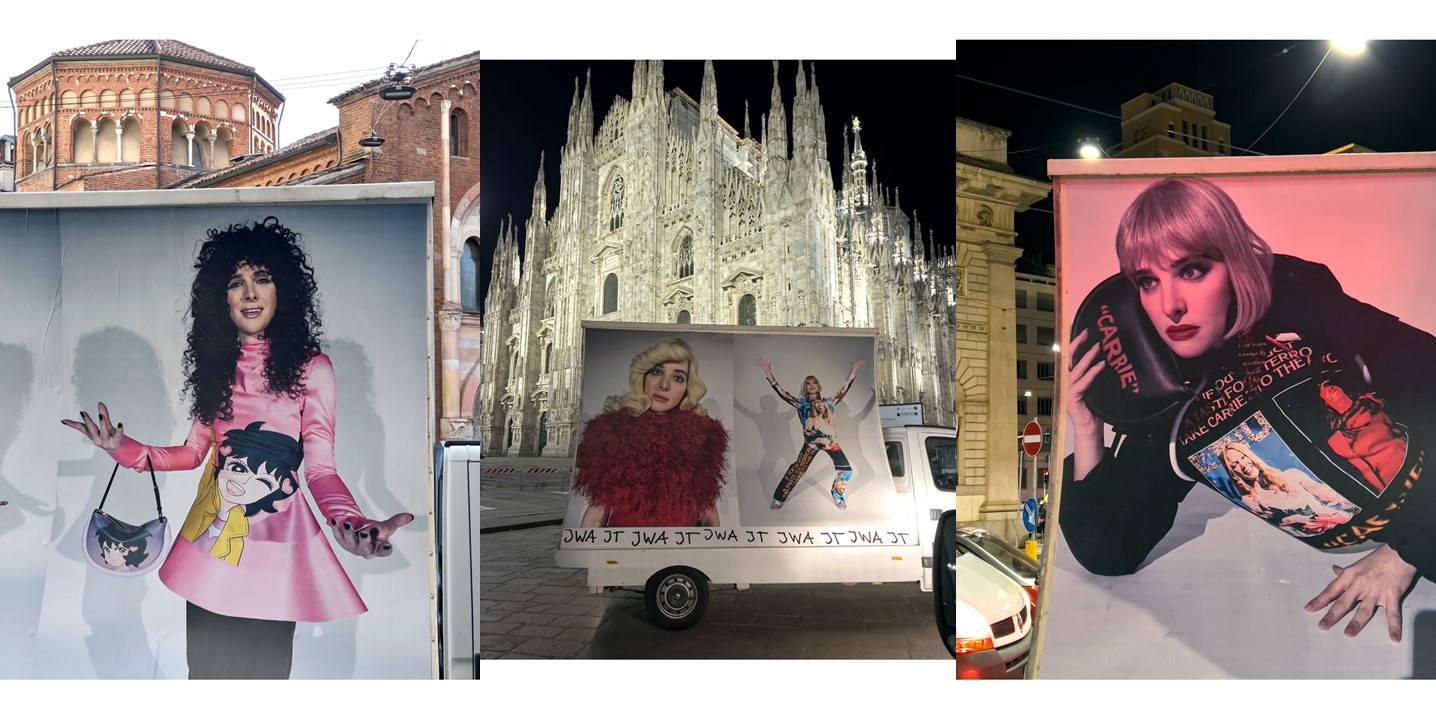
Jonathan Anderson left London and showed in Milan this season… to some extent. In the latest in his series of ingenious pandemic alternatives to putting models on a runway, he made a surprise intervention in public. “We have dozens of trucks with billboards of the collection images circulating Milan all day. Juergen Teller is out photographing them with people at gas stations and other stops. Content becomes content. Image becomes pictures of pictures. Fashion becomes part of the landscape”, the designer explained. As a device for creating a widely seen, soon to be endlessly Instagram-replicated public spectacle, it’s just the latest of JW Anderson’s super-smart manipulations of media – right in the middle of the Italian city where the institution of the fashion billboard has been part of the competitive pride of fashion week for years. And this, simply with one photographer and one model, his friend Hari Nef impersonating four pop-cultural ‘characters’ in a Cindy Sherman-esque, and a fleet of truckers. “We don’t have thematics any more. We’re doing bite-sized, light-hearted things like this,” Anderson said. “We have a young demographic, and we’re a small contemporary brand. With all the multiple issues we’re facing – going from one crisis to another crisis – there has to be learning from that. New types and ways of doing things.” Since the pandemic hit Anderson has been acing communication by playing with printed matter in delightful ways. He’s also re-focused his own-brand strategy on “two main seasons, and two experimental ones. So this is one of those experiments.”

Rolled out (literally) around Milan were pictures designed simultaneously to provoke lots of fun and push Gen-Z memory-buttons. “We’re playing with this media paradox in pop culture where there’s this constant going to the past, and bringing it forward. So things are just as valid as they were, but in a different context.” One set is around the movie posters for Carrie – original graphics from Sissy Spacek’s classic 1976 horror role as the awkward teenager who turns out to have gory telekinetic powers of revenge at the school prom. No random choice, that: “I feel like that movie is such an influence on teen TV series being made now,” Anderson acutely observed. Apart from the obvious T-shirt, sweatpant, and pajama-set graphics, there’s a one-shouldered silver silk satin prom dress. Quite ingeniously, it’s photo-printed all around the hem with “hyper realistic” balloons from Carrie’s own prom.
Collage by Edward Kanarecki.

Men’s – New Surrealism. Loewe AW22

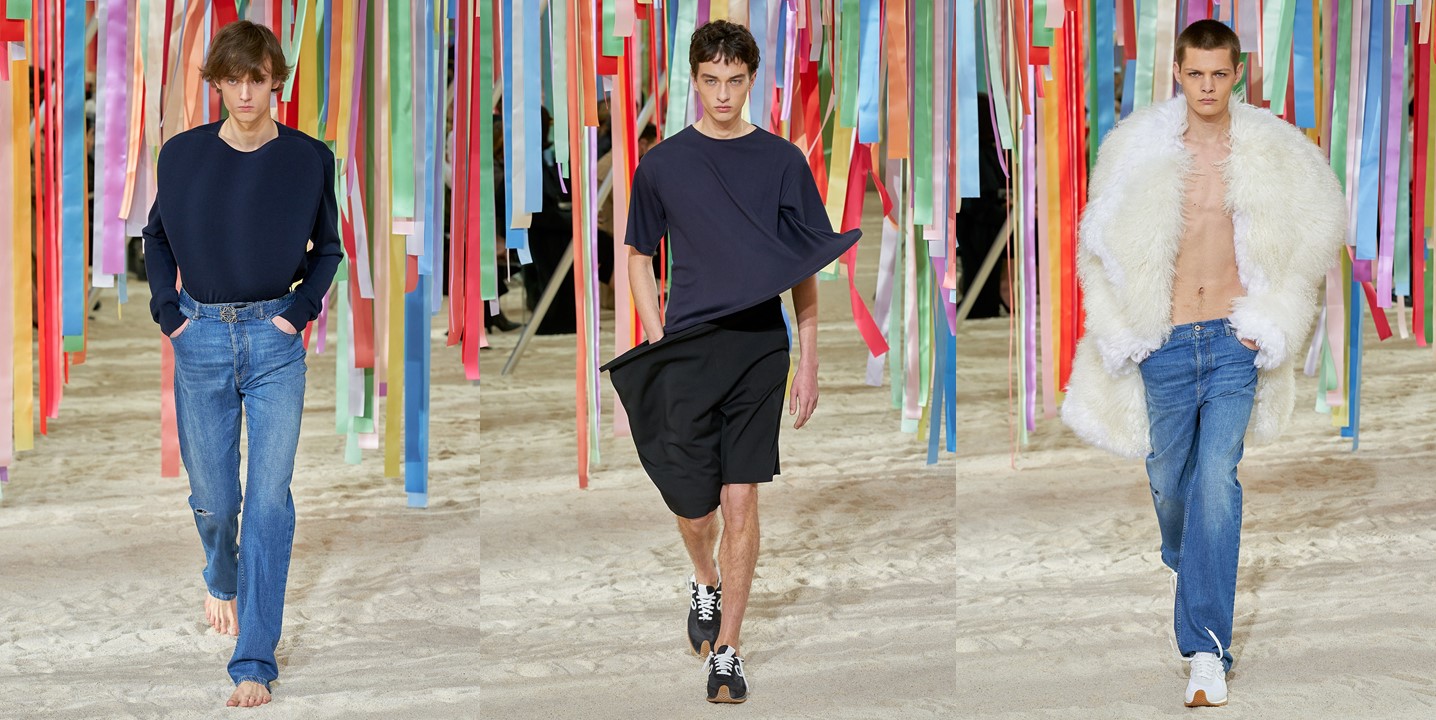
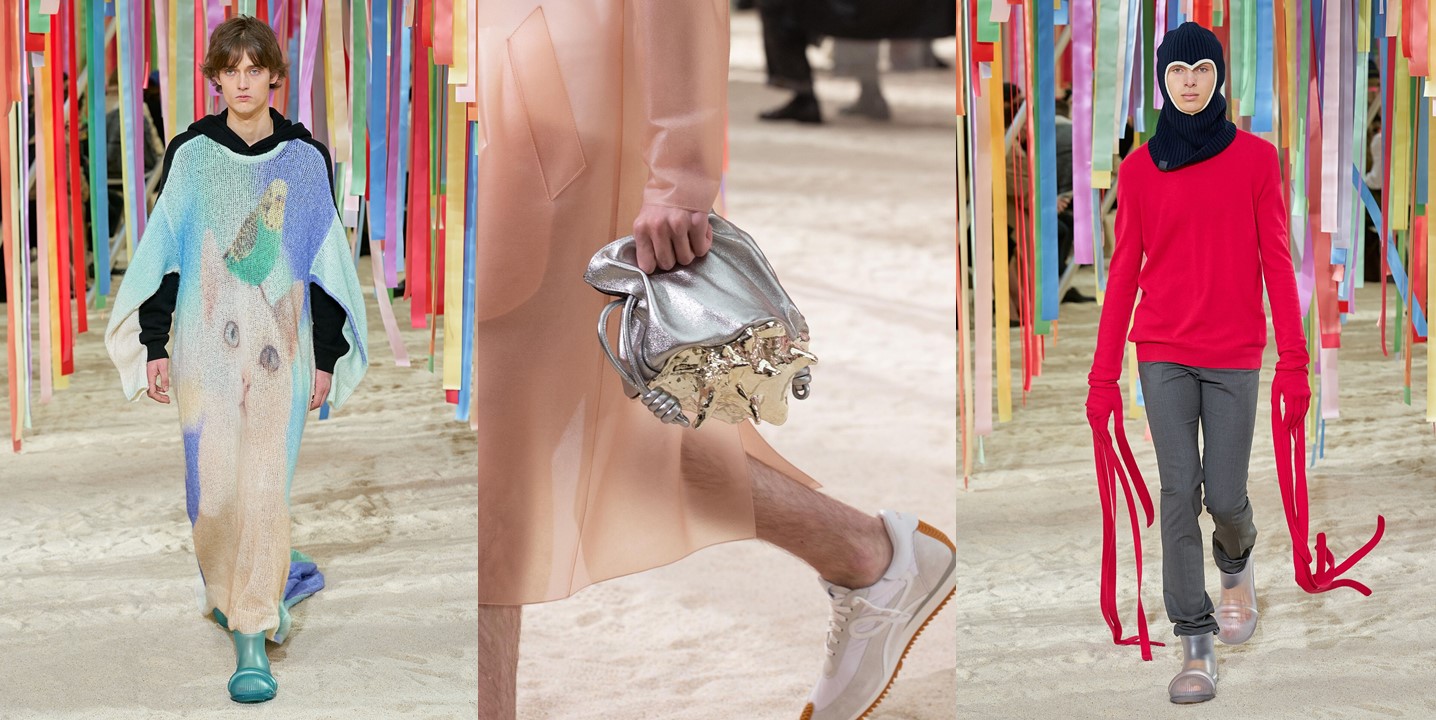
When Jonathan Anderson referenced “metaverse” in his J.W. Anderson collection last week, he said, “I was using it more in an ironic way. The idea that it doesn’t really do anything.” For all its brilliant and hilarious techy surrealism, his Loewe collection was not a wardrobe for the metaverse. In fact, it felt a lot like it was trolling the very idea of our digital lives lived on phones, and the hoopla whipped up around trendy concepts like the metaverse. If our attraction to VR and AR and whatnot is founded in the idea of possibility, Anderson’s collection was a twisted take on how these imaginings translate into real life. He illustrated it in decidedly normal things made abnormal. Shorts were embellished with sparkles that looked like raindrops, as if it had rained crystals. A wool coat had a gilded stain on its lower back “as if you sat on a park bench and it was gold.” Coats and tops were punched with big bathroom eyelets like you’d digitally dragged your most mundane morning surroundings into your wardrobe. Shoes looked like bags, and transparent coats were actually made of leather. Meanwhile, a series of garments satirized our relationship with technology. The sleeves and lapels of a furry coat had fiber optic lights inside them creating the illusion of wetness, the illuminated waistband of trousers made them seem like they were floating, and the entire frame of a coat was lit up. “It’s the idea that you become backlit because everything on a phone is backlit,” Anderson said, referring to the way we see things on our phones and the way our screens light up our faces. Balaclavas with heart-shaped peepholes played on the idea of digital frames. Similarly, the orbital hem of a shirt and the waistband of shorts were bent in separate directions so it looked like you’d skewed them in FaceTune. It evoked the DIY editing accidents you sometimes spot in people’s selfies where the person looks like a supermodel while the retouching process has turned the background into an abstract painting. We all follow someone like that. And those t-shirts and jumpsuits with faces and bodies printed on them like optical illusions? They were worn by the models who posed for them, distorting and reshaping their physiques the way we do it on those beautifying apps.

Anderson’s collection was an exercise in the surreal, but a post-digital era take on the genre, which he said was more “psychotic” in an existential way. “Who are we? Where are we going? Is it real, is it not real? Are we in that moment? Do we believe what we say?” In a world where we’re more fascinated with creating a metaverse than improving the real one, those were good questions.

Collage by Edward Kanarecki.

Men’s – Embrace The Weirdness. JW Anderson AW22

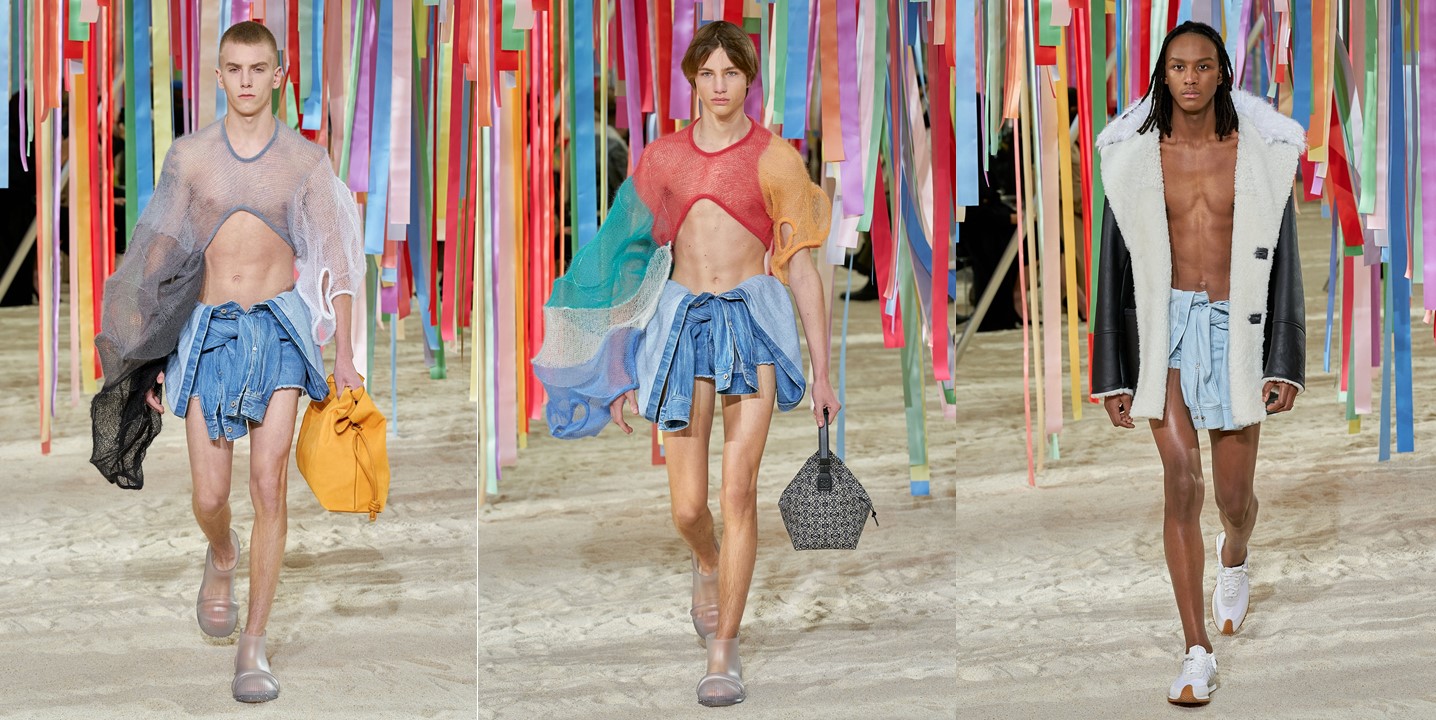
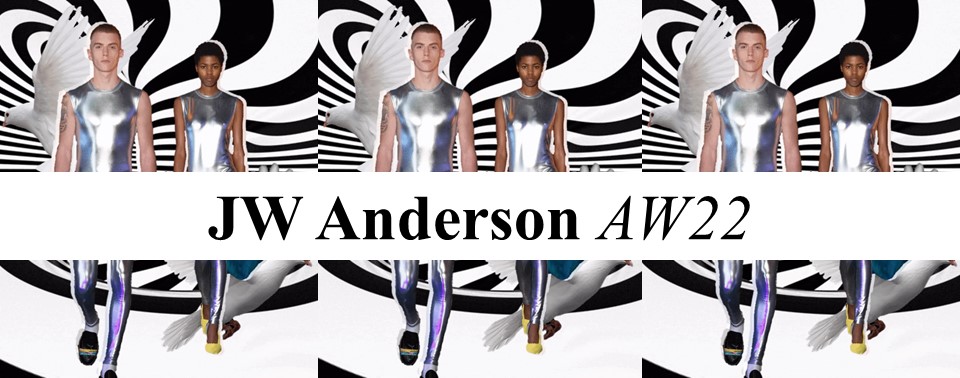
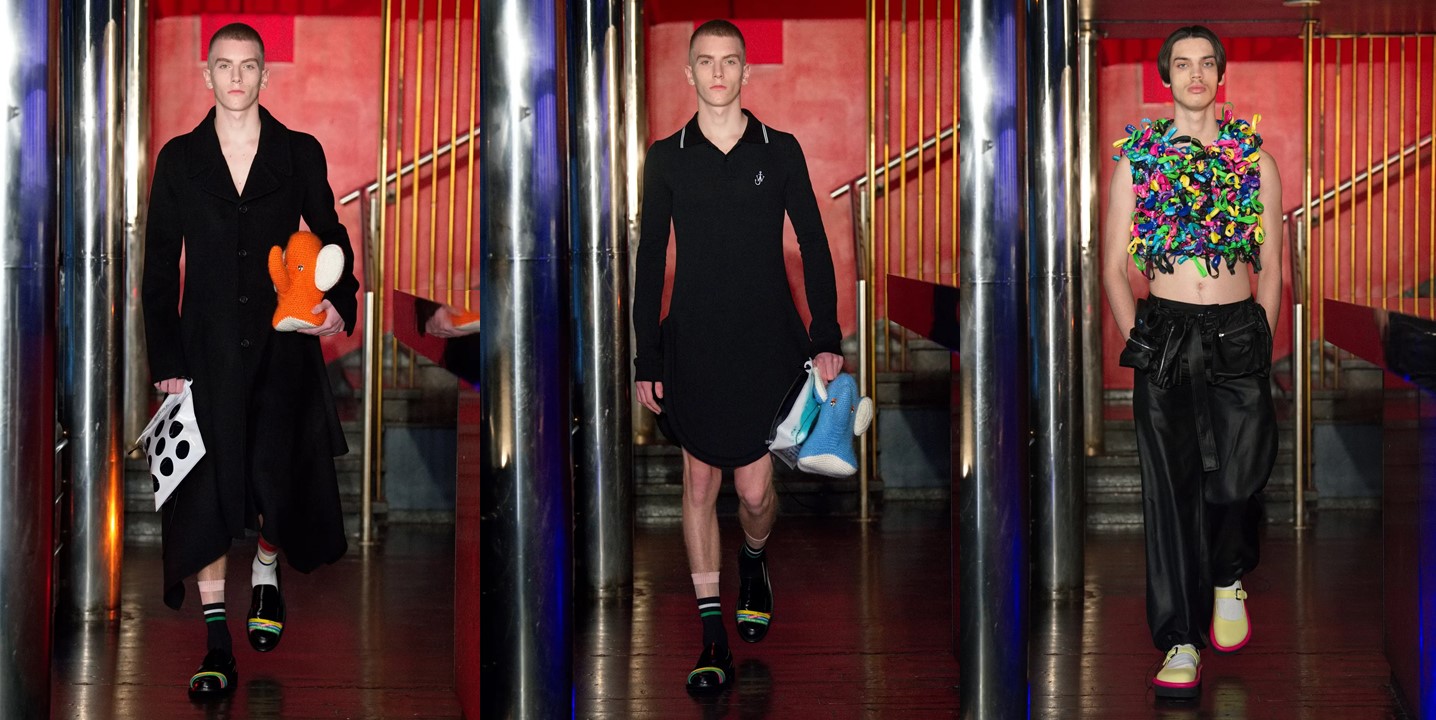
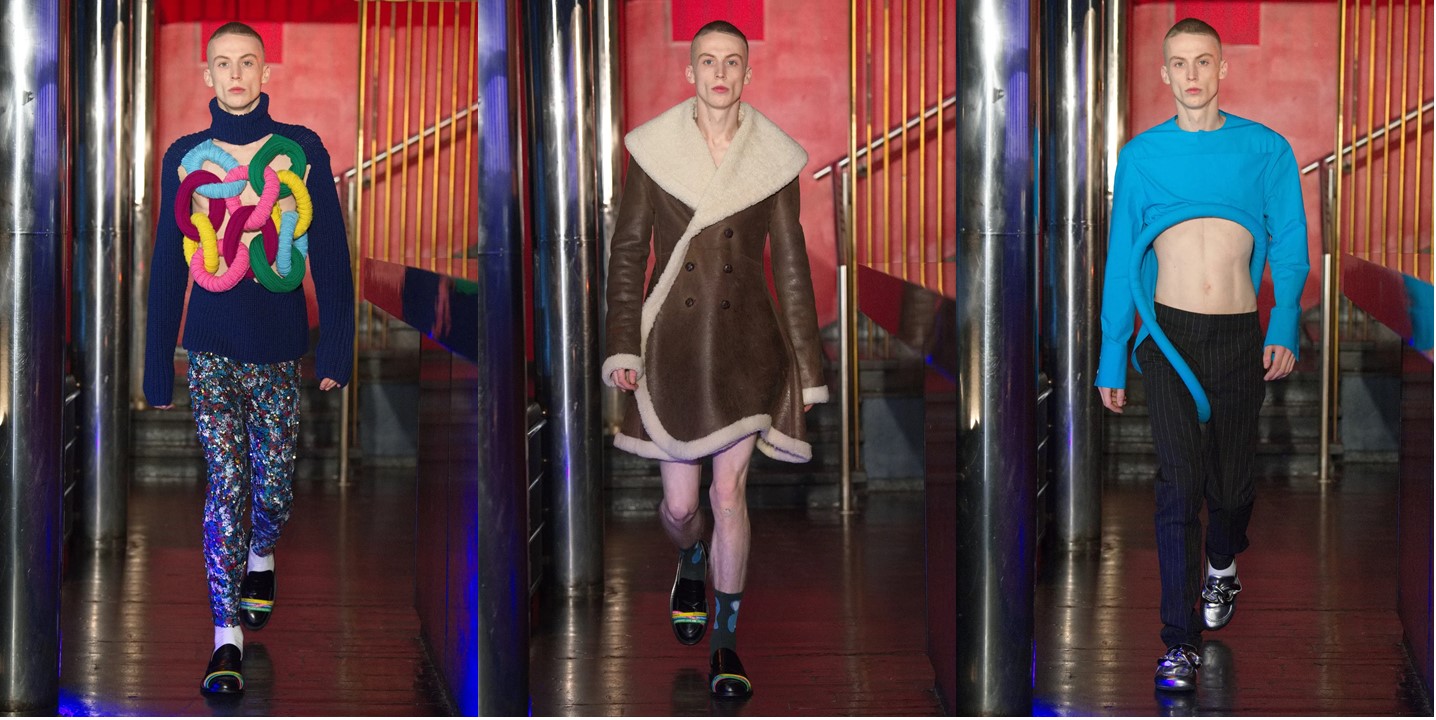
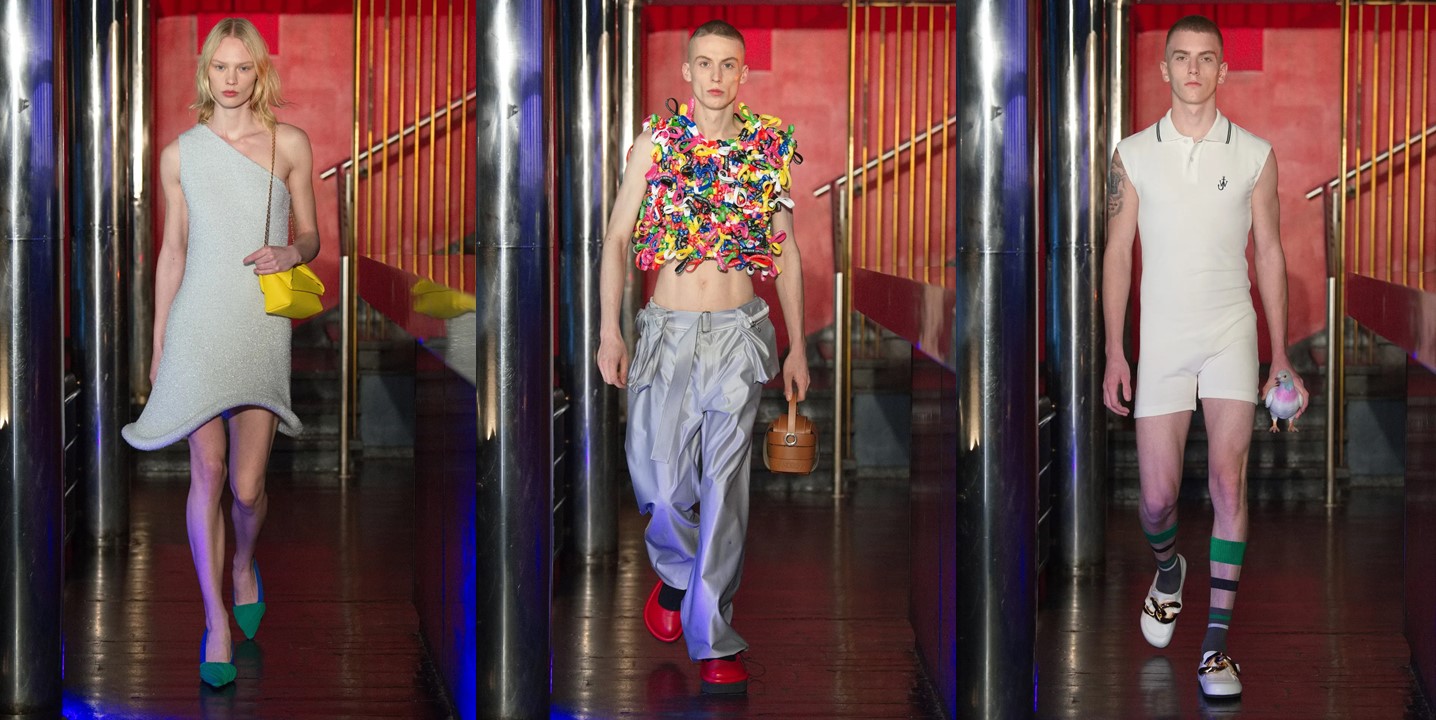
For autumn-winter 2022, Jonathan Anderson embraces all things “weird”, and seems to be aesthetically torn between the 1980s (sparkly party dresses) and now trending, early 2010s “indie sleaze” (metallic lycra jumpsuits). The JW Anderson collection was planned to be shown live in Milan with a late-night after-party. An IRL event would have enhanced and disrupted this season’s menswear week. As Anderson explained in a preview, however, the party element especially was nixed by Omicron restrictions and the live Milan debut has been pushed back until June. During that preview, Anderson used the word “weird” countless times: most often at a point at which he unlocked the thinking that had led to key elements in this collection. It was “weird” how a documentary on Cristiano Ronaldo inspired him to re-engage with “the limits of hyper-masculinity.” This lead to Anderson’s gleeful excavation of the polo shirt – “there is nothing more quintessential”—as a masculine cipher which he then disrupted by variously lengthening it into a hoop-hemmed dress, rendering it in micro-sequin with a vintage “Glamour Bonnet” hair net advert, or reconfiguring it as a high-shorted playsuit. This last look brought back fond back-in-the-day memories. When not watching documentaries “on everything and anything” Anderson spent much of his time weird-scrolling, and the results inflected this collection. The gorgeous eye-graphic dresses had a chin-strokily John Berger inference yet were sparked by a bout of engaging with the world of YouTube make-up tutorials. The menswear tunics peppered with rubber bands and sweaters featuring tubular protrusions that ran from one side of the hem, between the wearer’s legs, and up to the other hem with both pieces designed to generate sound through contact. “A lot of the materials have these odd sounds qualities that are kind of almost sexual… there’s a kind of tension,” he said. These were the by-product of spiraling into ASMR content on TikTok, another “weird” lockdown stop-off. When Anderson detects weirdness, he is not repelled but stimulated: for him “odd” and “bad taste” hold creative opportunity. Allied with his highly refined sense of beauty, the results are unorthodoxly compelling.

Collage by Edward Kanarecki.

Neurotic, Psychedelic, Completely Hysterical. Loewe SS22

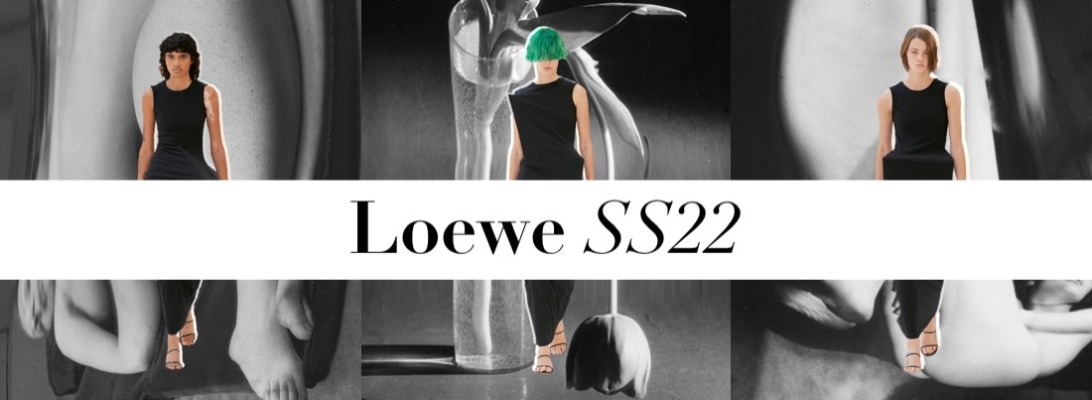
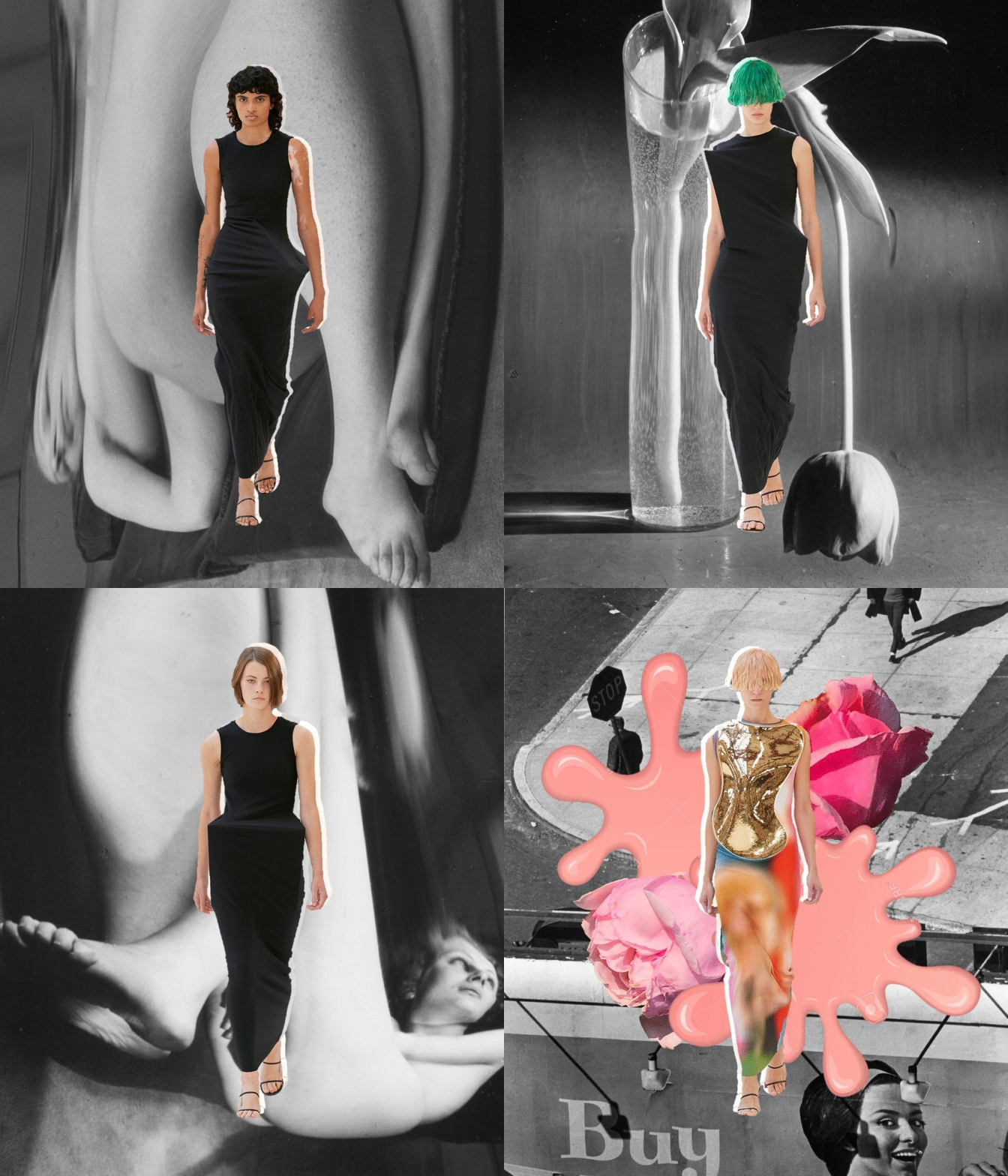
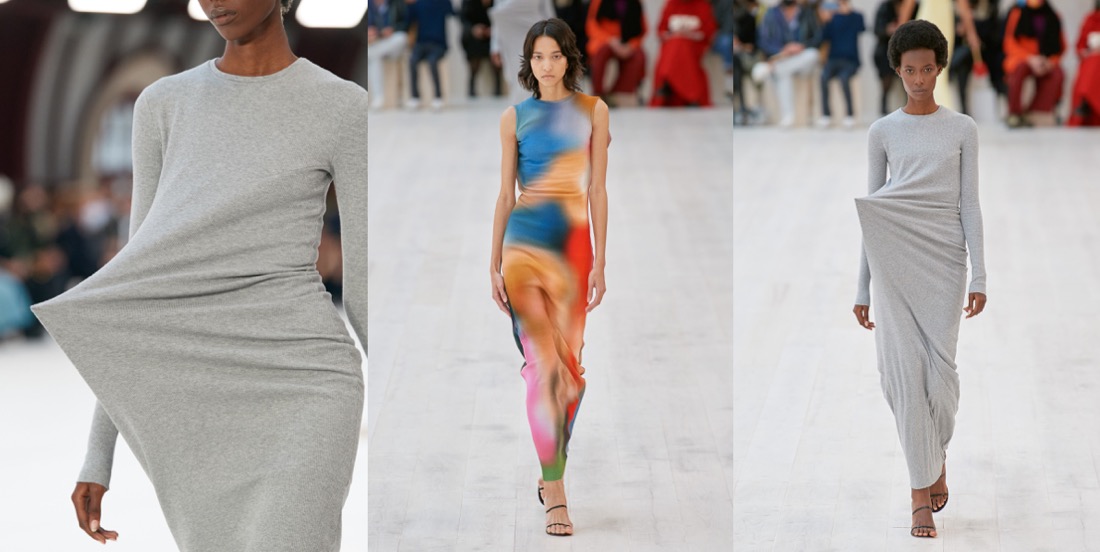
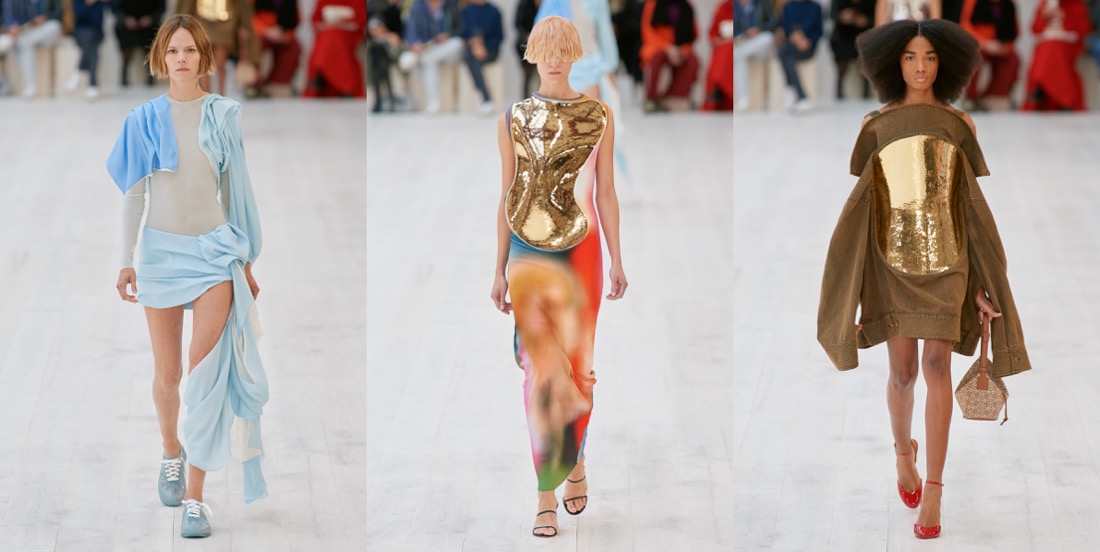
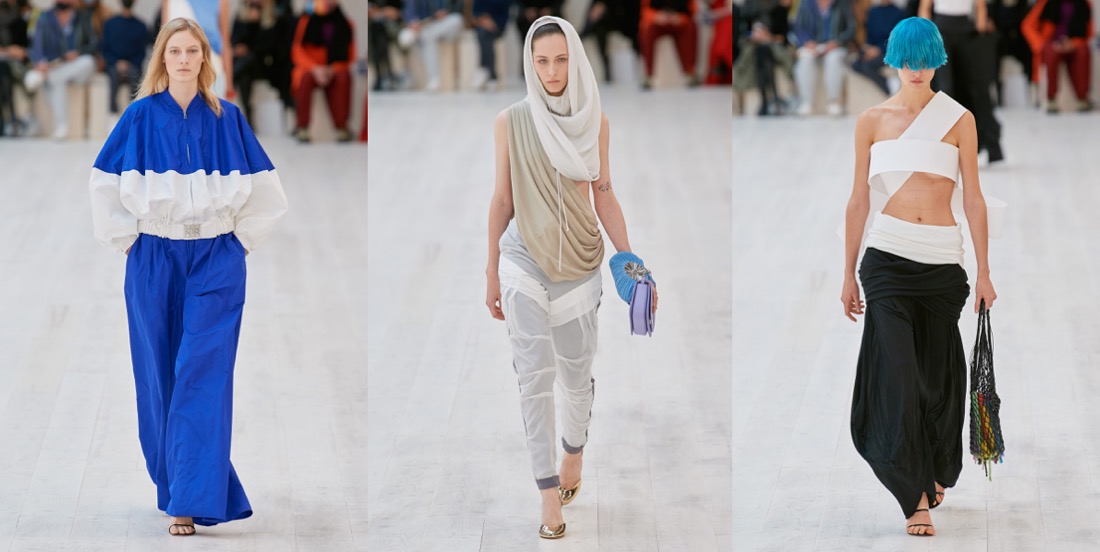
Sometimes, it’s great when nothing makes sense. “Neurotic, psychedelic, completely hysterical” are the terms describing the latest Loewe collection by Jonathan Anderson. After months of digital presentations, the designer was on a mission to mark his comeback runway show at Loewe with a massive creative change. “We’ve had the pandemic, and now we have to come out of it different,” he said. “I think it’s a moment of experimentation. If you’re going to reset after this period, you need to allow a moment to birth a new aesthetic. Start again.” It took place in a purpose-built “blank space.” No props, no artworks, no available rabbit holes of reference to divert attention: just clothes. Three long black column dresses to begin with. Minimal – except for the fact that each had a metal structure beneath, each one thrusting a different 3D geometric shape from stomach, shoulder, hip. The notorious “lumps and bumps” Comme des Garçons collection comes to mind instantly. Then three more ankle-length tube-dresses, one in a blurry pale blue and flesh-colored print; one pale gray, the next primrose yellow. So, was Anderson about to offer up an elegantly calm, relatively straightforward palate-cleansing antidote to the complexities and confusions of stepping out into the world again? Not so fast. He has a restless mind, always fighting against the too-obvious response. “In a weird way, I wanted the collection to be hysterical,” he said. “So that there’s a tension. Because this is a strange moment.” The collection had no moodboard behind, but Anderson provided one clue behind the passages of pastel blues and pinks, the swags and wraps of chiffon – and the wing-like shoulder structure that suddenly threw the collection off the straight and narrow. It was a picture of The Deposition from the Cross, painted by the Italian Mannerist artist Jacopo Pontormo in Florence 1528. Anderson liked all the “ hysteria” of the figures in the painting; something resonated. Back to the collection, there are even more exciting details to love. His fresh-start innovation combined ribbed jersey T-shirt material with golden breastplates – an echo, perhaps, of Claude Lalanne’s work for Yves Saint Laurent in the 1960s. There was an elevation of everyday fabric – white tanks terrifically teamed with chiffon balloon pants—and conceptual reworking of athletic tracksuits in taffeta. “Elevating the normal” as Anderson put it. On the feet were strappy shoes with heels surreally made from birthday candles, bottles of nail polish, a bar of soap. Bags in lavender or red were made from stiff teddy-bear fabric. Nothing made “sense” – but that was the daring and the fascination of this collection. We’re living in surreal times. Jonathan Anderson gets that, and is reflecting it back. Such experimentation with fashion is truly rare these days. Bravo to him for that.

Collage by Edward Kanarecki.

Humor is Key. JW Anderson SS22

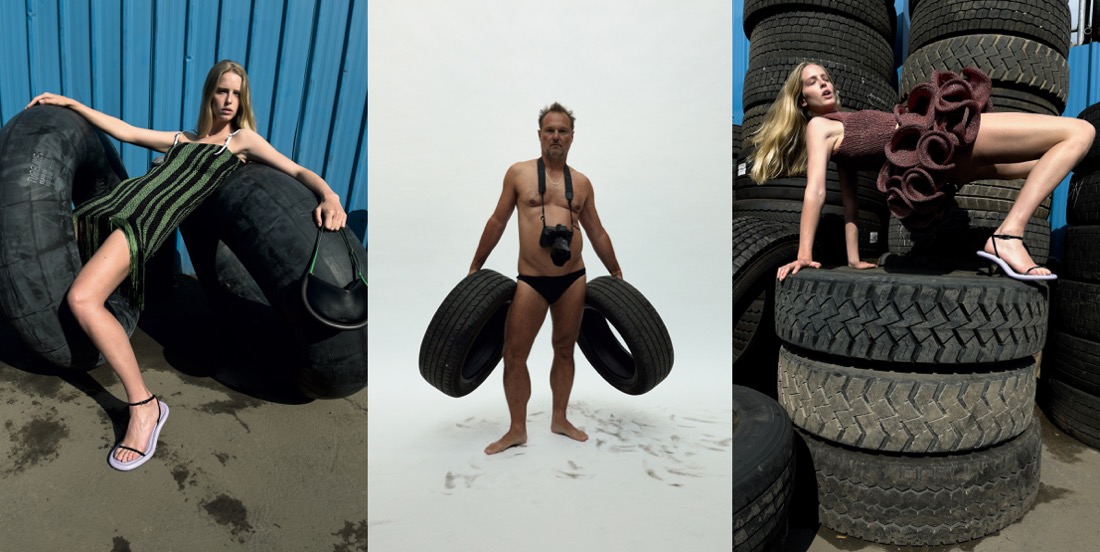
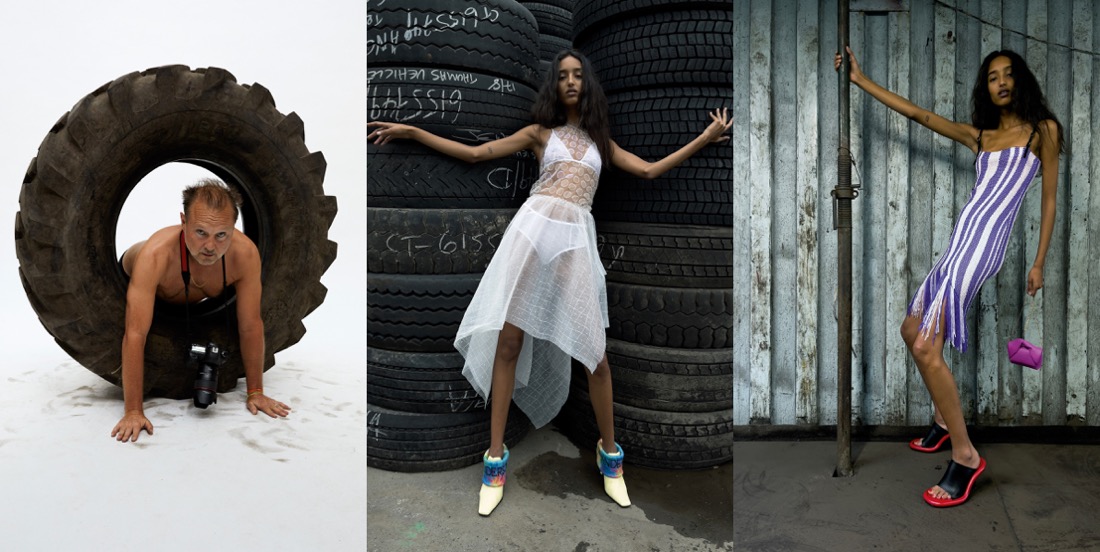
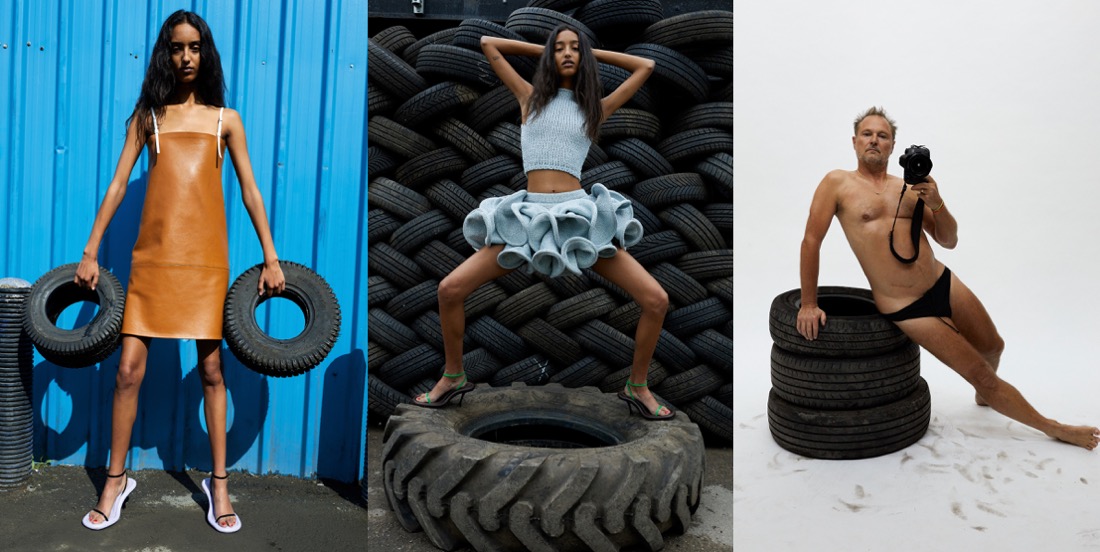
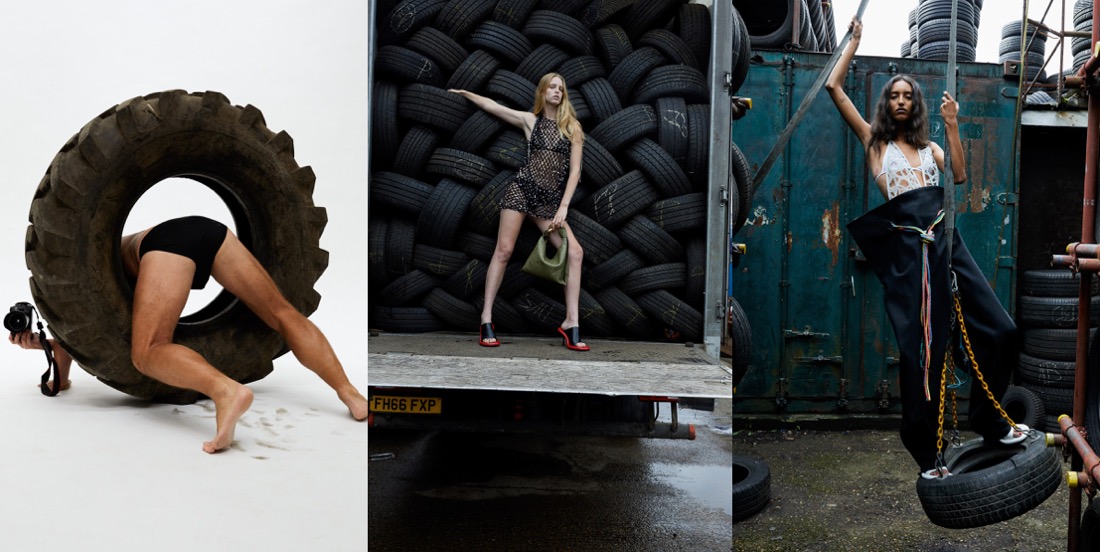
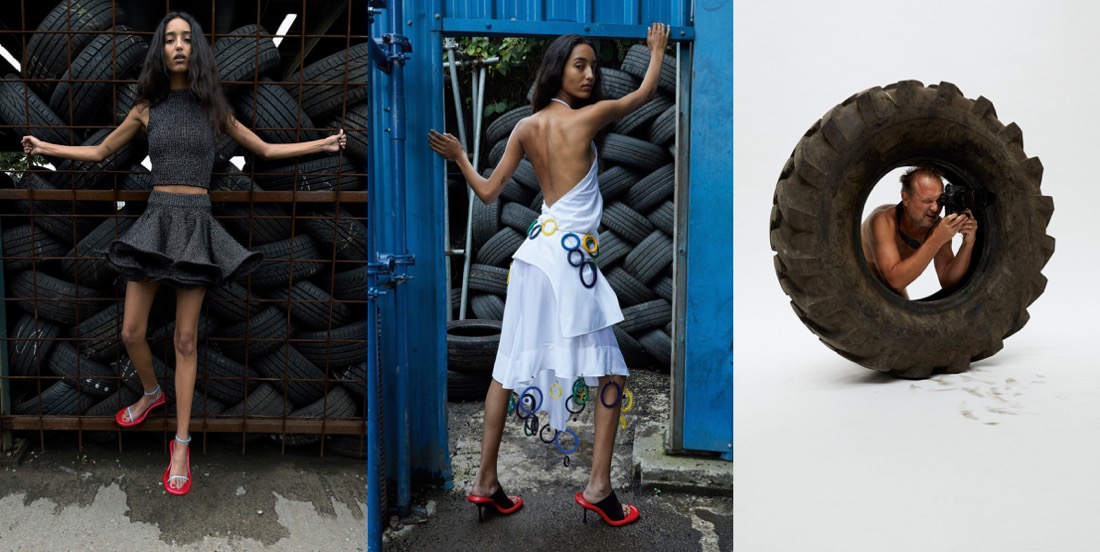
Juergen Teller, in all his near-naked glory, fronts JW Anderson’s spring-summer 2022 lookbook. The photographer had convinced the designer that he should shoot himself thus in his underpants with tires. For what is surely an in-joke satire on the Pirelli calendar (and the Italian tire company’s pin-up tradition), fitting right in 2021. Jonathan Anderson has collabed with Teller to produce printed matter, posters, and portraits of contemporary artists to send out in place of fashion shows during the pandemic. For the designer, the relevance of Teller’s work to the current zeitgeist is that there is “no retouching and no filter. You show things for what they are. You show being body-positive. You have to say, well, this is who I am.” Teller’s well-known, art world-sanctioned predilection for naked self-portraits predates the so-called post-pandemic situation by a long chalk. To Anderson, handing him free rein to work with models on the calendar project for spring 2022 satisfied his instinct for “something very blunt” and the fact that “you have to have humor.” Anderson continued: “Before the pandemic, I was showing a lot to gravitate attention. But what I’ve learned is that you have to have a very focused edit. You make your own pace, show what you want to show. My biggest fear is coming through the pandemic and not having changed.” He’s noticed “how excited girls and guys are, coming through this being more body-confident.” What that boiled down to is the “precision” of pieces like the semi-transparent, circular-embroidered, handkerchief-hemmed dresses and a tan leather shift, fastened with buckled straps. The crafty quirkiness of JW Anderson’s signatures is there, all right, in details like strands of upcyled plastic woven into shoulder-strap fringes and mesh mini-dresses. Looking forward, he says he’s serious about the “reset” everyone was talking about a year ago. His Instagram page was cut to three pictures on the day of the collection’s launch. “I don’t want to come through this pandemic being the same JW Anderson as before.” Quite a teaser for what may be to come.

Collage by Edward Kanarecki.