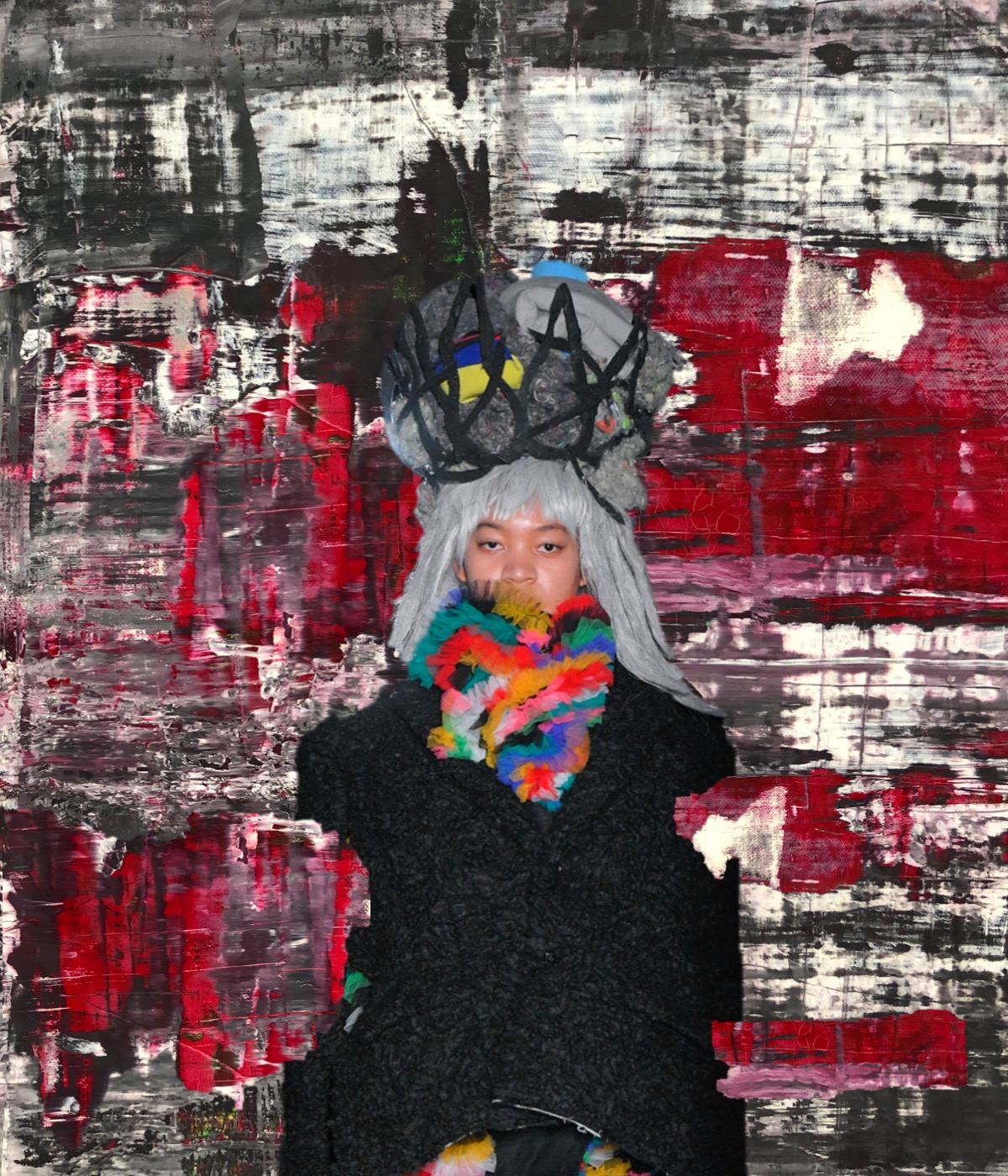
Randomness. Comme Des Garçons SS22

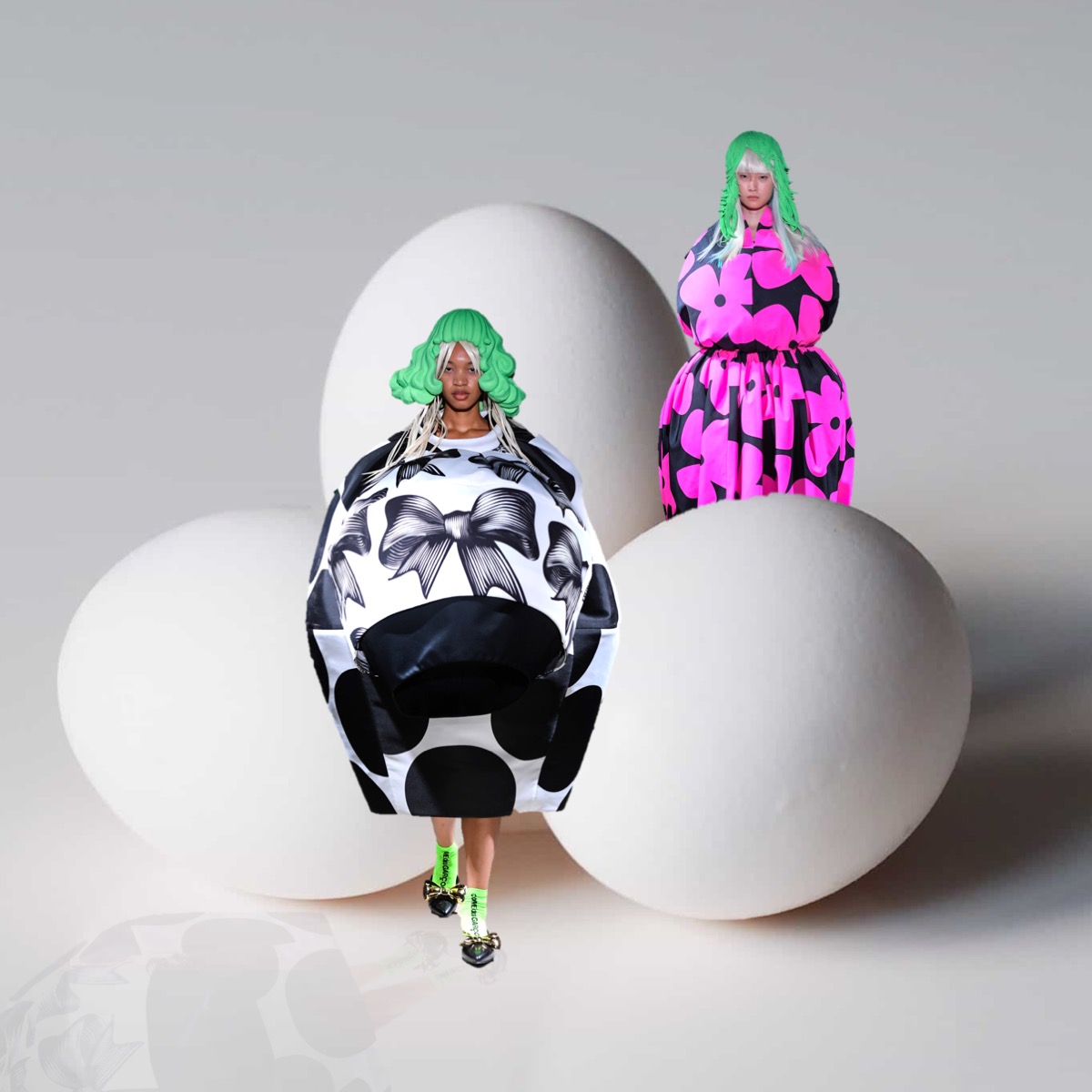
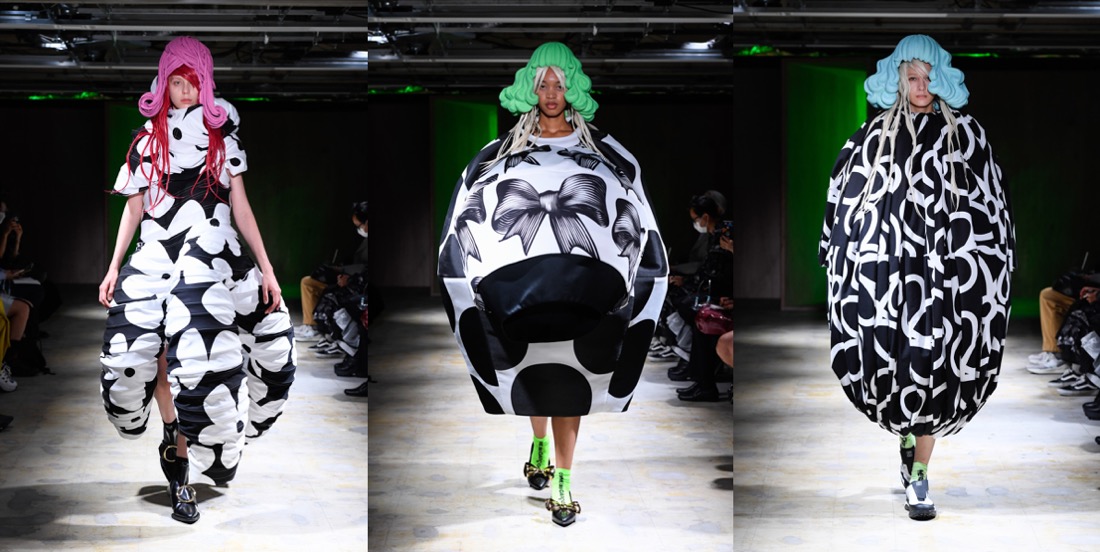
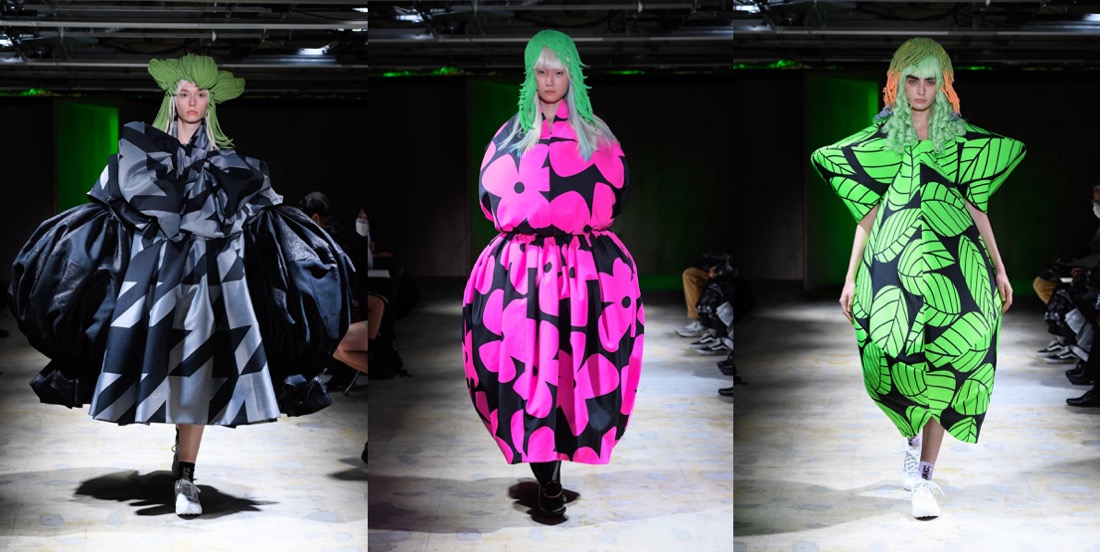
Livestreamed from Tokyo, Rei Kawakubo went for her signature giant portable Comme Des Garçons sculptures this season, imprinted with exaggerated flowers, leaves and bows. There were huge shapes, which meant models had to squeeze or shuffle sideways to emerge through a door onto a set. It didn’t feel like one of Kawakubo’s dystopian, apocalyptic moments in which she has seemed to sound a warning about bad things coming. Was her popping-out scenario closer to suggesting a feeling of rebirth, re-emergence, maybe? If so, it’s into a world where – as other fashion designers have been saying – nothing makes sense. Randomness, surrealism and absurdity are registering as part of the mood of 2021. Kawakubo, in confronting her “present state of mind” went large, very, very large, occupying space in ways that no women is meant to (though to be honest, vast art-fashion structures have been her safe space for experimenting for years). She certainly met her own criterion of avoiding making clothes. Comme “dresses” were presented as abstract perambulating 3-D fabric structures, topped off with pastiches of plastic cartoon girly wigs by Gary Card. Some of them had a sort of curved prow; several had net-filled cones spurting from their backs; some were ovoid, another was a 3-D black trashbag flower. Eventually there was an impression of the weight of furnishing fabric and swishing curtain swags. In the end there was a piece that seemed to have entirely merged a woman with a comfy black and white upholstered armchair. Paris Fashion Week missed having the Comme de Garçons show to contemplate at a time when fashion needs fearless innovators to take it forward. Kawakubo sets an example for all: a designer who has been independent for a lifetime and is still pushing.

Collage by Edward Kanarecki.
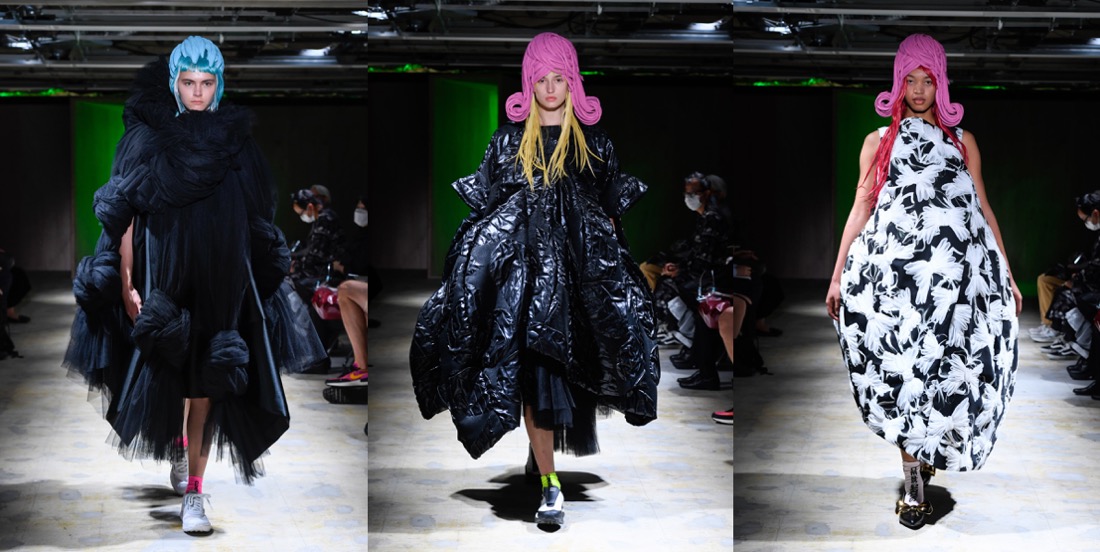
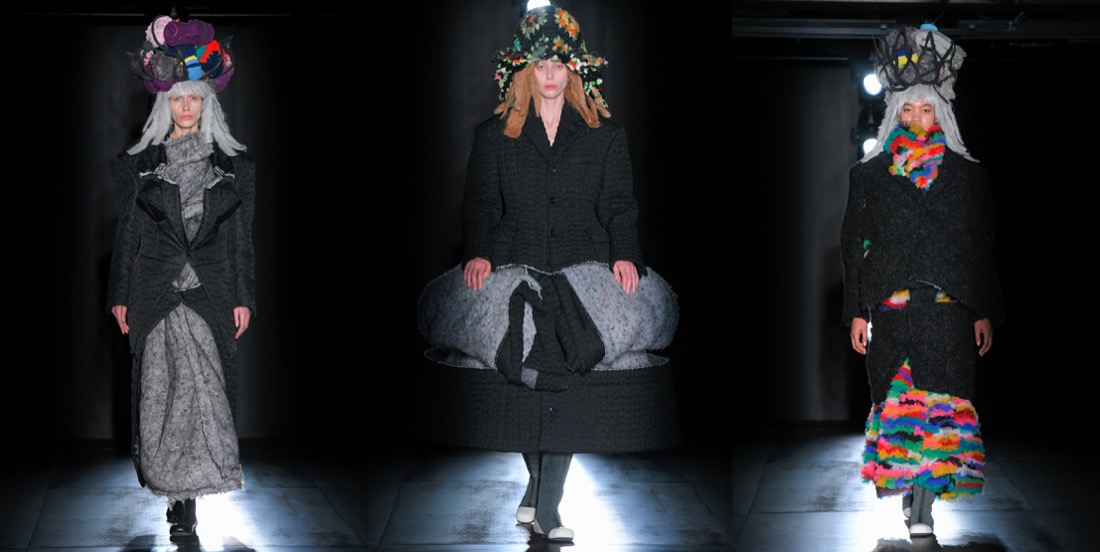
Monochrome Serenity. Comme Des Garçons AW21

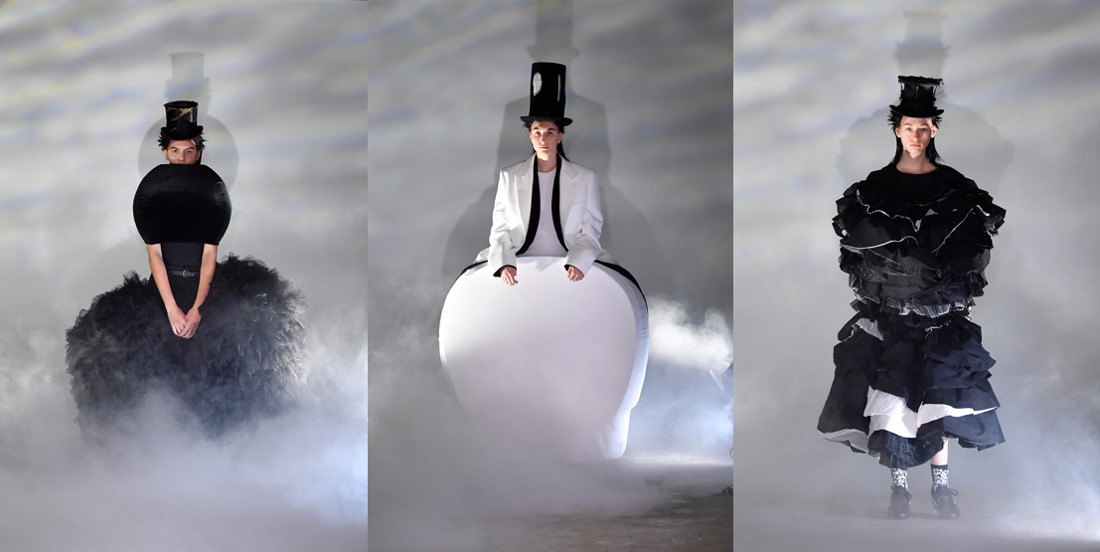
In the Comme des Garçons autumn-winter 2021 fashion show images coming straight from Tokyo, Rei Kawakubo‘s models looked as if they were walking clouds. “I needed to take one breath on the monochrome“, the designer summed up in her always-enigmatic manner. Monochrome is Kawakubo’s original signature. In the early 1980s, right at the start of her showing in Paris, Rei’s uncompromising use of black was deemed “shocking” and “conceptual” – especially in contrast to all the bold colours used by Montana or Saint Laurent at the time. Here, the designer seems to push it to extremes, creating wearable, layered-up sculptures which were kept in a rigorous black-and-white palette. With the addition of the rakish stovepipe hats made in collaboration with Ibrahim Kamara, the billowy dresses and voluminous coats played with romantic, Victorian styles. Comme des Garçons’ “monochrome serenity” definitely comes from an escapist place, breaking away from the global, lockdown routine. The longer you look at those pieces, the more beautiful things are revealed.

“Live” collage by Edward Kanarecki.

Dissonance. Comme Des Garçons SS21

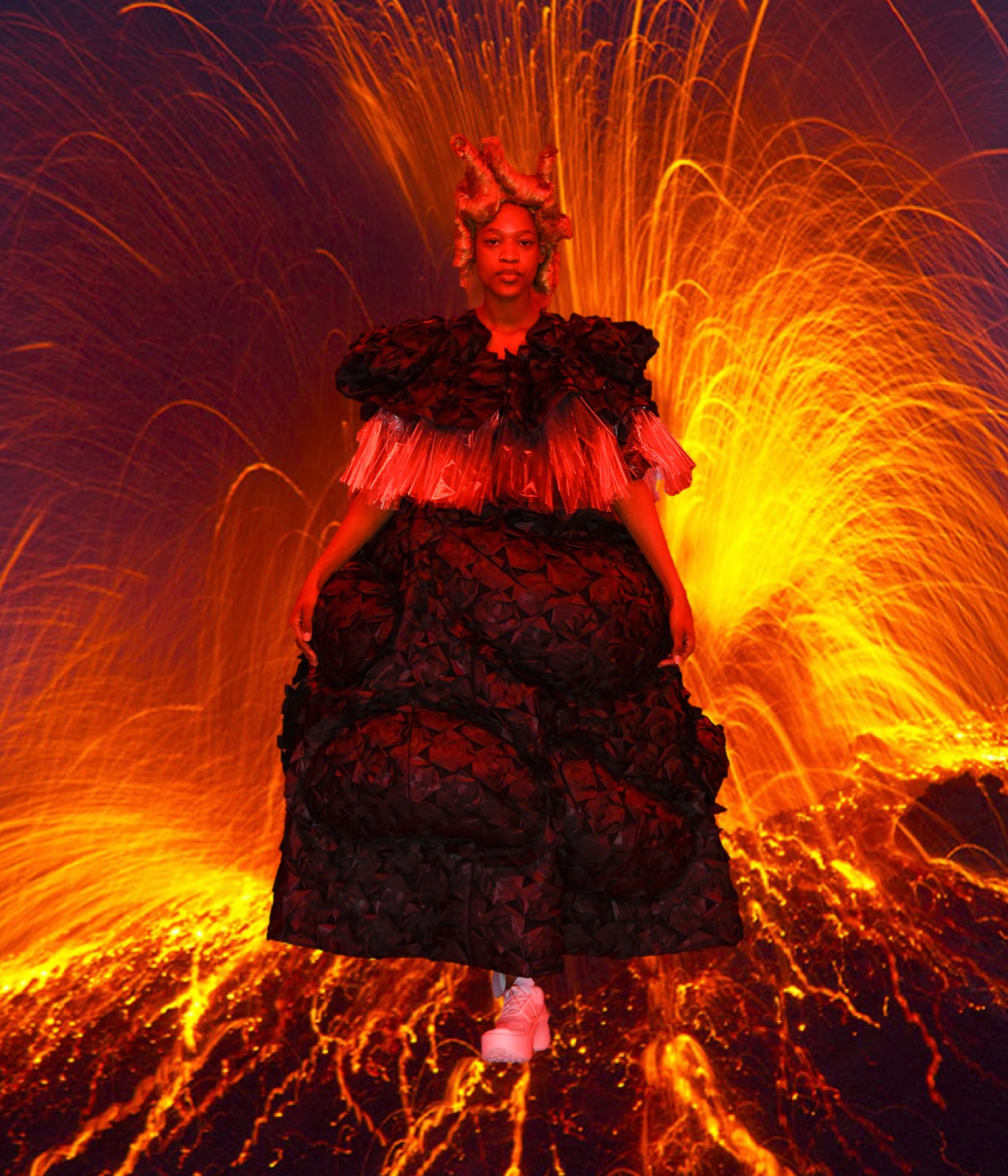
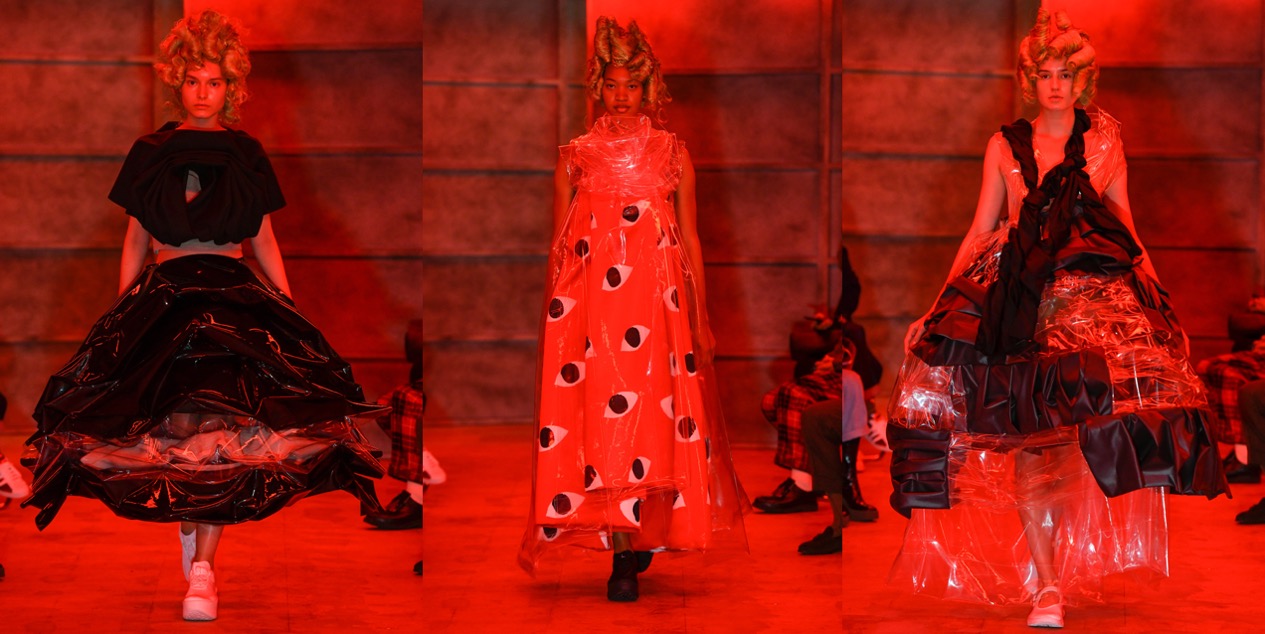
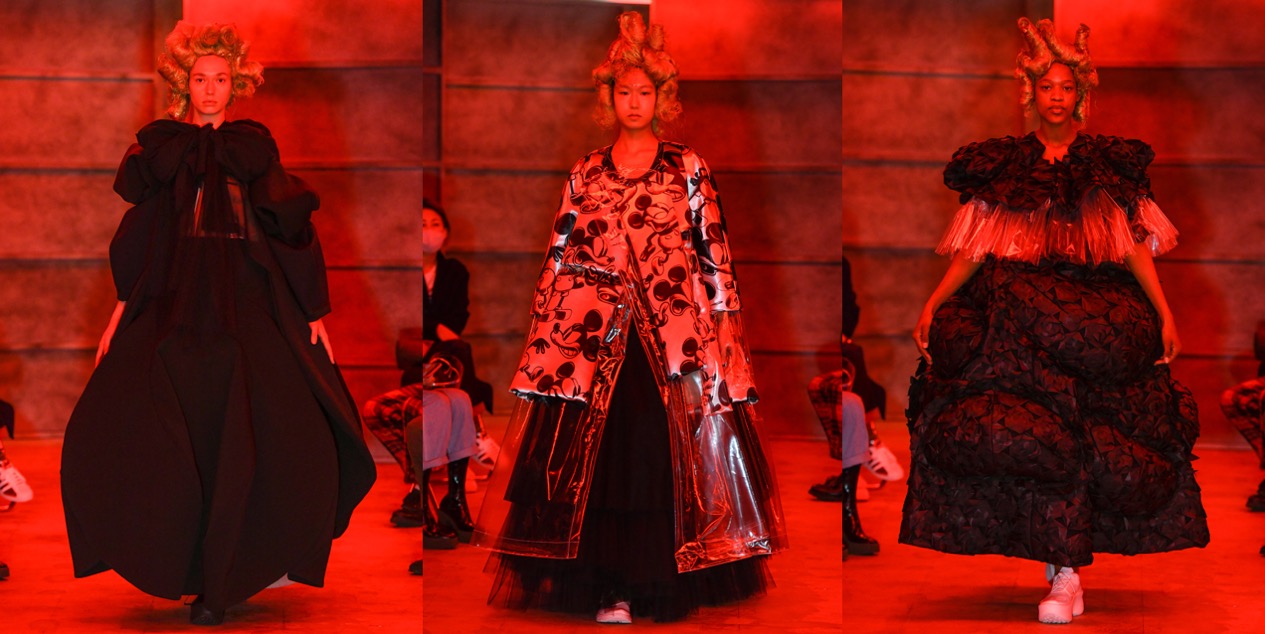
Paris Fashion Week felt incomplete without the Japanese avant-garde. From Tokyo, where all the Comme des Garçons family of designers have been showing, an email suggested that Rei Kawakubo has been striving to arrive at a creative resolution for designing in the midst of the existential plight that we’re all suffering. Dissonance was her theme: “The human brain always looks for harmony and logic. When logic is denied, when there is dissonance a powerful moment is created which leads you to feel an inner turmoil and tension that can lead to finding positive change and progress.” Any note of hope is gratefully received in these times of chaos. Discerned through the red light of her set – surely a signifier of the hellish state of the world, which at the same time made it hard to look at the garments in detail – her prescription for survival seemed threaded through with a playful, ironic sense of humor. Voluminous shapes, crinolines, bubbles, cloaks, and trapezoid coats came covered in plastic film. Then, what was Kawakubo up to, playing with Mickey Mouse and the Japanese Bearbrick teddy bear toy? Cutely reassuring representations of childhood innocence to cling to in our times of trouble, perhaps. The designer even messed around with the CdG heart logo, designed by Filip Pagowski back in the 1980s. The thing about Kawakubo is that her work brilliantly captures so many dissonant ideas at the same time. A phrase in her notes said she was interested in disrupting “the spirit of couture” with “illogical combinations and juxtapositions.” You sense she likes both the romance and glitter of couture and being punk with it, though – and this time, it almost felt like she’d had fun with it.

Collage by Edward Kanarecki.

Neo Future. Comme Des Garçons AW20

Slajd1

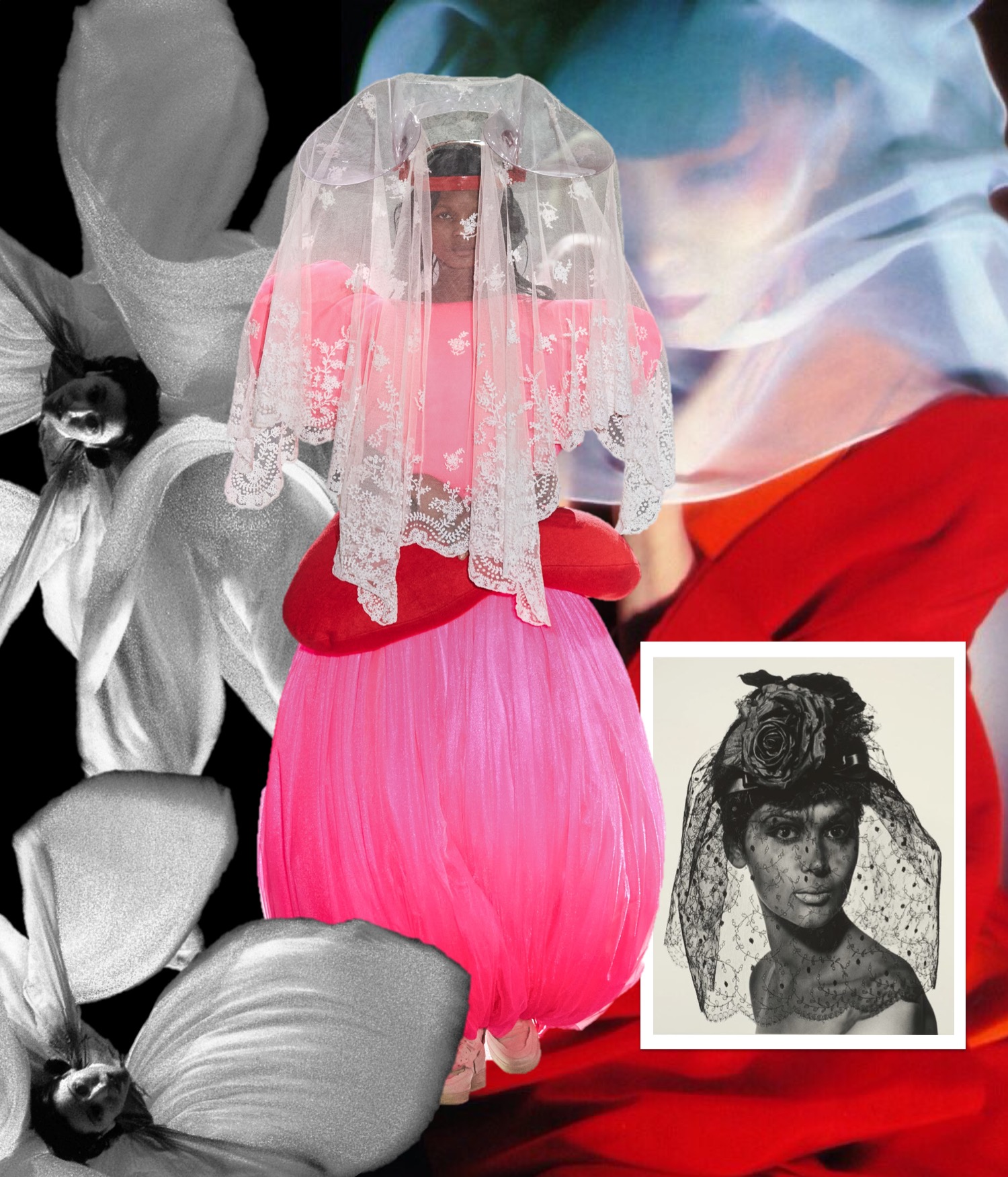
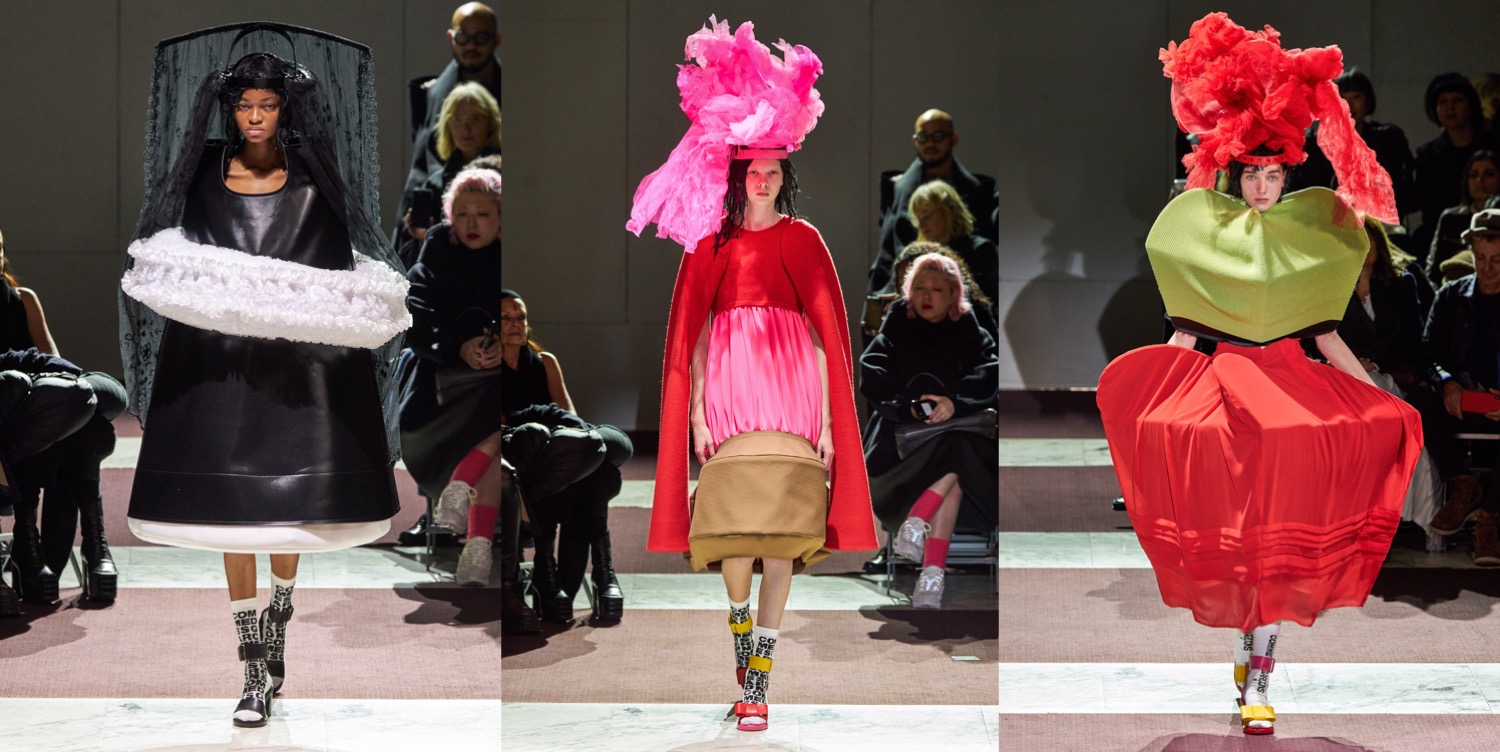
Is it impossible to make something completely and utterly new, since we are all living in this world?”, Rei Kawakubo asked rhetorically in the press notes of her autumn-winter 2020 Comme Des Garçons collection. Looking at some “big” designers for a couple of seasons, this question is an actual punch with a fist. At this stage in her legendary career, what’s still driving Kawakubo is the tantalizing goal of being able to make work that relates to nothing else; that triggers no associations; is devoid of storytelling and free of history, politics, or satire; and is incapable of being interpreted as belonging to any culture or subconscious brew of any of the above. Among the 20 looks she sent out –  bubbles, ledged pieces apparently made for furniture, towering headpieces – it felt like she was aiming to design for some post-world state. There appeared to be echoes of Comme Des Garçons collections from the past – the Flat collection; the ones rotated around the idea of weddings and funerals; fragmented reminders of the Lumps and Bumps presentation. Kawakubo admitted it was true – she really let herself remix some of her past works. “Continuing my work as a perpetual futurist, I worked from within the CDG world.” But when you’re having such a well-formed, complex and distinct vocabulary – Miuccia Prada as well comes up to my mind as one of those designers – then there’s no wonder you want to recycle some of those concepts from time to time.

Slajd1-kopia 5Slajd2Slajd3-kopiaSlajd4Slajd5

Collage by Edward Kanarecki.

The 2010s / Comme Des Garçons AW12

Believe it or not – I can’t! – but we’re heading towards a new millenium. So, how do you choose the most important collections, designers and labels of the decade? The ones that made an actual impact in the 2010s? Well, it’s not an easy task. It all began in September 2009 with New York’s spring-summer 2010 shows and ended when the autumn-winter 2019 haute couture shows wrapped in Paris. Few thousands of shows, by the way. There will be 19 posts (that’s really the only possible minimum!) reminding about the best – and if not the best, then strongly influencing – moments in fashion.

Rei Kawakubo‘s “flat” collection, Comme Des Garçons AW12.

Back in 2012, I was 13. And this collection was a complete fantasy for me. “The future’s in two dimensions” was its provocative premise. The cutout paper-dolliness of looks like the red and pink felted coat-dresses that opened the show, or the lilac jacket and pants that followed – all that was amazingly odd and phenomenal at the same time. In fact, this wasn’t just about fun dressing up – hello, it’s Rei Kawakubo’s work! – but rather a comment on the state of the industry (there was a sort of creativity crisis in the end of 2000s and the beginnings of 2010s, to be honest). If the fashion industry was happy with coverage that reduces its most elevated endeavors to two dimensions, then Rei was going to reduce the industry itself to an equally flat proposition. A handful of ultra-clichéd fashion patterns – camo, leopard, florals, polka dots – were used in the most literal of ways. The “eveningwear” was all about sequins, the ultimate evening cliché. How flat! Kawakubo mocked fashion and us, the viewers, but at the same she created wearable, geometric art-works that still make you sigh with delight. Here’s Iris Apfel photographed by Jeff Bark for Dazed & Confused wearing the most striking pieces from the collection. Naturally, the 13 year old me needed that issue. And the today me still cherishes it for this stunning editorial.

Collage by Edward Kanarecki.